![Unbranded [pillar-drug-class] injection pen on a neutral background — WeightLossInjections.com editorial hero](https://weightlossinjections.com/wp-content/uploads/2026/07/hero_tirzepatide_c5_lifestyle-1200x675.png)
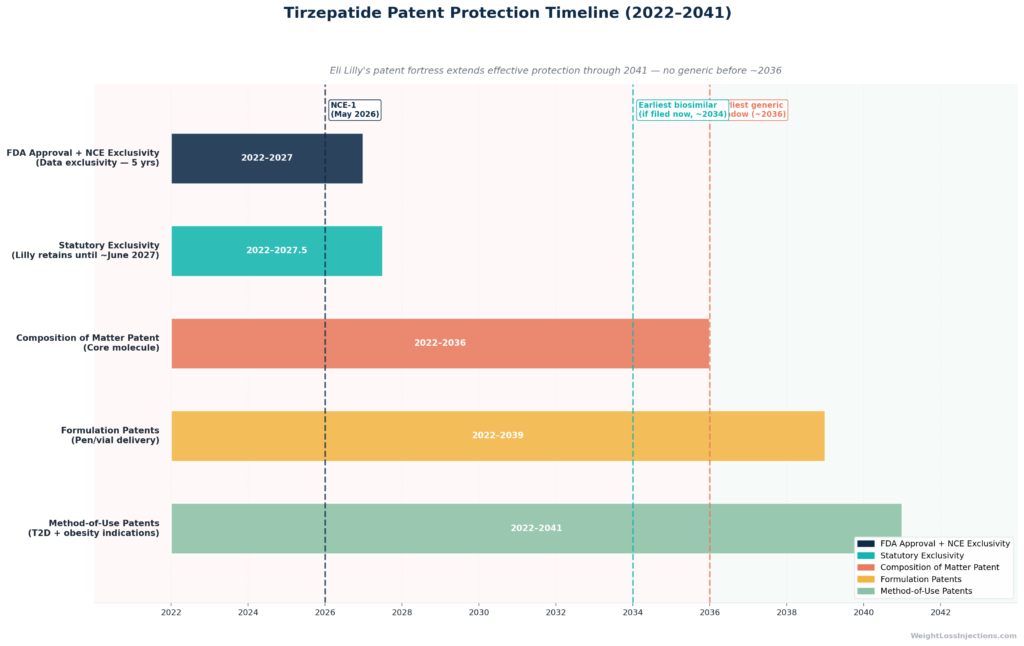
Horizontal Gantt-style bar chart titled “Tirzepatide Patent Protection Timeline (2022–2041)” showing four colored bars: FDA Approval/NCE Exclusivity (2022–2027, dark blue), Composition of Matter…
- No FDA-approved generic or biosimilar tirzepatide exists as of June 2026. The earliest any generic competitor could realistically reach the U.S. market is approximately 2036.
- Eli Lilly’s composition-of-matter patent on tirzepatide expires around December 30, 2036, per Biology Insights GLP-1 generic timeline analysis.
- Formulation patents extend protection to approximately 2039; method-of-use patents push it further to approximately 2041, per the same Biology Insights analysis.
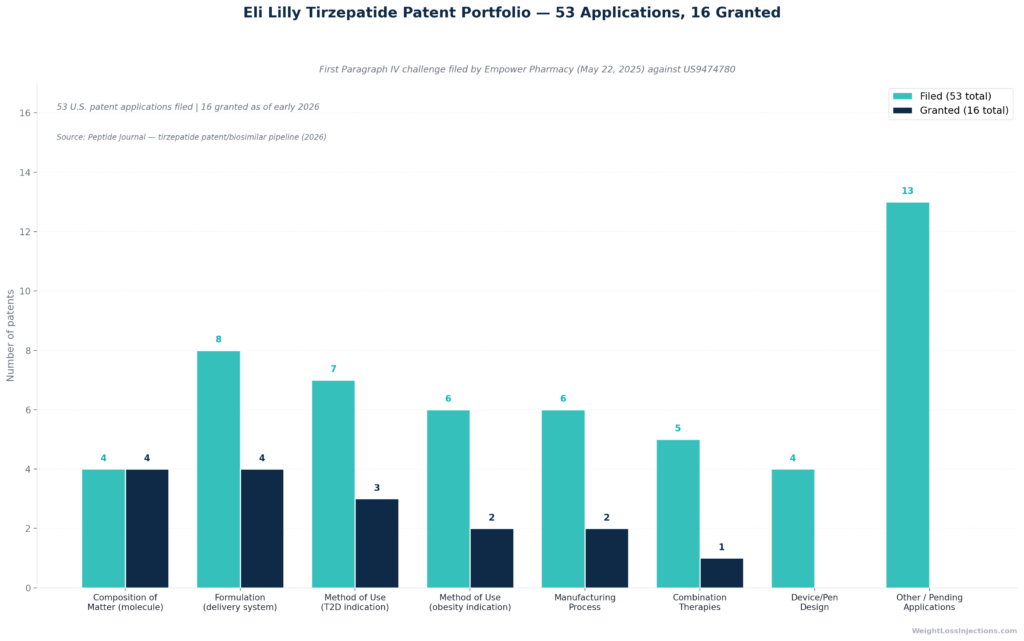
- Eli Lilly has filed 53 U.S. patent applications surrounding tirzepatide, with 16 granted as of early 2026, according to Peptide Journal’s generic and biosimilar pipeline analysis.
- A biosimilar pathway — distinct from a traditional generic — could theoretically produce competition by the mid-2030s, but no biosimilar application has been filed with the FDA as of June 2026.
- Semaglutide did go generic in India and several other markets in March 2026, but U.S. patients face a wait until at least 2032 for semaglutide generics — and tirzepatide’s timeline runs roughly 5–10 years behind semaglutide’s.
- Until generics arrive, the most cost-effective legal pathway is LillyDirect self-pay vials starting at approximately $299/month, or commercial insurance coverage that can reduce cost to as low as $25/fill.
The Short Answer: No Generic Tirzepatide Before 2036
If you arrived here looking for a fast, honest answer — here it is: no FDA-approved generic version of tirzepatide will reach U.S. patients before approximately 2036 at the earliest, and realistically not in meaningful volume until 2037 or 2038.
That answer is not a guess. It flows directly from the U.S. patent system, the FDA’s regulatory exclusivity framework, and the specific intellectual property strategy Eli Lilly has built around its blockbuster dual GIP/GLP-1 receptor agonist (a peptide hormone that simultaneously activates two different appetite- and insulin-regulating pathways). The law does not allow a competitor to sell a copy of a drug while a valid patent covers it — and tirzepatide is covered, layer upon layer, until the late 2030s and beyond.
The key dates, per Biology Insights:
| Protection Layer | Approximate Expiry |
|---|---|
| FDA New Chemical Entity (NCE) Exclusivity | May 2027 |
| Composition-of-Matter Patent | ~December 30, 2036 |
| Formulation Patents | ~2039 |
| Method-of-Use / Follow-On Patents | ~2041 |
Eli Lilly retains statutory exclusivity until at least June 2027, according to Harris Beach Murtha Cullina’s June 2026 analysis of GLP-1 exclusivity deadlines. This means that before mid-2027, no competitor can even complete the regulatory steps needed to challenge a tirzepatide patent.
A brief clarification on terminology: when we say “generic,” we mean an FDA-approved product that reaches the market through the Abbreviated New Drug Application (ANDA) pathway, with bioequivalent substitutability at the pharmacy. As we’ll explore in a later section, tirzepatide’s molecular complexity means the more likely competitive pathway is a biosimilar, not a traditional ANDA generic — but even that optimistic route leads to the mid-2030s at the earliest.
The bottom line for patients: tirzepatide (sold as Mounjaro® for type 2 diabetes and Zepbound® for chronic weight management) will remain under exclusive Lilly control for at least a decade. Understanding why — and what legitimate cost options exist in the meantime — is the purpose of this guide.
Eli Lilly’s Patent Fortress: How Tirzepatide Is Protected Until the 2030s
Pharmaceutical patent protection is rarely a single wall. For a blockbuster drug generating billions of dollars annually, it is more accurately described as a multi-layered fortress, with concentric rings of legal protection that extend well beyond any single patent’s expiry date. Tirzepatide is a textbook example of this strategy.
Three Layers of Patent Protection
Layer 1 — Composition of Matter: This is the foundational patent — it covers the tirzepatide molecule itself. The “composition of matter” patent is the most powerful type of pharmaceutical patent because it prevents any competitor from making or selling the exact same chemical entity, regardless of what the competitor intends to use it for. Lilly’s composition patent expires approximately December 30, 2036, per Biology Insights.
Layer 2 — Formulation Patents: These patents cover how tirzepatide is delivered — the specific pen device (the KwikPen autoinjector), the vial format, the inactive ingredients, the buffering system, and the concentration of the injectable solution. Even if a competitor’s molecule survived the composition patent, it would face approximately four additional formulation patents that extend protection to around 2039, according to GreyB’s Mounjaro patent analysis.
Layer 3 — Method-of-Use Patents: These cover the clinical applications — how tirzepatide is used to treat type 2 diabetes, how it is used to manage obesity and overweight, specific dose titration sequences, combination use protocols, and more. Method-of-use patents extend to approximately 2041 per Biology Insights. A competitor that somehow navigated the first two layers could still be blocked from marketing tirzepatide for its most commercially valuable uses until 2041.
The Scale of Lilly’s Patent Portfolio
As of early 2026, Eli Lilly has filed 53 U.S. patent applications surrounding tirzepatide, with 16 patents granted, according to Peptide Journal’s analysis of the generic peptide drugs and biosimilar pipeline. This portfolio strategy — sometimes called a “patent thicket” — is well-established pharmaceutical practice. The goal is not merely to protect the molecule from day one, but to file continuing applications throughout a drug’s development lifecycle, securing rights to manufacturing improvements, new delivery systems, new indications, and new patient populations as they are discovered.
From an investor’s perspective, this explains much of tirzepatide’s valuation. Analysts covering Eli Lilly frequently cite the extended exclusivity period as a core component of the drug’s multi-decade earnings potential. From a patient’s perspective, this same protection means a long wait for affordability through the generic channel.
NCE Exclusivity and the Paragraph IV Challenge Process
The FDA compounds patent protection with its own regulatory exclusivity regime. Tirzepatide received New Chemical Entity (NCE) exclusivity at first U.S. approval (Mounjaro, May 2022), granting five years of data exclusivity during which no generic manufacturer can even file an ANDA. The NCE-1 date — the earliest date a competitor can file a Paragraph IV patent challenge — was May 13, 2026, per Peptide Journal.
Notably, Empower Pharmacy was ahead of the clock: it filed the first Paragraph IV challenge against Lilly patent US9474780 on May 22, 2025 — technically before the formal NCE-1 date, which signals just how much commercial interest exists in breaking tirzepatide’s exclusivity as early as possible. However, filing a Paragraph IV challenge is only the beginning of a long legal battle. Under U.S. law, such a challenge triggers an automatic 30-month stay on FDA approval of the challenger’s product — meaning the generic stays off the market for at least 2.5 years even if the patent challenge ultimately succeeds. Lilly would almost certainly counter-sue, and pharmaceutical patent litigation routinely takes 3–5 years or longer to resolve fully. Even a challenger that prevailed in court would be looking at an earliest possible approval around 2031–2033, and would still face the formulation and method-of-use patent layers extending through the late 2030s.
The Biosimilar Pathway: Could a Tirzepatide Biosimilar Arrive Before 2036?
Here is where the story gets more nuanced — and where there is a small window of cautious optimism for patients willing to think a decade ahead.
Traditional Generics vs. Biosimilars: What’s the Difference?
When people say “generic drug,” they typically picture a small-molecule tablet — a simple chemical compound that can be exactly replicated and shown to be bioequivalent through standard testing. These reach the market through the FDA’s ANDA (Abbreviated New Drug Application) pathway, which does not require full clinical trials — just proof of bioequivalence.
Tirzepatide is not a small molecule. It is a 39-amino-acid synthetic peptide — a large, structurally complex molecule that falls into a different regulatory category. Its molecular complexity is fundamental to how tirzepatide works: the peptide backbone, fatty-acid moiety, and specific amino acid sequence are all engineered to activate both GIP and GLP-1 receptors simultaneously while enabling once-weekly dosing through albumin binding.
Because of this complexity, tirzepatide may be regulated as a biologic rather than a small-molecule drug — and biologics follow a different pathway to competition: the biosimilar (BLA) route rather than the ANDA route.
What the Biosimilar Pathway Means for Tirzepatide
A biosimilar does not have to be an exact replica. Instead, it must demonstrate “high similarity” to the reference product — comparable safety, purity, and potency — without clinically meaningful differences in efficacy or safety for patients. This actually gives biosimilar manufacturers a somewhat different route around composition patents: they are not required to invalidate the patent, but they must demonstrate sufficient biological similarity to the branded product.
The critical exclusivity difference: if tirzepatide is formally classified as a biologic, it receives 12 years of FDA exclusivity from first approval (May 2022), making the earliest biosimilar approval possible around May 2034, per the brief’s analysis. That is still the mid-2030s, but it is slightly ahead of the composition-of-matter patent expiry in 2036.
Here are the realistic variables, per Peptide Journal’s biosimilar pipeline analysis:
- No biosimilar application for tirzepatide has been filed with the FDA as of June 2026. Development and testing of a biosimilar takes 7–10 years; the first filings are unlikely before 2030.
- Manufacturing complexity is substantial. Producing a high-purity synthetic 39-amino-acid peptide at pharmaceutical scale requires highly specialized equipment, rigorous quality controls, and demonstrated lot-to-lot consistency. Very few manufacturers globally have this capacity for GLP-1 class peptides.
- Immunogenicity testing is required. Biosimilar applicants must demonstrate that the biosimilar does not elicit different immune responses than the reference product — adding significant time and expense to development.
- Regulatory pathway is not fully settled. The FDA has not definitively classified tirzepatide as a biologic vs. a small molecule for exclusivity purposes — this matters enormously for how competitors can approach the market.
The most realistic window for a U.S. biosimilar tirzepatide, assuming a manufacturer begins development now and regulatory processes proceed smoothly: 2034–2038. This is “possible but uncertain” — and patients should not make financial or treatment plans around it.
International Biosimilars: What to Know and What to Avoid
Biosimilar or follow-on tirzepatide products may appear in markets with different patent regimes — including India, China, and parts of the European Union — before they reach the United States. These are not FDA-approved products, and it is both illegal and dangerous to import them into the United States:
- Importation illegality: Under U.S. drug importation law, personal importation of prescription biologics not approved by the FDA is prohibited except under very narrow FDA-authorized programs (none of which currently cover tirzepatide alternatives).
- No USP oversight: International manufacturers are not subject to U.S. pharmacopeia standards, FDA facility inspections, or lot-release testing requirements.
- Product integrity risk: Peptide injectables are highly sensitive to temperature, handling, and storage conditions. Product purchased via grey-market channels carries real risks of subpotency, superpotency, or contamination.
In short: if you see advertisements for “biosimilar tirzepatide” available for import, treat them as a red flag, not an opportunity.
Side-by-side vertical timeline comparing semaglutide (left column: First US Approval 2017, First Paragraph IV ~2022, US Generic Launch ~2032) and tirzepatide (right column: First US Approval 2022,…
Our Top 3 · October 2026
The best GLP-1 providers right now
Independently reviewed. Ranked by price, medication access, provider quality, and patient outcomes.
Renew GLP
Personalized GLP-1, GIP plans: Semaglutide & Tirzepatide.
Medvi
No membership or hidden fees. Everything you need is included.
Trimi
US-licensed clinicians and shipped to your door, from $99/mo.
What Semaglutide’s Generic Launch Means, and Doesn’t Mean, for Tirzepatide
In March 2026, a historic event reshaped the global GLP-1 market: the core semaglutide patent — covering the active ingredient in Ozempic® and Wegovy® — expired in India and several other markets, triggering a wave of generic semaglutide launches with prices falling as much as 90% compared to branded products. More than 40 Indian manufacturers entered the market virtually overnight.
This news sent a predictable wave of search traffic to questions about tirzepatide: “If semaglutide went generic, why can’t tirzepatide?” It is a fair question. The answer requires understanding two things: the different patent timelines, and the limits of what one drug’s generification tells us about another.
The Timelines Are Offset by a Decade
Semaglutide received its first U.S. approval in December 2017. Tirzepatide received its first U.S. approval in May 2022 — nearly five years later. Patent exclusivity clocks run from approval. That offset alone accounts for much of the difference in generic timelines.
There is also the question of which markets we are talking about. The March 2026 semaglutide generics launched in India, where the core compound patent expired. For U.S. patients, semaglutide generics are not expected until approximately 2032, owing to patent term extensions and follow-on patents that Novo Nordisk layered onto its core compound patent, extending U.S. protection to December 2031 per DrugPatentWatch’s GLP-1 exclusivity analysis.
Applying the same framework to tirzepatide: the composition patent expires approximately December 30, 2036, according to Biology Insights, with formulation patents extending that protection further to 2039 per GreyB’s Mounjaro patent analysis. Tirzepatide’s exclusivity timeline runs approximately 5–10 years behind semaglutide’s in most markets.
The Semaglutide Precedent Tells Us How — Not When
The semaglutide generic launch does tell us something valuable about how tirzepatide’s eventual generification will unfold: multiple manufacturers will enter simultaneously, prices will fall sharply and quickly, and access will expand dramatically. The semaglutide market in India collapsed from ₹8,800–20,000/month to ₹1,290–4,200/month within days of the patent expiry. A similar dynamic will eventually play out for tirzepatide — just not until the mid-2030s.
The generification of semaglutide does not accelerate tirzepatide’s legal or regulatory timeline in any way. Lilly’s patents are not affected by what happens to Novo Nordisk’s patents. The two drugs are protected by entirely separate intellectual property portfolios, and each must run its own exclusivity clock.
Are the Two Drugs Clinically Equivalent Anyway?
For patients weighing whether generic semaglutide is a viable bridge until tirzepatide generics arrive, the clinical data is relevant context. According to the SURMOUNT-5 trial — a 72-week randomized study of 751 adults with obesity or overweight published in the New England Journal of Medicine in 2025 — tirzepatide at maximum tolerated doses produced mean weight loss of −20.2%, versus −13.7% with semaglutide at maximum tolerated doses. That is approximately 47% greater weight loss with tirzepatide (p<0.001). Patients in the tirzepatide group also had lower rates of GI-driven discontinuation (2.7% vs. 5.6%), per the ACC’s SURMOUNT-5 journal scan.
Generic semaglutide is a meaningful obesity treatment — significantly better than no treatment at all. But it is not a direct substitute for tirzepatide, and the tirzepatide weight loss results data make that clear. For patients with access to tirzepatide through a cost-effective channel, that superior efficacy should factor into treatment planning.
Compounded Tirzepatide Was the “Cheap Option” — What Fills That Gap Now?
Between late 2022 and early 2025, compounded tirzepatide became the most widely used workaround for the cost and supply barriers surrounding branded Zepbound and Mounjaro. Hundreds of thousands of patients accessed tirzepatide through telehealth platforms and compounding pharmacies at substantially lower prices than the $1,086/28-day retail cost of branded Zepbound. That era is over — but understanding exactly what changed, and what narrow exceptions survive, helps patients navigate their current options.
What Happened to Compounded Tirzepatide?
The legal foundation for mass-market compounded tirzepatide was an FDA drug shortage designation, first applied in December 2022. Under Section 503A and 503B of the Federal Food, Drug, and Cosmetic Act, compounding pharmacies and outsourcing facilities can lawfully compound copies of FDA-approved drugs while those drugs are on the FDA’s shortage list. That exception enabled the compounding boom.
The FDA resolved the tirzepatide shortage in December 2024, setting in motion a phased enforcement timeline:
- February 18, 2025: 503A pharmacy enforcement discretion ended for state-licensed compounding pharmacies.
- March 10, 2025: A federal judge denied the Outsourcing Facilities Association’s preliminary injunction attempt, effectively closing the 503A grace period for mass-market operations, per the Alliance for Pharmacy Compounding’s timeline.
- March 19, 2025: 503B outsourcing facility enforcement discretion ended, per the FDA’s GLP-1 compounding clarification page.
For a full timeline of the compounding shutdown, see our deep-dive: Is compounded tirzepatide legal in 2026?
As of April 2026, the FDA also proposed to formally exclude tirzepatide from the 503B Bulks List, finding no clinical need for outsourcing-facility bulk compounding, per the FDA’s April 30, 2026 press announcement. This proposal further entrenches tirzepatide’s exclusion from the compounding marketplace.
The Narrow 503A Exception That Survives
A limited, genuinely individualized 503A compounding pathway remains lawful in 2026, but it is not a volume solution. Per FDA’s April 1, 2026 updated guidance, a 503A pharmacy may compound tirzepatide only if:
- The prescriber documents a clinically significant difference for the specific patient — for example, a documented allergy to an inactive ingredient such as cresol (a preservative in branded pens), or a medically justified need for an intermediate dose strength not commercially available.
- The pharmacy compounds no more than four prescriptions per calendar month for essentially-copy tirzepatide products.
- The pharmacy holds an active state pharmacy license and compounds under USP \<797> sterile standards.
Cost alone is not a qualifying reason. A patient wanting compounded tirzepatide because it is cheaper does not meet the legal standard. Prescribers who document “patient preference” or cost-based need without a specific clinical rationale are creating significant compliance exposure for themselves and their patients.
Current Legal Options for Affordable Tirzepatide
The good news is that legal, FDA-supervised tirzepatide is more affordable in 2026 than it was during the pre-shortage era — partly because Eli Lilly has expanded its direct-to-patient access program in response to competitive pressure from generic semaglutide.
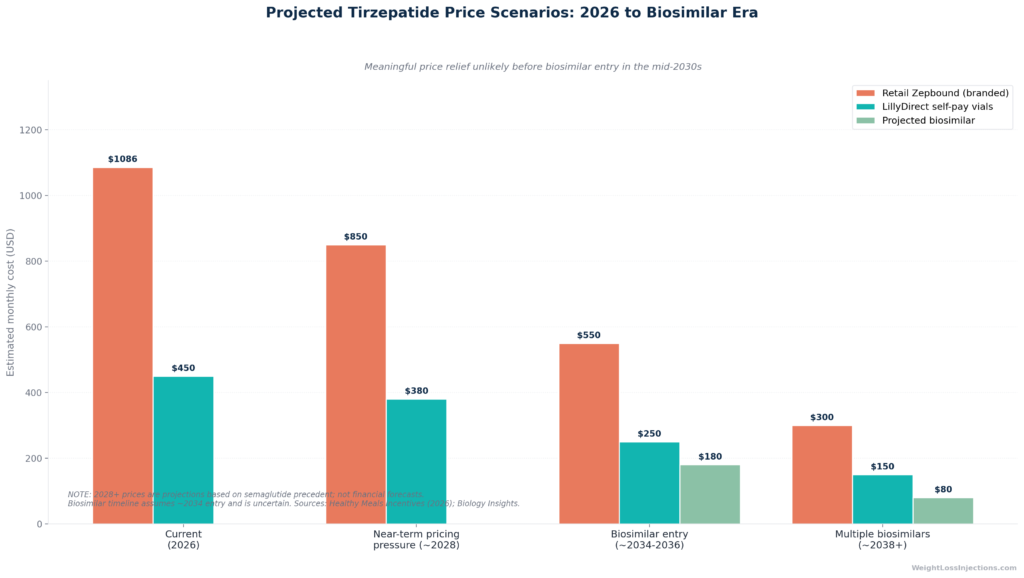
LillyDirect Self-Pay Vials: Lilly’s direct-to-patient program offers Zepbound single-dose vials at substantially reduced self-pay prices — starting at approximately $299/month for the 2.5 mg dose and $699/month for higher doses, compared to the retail pharmacy price of $1,086/28-day supply, according to Healthy Meals Incentives’ April 2026 tirzepatide cost analysis. These are FDA-approved products manufactured by Eli Lilly under full CGMP standards — not compounded alternatives.
Zepbound Savings Card: Patients with commercial insurance who obtain a Zepbound prescription may qualify for the Zepbound savings card, reducing their cost to as low as $25/fill per Healthy Meals Incentives. Note that Medicare and most Medicaid plans are not eligible for manufacturer savings cards.
Employer Benefit Plans: A growing number of large employers (generally those with over 2,000 employees) added Zepbound to their pharmacy benefit formularies in 2025–2026 as evidence accumulated for tirzepatide’s cardiovascular outcomes and productivity benefits.
Manufacturer Patient Assistance: Eli Lilly’s patient assistance program provides free or reduced-cost Zepbound to income-qualified patients who meet specific household income thresholds. Income-qualified patients who cannot afford even the LillyDirect vial pricing should explore this pathway before paying out of pocket.
WeightLossInjections.com: Our platform connects patients with licensed healthcare providers who can evaluate your eligibility for tirzepatide, determine the most cost-effective legal access pathway for your situation, and provide ongoing clinical oversight. Pricing starts at [$X/month] for [service detail]. This is not a substitute for a primary care relationship, but for patients navigating the complex landscape of GLP-1 access, having a provider who specializes in how much does tirzepatide cost navigation can meaningfully reduce the friction and expense.
The frame for this transitional period: until generic or biosimilar tirzepatide arrives in the 2030s, accessing branded tirzepatide affordably requires strategic navigation of Lilly’s direct programs, insurance coverage opportunities, and qualified telehealth providers. Mass-market compounding is no longer part of that equation.
What Happens to Tirzepatide Pricing Before Generics Arrive?
A decade is a long time to wait for price competition. Between now and the mid-2030s generic/biosimilar window, several market forces will shape what patients actually pay for tirzepatide — some working in patients’ favor, others less so.
Market Pressure from Generic Semaglutide
The most immediate pricing lever is competitive pressure from semaglutide generics in markets where they are now available. In the United States, this pressure will begin to be felt as semaglutide generics approach their expected U.S. launch around 2032. Before that date, Eli Lilly will be watching patient migration data carefully: any meaningful shift of patients away from tirzepatide toward branded semaglutide or its eventual generics creates incentive for Lilly to make tirzepatide more price-competitive.
The LillyDirect vial program — already a substantial discount from retail pharmacy pricing — appears to be Lilly’s proactive move to retain market share by removing the price barrier for self-pay patients. Expect this program to expand or reprice as the competitive environment evolves.
Insurance Coverage Expansion
The most meaningful pricing change for the average patient between now and 2030 will likely come from insurance coverage expansion rather than manufacturer price cuts. The cardiovascular outcomes data now behind tirzepatide is increasingly difficult for payers to ignore:
- The SUMMIT trial showed tirzepatide reduced cardiovascular death or worsening heart failure events by 38% compared to placebo in patients with heart failure with preserved ejection fraction (HFpEF) and obesity, per the Circulation full results published in March 2025.
- The SURPASS-CVOT trial, published in the New England Journal of Medicine in December 2025, demonstrated non-inferior cardiovascular outcomes for tirzepatide versus dulaglutide in patients with type 2 diabetes and established cardiovascular disease.
As payers incorporate this outcomes evidence into formulary decisions, expect broader commercial insurance coverage for Zepbound — particularly for patients with qualifying cardiometabolic comorbidities. Coverage converts a $699/month cost into a $25/fill cost, a difference that dwarfs anything achievable through manufacturer discounts alone.
Employer Benefit Plans: A Growing Channel
Large self-insured employers are increasingly covering anti-obesity medications as part of metabolic health benefit expansions. Employers that contract with pharmacy benefit managers (PBMs) can negotiate preferred tier placement for Zepbound. For employees at large companies (generally those with 2,000+ covered lives), this is potentially the highest-value access pathway available before generic competition arrives.
International Pricing: Useful Context, Not a Solution
Tirzepatide is available at substantially lower official prices in the United Kingdom, Canada, Germany, and other high-income markets outside the United States. UK patients accessing Wegovy (semaglutide) or equivalent GLP-1 medications through the NHS pay dramatically less. This is a real disparity and a valid policy concern — but it is not a practical solution for U.S. patients:
- Importation is illegal for personal use under U.S. law, with narrow humanitarian exceptions that do not apply to GLP-1 weight management therapies.
- International compounders operating without U.S. regulatory oversight present the same safety risks as domestic grey-market sources — no FDA lot testing, no USP standards, no certificate of analysis from accredited labs.
- Medical tourism for injectable biologics introduces supply chain, cold-chain integrity, and customs interception risks that are simply not worth the cost savings.
The Bottom Line on Pricing
Tirzepatide pricing will likely decline gradually through the late 2020s and early 2030s as market competition with semaglutide and Lilly’s own strategic pricing moves play out. It will not decline dramatically until biosimilar or generic competition arrives in the mid-2030s. The current cost range of $299–$699/month via LillyDirect, or $25/fill with qualifying commercial insurance, represents the realistic floor for most patients until the competitive landscape fundamentally changes.
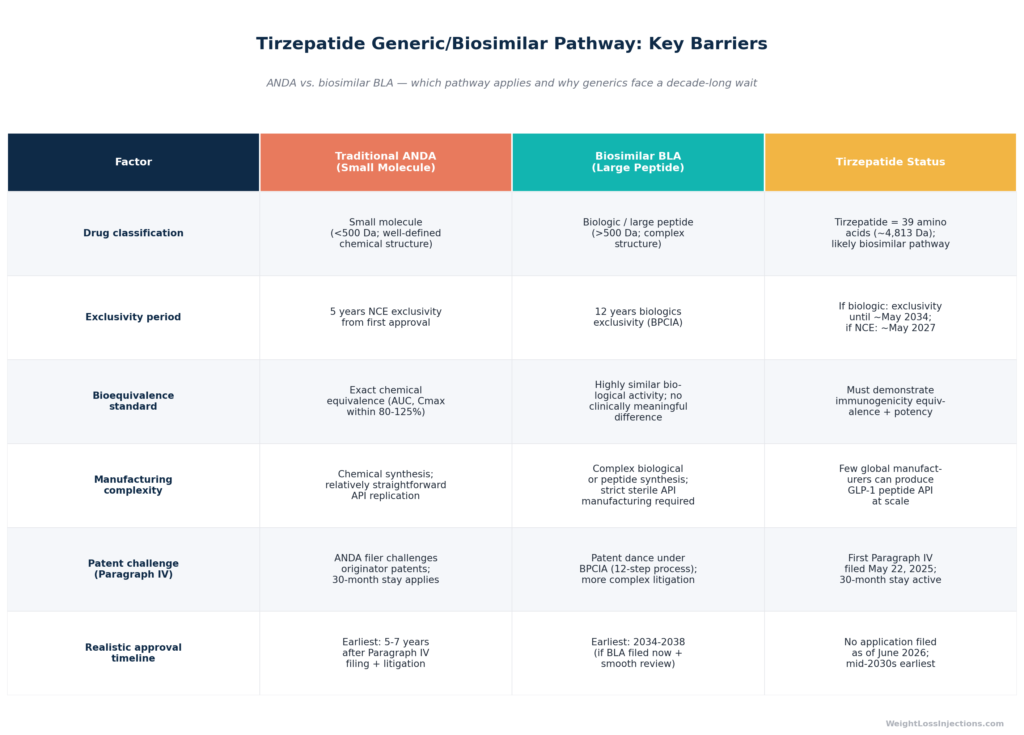
Two-column infographic comparing ANDA (Traditional Generic) pathway vs
Our Take at WeightLossInjections.com
We work with patients every day who are frustrated by tirzepatide’s cost — patients who saw the semaglutide generic headlines in March 2026 and hoped tirzepatide would follow quickly. We understand that frustration, and we want to be honest about what the data actually says rather than offer false comfort.
The reality is that tirzepatide is the most effective weight-loss medication currently approved by the FDA. In head-to-head clinical testing, it outperforms semaglutide by approximately 47% on mean weight loss — a clinically meaningful difference that translates to real health outcomes. Eli Lilly built a 53-patent portfolio around this molecule because it is genuinely valuable, and the legal system gives innovators the right to recoup their investment over an exclusivity period. That is the framework that funded tirzepatide’s development in the first place.
What this means practically: the “wait for the generic” strategy is a mid-2030s proposition at the earliest. Patients who need effective weight management today should not defer care while waiting for a price event that is a decade away. The compounding workaround that existed from 2022 to 2025 is no longer legally available to most patients, and we do not recommend seeking it from non-compliant sources.
What we do recommend: working with a licensed provider to access tirzepatide through the most cost-effective legal channel available for your specific situation. For many patients, that is the LillyDirect vial program. For others, it is employer benefit coverage, manufacturer patient assistance, or — when commercially insured — the $25/fill savings card pathway. At WeightLossInjections.com, our licensed providers understand the insurance and access landscape in depth, and they can help you find the pathway that works for your budget without waiting for a generic that is still a decade away.
When generic and biosimilar tirzepatide eventually arrives in the 2030s, we will be the first to update this article. Until then, the most effective thing a patient can do is access the best available treatment now — and we are here to help make that possible.
Ready to find out if you qualify and what it will cost? Speak with a licensed provider at WeightLossInjections.com. [service detail] [$X/month]
FAQ
No. No FDA-approved generic or biosimilar tirzepatide exists as of June 2026. The earliest possible generic approval is approximately 2036, when Eli Lilly’s primary composition-of-matter patent expires, per Biology Insights. Eli Lilly retains statutory exclusivity until at least June 2027, meaning no competitor can even complete the regulatory challenge process during this period, per Harris Beach Murtha Cullina’s June 2026 GLP-1 exclusivity analysis.
Eli Lilly’s composition-of-matter patent on tirzepatide expires approximately December 30, 2036, per Biology Insights’ GLP-1 generic timeline analysis. Formulation patents extend protection to approximately 2039 — a figure corroborated by GreyB’s Mounjaro patent expiration analysis — and method-of-use and follow-on patents push protection further to approximately 2041, per Biology Insights. Lilly has filed 53 U.S. patent applications and had 16 granted as of early 2026, according to Peptide Journal, creating overlapping protection through the late 2030s and beyond.
Possibly, but not before the mid-2030s at the earliest. A biosimilar demonstration does not require invalidating Lilly’s patents — it requires showing “high similarity” to the reference product through extensive analytical, preclinical, and clinical testing. However, no biosimilar application for tirzepatide has been filed with the FDA as of June 2026, per Peptide Journal, and biosimilar development typically takes 7–10 years. A 2034–2038 window is the most optimistic realistic scenario, assuming manufacturers begin development now. There is no guarantee of this timeline.
The semaglutide generics launched in India in March 2026 because the core Indian patent for semaglutide expired on March 20, 2026, per Pearce IP’s analysis of the Indian market launches. In the United States, semaglutide generics are not expected until approximately 2032 due to patent term extensions, per DrugPatentWatch’s GLP-1 exclusivity analysis. Semaglutide’s patent timeline is approximately 8–10 years ahead of tirzepatide’s — semaglutide received its first U.S. approval in 2017; tirzepatide in 2022. The exclusivity clocks run on different schedules, and one drug’s generification does not legally or regulatorily accelerate the other’s.
Not in any general-access sense. Mass-market compounding of tirzepatide became illegal after March 2025 when FDA enforcement discretion ended following the shortage resolution, per the FDA’s GLP-1 compounding clarification page and the Alliance for Pharmacy Compounding’s enforcement timeline. A narrow exception exists for 503A pharmacies compounding tirzepatide for patients with a documented clinically significant need — such as a specific ingredient allergy — limited to four prescriptions per month per pharmacy under FDA’s April 2026 updated guidance. Cost-based compounding is not permitted.
LillyDirect self-pay vials offer tirzepatide starting at approximately $299/month for lower doses, significantly less than the retail pharmacy price of $1,086/28-day supply, per Healthy Meals Incentives’ April 2026 cost analysis. With commercial insurance and the Zepbound savings card, cost can drop to as low as $25/fill. Income-qualified patients may qualify for Eli Lilly’s patient assistance program for free or reduced-cost Zepbound. WeightLossInjections.com [$X/month] connects patients with licensed providers who can evaluate your eligibility and identify the most cost-effective legal pathway for your specific insurance and income situation. [service detail]
This content is for informational purposes only and does not constitute medical advice. Consult a licensed healthcare provider before making any treatment decisions.