
Key Takeaways
- Retatrutide is investigational and not approved by the FDA or any other regulatory authority as of July 2026 — there is no retatrutide discontinuation or maintenance-dose trial data published yet, and everything in this article is extrapolation from other drugs in the class, clearly labeled as theoretical.
- No dedicated retatrutide withdrawal study has been conducted or reported. What we know about stopping GLP-1-class drugs comes from other agents: STEP-4 (semaglutide) and SURMOUNT-4 (tirzepatide).
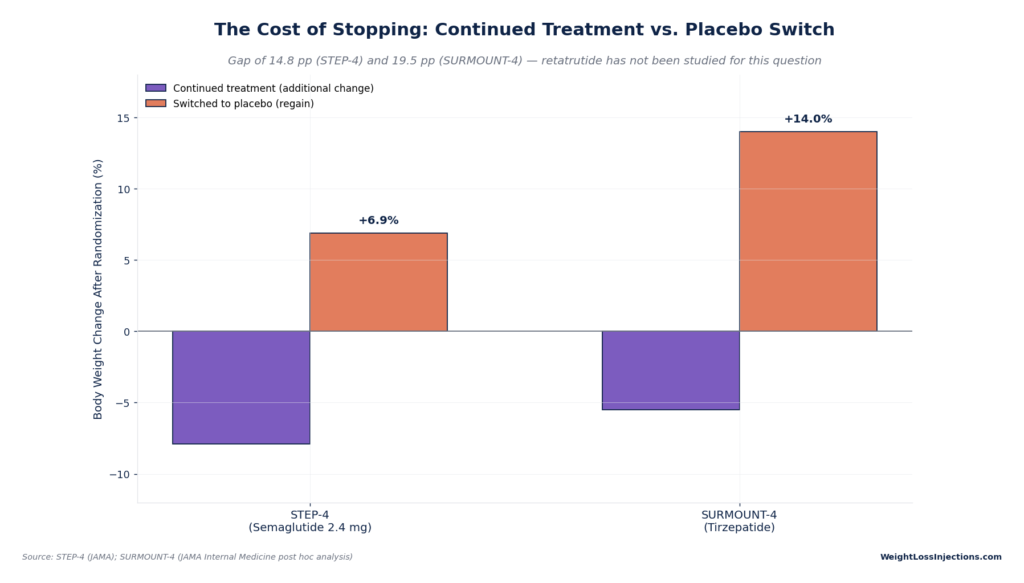
- STEP-4 found that participants who switched from semaglutide to placebo after a run-in period regained approximately 6.9% of body weight over the following period, versus continuing to lose an additional 7.9% on active treatment — a roughly 14.8-percentage-point gap.
- SURMOUNT-4 found an even larger divergence for tirzepatide: participants switched to placebo regained approximately 14% of body weight over 52 weeks, while those who continued treatment lost a further 5.5%.
- Based on this consistent class-wide pattern, it is reasonable to hypothesize — but not yet proven — that retatrutide would likely require long-term, possibly indefinite, therapy to sustain weight loss, similar to other chronic-disease medications; questions about an eventual “maintenance dose” remain entirely unanswered.
This article is explicitly theoretical and extrapolative. No retatrutide-specific discontinuation trial has been published as of July 2026. Everything here about stopping retatrutide is inference from other drugs in the same class, not established retatrutide data.
Why This Question Doesn’t Have a Retatrutide-Specific Answer Yet
Retatrutide (LY3437943) is an investigational triple hormone receptor agonist from Eli Lilly and Company, targeting GIP, GLP-1, and glucagon receptors. It has not been approved by the FDA, the European Medicines Agency, or any other regulator as of July 2026, and there is no dedicated clinical trial data on what happens when someone stops taking it after achieving significant weight loss. Every claim in this article about “stopping retatrutide” is an inference based on patterns observed with other, already-approved drugs in the same broad therapeutic class — not retatrutide-specific findings. The only legal way to access retatrutide today, for any duration, is enrollment in an authorized clinical trial through ClinicalTrials.gov.
With that limitation clearly stated, it’s still a reasonable and important question to explore: TRIUMPH-1 has shown that retatrutide can produce substantial weight loss that continues to accumulate through 104 weeks. But nobody has yet studied what happens if someone stops. The closest available evidence comes from two landmark withdrawal trials conducted on the two closest approved comparators — semaglutide and tirzepatide.
What STEP-4 Showed About Stopping Semaglutide
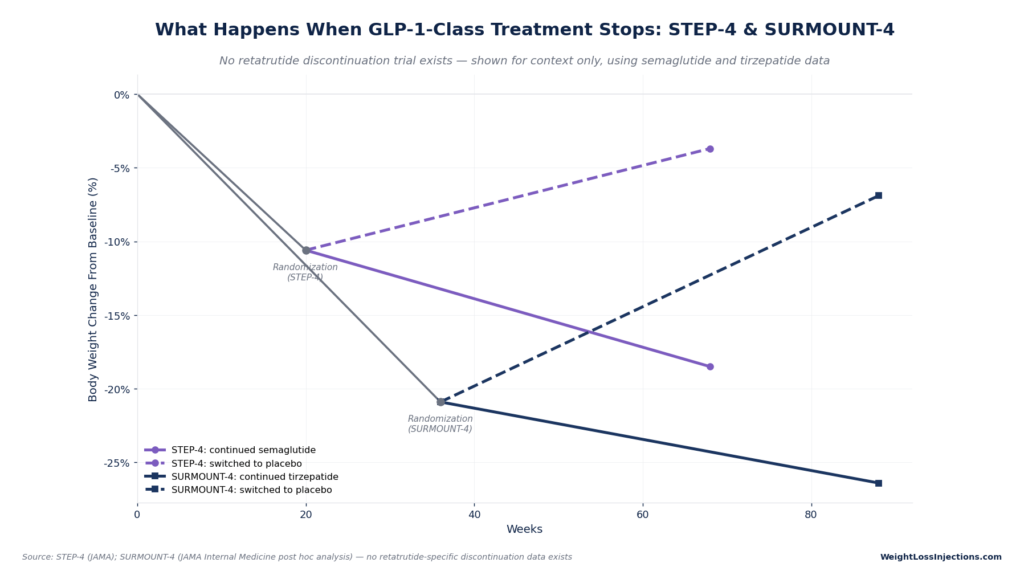
STEP-4 is a randomized trial designed specifically to study this question for semaglutide, the drug behind Wegovy. Participants first underwent a 20-week open-label run-in period on semaglutide 2.4 mg, during which the group lost a mean of 10.6% of body weight. At that point, participants were randomized to either continue semaglutide or switch to placebo for an additional 48 weeks, while both groups continued lifestyle counseling.
The results, published in JAMA, were stark:
- Participants who continued semaglutide lost an additional 7.9% of body weight from week 20 to week 68.
- Participants who switched to placebo regained 6.9% of body weight over the same period.
- The between-group difference was 14.8 percentage points at week 68.
A longer-term follow-up — the STEP-1 extension, which tracked participants after semaglutide was stopped at week 68 — found that roughly two-thirds of the weight lost during active treatment was regained within about a year of discontinuation. Regain in these studies has generally been shown to begin within weeks of stopping, not months.
What SURMOUNT-4 Showed About Stopping Tirzepatide
Tirzepatide — the dual GIP/GLP-1 agonist behind Zepbound — was studied in a comparable withdrawal design called SURMOUNT-4. Participants completed a 36-week open-label tirzepatide lead-in period, during which they lost a mean of 20.9% of body weight, then were randomized to continue tirzepatide or switch to placebo for an additional 52 weeks.
The divergence was even larger in absolute terms than STEP-4’s:
- Participants who continued tirzepatide lost an additional 5.5% of body weight from week 36 to week 88.
- Participants who switched to placebo regained approximately 14.0% of body weight over the same period.
- Published post hoc analysis in JAMA Internal Medicine found that 82.5% of the placebo-switched group regained 25% or more of the weight they had lost during the lead-in period within one year, and that regain was associated with a reversal of cardiometabolic improvements — worsening waist circumference, blood pressure, and lipid measures in proportion to how much weight came back.
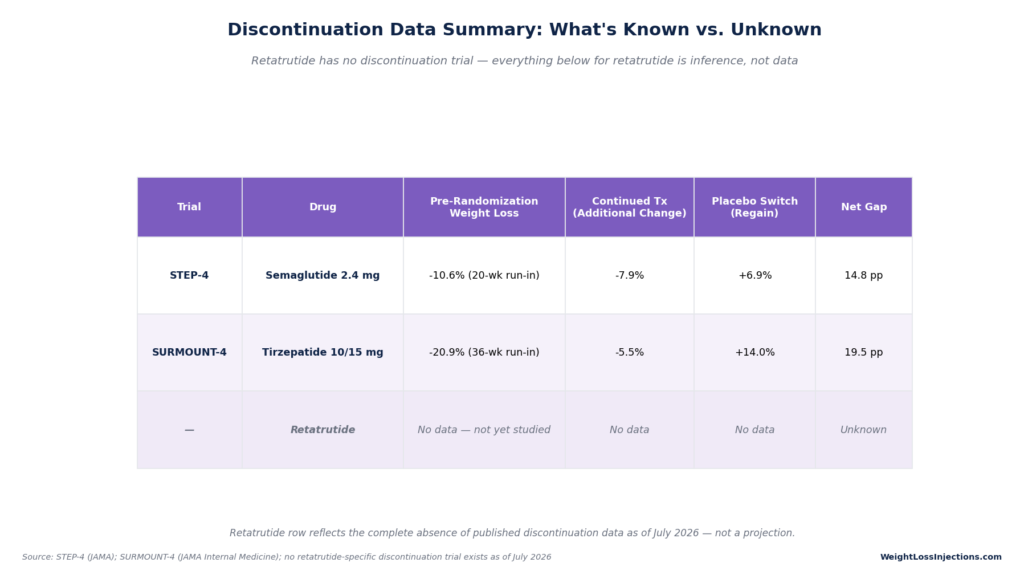
| Trial | Drug | Weight Lost Pre-Randomization | Change on Continued Treatment | Change After Switching to Placebo | Net Gap |
|---|---|---|---|---|---|
| STEP-4 | Semaglutide 2.4 mg | -10.6% (20-week run-in) | -7.9% additional | +6.9% regain | 14.8 pp |
| SURMOUNT-4 | Tirzepatide 10/15 mg | -20.9% (36-week run-in) | -5.5% additional | +14.0% regain | 19.5 pp |
| Retatrutide | — | — | No data — not yet studied | No data — not yet studied | Unknown |
The pattern across both trials — and across other GLP-1-class agents referenced in the broader withdrawal literature — is consistent: stopping treatment after achieving meaningful weight loss leads to substantial, relatively rapid weight regain, while continuing treatment sustains and often extends the loss.
Our Top 3 · September 2026
The best GLP-1 providers right now
Independently reviewed. Ranked by price, medication access, provider quality, and patient outcomes.
Renew GLP
Personalized GLP-1, GIP plans: Semaglutide & Tirzepatide.
Medvi
No membership or hidden fees. Everything you need is included.
Trimi
US-licensed clinicians and shipped to your door, from $99/mo.
Why It’s Reasonable to Hypothesize the Same Pattern Would Apply to Retatrutide — But Not Yet Proven
Retatrutide shares core mechanistic features with both semaglutide and tirzepatide — GLP-1 receptor agonism drives appetite suppression in all three, layered with GIP agonism in tirzepatide and retatrutide, and further layered with glucagon receptor agonism unique to retatrutide. Because the appetite-suppressing and metabolic effects of these drugs are understood to depend on ongoing receptor activation, it is biologically plausible that stopping retatrutide would remove that ongoing suppression in a broadly similar way to what’s observed when semaglutide or tirzepatide is stopped.
This is a reasonable hypothesis grounded in shared mechanism and a consistent cross-drug pattern — the Journal of Clinical Medicine review of GLP-1 receptor agonist withdrawal notes that “weight recovery was observed immediately following the cessation of therapy” across multiple studied agents. But it remains a hypothesis specifically for retatrutide. No discontinuation trial for retatrutide has been designed, conducted, or reported as of July 2026. It’s entirely possible — though currently unproven — that retatrutide’s added glucagon receptor mechanism, or the greater magnitude of weight loss it produces, could result in a somewhat different regain pattern than what’s been observed with semaglutide or tirzepatide. There is no data either supporting or refuting that possibility right now.
The Unanswered “Maintenance Dose” Question
A related question that comes up frequently: if retatrutide is eventually approved, will there be a lower “maintenance dose” intended for long-term use after an initial higher-dose weight-loss phase, distinct from the escalation-to-maximum-tolerated-dose approach used in TRIUMPH-1?
As of July 2026, this question has no answer. TRIUMPH-1’s design used a titration schedule escalating toward a fixed maintenance dose (4 mg, 9 mg, or 12 mg, depending on assigned arm) sustained through the full 80-week (and 104-week extension) observation period — it did not test a lower dose specifically as a post-weight-loss maintenance strategy distinct from the treatment dose. No published retatrutide trial has evaluated a dose-reduction or step-down protocol after initial weight loss is achieved. Any answer to “what would the maintenance dose be” at this point would be pure speculation, and this article does not offer one.
The Likely Implication: Retatrutide Would Probably Require Long-Term Therapy
Taken together, the consistent findings from STEP-4 and SURMOUNT-4 — combined with the broader pattern seen across the GLP-1 drug class, and echoed in the SURMOUNT-4 investigators’ own conclusion that “obesity is a chronic metabolic condition similar to type 2 diabetes and hypertension requiring long-term therapy in most patients” — point toward an important framing for how to think about retatrutide, if it is eventually approved: it would most plausibly function as a long-term, likely indefinite therapy for most patients who respond to it, not a finite course with a defined stopping point.
This framing has real implications beyond the clinical question — it touches on projected long-term cost (retatrutide’s anticipated list price is estimated at $1,300–$1,600/month, though unconfirmed), insurance coverage sustainability, and the practical reality that any future retatrutide “success story” would likely require sustained treatment rather than a course that ends once a weight goal is reached. None of this is confirmed by retatrutide-specific data; it is a reasonable extrapolation from the closest available evidence.
What We Still Don’t Know
To summarize the boundaries of current knowledge clearly:
- No retatrutide discontinuation trial exists. Everything about “stopping retatrutide” in this article is inferred from semaglutide and tirzepatide data, not retatrutide data.
- No maintenance-dose protocol has been tested. There’s no published data on whether a lower dose could sustain retatrutide’s weight-loss effect after an initial higher-dose phase.
- Retatrutide’s larger magnitude of weight loss is an unstudied variable. Whether a larger percentage of weight lost translates into a larger percentage of weight regained on discontinuation, a similar percentage, or something different, is unknown.
- Long-term safety of indefinite therapy is still being assessed. TRIUMPH-3, which includes cardiovascular outcomes data relevant to long-duration use, has not yet reported results.
The Only Legal Way to Be Part of Future Discontinuation Research
Retatrutide remains investigational, with no legal compounding pathway — it was not included in the FDA’s April 2026 peptide reclassification and has no USP/NF monograph. The only legal way to access retatrutide, and potentially contribute to future research on discontinuation or maintenance dosing, is enrollment in an authorized clinical trial through ClinicalTrials.gov.
For people currently using or considering an approved option, the STEP-4 and SURMOUNT-4 findings are directly relevant today: they suggest that anyone using semaglutide or tirzepatide for weight management should discuss a long-term treatment plan with their healthcare provider rather than assuming the medication is intended for short-term use.
FAQ
Has retatrutide been studied for what happens when you stop taking it?
No. As of July 2026, there is no published or reported retatrutide discontinuation trial. Everything about stopping retatrutide is extrapolated from withdrawal studies of other drugs in the class — primarily STEP-4 (semaglutide) and SURMOUNT-4 (tirzepatide) — not from retatrutide-specific data.
Will people likely regain weight if they stop retatrutide?
Based on the consistent pattern observed with semaglutide (STEP-4) and tirzepatide (SURMOUNT-4), it’s reasonable to hypothesize a similar regain pattern would occur with retatrutide, since all three drugs share overlapping appetite-suppressing mechanisms. However, this has not been directly studied or confirmed for retatrutide, and it remains a theoretical extrapolation.
Is there a known maintenance dose for retatrutide after initial weight loss?
No. TRIUMPH-1 used a fixed maintenance dose sustained throughout the trial rather than testing a step-down or dose-reduction maintenance protocol. No published data addresses whether a lower dose could sustain weight loss long-term. This question remains entirely unanswered.
How much weight did people regain after stopping tirzepatide and semaglutide in trials?
In STEP-4, participants who switched from semaglutide to placebo regained about 6.9% of body weight over 48 weeks (versus an additional 7.9% loss on continued treatment). In SURMOUNT-4, participants who switched from tirzepatide to placebo regained about 14.0% of body weight over 52 weeks (versus an additional 5.5% loss on continued treatment), and a post hoc analysis found 82.5% of that group regained at least 25% of their lost weight within a year.
Does this mean retatrutide would need to be taken for life if approved?
Based on the pattern seen across the broader GLP-1 drug class — where discontinuation trials have consistently shown substantial regain — it’s a reasonable hypothesis that retatrutide would function similarly, requiring long-term or indefinite use for most responders to sustain results. This is an extrapolation from other drugs’ data, not a retatrutide-specific finding, since no such study has been conducted for retatrutide itself.
Medical disclaimer: Retatrutide is an investigational drug not approved by the FDA or any other regulatory authority as of July 2026. It is available only through enrollment in authorized clinical trials. This article is for informational purposes only and does not constitute medical advice, endorsement, or a recommendation to obtain retatrutide outside of a registered clinical trial. Speak with your healthcare provider about currently approved weight-loss treatments. Content published by WeightLossInjections.com.