
Key Takeaways
- Retatrutide is investigational and not approved by the FDA or any other regulatory authority as of July 2026 — it is not an approved treatment for obstructive sleep apnea (OSA) or any other condition.
- A nested OSA basket within TRIUMPH-1 reported a 60.6% reduction in the Apnea-Hypopnea Index (AHI) among participants with obstructive sleep apnea, alongside the trial’s broader weight-loss results.
- This places retatrutide’s OSA basket results in the same general territory as tirzepatide’s dedicated SURMOUNT-OSA trial, which reported AHI reductions in the range of roughly 48–56% (percentage terms) across its two component trials.
- The mechanism is believed to combine substantial weight loss (which reduces upper airway obstruction) with possible direct effects on airway or metabolic physiology, though the latter is not yet well established for retatrutide specifically.
- TRIUMPH-2 also includes an OSA basket, with a readout expected in Q3–Q4 2026 — additional data that could either reinforce or complicate the TRIUMPH-1 findings.
This article discusses nested trial data and comparative research findings for informational purposes. It is not a treatment recommendation and does not suggest retatrutide is approved for OSA or any other indication.
An Investigational Drug, Not an Approved OSA Treatment
It’s worth being direct about this up front: retatrutide is an investigational triple hormone receptor agonist (GIP + GLP-1 + glucagon) developed by Eli Lilly and Company, and it has not been approved by the FDA or any other regulator for any use — including obstructive sleep apnea — as of July 2026. The OSA data discussed in this article comes from a nested basket within a Phase 3 obesity trial, not from a dedicated, completed, peer-reviewed sleep apnea trial, and it does not establish retatrutide as an approved or recommended OSA treatment. The only legal way to access retatrutide for any indication today is through enrollment in an authorized clinical trial via ClinicalTrials.gov.
With that framing in place, the OSA findings from TRIUMPH-1 are one of the more clinically interesting secondary results in the retatrutide program, because they point toward a possible future indication beyond weight loss alone — following a path that tirzepatide has already partially walked with the FDA-approved Zepbound OSA indication.
What the TRIUMPH-1 OSA Basket Measured
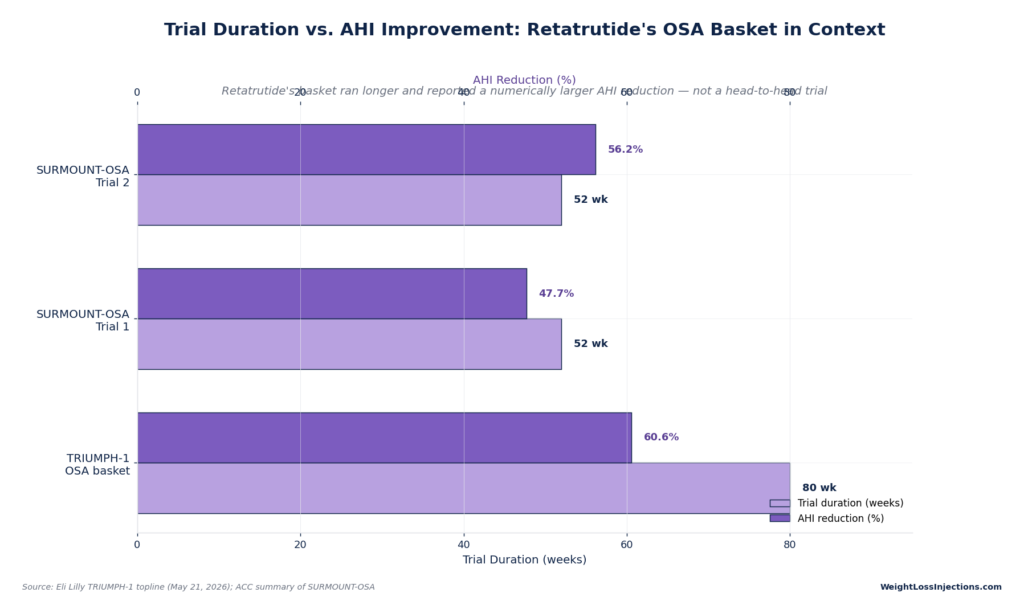
TRIUMPH-1, the pivotal Phase 3 obesity trial for retatrutide, enrolled 2,339 adults with obesity or overweight plus at least one weight-related complication, studied over 80 weeks (with a 104-week extension for a subgroup). Within that broader trial, researchers included a nested basket analysis specifically looking at participants who had obstructive sleep apnea at baseline, measuring changes in their Apnea-Hypopnea Index (AHI) — the standard clinical measure of how many breathing interruptions (apneas and hypopneas) a person experiences per hour of sleep.
The result: participants in the OSA basket saw a 60.6% reduction in AHI (Eli Lilly, May 21, 2026 TRIUMPH-1 topline announcement). In practical terms, this means that for someone entering the trial with a given number of breathing interruptions per hour, that number fell by roughly three-fifths on average by the end of the observation period — a magnitude of improvement that, in principle, could move some patients from a more severe OSA classification to a milder one, or in some cases below the diagnostic threshold altogether. Full basket-level data — including baseline AHI severity distribution, dose-specific breakdowns, and PAP-therapy subgroup analysis — has not yet been published in a peer-reviewed format as of July 2026.
Our Top 3 · September 2026
The best GLP-1 providers right now
Independently reviewed. Ranked by price, medication access, provider quality, and patient outcomes.
Renew GLP
Personalized GLP-1, GIP plans: Semaglutide & Tirzepatide.
Medvi
No membership or hidden fees. Everything you need is included.
Trimi
US-licensed clinicians and shipped to your door, from $99/mo.
How This Compares to Tirzepatide’s SURMOUNT-OSA Program
Retatrutide isn’t the first incretin-based therapy to show this kind of effect. Tirzepatide — the dual GIP/GLP-1 agonist marketed as Zepbound — was studied specifically for OSA in the dedicated SURMOUNT-OSA program, which became the basis for an FDA-approved OSA indication for Zepbound in adults with obesity.
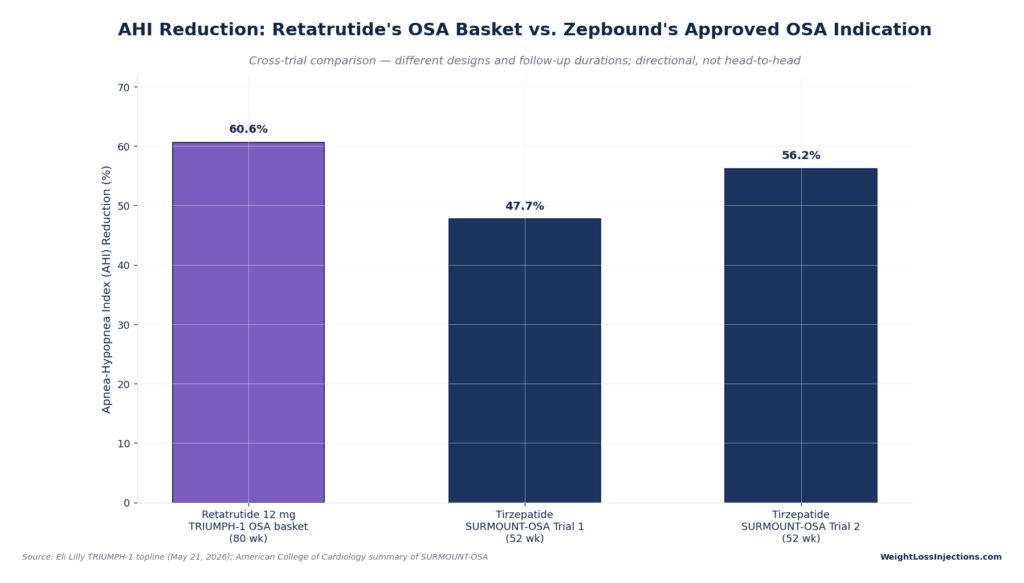
SURMOUNT-OSA consisted of two component trials assessing tirzepatide with and without positive airway pressure (PAP) therapy. At 52 weeks, tirzepatide produced AHI reductions of approximately -25.3 to -29.3 events per hour in absolute terms compared to placebo, corresponding to percentage reductions of roughly -47.7% to -56.2% relative to baseline, depending on the specific trial and PAP-use subgroup (American College of Cardiology summary of SURMOUNT-OSA).
| Trial | Drug | AHI Reduction | Duration | Regulatory Status |
|---|---|---|---|---|
| TRIUMPH-1 OSA basket | Retatrutide 12 mg | 60.6% | 80 weeks | Investigational |
| SURMOUNT-OSA (Trial 1) | Tirzepatide | ~47.7% | 52 weeks | FDA-approved indication (Zepbound) |
| SURMOUNT-OSA (Trial 2) | Tirzepatide | ~56.2% | 52 weeks | FDA-approved indication (Zepbound) |
Retatrutide’s reported 60.6% AHI reduction is numerically larger than tirzepatide’s SURMOUNT-OSA results, which is broadly consistent with the pattern seen across retatrutide’s weight-loss data — the triple agonist has generally produced larger effect sizes than the dual agonist in comparable measures. However, this is a cross-trial comparison, not a head-to-head study: different trial designs, different baseline severity distributions, different follow-up durations (80 weeks vs. 52 weeks), and the fact that TRIUMPH-1’s OSA basket was nested within a broader obesity trial rather than purpose-built around OSA as SURMOUNT-OSA was. These differences mean the comparison should be read as directional interest, not definitive superiority.
Why Would a Weight-Loss Drug Improve Sleep Apnea?
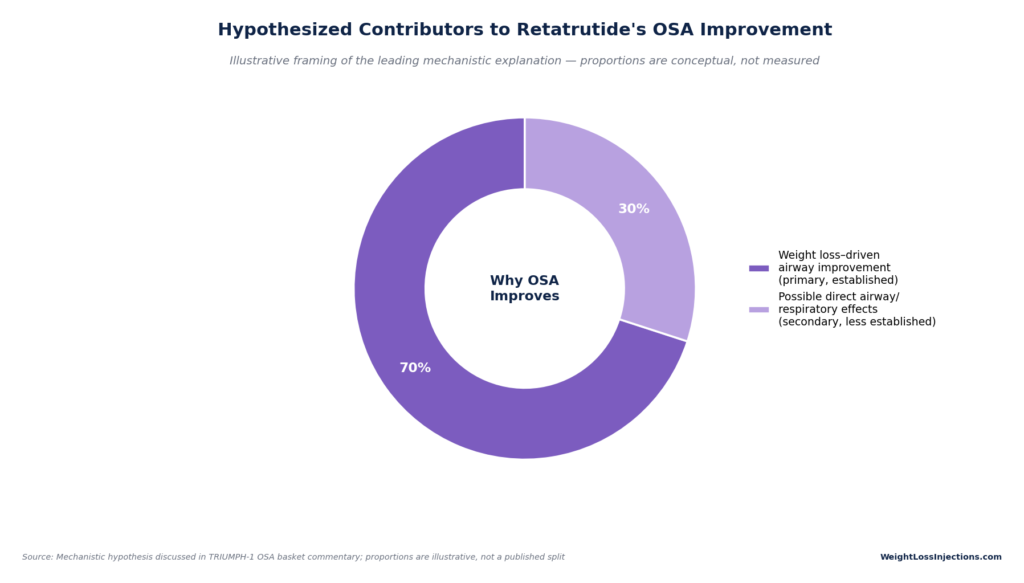
The leading explanation for why incretin-based therapies improve OSA outcomes is fairly intuitive: obstructive sleep apnea is strongly associated with excess body weight, particularly fat deposition around the neck and upper airway, which narrows the airway and makes it more prone to collapse during sleep. Substantial weight loss — the kind retatrutide produced in TRIUMPH-1’s main cohort (28.3% at 12 mg over 80 weeks) — reduces that fat deposition and can directly ease the mechanical obstruction that drives apnea events.
There is also a secondary hypothesis, less well established, that GLP-1 and related incretin pathways may have direct effects on respiratory drive, upper airway muscle tone, or systemic inflammation that could contribute independently of weight loss. This remains a more speculative area of research, and the currently available retatrutide OSA data does not distinguish between “weight loss caused it” and “the drug had a direct additional effect” — both plausible contributors have not been separately isolated in the published data.
What This Could Mean for a Future Retatrutide Indication
Zepbound’s OSA indication demonstrates that the FDA is willing to approve an incretin-based weight-loss drug for a specific secondary condition when supported by a dedicated trial. If retatrutide’s OSA signal holds up in TRIUMPH-2 — which also includes an OSA basket, with a readout expected in Q3–Q4 2026 — Eli Lilly could plausibly pursue a similar indication-expansion strategy after any core obesity approval. That would likely require a dedicated OSA trial design (similar to SURMOUNT-OSA) rather than relying solely on a nested basket within a broader obesity trial, since indication-specific approvals generally require indication-specific pivotal evidence.
None of this is confirmed. As of July 2026, retatrutide’s overall regulatory pathway anticipates an NDA submission around Q4 2026 for the core obesity indication, with a potential approval decision in late 2027 — and any OSA-specific indication would likely follow well after that, pending TRIUMPH-2 data and any dedicated follow-up trial Eli Lilly may choose to run.
What This Doesn’t Mean for People With Sleep Apnea Today
To be clear: this data does not mean people with obstructive sleep apnea should seek out retatrutide now. It is not approved for OSA, is not approved for anything, and has no legal compounding pathway — it has no USP/NF monograph and was not included in the FDA’s April 2026 peptide reclassification. The only legal way to access retatrutide, for OSA or any other reason, is enrollment in an authorized clinical trial through ClinicalTrials.gov, which would include TRIUMPH-2 if it remains actively enrolling.
For people managing obstructive sleep apnea and excess weight today, tirzepatide-based treatment under the Zepbound OSA indication is an FDA-approved option worth discussing with a healthcare provider, alongside standard OSA treatments like PAP therapy.
FAQ
Is retatrutide approved to treat sleep apnea?
No. Retatrutide is investigational and not approved by the FDA or any other regulator for sleep apnea or any other condition. The 60.6% AHI reduction reported in TRIUMPH-1’s OSA basket comes from a nested analysis within a broader Phase 3 obesity trial, not a completed, dedicated OSA approval pathway.
How does retatrutide’s sleep apnea data compare to Zepbound’s?
TRIUMPH-1’s OSA basket reported a 60.6% AHI reduction over 80 weeks, numerically higher than the roughly 47.7–56.2% reductions reported in tirzepatide’s SURMOUNT-OSA trials over 52 weeks, which supported Zepbound’s FDA-approved OSA indication. These are different trials with different designs, so this is a directional comparison rather than a head-to-head result.
Does retatrutide improve sleep apnea because of weight loss, or does it have a separate direct effect?
The leading explanation is that weight loss reduces upper airway fat deposition and obstruction, which is the primary driver of improvement. A possible additional direct effect on airway or respiratory physiology has been proposed for incretin-based drugs generally, but this has not been clearly isolated or confirmed for retatrutide specifically.
Will there be more retatrutide sleep apnea data soon?
Yes — TRIUMPH-2 includes its own OSA basket, with a readout expected in Q3–Q4 2026. That data could reinforce, refine, or complicate the TRIUMPH-1 OSA findings.
Can I enroll in a retatrutide trial specifically for my sleep apnea?
Some active retatrutide trials, such as TRIUMPH-2, include OSA-related components, but eligibility depends on the specific trial’s criteria. Search current studies at ClinicalTrials.gov to see what’s actively enrolling and whether you meet eligibility requirements.
Medical disclaimer: Retatrutide is an investigational drug not approved by the FDA or any other regulatory authority as of July 2026. It is available only through enrollment in authorized clinical trials. This article is for informational purposes only and does not constitute medical advice, endorsement, or a recommendation to obtain retatrutide outside of a registered clinical trial. Speak with your healthcare provider about currently approved weight-loss treatments. Content published by WeightLossInjections.com.