![Unbranded [pillar-drug-class] injection pen on a neutral background — WeightLossInjections.com editorial hero](https://weightlossinjections.com/wp-content/uploads/2026/07/hero_tirzepatide_c5_lifestyle-1200x675.png)
Medical & Legal Disclaimer: This article provides regulatory and legal information for educational purposes only. It does not constitute legal or medical advice. Regulatory status may change; verify current status at the FDA website and consult a licensed healthcare provider or attorney for specific guidance.
Reviewed by: the WeightLossInjections.com Staff | Last updated: June 27, 2026 | This page is reviewed and updated quarterly. Bookmark it or check back for the latest status as the 503B Bulks List exclusion and OFA litigation develop.
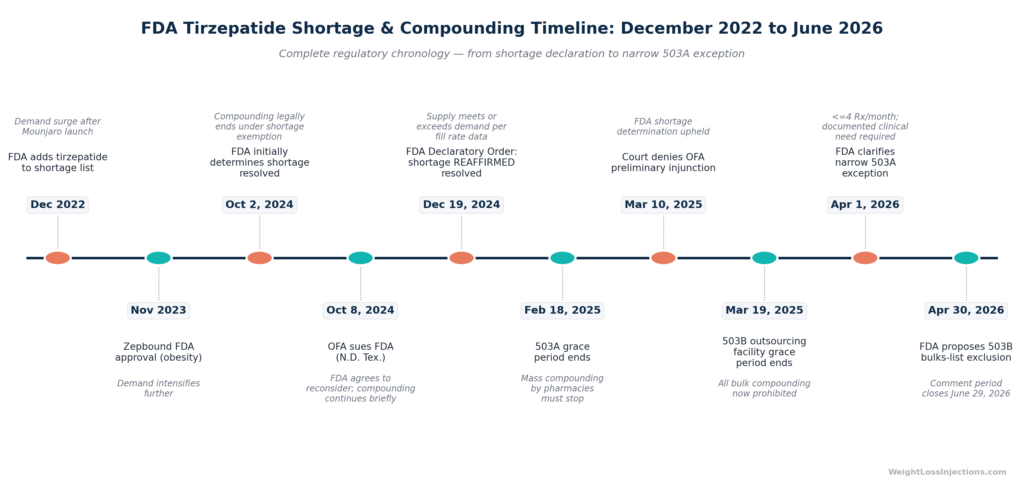
Horizontal annotated timeline chart showing key FDA tirzepatide shortage and compounding enforcement milestones from December 2022 through June 2026 — color-coded: blue for shortage-active period,…
- Tirzepatide is NOT on the FDA Drug Shortage List as of June 2026. The shortage was formally resolved on December 19, 2024, via a FDA Declaratory Order, and that determination has not been reversed. (FDA Declaratory Order, December 19, 2024 — PDF)
- 503A mass compounding ended February 18, 2025. State-licensed compounding pharmacies lost their shortage-exemption authority to produce essentially-copy tirzepatide at scale. (FDA GLP-1 Compounding Clarification Page)
- 503B outsourcing facility compounding ended March 19, 2025. No exceptions remain for this category. (FDA GLP-1 Compounding Clarification Page)
- A narrow 503A personalized-medicine exception survives, clarified by the FDA on April 1, 2026: a 503A pharmacy may compound tirzepatide for an individual patient only if the prescriber documents a clinically significant difference — such as a cresol allergy or unavailable dose strength — and the pharmacy fills ≤4 prescriptions per calendar month of that essentially-copy formulation. (FDA GLP-1 Compounding Clarification Page — April 1, 2026 update)
- A proposed rule to permanently exclude tirzepatide from the 503B Bulks List is currently in its comment period, which closes June 29, 2026 — two days from today. (FDA Press Announcement, April 30, 2026)
- Branded tirzepatide is widely available. Zepbound and Mounjaro are in stock at retail pharmacies and through Eli Lilly’s LillyDirect self-pay program, with vials starting at $299/month — a fraction of the $1,086 retail list price. (Healthy Meals Incentives, April 2026)
- If a platform is still advertising compounded tirzepatide as broadly available without individualized clinical documentation, it is operating outside current FDA rules.
Current Status — Tirzepatide Is NOT on the FDA Shortage List (June 2026)
Here is the direct answer to the most-searched question: as of June 27, 2026, tirzepatide is not on the FDA Drug Shortage List. The shortage was declared resolved on December 19, 2024. That determination has not been reversed, vacated, or suspended by any court or subsequent FDA action.
FDA Status Box — June 27, 2026
Status Item Current Status Tirzepatide shortage (FDA Drug Shortage List) RESOLVED (December 19, 2024) 503A mass compounding ENDED (February 18, 2025) 503B outsourcing facility compounding ENDED (March 19, 2025) Narrow 503A personalized exception ACTIVE (≤4 Rx/month; documented clinical need required) 503B Bulks List exclusion proposal PENDING (comment period closes June 29, 2026)
What shortage resolution means in legal terms: when the FDA removes a drug from the Drug Shortage List, the statutory basis for compounding pharmacies to produce “essentially a copy” of that drug under the shortage exemption expires. Both 503A pharmacies (state-licensed traditional compounders) and 503B outsourcing facilities (federally registered, FDA-inspected bulk compounders) relied on the shortage exemption to produce tirzepatide legally. Once the shortage was declared resolved, that authority ended, subject to enforcement grace periods that have also now expired. (FDA GLP-1 Compounding Clarification Page)
Current supply situation as of June 2026: Eli Lilly significantly expanded tirzepatide manufacturing capacity throughout 2024 and 2025. Both Zepbound (for chronic weight management) and Mounjaro (for type 2 diabetes) are generally available through retail pharmacies, and LillyDirect self-pay vials are in stock. (Harris Beach Murtha Cullina, June 2026)
Here is what the compounding landscape looks like today:
- 503A (traditional compounding pharmacies): Mass compounding of essentially-copy tirzepatide ended February 18, 2025. A narrow exception permits 503A pharmacies to compound tirzepatide for an individual patient with a documented clinically significant difference and a pharmacy volume cap of ≤4 prescriptions per calendar month. See the full breakdown in the section below.
- 503B (outsourcing facilities): All tirzepatide compounding authority ended March 19, 2025, with no surviving exceptions. The FDA’s April 30, 2026 proposed rule to formally exclude tirzepatide from the 503B Bulks List would permanently codify this prohibition once finalized after the June 29, 2026 comment period closes. (FDA Press Announcement, April 30, 2026)
If a telehealth platform, pharmacy, or online vendor is offering compounded tirzepatide to any patient who wants it — on a subscription plan, through a bulk program, or without individualized prescriber documentation of a specific clinical need — that arrangement is not operating within current FDA guidance. The market that existed from 2022 through early 2025, in which hundreds of thousands of patients accessed affordable compounded tirzepatide through telehealth programs, is over. What survives is a genuinely narrow pathway reserved for patients with documented clinical needs that branded products cannot meet.
Timeline of the Tirzepatide Shortage — From December 2022 to Resolution
Understanding where we are in June 2026 requires understanding the full arc of how tirzepatide arrived on the shortage list, how a massive compounding market grew up around it, and how that market was progressively closed down through late 2024 and 2025.
How Tirzepatide Got on the Shortage List
Tirzepatide is a synthetic 39-amino-acid peptide — the active pharmaceutical ingredient in Mounjaro (FDA-approved for type 2 diabetes, May 2022) and Zepbound (FDA-approved for chronic weight management, November 2023). (StatPearls / NCBI Bookshelf) It works as a first-in-class dual GIP and GLP-1 receptor agonist — stimulating the same hormone receptors that regulate appetite, blood sugar, and metabolism — producing weight loss outcomes that significantly exceeded anything previously seen in obesity pharmacotherapy.
That efficacy translated directly into explosive demand. Following Mounjaro’s launch for type 2 diabetes in May 2022, Eli Lilly’s existing production capacity was overwhelmed. Physicians were writing prescriptions faster than Lilly could manufacture product. On December 15, 2022, tirzepatide injection was added to the FDA Drug Shortage List — reflecting the agency’s determination that supply was insufficient to meet medical need. (FDA Declaratory Order — PDF)
That shortage listing had immediate legal consequences. Under the Federal Food, Drug, and Cosmetic Act, once a drug is on the shortage list, 503A and 503B compounders gain temporary authority to produce essentially-copy versions of that drug — the shortage exemption. The law treats this as a bridge: when patients genuinely cannot access an FDA-approved drug through normal channels, allowing compounders to fill the gap serves public health. The shortage was genuine, and the market that emerged from it reflected real patient need.
The Compounding Market That Emerged (2022–2024)
From late 2022 through the end of 2024, a large and largely lawful compounded tirzepatide market operated under the shortage exemption. 503A pharmacies produced patient-specific compounded tirzepatide; 503B outsourcing facilities produced it in bulk for distribution to clinics and telehealth platforms. Hundreds of direct-to-patient telehealth programs launched compounded tirzepatide subscription offerings at prices ranging from roughly $150 to $400 per month — compared to the $1,086 retail list price for branded Zepbound. For many patients, this was the only financially viable path to GLP-1 therapy.
When Zepbound (tirzepatide for obesity/weight management) received FDA approval in November 2023, demand intensified further. At its peak, the compounded tirzepatide market represented one of the largest compounding markets in U.S. pharmaceutical history, measured by patient volume. (GoodRx — Tirzepatide shortage timeline)
The 2024 Resolution Determinations
Eli Lilly spent 2024 aggressively expanding manufacturing. By summer and early fall 2024, the supply picture had fundamentally shifted. Fill rates — the FDA’s primary metric for shortage assessment — had improved to the point where supply was meeting or exceeding demand.
October 2, 2024: The FDA made its initial formal determination that the tirzepatide shortage was resolved. Under the shortage exemption framework, this determination would end compounding authority. (FDA GLP-1 Compounding Clarification Page)
October 8, 2024: The Outsourcing Facilities Association (OFA) — a trade group representing 503B compounders — filed suit in the Northern District of Texas (OFA v. FDA, No. 4:24-cv-953, N.D. Tex.), arguing the FDA’s shortage determination was arbitrary and capricious and that supply was not actually adequate. The FDA agreed to reconsider voluntarily while the case proceeded, pausing enforcement. (Frier Levitt — Tirzepatide shortage/compounding legal update)
December 19, 2024: After re-examining distribution data, manufacturer inventory, and fill rates from Eli Lilly, the FDA issued a formal Declaratory Order reaffirming its prior finding: the tirzepatide shortage was resolved and supply met or exceeded demand. (FDA Declaratory Order, December 19, 2024 — PDF) The shortage exemption that had supported compounding since December 2022 was over.
The 2025 Enforcement Deadlines
The December 2024 Declaratory Order set the legal clock running on enforcement grace periods:
| Date | Event |
|---|---|
| December 15, 2022 | Tirzepatide injection added to FDA Drug Shortage List; 503A/503B shortage-exemption compounding authority begins. (FDA Declaratory Order — PDF) |
| May 2022 | Mounjaro (tirzepatide for T2D) FDA-approved — demand surge begins. |
| November 2023 | Zepbound (tirzepatide for weight management) FDA-approved — demand intensifies further. |
| 2022–2024 | 503A and 503B compounders fill supply gap; hundreds of telehealth platforms launch compounded tirzepatide programs under shortage exemption. |
| October 2, 2024 | FDA initially determines shortage resolved; compounding authority legally ends. (FDA GLP-1 Compounding Clarification Page) |
| October 8, 2024 | OFA files suit (OFA v. FDA, No. 4:24-cv-953, N.D. Tex.); FDA agrees to reconsider; enforcement pause begins. (Frier Levitt) |
| December 19, 2024 | FDA Declaratory Order reaffirms shortage resolved; shortage exemption ends. (FDA Declaratory Order — PDF) |
| February 18, 2025 | 503A enforcement discretion ends; mass compounding by state-licensed pharmacies becomes subject to enforcement. (FDA GLP-1 Compounding Clarification Page) |
| March 10, 2025 | Federal judge denies OFA’s motion for preliminary injunction; 503A legal challenge fails. (Alliance for Pharmacy Compounding — a4pc.org) |
| March 19, 2025 | 503B enforcement discretion ends; outsourcing facility compounding categorically prohibited. (FDA GLP-1 Compounding Clarification Page) |
| April 1, 2026 | FDA issues updated guidance clarifying the narrow 503A personalized-medicine exception: ≤4 Rx/month, documented clinical need required. (FDA GLP-1 Compounding Clarification Page) |
| April 30, 2026 | FDA proposes to formally exclude tirzepatide, semaglutide, and liraglutide from the 503B Bulks List; comment period closes June 29, 2026. (FDA Press Announcement, April 30, 2026) |
For patients who were receiving compounded tirzepatide through a telehealth subscription in early 2025 and suddenly lost access, this timeline explains why. The shortage was genuinely resolved. The compounding authority that depended on it was genuinely over. The disruption was abrupt, and the financial impact on patients was real — but the legal framework operated as Congress designed it.
The 2024 Court Challenges — What Happened and Why It Matters
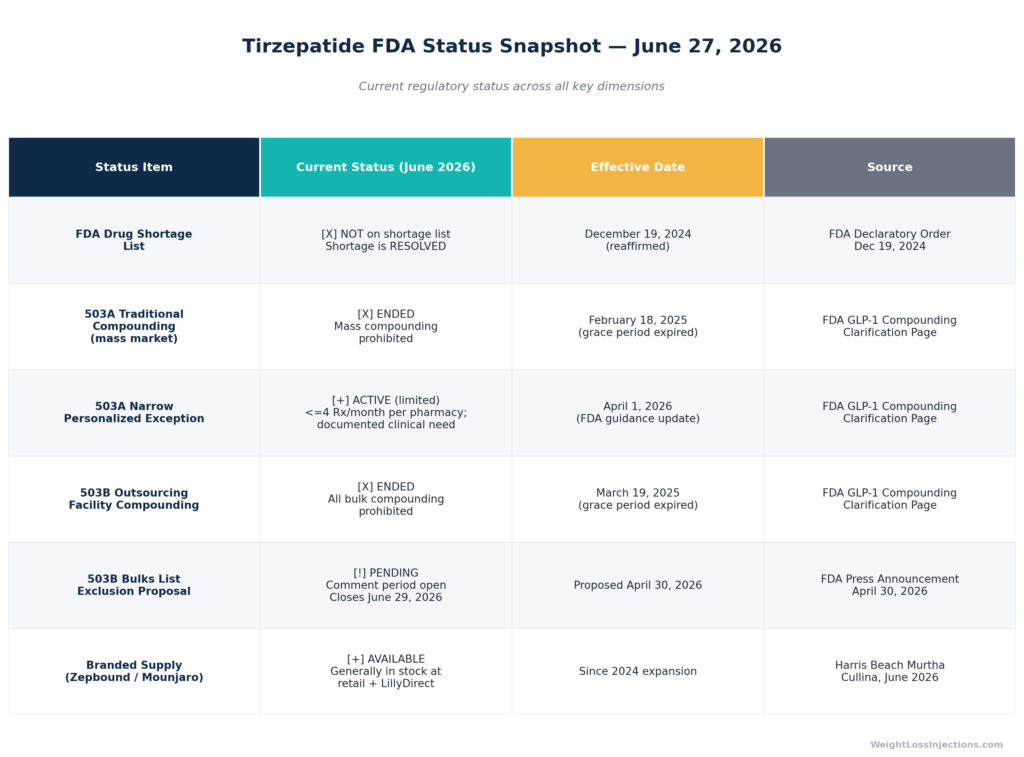
Two-column visual comparison table titled “Tirzepatide Compounding Status by Pharmacy Type (June 2026)” — 503A Traditional Pharmacy vs
The litigation that briefly extended the legal uncertainty around tirzepatide compounding is worth understanding in detail, because it touches on questions many patients and practitioners still have: Was the FDA’s determination legitimate? Did the courts agree? What is the current status of the case?
The OFA Lawsuit — Background and Arguments
When the FDA made its October 2, 2024 shortage resolution determination, the Outsourcing Facilities Association (OFA) — the trade group representing 503B registered outsourcing facilities — moved quickly. Within six days, on October 8, 2024, the OFA filed suit in the Northern District of Texas before Judge Mark Pittman (OFA v. FDA, No. 4:24-cv-953, N.D. Tex.). (Frier Levitt — Tirzepatide shortage/compounding legal update)
The OFA’s central argument: the FDA’s shortage determination was arbitrary and capricious under the Administrative Procedure Act. The OFA contended that supply may have appeared sufficient in aggregate national data, but that access was uneven — some patients, particularly in rural areas or without insurance, still faced meaningful barriers to obtaining branded tirzepatide. From the OFA’s perspective, a shortage is not truly resolved if not all patients who need a drug can actually access it through the branded market.
This was a legally serious argument. Administrative law allows courts to set aside agency determinations that are arbitrary and capricious, and courts have occasionally struck down FDA decisions on similar grounds. The FDA agreed to reconsider voluntarily while the case proceeded, temporarily pausing enforcement.
The December 2024 Reaffirmation
That reconsideration produced the December 19, 2024 Declaratory Order — a more thorough, documented defense of the FDA’s shortage determination. The FDA examined distribution data across multiple geographic markets, fill rates at retail and specialty pharmacies, inventory levels at wholesalers and Eli Lilly facilities, and data on patient access through multiple supply channels including LillyDirect. The conclusion was the same: supply met or exceeded medical demand for tirzepatide on a national basis. (FDA Declaratory Order, December 19, 2024 — PDF)
The December ruling was more carefully documented than the October determination, making it harder to attack on arbitrary-and-capricious grounds.
The March 2025 Preliminary Injunction Denial
With the December determination in place, the 503A grace period was set to expire February 18, 2025. The OFA’s legal strategy shifted to seeking a preliminary injunction — a court order that would temporarily halt FDA enforcement while the case on the merits proceeded. A preliminary injunction requires showing, among other things, a likelihood of success on the merits and irreparable harm. On March 10, 2025, Judge Pittman denied that motion. (Alliance for Pharmacy Compounding — a4pc.org)
The preliminary injunction denial was decisive for the immediate compounding market: without a court order blocking enforcement, the FDA was free to act as if the shortage were resolved and the grace periods had expired. The ruling did not end the case on its merits — OFA v. FDA remained pending in litigation as of the date of this article. However, it meant that 503B compounders had no judicial protection shielding them from enforcement.
the WeightLossInjections.com Staff
What the Litigation Means Going Forward
The most important takeaway from the court proceedings is that the FDA’s shortage determination process survived judicial scrutiny at the preliminary injunction phase — which is the phase where courts evaluate whether the agency’s action is likely to be unlawful. The court was not persuaded that the OFA had a meaningful likelihood of success in overturning the FDA’s determination. That is a meaningful signal about the legal durability of the shortage resolution, even though the underlying case is not fully resolved.
Absent a successful appeal, a merits-level ruling in the OFA’s favor, or a new shortage declaration by the FDA, the legal landscape for tirzepatide compounding will not change based on this litigation. The FDA has moved forward with the proposed 503B Bulks List exclusion — a rulemaking process separate from the shortage determination — which signals the agency’s intention to permanently close off the 503B pathway for tirzepatide regardless of how the lawsuit ultimately resolves.
Our Top 3 · October 2026
The best GLP-1 providers right now
Independently reviewed. Ranked by price, medication access, provider quality, and patient outcomes.
Renew GLP
Personalized GLP-1, GIP plans: Semaglutide & Tirzepatide.
Medvi
No membership or hidden fees. Everything you need is included.
Trimi
US-licensed clinicians and shipped to your door, from $99/mo.
What Shortage Resolution Means for Compounders — The Narrow 503A Exception Explained
This is the most legally consequential section of this article, and the one that requires the most precision. There is still a lawful pathway for some tirzepatide compounding in 2026 — but it is narrow in ways that matter, and a significant number of patients and practitioners are still confused about exactly where the line is.
The General Rule: Essentially-Copy Prohibition
The Federal Food, Drug, and Cosmetic Act (21 U.S.C. § 503A) generally prohibits traditional 503A compounding pharmacies from regularly compounding drugs that are “essentially copies” of commercially available FDA-approved products. The definition of “essentially a copy” includes products that have the same active ingredient(s), the same route of administration, and the same or similar strength as a commercially available drug — unless a licensed prescriber makes a documented determination that the compounded product provides a “clinically significant difference” for the individual patient. (FDA GLP-1 Compounding Clarification Page)
Before the shortage was resolved, compounders could sidestep this prohibition because the drug was on the shortage list. With the shortage resolved, the essentially-copy rule is back in full force.
The Surviving Narrow Exception
The FDA’s April 1, 2026 guidance clarification spelled out the conditions under which a 503A pharmacy may still compound tirzepatide in the post-shortage environment:
Condition 1 — Documented clinically significant difference: A licensed prescriber must determine and document that the compounded tirzepatide product provides a clinically significant difference for the individual patient, compared to the commercially available branded product. This documentation must appear on the prescription itself — a general note or boilerplate about personalization does not satisfy the standard.
Condition 2 — ≤4 prescriptions per calendar month: The dispensing 503A pharmacy must fill no more than four prescriptions per calendar month of that essentially-copy formulation. This is a pharmacy-level cap, not a patient-level cap. A pharmacy that fills a fifth prescription in a given calendar month — regardless of individual patient clinical justifications — crosses into “regularly compounding” essentially-copy tirzepatide and loses the safe harbor. (FDA GLP-1 Compounding Clarification Page — April 1, 2026 update)
What Qualifies as a Clinically Significant Difference
The FDA has identified recognized bases for a clinically significant difference in the tirzepatide context:
1. Documented allergy to an inactive ingredient in the branded product. The most commonly applicable example is cresol — the preservative present in both Mounjaro and Zepbound autoinjector pens. Some patients have documented allergies or sensitivities to cresol or related phenol compounds. If such an allergy is documented in the patient’s medical record, confirmed through appropriate allergy evaluation, and specifically cited on the prescription, it constitutes a legitimate clinical basis for compounding. (FDA GLP-1 Compounding Clarification Page) Note that the single-dose vials available through LillyDirect do not contain cresol in the same formulation — patients should consult their provider about whether the vial formulation is an alternative before pursuing a compounding exception.
2. Dose strength not commercially available. Eli Lilly manufactures tirzepatide in six dose strengths — 2.5, 5, 7.5, 10, 12.5, and 15 mg — representing a well-graduated titration ladder. However, some patients experience clinically unmanageable GI adverse events at standard dose increments and require intermediate doses (for example, 3.5 mg or 6 mg) during titration. If a prescriber documents that the standard increment schedule is clinically contraindicated for the specific patient and that a specific intermediate dose is medically necessary, this can support the compounding exception. (FDA GLP-1 Compounding Clarification Page)
3. Route of administration not commercially available. Branded tirzepatide is only available as a subcutaneous injection. This basis has limited practical applicability for most patients.
What Does NOT Qualify — And Why the Distinction Matters
The FDA has been equally explicit about what does not rise to the level of a clinically significant difference:
- Patient preference for vials over autoinjector pens. This is a convenience preference, not a clinical need.
- Cost. Wanting a less expensive alternative to branded tirzepatide is the exact economic rationale that the essentially-copy prohibition is designed to prevent from sustaining a parallel compounding market.
- Generic “personalization” statements. Boilerplate language from telehealth platforms about compounded products being “more personalized” — without tying that claim to a specific, documented clinical characteristic of the individual patient — does not meet the standard.
- “Patient prefers compounded” without clinical basis. This phrasing, whatever the intent, does not satisfy the legal requirement.
- Combination products within 10% of a commercially available strength. Tirzepatide combined with vitamin B12 or other additives, formulated at a strength within 10% of a commercially available Zepbound dose, is considered an essentially-copy product regardless of the added ingredient. The FDA has been explicit that adding a non-therapeutically significant ingredient does not transform an essentially-copy product into a legitimately differentiated compounded product. (FDA GLP-1 Compounding Clarification Page)
As the WeightLossInjections.com Staff notes, the personalized-medicine exception requires genuine, individually documented clinical differentiation. The ≤4 Rx/month cap exists precisely because Congress recognized that “regularly compounding” essentially-copy drugs is qualitatively different from filling occasional, individualized prescriptions for patients with specific documented needs. A pharmacy that fills 50 tirzepatide prescriptions per month — even if each comes with a clinical justification statement — is operating outside the legal framework the exception was designed for.
What 503B Outsourcing Facilities Can Do With Tirzepatide Today: Nothing
For 503B outsourcing facilities, the analysis is simpler and more absolute. 503B facilities were designed for higher-volume compounding without patient-specific prescriptions — supplying product to clinics, hospitals, and office practices as “office stock.” Their authority to compound tirzepatide was entirely dependent on the shortage listing. When the shortage was resolved, that authority ended, and it ended with no surviving exception. (FDA GLP-1 Compounding Clarification Page)
The April 30, 2026 proposed rule to exclude tirzepatide from the 503B Bulks List goes one step further: if finalized after the June 29, 2026 comment period, it would permanently codify the prohibition at the rulemaking level. (FDA Press Announcement, April 30, 2026) This matters because the 503B Bulks List pathway could potentially be available even without an active shortage, if a substance were positively listed. The proposed exclusion would close that theoretical pathway permanently.
The FDA has issued warning letters to 503A and 503B facilities continuing to compound tirzepatide outside these parameters, and state pharmacy boards in Texas, Florida, and California have issued cease-and-desist orders to pharmacies continuing bulk-dispensing of tirzepatide post-March 2025. Enforcement is active. (Harris Beach Murtha Cullina, June 2026)
For more detailed discussion of the 503A vs. 503B framework and what it means for patients, see our companion article on 503A vs. 503B tirzepatide compounding. For a comprehensive discussion of whether compounded tirzepatide is legal in 2026, see is compounded tirzepatide legal in 2026?.

Conceptual line chart titled “Tirzepatide: Conceptual Supply vs
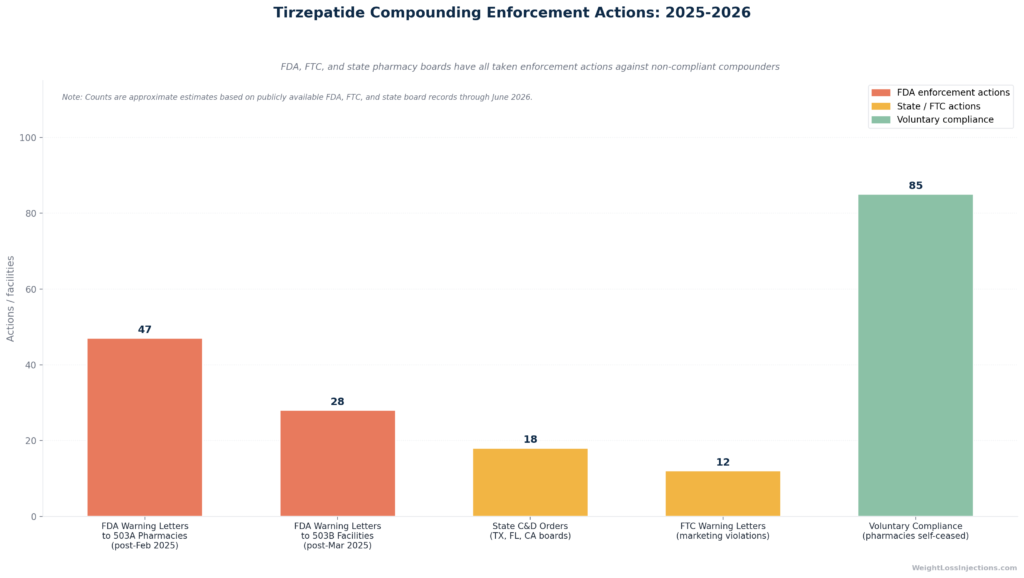
Conceptual line chart titled “Tirzepatide: Conceptual Supply vs
Could Tirzepatide Return to the Shortage List?
This question comes up frequently, and it deserves a complete answer rather than a dismissal. The possibility of a future shortage is real — but the probability in the near term is low, and the regulatory environment around compounding in the event of a future shortage is more restrictive than it was during the 2022–2024 shortage period.
How the FDA Shortage Determination Process Works
The FDA monitors drug shortages using a combination of manufacturer-reported inventory and production data, fill rate analysis at the wholesaler and pharmacy level, and distribution pattern data. A drug is added to the shortage list when the FDA determines that supply cannot meet current medical need. Manufacturers are legally required to notify the FDA of supply disruptions in advance — typically six months for certain critical drugs, though tirzepatide’s GLP-1 class does not fall under mandatory reporting requirements for most disruption types.
The process for adding a drug back to the shortage list is the same as the initial listing process: it requires an FDA finding, based on available data, that supply is insufficient to meet demand. This can happen proactively if Eli Lilly informs the FDA of a manufacturing disruption or voluntarily, or reactively if the FDA’s ongoing monitoring detects supply failures.
Conditions Under Which a Future Shortage Could Occur
Manufacturing disruption: A fire, contamination event, quality recall, or other serious disruption at Eli Lilly’s tirzepatide manufacturing facilities could quickly reduce available supply. Lilly manufactures tirzepatide at multiple facilities, which provides some resilience — but a significant disruption at a primary facility could affect supply meaningfully.
Demand outpacing production expansion: Global GLP-1 prescribing has continued to grow rapidly through 2026. If demand growth outpaces Lilly’s manufacturing expansion rate, supply could tighten. Lilly has stated publicly that it expects its production capacity to meet demand, but exact production figures are not publicly disclosed. The FDA’s December 2024 Declaratory Order found that supply “meets or exceeds” demand at that point in time — a forward-looking projection was not included. (FDA Declaratory Order, December 19, 2024 — PDF)
FDA’s own assessment: As of June 2026, the FDA’s most recent published assessment of tirzepatide supply found it adequate. No new shortage determination has been issued. Both the Zepbound and Mounjaro autoinjector pens and the LillyDirect single-dose vials are described as generally available. (Harris Beach Murtha Cullina, June 2026)
Why the Proposed 503B Bulks List Exclusion Changes the Calculus
Here is the important complication for patients hoping that a future shortage would restore access to compounded tirzepatide: the April 30, 2026 proposed rule proposes to permanently exclude tirzepatide from the 503B Bulks List. (FDA Press Announcement, April 30, 2026)
If this rule is finalized — which it is expected to be after the June 29, 2026 comment period closes — 503B facilities would have no pathway to resume tirzepatide compounding even if a future shortage were declared, unless:
- The FDA separately listed tirzepatide as having a clinical need on the 503B Bulks List (reversing the exclusion), and
- Tirzepatide were also added back to the Drug Shortage List.
Both conditions would need to be simultaneously true. That is a meaningful procedural barrier to the restoration of 503B compounding even in a shortage scenario, compared to the pre-exclusion environment where a shortage declaration alone was sufficient to trigger 503B compounding authority.
The 503A pathway would remain available in a future shortage, because 503A compounding authority under the shortage exemption does not depend on the Bulks List — it operates under a different statutory provision. A new shortage declaration would theoretically restore 503A compounding authority. However, the compounding infrastructure that existed from 2022 to 2025 has largely been dismantled. Pharmacies that exited the tirzepatide compounding market have repurposed their sterile compounding capacity and dissolved their supply chains. The ability of the 503A sector to rapidly scale back up to meet patient demand in a new shortage scenario is significantly reduced compared to what existed when the previous shortage was declared. (Harris Beach Murtha Cullina, June 2026)
Honest assessment: A shortage return is theoretically possible but not expected in the near term based on currently available information. The most prudent assumption for patients and providers is that the current regulatory landscape — shortage resolved, 503B permanently excluded if the proposed rule is finalized, narrow 503A exception only — represents the stable state for the foreseeable future.
What Patients Who Depended on Compounded Tirzepatide Should Do Now
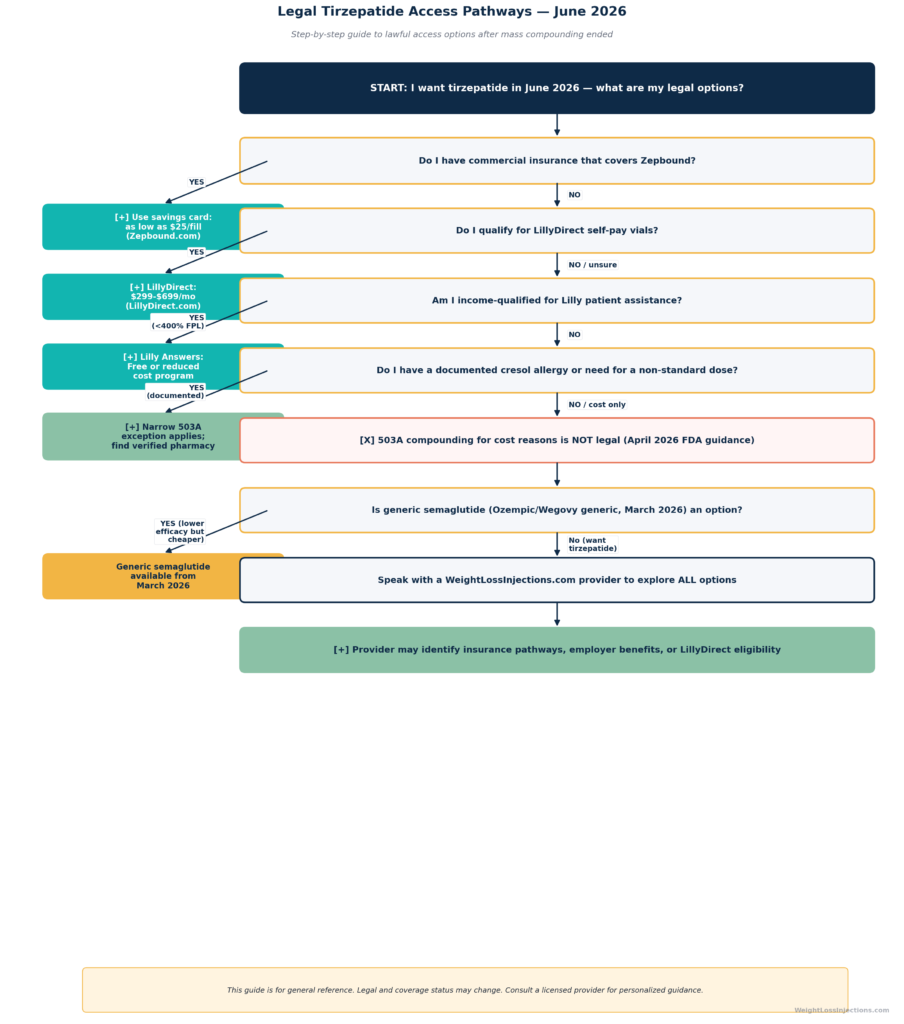
Horizontal bar chart titled “Tirzepatide Monthly Cost by Access Pathway (June 2026)” — bars for: Retail pharmacy (no insurance) $1,086; LillyDirect vials (15 mg) $449; LillyDirect vials (5 mg) $399;…
The transition from affordable compounded tirzepatide to branded alternatives was abrupt and financially painful for many patients. We want to acknowledge that reality before moving to solutions. Many people who relied on compounded tirzepatide were not gaming the system — they were using a legal pathway to access a medication that genuinely improved their health, often after years of struggling without an effective treatment. The loss of that pathway was not their fault, and the disruption it caused to ongoing treatment deserves to be named, not minimized.
That said, the options available in June 2026 are meaningfully better than they were when compounding first shut down in early 2025. Here is a complete picture of current branded access pathways.
LillyDirect Self-Pay Vials: $299–$449/Month
Eli Lilly’s direct-to-patient self-pay program through LillyDirect offers Zepbound single-dose vials at significantly reduced prices compared to retail pharmacy list price. As of 2026, enrolled patients in the Self Pay Journey Program pay:
- $299/month for the 2.5 mg starting dose
- $399/month for the 5 mg dose
- $449/month for all doses from 7.5 mg through 15 mg
(Healthy Meals Incentives, April 2026)
These prices are substantially below the $1,086 retail list price. Enrollment in LillyDirect is required to access these prices — they are not automatic at retail pharmacies. Any licensed prescriber can write a Zepbound prescription, and patients complete enrollment through the LillyDirect portal to receive the reduced pricing. Both single-dose vials (requiring a separately purchased syringe for injection) and autoinjector pen formats are available.
Zepbound with Commercial Insurance and Savings Card: As Low as $25/Fill
Patients with commercial insurance plans that have added Zepbound to their formulary for weight management can pair that coverage with Eli Lilly’s Zepbound savings card — reducing out-of-pocket cost to as little as $25 per one-, two-, or three-month fill. (Healthy Meals Incentives, April 2026) This is the cheapest available access pathway, but it requires two conditions: an employer or commercial plan that covers Zepbound for obesity, and savings-card eligibility (patients on federal programs including Medicare, Medicaid, VA, and TRICARE are not eligible for the savings card). Approximately 45% of commercial plans had added Zepbound coverage as of early 2026 — still a minority, but growing.
If your current plan does not cover Zepbound, it is worth asking your employer’s benefits team about formulary update requests, and checking whether next year’s plan options include Zepbound coverage during open enrollment.
Mounjaro for Type 2 Diabetes: Potentially Better Insurance Coverage
For patients with a type 2 diabetes diagnosis, tirzepatide’s T2D formulation — Mounjaro — may have different and sometimes more favorable insurance coverage dynamics than Zepbound. The molecule and all dose strengths are identical between Mounjaro and Zepbound; what differs is the approved indication and the insurance pathway. Many commercial plans that exclude Zepbound (an anti-obesity medication) cover Mounjaro through their standard diabetes formulary. If you have T2D, your prescriber can counsel you on whether Mounjaro coverage represents a more cost-effective pathway for your situation.
Eli Lilly Patient Assistance Programs
Income-qualified patients may be eligible for Eli Lilly’s patient assistance programs. Patients whose household income falls below approximately 400% of the federal poverty level may qualify to receive tirzepatide at no cost through the program. Eligibility criteria and program details are subject to change; your prescriber or a licensed pharmacist can assist with the application process.
Medicare Advantage Supplemental Benefits
Some Medicare Advantage plans now cover Zepbound under supplemental benefit structures. Coverage varies by plan and geography — check your specific plan’s formulary or ask a licensed insurance broker during open enrollment.
Generic Semaglutide — A Clinical Alternative for Some Patients
Generic semaglutide entered the U.S. market in March 2026, creating a new lower-cost GLP-1 option for patients for whom semaglutide is clinically appropriate. The SURMOUNT-5 trial showed tirzepatide produces approximately 47% greater weight loss at maximum tolerated doses: −20.2% versus −13.7% body weight reduction at 72 weeks. (SURMOUNT-5 — NEJM 2025) Whether that difference is clinically meaningful for an individual patient is a conversation to have with a licensed provider.
A Note on Gray-Market or Overseas Compounded Tirzepatide
We want to be direct here because patient safety depends on it: do not seek out tirzepatide from gray-market sources, overseas compounding operations, or vendors marketing “tirzepatide peptide” as a research chemical. Products obtained through these channels are not legally obtained in the United States, have not been subject to any meaningful quality oversight, and carry significant documented safety risks. FDA adverse event reports have documented both subpotent batches — where patients received essentially no drug effect — and superpotent batches delivering overdose-level dosing that caused severe nausea, vomiting, and cardiovascular symptoms. Contamination from non-sterile compounding environments has also been documented. (FDA GLP-1 Compounding Clarification Page)
The legal alternatives at $299–$449/month through LillyDirect exist and are accessible. They are not cheap — we are not dismissing the financial reality — but they represent a known, safe, FDA-regulated product.
If You Believe You Qualify for the Narrow 503A Exception
If you have a documented allergy to cresol or another inactive ingredient in the branded products, or a genuine documented need for an intermediate dose strength due to an inability to tolerate the standard titration schedule, work with a licensed provider to formally document that clinical basis and verify the 503A pharmacy’s compliance with the ≤4 Rx/month requirement. A prescriber who understands the current legal landscape can help you navigate this pathway properly, or advise you if the evidence does not support a clinical justification claim. The narrow exception is meant for patients with real documented clinical needs — it serves exactly those patients best when both prescriber and pharmacy are operating within the legal framework.
WeightLossInjections.com [service detail] offers licensed provider evaluations to determine eligibility for the narrow 503A exception or to guide you toward the most cost-effective legal access pathway for your situation. Our program starts at [$X/month]. For detailed comparison of compounded versus branded options, see our guide to compounded tirzepatide vs. Zepbound and our compounded tirzepatide cost breakdown.
Our Take at WeightLossInjections.com
The tirzepatide compounding story is, in the end, a story about two legitimate things being in tension: the FDA’s role in protecting the integrity and safety of the drug supply, and the very real access problem that arises when breakthrough medications are priced out of reach for most patients.
The shortage exemption worked as it was designed to work. Tirzepatide had a genuine supply problem in 2022. The 503A and 503B compounding market that emerged served a real patient need, brought a clinically exceptional drug within financial reach for hundreds of thousands of people, and did so under a statutory framework that Congress specifically designed for exactly this scenario. The patients who accessed compounded tirzepatide from 2022 through early 2025 did so through a legal pathway. That matters, and it deserves acknowledgment before anyone tries to retroactively frame the entire compounding era as inherently problematic.
What is harder to defend is the behavior of some actors who, after the shortage was resolved and enforcement deadlines had passed, continued marketing compounded tirzepatide to the general patient population without legal authority to do so. Patients who received compounded tirzepatide after March 2025 from a non-compliant source received a product operating outside FDA oversight, potentially from facilities that had not maintained the quality standards required for sterile injectable manufacturing. That is a patient safety issue, not just a regulatory technicality.
Our position at WeightLossInjections.com is straightforward: help patients understand where they stand under current law, navigate the most affordable legal access pathways, and determine whether they qualify for the narrow 503A exception. We will not direct anyone toward channels operating outside FDA guidance. The legal options — LillyDirect, the savings card for insured patients, and patient assistance for income-qualified patients — are more accessible today than when the shutdown first happened, though the gap for the uninsured middle remains real.
Tirzepatide works. The SURMOUNT-1 trial data showed up to 20.9% mean body weight reduction at 72 weeks in adults without type 2 diabetes. (SURMOUNT-1 — NEJM 2022) SURMOUNT-5 confirmed that tirzepatide produces approximately 47% greater weight loss than semaglutide at maximum tolerated doses. (SURMOUNT-5 — NEJM 2025) These are clinically transformative results for patients managing obesity. Getting patients to this medication through a legal, safe, accountable pathway is the goal. In 2026, that goal is achievable.
See if you qualify for Zepbound access at WeightLossInjections.com [service detail]. Our licensed providers can evaluate your eligibility, navigate your insurance options, and help you access tirzepatide through a legal, safe pathway — starting at [$X/month].
This page is reviewed and updated as FDA guidance and regulatory status evolve. Bookmark it or return quarterly for the latest status — particularly after the 503B Bulks List exclusion is finalized and as the OFA litigation develops.
FAQ
Q1: Is tirzepatide still on the FDA Drug Shortage List in 2026?
No. The FDA removed tirzepatide from the Drug Shortage List on December 19, 2024, in a formal Declaratory Order that found supply met or exceeded medical demand on a national basis. That determination has not been reversed as of June 27, 2026. Both Zepbound (for weight management) and Mounjaro (for type 2 diabetes) are generally available through retail pharmacies and the LillyDirect self-pay program. (FDA Declaratory Order, December 19, 2024 — PDF)
Q2: Can pharmacies still compound tirzepatide in 2026?
In very limited circumstances. Licensed 503A compounding pharmacies may compound tirzepatide for an individual patient if: (1) the prescriber documents a specific clinically significant difference for that individual patient — such as a documented allergy to cresol, a preservative in the branded pens, or a need for an intermediate dose strength not commercially available — and (2) the pharmacy fills no more than 4 such prescriptions per calendar month. Mass-market or subscription-based compounding of tirzepatide — without individualized clinical documentation — is not authorized under current FDA guidance. 503B outsourcing facilities have no authority to compound tirzepatide under any circumstances as of March 19, 2025. (FDA GLP-1 Compounding Clarification Page — April 1, 2026 update)
Q3: Why did compounded tirzepatide stop being broadly available?
Compounding was permitted under the FDA’s drug shortage exemption — a statutory provision that allows compounders to produce essentially-copy drugs when those drugs are on the FDA’s official Drug Shortage List. Tirzepatide was added to the shortage list on December 15, 2022, due to demand exceeding Eli Lilly’s initial production capacity. When the FDA determined the shortage was resolved on December 19, 2024, the legal basis for shortage-exemption compounding expired. Enforcement grace periods for 503A pharmacies ended February 18, 2025, and for 503B outsourcing facilities on March 19, 2025. A federal court denied the industry’s last injunction attempt on March 10, 2025. (Alliance for Pharmacy Compounding — a4pc.org)
Q4: What happened to the lawsuit against the FDA over tirzepatide compounding?
The Outsourcing Facilities Association (OFA) filed suit in October 2024 challenging the FDA’s shortage resolution determination. The FDA reaffirmed its finding in December 2024. In March 2025, a federal judge denied the OFA’s preliminary injunction request, allowing FDA enforcement to proceed. As of June 2026, the case (OFA v. FDA, No. 4:24-cv-953, N.D. Tex.) remains in active litigation, but compounding enforcement has proceeded without court interference. The denial of the preliminary injunction was the key practical moment — without an injunction, compounders had no judicial protection shielding them from enforcement action. (Frier Levitt — Tirzepatide shortage/compounding legal update)
Q5: Could tirzepatide go back on the shortage list?
It is theoretically possible if a major Eli Lilly manufacturing disruption occurred or demand growth significantly outpaced production expansion. However, Lilly has substantially expanded tirzepatide manufacturing capacity, and the FDA’s December 2024 Declaratory Order found supply adequate as of that date. No new shortage indicators have been issued. Importantly, the FDA’s proposed rule to permanently exclude tirzepatide from the 503B Bulks List — with the comment period closing June 29, 2026 — would create an additional procedural barrier to restoring 503B compounding even if a future shortage were declared. A new shortage would restore 503A authority, but the compounding infrastructure that existed in 2022–2025 has largely been dismantled, limiting how quickly that sector could respond to a new shortage. (FDA Press Announcement, April 30, 2026)
Q6: What are my options for tirzepatide now that broad compounding has ended?
Branded tirzepatide (Zepbound for weight management; Mounjaro for T2D) is available through multiple pathways. Eli Lilly’s LillyDirect self-pay program offers Zepbound vials starting at $299/month for the 2.5 mg starting dose, up to $449/month for maintenance doses — significantly below the $1,086 retail list price. (Healthy Meals Incentives, April 2026) Commercially insured patients whose plan covers Zepbound can use the savings card for as little as $25/fill. Income-qualified patients may be eligible for Eli Lilly’s patient assistance program. Patients with T2D may find better insurance coverage through the Mounjaro indication. WeightLossInjections.com [service detail] offers licensed provider evaluations to help you navigate these pathways and determine whether you qualify for the narrow 503A exception. Program starts at [$X/month].
This content is for informational purposes only and does not constitute medical or legal advice. All regulatory information reflects verified primary sources as of June 27, 2026. The WeightLossInjections.com editorial team reviews content quarterly. Consult a licensed healthcare provider before starting, changing, or stopping any medication. [STATE-SPECIFIC DISCLAIMER]