![Unbranded [pillar-drug-class] injection pen on a neutral background — WeightLossInjections.com editorial hero](https://weightlossinjections.com/wp-content/uploads/2026/05/hero_zepbound_c4_compare-1200x675.png)
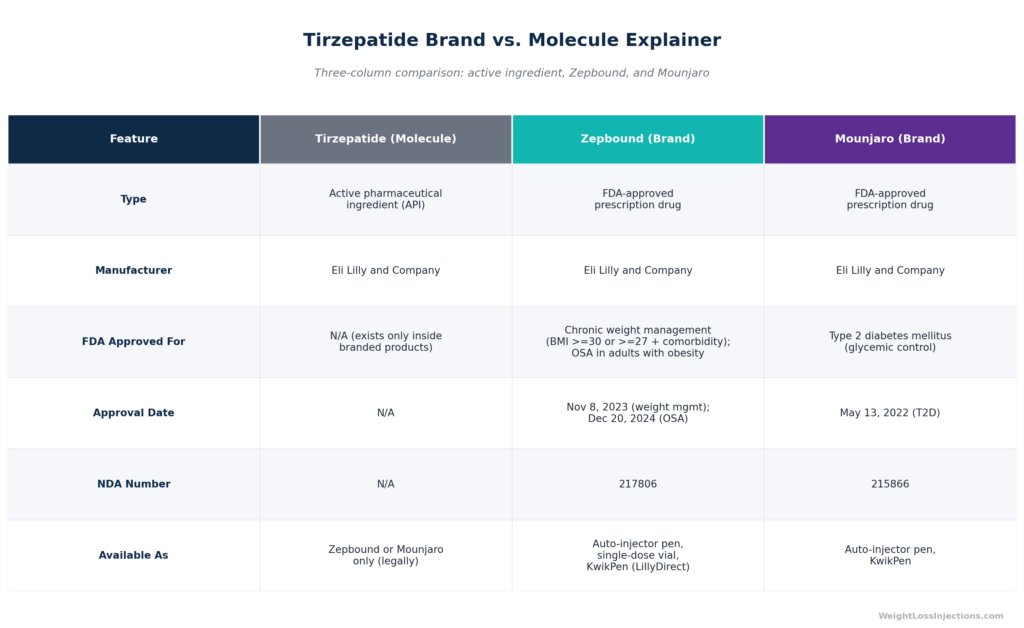
Tirzepatide Brand vs. Molecule Explainer
Tirzepatide is the active molecule. Zepbound and Mounjaro are the two FDA-approved brand names that contain it. Zepbound is approved for weight management and obstructive sleep apnea; Mounjaro is approved for type 2 diabetes. Both use identical dosing and the same drug. Compounded tirzepatide, the cheaper “generic” version sold by telehealth startups, was permissible during a shortage period but became illegal for most patients after the 503A window closed February 18, 2025 and the 503B window closed March 19, 2025.
In April 2026, any “tirzepatide” sold by a compounding pharmacy at scale is not FDA-reviewed and may violate federal law. The only legitimate path to tirzepatide for weight loss in 2026 is Zepbound, and prices have dropped substantially since the compounding window closed.
Is Zepbound the Same as Tirzepatide?
Yes. Zepbound and tirzepatide refer to the same substance, one is the brand name, the other is the active ingredient’s generic (INN) name. The relationship is identical to that between Tylenol and acetaminophen, or between Advil and ibuprofen.
Tirzepatide is the International Nonproprietary Name (INN) for Eli Lilly’s dual GIP/GLP-1 receptor agonist, internally coded LY3298176. It is a synthetic 39-amino acid peptide with the molecular formula C₂₂₅H₃₄₈N₄₈O₆₈ and a molecular weight of approximately 4,813 Da, per the FDA pharmacology review for NDA 217806.
Zepbound is Eli Lilly’s brand name for tirzepatide sold under NDA 217806, approved by the FDA on November 8, 2023, for chronic weight management and subsequently on December 20, 2024, for moderate-to-severe obstructive sleep apnea (OSA) in adults with obesity, per the Eli Lilly OSA approval press release.
The molecule itself is not “available” as a standalone product. You cannot go to a pharmacy and ask for “tirzepatide.” What you can legally access is one of two Lilly-manufactured branded products, Zepbound or Mounjaro, each approved for a different clinical indication.
Why Does the Same Drug Get Two Brand Names?
FDA drug approval is indication-specific. A manufacturer must file a separate New Drug Application (NDA) for each approved use of an active ingredient. Eli Lilly did exactly this: NDA 215866 was filed and approved May 13, 2022, for type 2 diabetes (Mounjaro). A separate NDA 217806 was approved November 8, 2023, for chronic weight management (Zepbound).
The drug in each product is chemically identical. The brand name signals the FDA-approved indication, which in turn governs insurance coverage criteria, prescribing eligibility, and regulatory labeling. This is not unusual, it is how the U.S. drug approval system works for drugs with multiple indications.
What Makes Tirzepatide Unique?
Tirzepatide is the first and only dual GIP receptor (GIPR) and GLP-1 receptor (GLP-1R) agonist approved in the United States. Unlike semaglutide (Ozempic, Wegovy), which activates only GLP-1 receptors, tirzepatide simultaneously activates both incretin pathways. GIP receptor activation enhances insulin secretion in a glucose-dependent manner, suppresses glucagon, and reduces adipogenesis via adipose tissue GIPR, adding mechanisms beyond what GLP-1 agonism alone provides.
This dual mechanism translates to clinical outcomes. In SURMOUNT-1, published in the New England Journal of Medicine, patients treated with tirzepatide 15 mg lost an average of 20.9% of body weight over 72 weeks versus 3.1% on placebo, a placebo-adjusted reduction of 17.8 percentage points. At that same dose, 57% of participants lost 20% or more of their body weight.
Zepbound vs. Mounjaro: Same Molecule, Different Indication
The question patients most frequently have after learning “Zepbound is tirzepatide” is: what is the difference between Zepbound and Mounjaro?
The answer is the FDA-approved indication, and everything that flows from it.
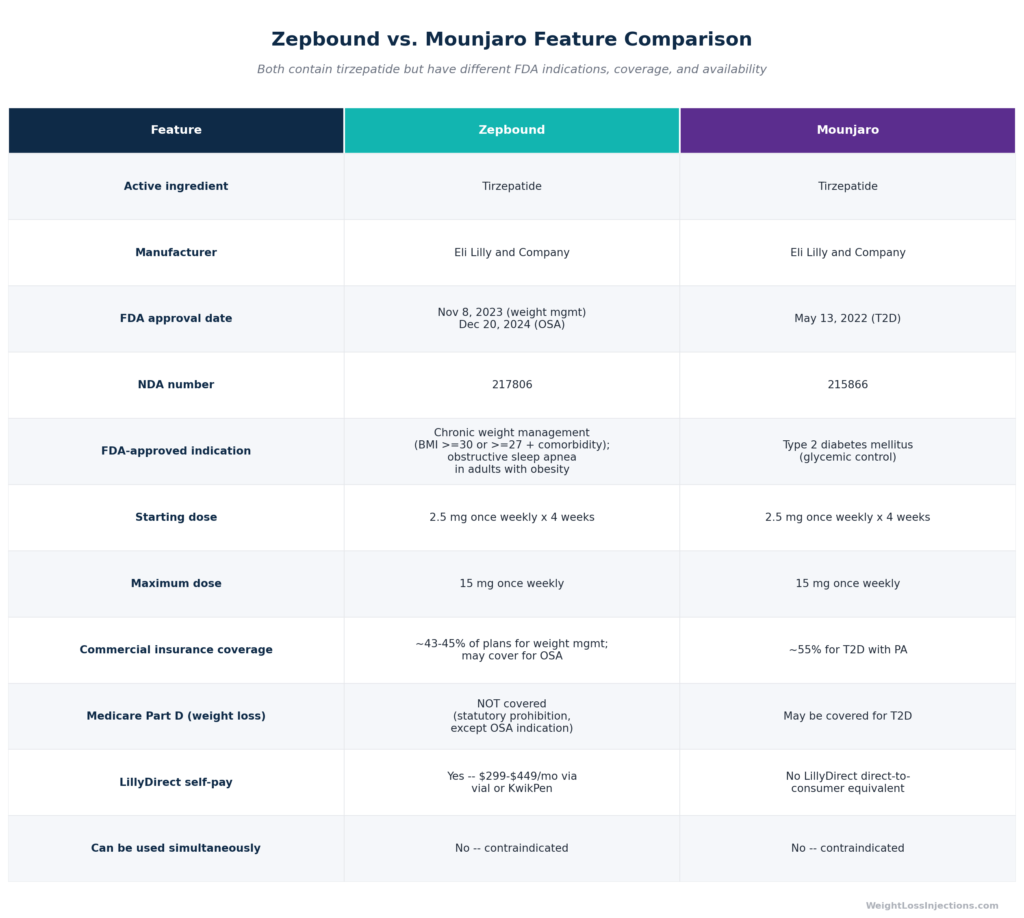
Zepbound vs. Mounjaro Feature Comparison
FDA Eligibility Criteria
Zepbound is indicated as an adjunct to a reduced-calorie diet and increased physical activity for chronic weight management in adults with obesity (BMI ≥30 kg/m²) or overweight (BMI ≥27 kg/m²) with at least one weight-related comorbid condition such as hypertension, type 2 diabetes, or dyslipidemia, per the FDA press release for Zepbound approval. The December 2024 OSA indication extends eligibility to adults with moderate-to-severe obstructive sleep apnea and obesity, where tirzepatide reduced apnea-hypopnea index (AHI) by 25 events/hour versus 5 events/hour on placebo in SURMOUNT-OSA Trial 1.
Mounjaro is indicated for glycemic control in adults with type 2 diabetes. Its approval is grounded in the SURPASS clinical trial program, which enrolled more than 20,000 people with T2D across five global phase 3 registration trials. Mounjaro’s approval was based on NDA 215866 by the FDA on May 13, 2022.
The Drug Inside Is Identical
When used at equivalent doses for weight loss, clinical outcomes with Mounjaro and Zepbound are essentially the same, the drug is the same, the dosing schedule is the same (2.5 mg → 15 mg once weekly titration), and the prescribing information for both products confirms they contain tirzepatide at identical concentrations per the Zepbound prescribing information. A patient prescribed Mounjaro off-label for weight loss receives the same active ingredient and dose as a Zepbound patient.
The practical consequence: if you have type 2 diabetes and are on Mounjaro, you are already receiving tirzepatide, you do not need and should not add Zepbound. Both products’ prescribing information explicitly contraindicate concurrent use.
Insurance and Coverage Differences
The indication difference matters most for insurance. Commercial plans typically cover Mounjaro for T2D with prior authorization at a coverage rate of approximately 55%, while Zepbound coverage for weight management runs 43–45% of commercial plans (rising to about 55% with prior authorization at employer-sponsored plans), per Pandameds insurance coverage analysis for March 2026.
Medicare coverage is where the divergence is sharpest. Mounjaro may be covered under Medicare Part D for T2D. Zepbound for weight management is not covered, Medicare is statutorily prohibited from covering drugs used solely for weight loss, per American College of Gastroenterology guidance from April 2025. However, Zepbound prescribed specifically for OSA may be covered by individual Part D plan formularies. And beginning July 1, 2026, a temporary CMS Medicare GLP-1 Bridge program provides Zepbound at a $50 copayment for eligible Part D enrollees (BMI ≥35 or ≥27 with clinical criteria) through December 31, 2026, per KFF analysis from March 2026.
What About Compounded Tirzepatide? The 2025 Shutdown Explained
If you have searched for “tirzepatide” online in the past year and found products priced at $150 to $400 per month, dramatically below Zepbound’s list price, you encountered compounded tirzepatide. Understanding what it is and why it is no longer legally available is critical context for any tirzepatide decision in 2026.
Why Compounded Tirzepatide Existed at All
The legal basis for compounded tirzepatide was a documented drug shortage. Tirzepatide was added to the FDA Drug Shortages list in August 2022 due to surging demand that outpaced Lilly’s production capacity.
Under the Federal Food, Drug, and Cosmetic Act (FD&C Act), during a documented shortage, two categories of compounding facilities are permitted to produce essentially-copy versions of the shortage drug:
- 503A pharmacies — state-licensed compounding pharmacies dispensing to individual patients with valid prescriptions
- 503B outsourcing facilities — FDA-registered facilities that can produce larger batches without patient-specific prescriptions
This created a legal window during which telehealth companies could offer “compounded tirzepatide” at substantially lower prices. Many did. The products were not FDA-reviewed for safety, purity, or potency, but the shortage exemption provided legal cover.
Both Windows Are Now Closed
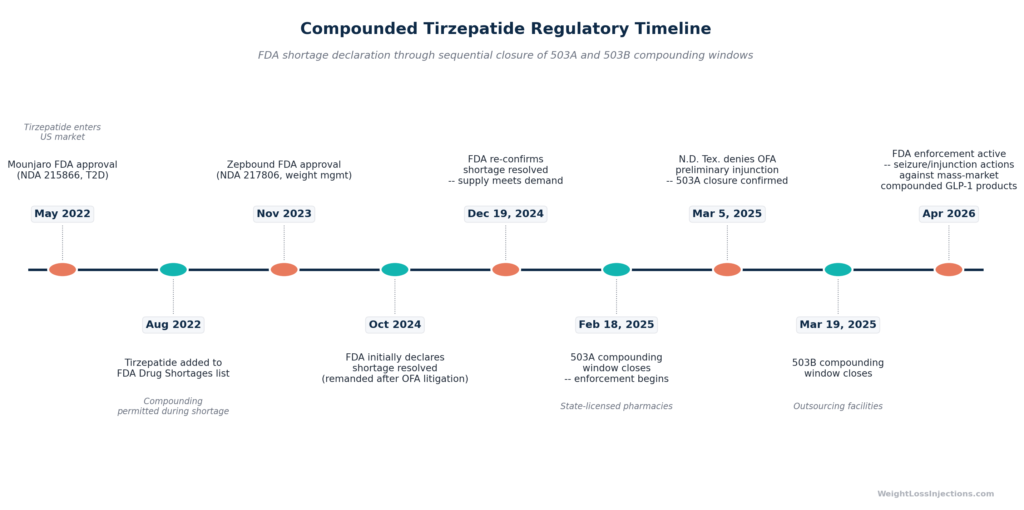
Compounded Tirzepatide Regulatory Timeline
The shortage situation changed materially in late 2024. The FDA initially declared the tirzepatide shortage resolved on October 2, 2024, a determination later remanded for re-evaluation after litigation by the Outsourcing Facilities Association (OFA). After re-evaluation, the FDA re-confirmed the tirzepatide shortage resolved on December 19, 2024, finding that supply met or exceeded demand.
From that determination, two enforceable deadlines followed:
- 503A deadline — February 18, 2025: State-licensed compounding pharmacies were required to cease producing essentially-copy tirzepatide by this date, per the FDA clarification page on compounding policies. The N.D. Texas district court denied the OFA’s request for a preliminary injunction on March 5, 2025, confirming the 503A window was closed.
- 503B deadline — March 19, 2025: FDA-registered outsourcing facilities were required to cease producing essentially-copy tirzepatide by this date, per the same FDA clarification page.
Both windows are now closed, confirmed by Drug Topics coverage of the GLP-1 shortage resolution in August 2025. As of April 2026, FDA is actively targeting manufacturers, distributors, and marketers of non-FDA-approved compounded GLP-1 products with seizure or injunction actions.
The Narrow Exceptions That Remain
A limited category of individualized compounding remains permissible. Under FDA April 2026 guidance on compounding policies, 503A pharmacies may still compound tirzepatide for individual patients with:
- Documented allergies to excipients in the branded products (Zepbound or Mounjaro)
- Clinical need for a different administration route
- Other individualized clinical needs that cannot be met by the branded product
503A pharmacies may fill up to 4 such prescriptions per month without triggering “regularly or in inordinate amounts” enforcement under the same April 2026 FDA statement. These exceptions are narrow. They do not cover the mass-market “cheaper tirzepatide” product that hundreds of telehealth companies were offering during the shortage.
Why “Tirzepatide” Sold Online in 2026 Is a Serious Red Flag
Here is the practical problem: the web has not caught up to the regulatory closure. Dozens of websites still market “tirzepatide,” “compounded tirzepatide,” or “tirzepatide injections” at prices well below Zepbound’s list price. Some of these sites were built during the shortage window and continue operating. Others were launched afterward.
In April 2026, if you encounter a website offering tirzepatide for $150 to $400 per month outside of LillyDirect or a traditional retail pharmacy, ask three questions:
- Is this a branded Lilly product (Zepbound or Mounjaro)? If the answer is no or unclear, the product is likely compounded.
- Is it coming from a 503A or 503B facility? Both are now prohibited from mass-market compounding of tirzepatide.
- Is the company citing an individual-patient exception? A legitimate individual exception requires documented clinical need — not a blanket “all patients qualify” approach.
Federal Law Stakes
The legal exposure is real. Pharmacies and prescribers that continue mass-marketing compounded tirzepatide outside the narrow individualized exceptions face federal action under multiple statutes. The anti-kickback exclusion at 42 U.S.C. §1320a-7b applies to arrangements that improperly induce referrals for compounded drug programs. The FD&C Act’s adulteration and misbranding provisions apply to compounded products that are not within the statutory exemptions. And FDA enforcement is escalating.
From a patient safety standpoint, compounded tirzepatide produced outside the shortage window was never reviewed by FDA for sterility, potency, or purity. Dosing inconsistencies in compounded peptide products have caused adverse events. The risk profile is not equivalent to branded Zepbound, regardless of what a vendor claims.
With Harris Beach Murtha Cullina analysis confirming that Lilly’s statutory exclusivity precludes any generic ANDA filing for tirzepatide until approximately June 2027, there is no legitimate generic tirzepatide. “Generic tirzepatide” does not exist as a legal product.
Our Top 3 · October 2026
The best GLP-1 providers right now
Independently reviewed. Ranked by price, medication access, provider quality, and patient outcomes.
Renew GLP
Personalized GLP-1, GIP plans: Semaglutide & Tirzepatide.
Medvi
No membership or hidden fees. Everything you need is included.
Trimi
US-licensed clinicians and shipped to your door, from $99/mo.
FDA-Approved Tirzepatide Options in 2026: What You Can Legally Get
Two FDA-approved tirzepatide products exist as of April 2026:
1. Zepbound (Eli Lilly) — NDA 217806
- Approved indications: chronic weight management in adults with BMI ≥30 or ≥27 with at least one weight-related comorbidity; moderate-to-severe OSA in adults with obesity
- Available as: single-dose auto-injector pen, single-dose vial, multi-dose KwikPen (via LillyDirect, launched February 23, 2026)
- Self-pay pricing: $299/mo (2.5 mg) to $449/mo (all higher doses) via LillyDirect Self Pay Journey Program
- List price (WAC): $1,086/mo for all strengths, per Eli Lilly’s pricing information
2. Mounjaro (Eli Lilly) — NDA 215866
- Approved indication: type 2 diabetes mellitus (glycemic control)
- Available as: single-dose auto-injector pen, KwikPen
- No LillyDirect self-pay direct-to-consumer program equivalent to Zepbound’s
- List price (WAC): $1,086/mo for all strengths
- Commonly prescribed off-label for weight loss, but the FDA-approved indication is T2D
No other legal tirzepatide product exists in the United States market as of April 2026. Tirzepatide does not appear on the FDA’s 503B bulk drug substances list and is not on the current FDA Drug Shortages database for resolved shortages.
LillyDirect Vials and KwikPen: Tirzepatide at a Legitimate Lower Price
The most significant development for patients seeking affordable tirzepatide since the compounding window closed is Eli Lilly’s expansion of LillyDirect pricing. The price cuts and new product launches have substantially narrowed the gap between branded Zepbound and what compounded products were charging during the shortage.
On December 1, 2025, Lilly cut LillyDirect vial prices significantly: patients enrolled in the Self Pay Journey Program pay $299/mo for 2.5 mg, $399/mo for 5 mg, and $449/mo flat for all higher doses (7.5 mg through 15 mg). On February 23, 2026, Lilly launched the multi-dose Zepbound KwikPen, a four-dose-per-pen device already familiar from Mounjaro, at identical pricing through LillyDirect.
Both the vials and the KwikPen are:
- Genuine Eli Lilly manufactured Zepbound (NDA 217806)
- FDA-reviewed for safety, sterility, potency, and purity
- Sold under a valid Zepbound prescription through LillyDirect
- Available at Walmart Pharmacy as a LillyDirect retail pick-up partner, per Walmart’s October 2025 announcement
The LillyDirect products are not compounded, not generic, and not “cheaper tirzepatide.” They are the same branded Zepbound product at a manufacturer-set direct-to-consumer price, bypassing the traditional pharmacy distribution channel that adds cost.
| Access Pathway | Product | Monthly Cost |
|---|---|---|
| LillyDirect vial — 2.5 mg (Self Pay Journey) | Zepbound | $299/mo |
| LillyDirect vial/KwikPen — 5 mg (Self Pay Journey) | Zepbound | $399/mo |
| LillyDirect vial/KwikPen — 7.5–15 mg (Self Pay Journey) | Zepbound | $449/mo |
| Savings card — commercially insured (covered benefit) | Zepbound | As low as $25/mo |
| Savings card — commercially insured (non-covered benefit) | Zepbound | As low as $499/mo |
| Medicare GLP-1 Bridge (July–December 2026) | Zepbound | $50 copay |
| Retail WAC (list price) | Zepbound or Mounjaro | $1,086/mo |
Sources: CNBC Dec 1, 2025; CNBC Feb 23, 2026; KFF March 2026; Eli Lilly pricing page; verified April 2026.
How to Verify Legitimate Tirzepatide in 2026
Given the volume of non-compliant products still circulating online, here is a practical checklist for any patient evaluating a tirzepatide source:
Verify the prescriber. Any legitimate tirzepatide prescription requires an evaluation by a licensed U.S. physician or nurse practitioner. A website that sells “tirzepatide” without a prescriber evaluation, or with a rubber-stamp questionnaire, is a warning sign.
Confirm the pharmacy. Zepbound through a traditional retail pharmacy (CVS, Walgreens, Walmart, etc.) or through LillyDirect is legitimate. A website with an unfamiliar or unverifiable pharmacy behind it requires scrutiny. The National Association of Boards of Pharmacy (NABP) maintains a “.pharmacy” domain accreditation program and a list of not-recommended online pharmacies.
Check the NDC number. Zepbound has registered National Drug Code (NDC) numbers tied to NDA 217806. Ask your pharmacy to confirm the NDC on your dispensed product. A legitimate prescription of Zepbound will carry an NDC traceable to Eli Lilly.
Watch for the compounding signals. Products described as “tirzepatide base,” “tirzepatide acetate,” “tirzepatide peptide,” or similar, without the Zepbound brand label, are almost certainly compounded. LillyDirect’s products are labeled as Zepbound, period.
Ask about the pharmacist. If the entity providing the product cannot identify the dispensing pharmacist, the state license, and the prescribing physician by name, stop the transaction.
Insurance Considerations for Tirzepatide in 2026
Insurance coverage for tirzepatide in 2026 depends heavily on which product you receive and for which indication.
Zepbound Coverage
Approximately 43–45% of commercial plans cover Zepbound for the obesity/weight management indication, rising to roughly 55% at employer-sponsored plans with prior authorization processing, per Pandameds insurance coverage analysis. The standard requirements are documented BMI ≥30 or ≥27 with a qualifying comorbidity, a record of prior lifestyle intervention, and in many cases a prior authorization from the prescriber.
Zepbound for the OSA indication may have different coverage pathways, some plans treat it as a respiratory therapy rather than a weight loss medication, which may affect formulary placement and prior authorization requirements.
Medicare Part D for weight management remains statutorily prohibited, per American College of Gastroenterology guidance. The exception is the temporary Medicare GLP-1 Bridge (July 1–December 31, 2026) at $50 copay for eligible Part D enrollees, per KFF analysis.
Mounjaro Coverage (When Prescribed for Weight Loss)
Patients prescribed Mounjaro off-label for weight loss typically face a coverage denial for that indication. The drug is covered for T2D; the off-label weight loss use will generally not be reimbursed. Patients in this situation who want insurance-supported weight management should discuss switching to Zepbound with their prescriber, which requires the T2D patient to also qualify under the Zepbound eligibility criteria (BMI ≥27 with a comorbidity that could include their diabetes).
Savings Cards
The Zepbound savings card for commercially insured patients with coverage brings cost down to as little as $25/mo for up to 13 fills in 2026 (with a maximum annual savings benefit of approximately $1,300), per prescriber and patient community tracking of the 2026 card terms. For patients with commercial insurance but no coverage benefit, the non-covered savings card offers pricing as low as $499/mo, per PrescriberPoint savings program details. Government beneficiaries, Medicare, Medicaid, VA, TRICARE, are excluded from manufacturer savings card programs.

2026 Tirzepatide Source Decision Flowchart
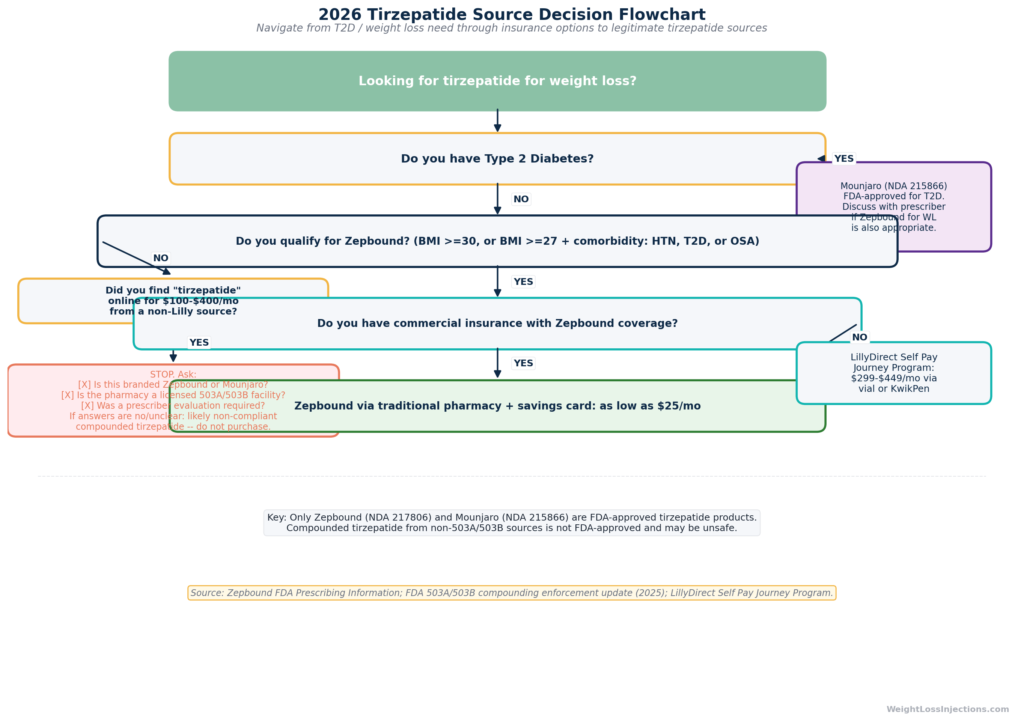
2026 Tirzepatide Source Decision Flowchart
Telehealth Prescribing at WeightLossInjections.com
Obtaining a legitimate Zepbound prescription starts with a prescriber evaluation. At WeightLossInjections.com, that process happens entirely online. [service detail]
Our take at WeightLossInjections.com: The compounding window for tirzepatide is closed. Both 503A and 503B windows shut in February and March 2025, and federal enforcement is active. Any telehealth company still marketing “compounded tirzepatide” or “generic tirzepatide” in 2026 is offering a product that is not FDA-reviewed, not legally mass-produced, and potentially subject to federal seizure or injunction. We prescribe Zepbound, the actual FDA-approved product, and we connect patients to legitimate pricing pathways including LillyDirect’s Self Pay Journey Program starting at $299/mo for 2.5 mg. That $449/mo cap for higher doses is not substantially different from what many compounding operations charged during the shortage, but it comes with full FDA oversight, Lilly’s quality controls, and no legal risk to you. We do not offer compounded tirzepatide, and we strongly advise against any product marketed under that label in 2026.
Starting at [$X/month] for bundled telehealth services including provider evaluation, prescription, and ongoing clinical support, WeightLossInjections.com [service detail] for accessing FDA-approved Zepbound.
Frequently Asked Questions
Yes. Tirzepatide is the generic (INN) name for the active ingredient; Zepbound is Eli Lilly’s brand name for tirzepatide approved for weight management and obstructive sleep apnea. The two terms describe the same molecule. You cannot purchase “tirzepatide” independently, it only exists as branded Zepbound (NDA 217806, weight management/OSA) or branded Mounjaro (NDA 215866, type 2 diabetes), per the Zepbound prescribing information and Drugs@FDA records.
Both Zepbound and Mounjaro contain identical tirzepatide, the same molecule, the same dose strengths (2.5 mg to 15 mg), the same once-weekly injection schedule. The difference is their FDA-approved indications: Zepbound is approved for chronic weight management (and OSA) in adults with obesity or overweight with comorbidities; Mounjaro is approved for type 2 diabetes. Insurance coverage, prescribing criteria, and labeling differ accordingly. The two products must not be used simultaneously, as both FDA-approved labels explicitly contraindicate concurrent use of tirzepatide-containing products.
For most patients, no. Both compounding windows that permitted mass-market production of essentially-copy tirzepatide during the shortage are now closed: the 503A (state-licensed pharmacy) window closed February 18, 2025 and the 503B (outsourcing facility) window closed March 19, 2025. Any entity still offering mass-market compounded tirzepatide in 2026 is operating outside these closed windows. A narrow exception permits individualized compounding for patients with documented allergies to branded excipients or other specific clinical needs, not for general weight loss use.
Mounjaro is FDA-approved for type 2 diabetes, not for weight management. Prescribers can and do prescribe it off-label for weight loss, and the drug is identical to Zepbound at equivalent doses. However, for patients without T2D, Zepbound is the FDA-approved and insurance-covered indication for weight management. Off-label Mounjaro for weight loss will typically not be covered by commercial insurance or Medicare, Zepbound with a proper BMI + comorbidity indication is the appropriate and insurance-supportable path, per the FDA-approved Zepbound indication.
The lower-priced “tirzepatide” you encountered was almost certainly compounded tirzepatide, produced during, or illegally after, the shortage window. Compounded versions were cheaper because compounders were not required to conduct the clinical trials, FDA submissions, manufacturing audits, or quality control processes that Eli Lilly undertakes for branded Zepbound. In 2026, that market is largely illegal. Zepbound through LillyDirect’s Self Pay Journey Program now starts at $299/mo, the lowest price that existed for compounded tirzepatide during the peak shortage period, while providing full FDA oversight and Lilly’s manufacturing quality guarantees. CNBC’s December 2025 reporting on the LillyDirect price cut documented the price reduction in detail.
No. This is explicitly contraindicated. Both products contain tirzepatide, combining them would result in a double dose of the active ingredient, increasing the risk of severe adverse effects including pancreatitis, gallbladder disease, acute kidney injury (from GI-mediated fluid loss), and hypoglycemia (especially if also using insulin or sulfonylureas). The Zepbound prescribing information states that Zepbound must not be used with other tirzepatide-containing products. Additionally, combining any two GLP-1 receptor agonists, for example, taking semaglutide and tirzepatide simultaneously, is contraindicated, per the FDA press release for Zepbound approval.