![Unbranded [pillar-drug-class] injection pen on a neutral background — WeightLossInjections.com editorial hero](https://weightlossinjections.com/wp-content/uploads/2026/05/hero_zepbound_c3_safety-1200x675.png)
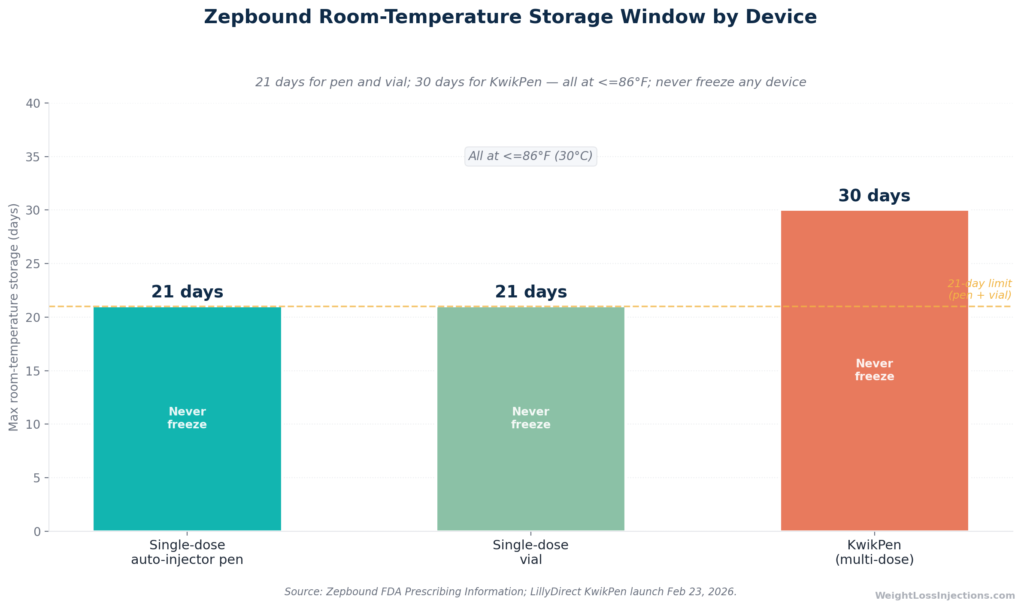
Bar chart: Room-temperature storage window by Zepbound device type
Zepbound cannot be frozen under any circumstances. The Zepbound FDA prescribing information is explicit: “Never freeze. Do not use if frozen.” This applies to all three device types, the single-dose auto-injector pen, the single-dose vial, and the multi-dose KwikPen. Freezing permanently destroys tirzepatide’s peptide structure through ice crystal formation and protein denaturation, and the damage cannot be reversed by thawing.
If your Zepbound has been frozen, or if you suspect it may have been, discard it immediately and contact your provider or pharmacy for a replacement before your next scheduled dose.
Can Zepbound Be Frozen? The Answer Is No, for Every Device Type
There is no ambiguity here. Zepbound cannot be frozen, and the instruction to never freeze it is not a cautionary recommendation, it is a hard rule that applies without exception to every format of the medication. The Zepbound prescribing information (Eli Lilly) states this directly in the How Supplied/Storage section: “Do not freeze.” And in the Instructions for Use for the single-dose pen, the guidance is equally unambiguous: “Do not use if frozen.”
This prohibition covers all three delivery devices that are currently on the market as of April 2026:
- Single-dose auto-injector pen — the original Zepbound device, one pen per weekly dose, available in all six strengths (2.5 mg through 15 mg), per the Zepbound pen Instructions for Use (IFU)
- Single-dose vial — requires a separate syringe and needle; available through LillyDirect at lower self-pay prices, per the Zepbound prescribing information
- Multi-dose KwikPen — launched February 23, 2026, containing four weekly doses per pen; available through LillyDirect for self-pay patients, per CNBC coverage of the KwikPen launch
The freezing prohibition is not a packaging technicality. It reflects fundamental chemistry: tirzepatide, the active drug in Zepbound, is a protein-based peptide molecule that is permanently damaged when ice forms in the solution. Freezing does not pause the drug’s potency the way a freezer preserves food. It destroys it.
What “Never Freeze” Looks Like in Practice
The proper storage range for Zepbound, all device types, when refrigerated is 36°F to 46°F (2°C to 8°C), per the Zepbound prescribing information. The freezing point of water is 32°F (0°C). That means there is only a 4-degree buffer between the lower end of acceptable refrigerator storage and the temperature at which the solution begins to freeze. This is why placement inside the refrigerator matters so much, more on that below.
At room temperature, Zepbound’s stability windows are:
- Single-dose pen and vial: Up to 21 days at or below 86°F (30°C), per the Zepbound prescribing information
- Multi-dose KwikPen: Up to 30 days at or below 86°F (30°C), per the Eli Lilly KwikPen launch announcement
Once any device has been kept at room temperature, it must never be returned to the refrigerator, the no-re-refrigeration rule is absolute and applies equally to all three formats, per the Zepbound prescribing information.
Proper Storage: The Exact Temperature Rules by Device
Before explaining the science of freeze damage, it helps to establish exactly what correct storage looks like. Understanding the target makes it easier to recognize when something has gone wrong.
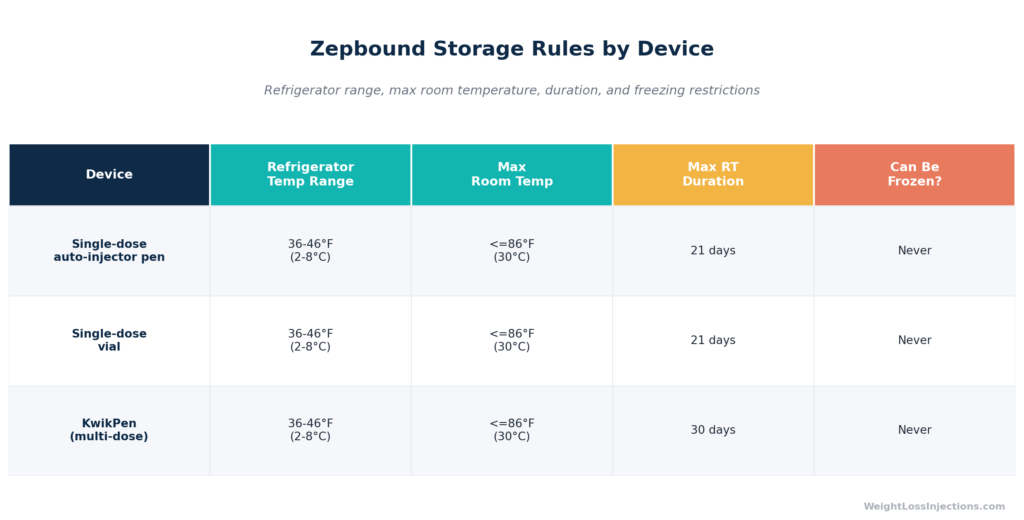
Table: Zepbound storage rules by device
Single-Dose Auto-Injector Pen
The original Zepbound device stores in the refrigerator at 36°F–46°F (2°C–8°C) in its original carton to protect from light. Shelf life at continuous refrigerated storage is 24 months from manufacture, per the Zepbound prescribing information. Once removed from the refrigerator, the pen may be kept at room temperature, at or below 86°F (30°C), for up to 21 days. After that window, discard unused pens. Do not return to the refrigerator. Do not freeze.
Single-Dose Vial
Identical temperature rules: refrigerate at 36°F–46°F, or store at room temperature (≤86°F) for up to 21 days. Available in all six dose strengths and currently offered through LillyDirect’s self-pay vial program, where 2.5 mg costs $299/month and higher doses cost up to $449/month under the Self Pay Journey Program enrollment, per CNBC’s December 2025 pricing report. The vial is single-use: once punctured, draw the dose and use immediately. Discard the vial and needle after the single draw, do not store a punctured, partially used vial.
Multi-Dose KwikPen
The KwikPen received FDA label expansion approval on February 23, 2026, and launched the same day through LillyDirect for self-pay patients only, per the CNBC report on the launch. Each pen contains four weekly doses — a full month of treatment. The KwikPen’s room-temperature allowance is 30 days at or below 86°F (30°C), reflecting the multi-dose design’s extended in-use period. The same rules apply as all other devices: never freeze, and once at room temperature, do not return to the refrigerator. As of April 2026, the KwikPen is available only through LillyDirect for self-pay patients and is not yet available at traditional retail pharmacies or for commercially insured patients.
Best Practices at Home
Store Zepbound on the middle shelf of the refrigerator, away from the cooling element, the door (which fluctuates with every opening), and the produce drawer. Keep it in the original carton, which provides light protection and thermal buffering. If any section of your fridge tends to freeze items left near the back wall, that is not a safe location for Zepbound.
What Happens at the Molecular Level When Zepbound Freezes
Most patients never need this information. But understanding the mechanism behind the “never freeze” rule makes the instruction feel less arbitrary, and makes it easier to take the right action confidently when something goes wrong.
Tirzepatide Is a 39-Amino-Acid Peptide
Tirzepatide, the active ingredient in Zepbound, is a 39-amino-acid synthetic peptide, a medium-sized biological molecule with a molecular formula of C₂₂₅H₃₄₈N₄₈O₆₈ and an average molecular weight of approximately 4,813 Da, per the FDA pharmacology review for NDA 217806. Tirzepatide is the world’s first approved dual GIP/GLP-1 receptor agonist, it simultaneously activates two distinct incretin hormone receptors to suppress appetite, slow gastric emptying, and improve insulin sensitivity, per the Zepbound prescribing information.
Its potency and specificity depend entirely on a precise three-dimensional structure. Tirzepatide has a key structural modification: a C20 fatty diacid moiety attached at Lys-20 via a linker that promotes albumin binding, enabling the ~5–6 day elimination half-life that makes once-weekly dosing possible, per the FDA pharmacology review. That folded, three-dimensional structure is what allows tirzepatide to dock precisely with GIP and GLP-1 receptors and activate the signaling cascade that drives weight loss. It is also exactly what freezing destroys.
How Ice Crystals Destroy Tirzepatide
When the aqueous solution in a Zepbound pen or vial drops to 32°F (0°C) or below, the water molecules begin forming an ice lattice. This process creates multiple simultaneous stressors for the tirzepatide peptide:
Ice crystal formation physically disrupts the peptide. As ice crystals grow, they create a solid-liquid interface with extreme surface tension forces. Peptide molecules concentrated at this interface are mechanically stressed, literally sheared by the physical force of crystal growth expanding through the solution. Research on pharmaceutical biologics confirms that fast freezing and slow thawing is particularly destructive because slow thawing allows ice crystals to grow and subject proteins to extended periods of this physical stress, per peer-reviewed pharmaceutical freeze-thaw characterization studies in Scientific Reports (PMC8166975).
Freeze-concentration increases solute stress. As water freezes out of solution, the remaining unfrozen liquid becomes highly concentrated with excipients, buffers, and salt ions. This freeze-concentration creates a chemical environment that can destabilize protein structure through changes in local pH and ionic strength that the peptide is not designed to tolerate, per the Scientific Reports freeze-thaw analysis.
Partial unfolding leads to protein aggregation. The combined mechanical and chemical stresses cause tirzepatide molecules to partially unfold — exposing hydrophobic regions normally buried in the peptide’s interior. These exposed regions then stick together with other partially unfolded molecules, forming aggregates of varying size. Per pharmaceutical biologic literature, aggregation during freeze-thaw can increase from near zero to double-digit percentage ranges with even a single fast-freeze/slow-thaw cycle, per the Scientific Reports study.
The result is permanent denaturation. Unlike refrigeration or brief room-temperature excursions, freezing causes structural damage that cannot be undone. There is no reversible molecular “unfreeze.” Once the peptide has aggregated, the aggregates are stable and persist even after the solution thaws. The aggregated tirzepatide can no longer bind GIP and GLP-1 receptors with normal affinity, and may not bind them at all, per analysis of tirzepatide freeze damage in pharmaceutical storage guidance published by Fella Health.
What the FDA Label Says — Verbatim
The Zepbound FDA prescribing information states:
“Do not freeze.”
“Do not use if frozen.”
These two instructions are included in the How Supplied/Storage section. The Zepbound single-dose pen IFU reinforces the same instructions as a step-by-step checklist item before every injection. There is no carve-out for “only slightly frozen,” “frozen once,” or “thawed quickly.” The rule is absolute.
How to Identify Damaged Medication: Recognizing a Frozen-Then-Thawed Pen or Vial
The honest answer is that you often cannot tell by looking. This is one of the more unsettling aspects of peptide drug freeze damage: a Zepbound pen that has been frozen and then thawed can look completely normal — clear, colorless-to-slightly-yellow solution, no visible particles, while the tirzepatide inside has already been denatured by aggregation. The visual inspection check is a useful but imperfect filter.
What the FDA Label Tells You to Look For
Per the Zepbound pen Instructions for Use (IFU), before every injection the solution should be:
- Colorless to slightly yellow — both are acceptable; a light yellow tint is normal
- Clear — no cloudiness, no haziness
Discard the pen immediately and do not inject if the solution is:
- Cloudy or hazy — this can indicate protein aggregation resulting from freezing, overheating, or light exposure
- Contains visible particles — flakes, crystals, or floating debris are a definitive discard signal regardless of cause
- Markedly discolored — any color shift beyond the normal slight yellow warrants discarding
A cloudy appearance is a reliable indicator that significant damage has occurred. However, the absence of cloudiness does not guarantee the drug is intact, molecular-level aggregation below the threshold of visual detection can still render a dose partially or fully ineffective.
Physical Clues That Freezing May Have Occurred
Beyond visual inspection of the solution itself, there are contextual clues that suggest a freeze event:
- Ice residue on the carton or pen — any visible frost, ice crystals, or condensation from recently frozen items adjacent to the pen in the refrigerator
- Pen or vial feels unusually stiff — a partially frozen or recently thawed pen may have a different tactile quality than normal, though this is not a reliable indicator once fully thawed
- Refrigerator thermostat known to be set too low — if the fridge has been freezing produce or the back wall shows frost buildup, the Zepbound stored there should be treated as potentially frozen
- Fully frozen ice packs in a mail delivery — if shipped with ice packs that arrived rock-solid frozen rather than slushy or melted, and the package interior shows signs of extreme cold, the medication may have frozen during transit
If you suspect freezing but cannot confirm it, default to discard. The cost of replacing one pen is lower than the cost of a week of missed effective treatment.
When to Call the Manufacturer
If you are uncertain whether your Zepbound was frozen and want guidance specific to your situation, you can contact Eli Lilly directly at 1-800-545-5979 or contact your dispensing pharmacy. Do not inject medication you have reasonable doubt about.
Our Top 3 · October 2026
The best GLP-1 providers right now
Independently reviewed. Ranked by price, medication access, provider quality, and patient outcomes.
Renew GLP
Personalized GLP-1, GIP plans: Semaglutide & Tirzepatide.
Medvi
No membership or hidden fees. Everything you need is included.
Trimi
US-licensed clinicians and shipped to your door, from $99/mo.
What to Do If Your Zepbound Froze Accidentally
This section covers the most important practical information in this article: the exact steps to take if you discover your Zepbound has been frozen.
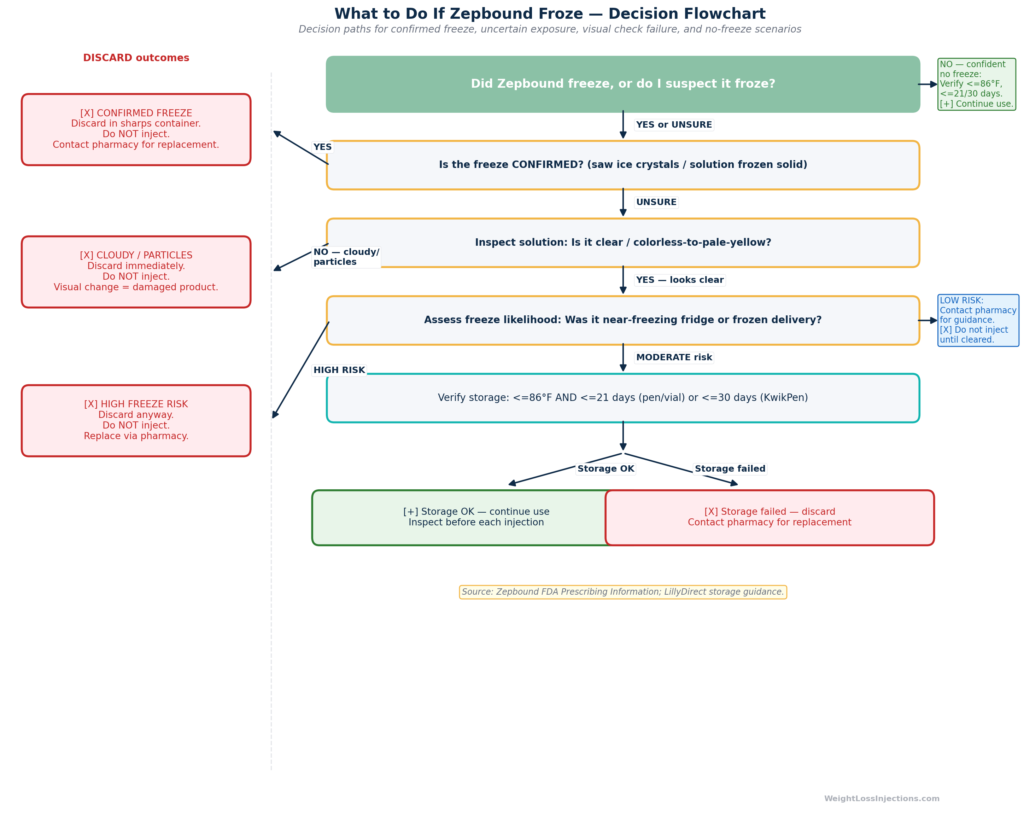
Flowchart: What to do if Zepbound froze
Step 1: Do Not Inject
If you know or strongly suspect the pen or vial was frozen, stop. Do not attempt to inject the medication, even after it has thawed. The damage caused by freezing is already done, thawing does not restore tirzepatide’s structure. Per the Zepbound prescribing information, a frozen-then-thawed pen must be discarded regardless of appearance.
Step 2: Discard the Pen or Vial Safely
Discard the pen, vial, and any associated needles in a FDA-cleared sharps disposal container. These rigid plastic containers are available through most retail pharmacies, medical supply companies, and online retailers. Do not place loose pens or vials in household trash or recycling; the sharps container prevents needle-stick injuries and contains the waste properly.
If you do not have a sharps container at home, a heavy-duty plastic household container with a tight-fitting, puncture-resistant lid (such as a laundry detergent bottle) is an acceptable alternative per FDA sharps disposal guidance while you obtain a proper container. For disposal of unused medications along with the pen, the FDA drug take-back program locator can identify authorized drop-off sites near you.
Note: Zepbound is not on the FDA’s flush list, so do not flush it down the toilet.
Step 3: Contact Your Provider or Pharmacy Immediately
Do not wait until your next scheduled appointment to report the situation. Contact your prescribing provider or pharmacy the same day you discover the frozen pen. Your provider can issue a replacement prescription; your pharmacy may have replacement or reshipment procedures in place for documented temperature excursions.
If you received Zepbound through a mail-order or specialty pharmacy and the shipping conditions are suspected to be responsible, document the following before contacting them:
- When the package arrived
- The state of the ice packs (frozen solid vs. partially melted vs. fully melted)
- Any visible damage to outer packaging or insulation
- Photographs if possible
Pharmacies and specialty distributors may offer replacements for documented cold-chain failures. Having this documentation ready speeds the replacement process significantly.
Step 4: Bridge the Dose Gap Without Missing a Week
A skipped weekly dose matters clinically. Per the Zepbound prescribing information, if a dose is missed and more than 4 days (96 hours) have passed since it was due, skip it and resume on the next scheduled day. But the goal is to replace the frozen medication and administer the dose within that 4-day window if possible — not to skip the week.
At WeightLossInjections.com, patients enrolled in [service detail] have access to prescribers who can generate same-day or next-day replacement prescriptions for exactly these situations. If you are not yet a patient, call your dispensing pharmacy directly, most will have an emergency prescription refill process.
Replacement Options
- LillyDirect direct purchase: For self-pay patients, single-dose vials and the multi-dose KwikPen are available through LillyDirect, with vials at $299–$449/month under the Self Pay Journey Program and the KwikPen at $299–$449/month, per CNBC’s KwikPen launch coverage
- Retail pharmacy: Single-dose pens are available at retail pharmacies at a list price of $1,086/month, with Lilly savings cards potentially reducing cost to as low as $25/month for commercially insured patients with coverage, per Lilly’s pricing information
- WeightLossInjections.com telehealth: Our team can coordinate a replacement prescription through [service detail] at [$X/month]
Preventing Freeze Accidents: Where Zepbound Goes Wrong
Most freeze events are not catastrophic accidents, they are the result of one of a handful of predictable situations. Knowing them in advance makes them preventable.
Hotel Mini-Fridge
This is the single most common source of accidental Zepbound freezing. Hotel mini-fridges are notorious for inconsistent temperatures. Many units run colder than their thermostat displays suggest, and the back wall of a mini-fridge often forms a thin ice layer even when the unit is not set to freeze. Zepbound stored against the back wall of a hotel mini-fridge is at real risk of freezing overnight.
Prevention: When traveling and using a hotel mini-fridge, store Zepbound in the door shelf, which is the warmest zone in any refrigerator. Better yet, if your trip is 21 days or fewer (pens/vials) or 30 days or fewer (KwikPen), consider simply keeping Zepbound at room temperature in the hotel room, provided the room stays at or below 86°F (30°C) with air conditioning on. This eliminates the mini-fridge variable entirely.
On arrival at any hotel, verify the mini-fridge temperature with a small digital thermometer (widely available online for a few dollars). This one-minute check can save a $300–$449 medication replacement.
Pharmacy Mail Delivery in Winter
Winter deliveries that sit in mailboxes or on unheated porches for extended periods risk freeze exposure. Upon receiving a shipment, check the ice packs first. Ice packs in a properly managed cold-chain delivery should arrive partially melted to slushy, not frozen solid. Completely frozen solid ice packs suggest the package interior reached freezing temperatures. Inspect the solution before using and contact the pharmacy if concerned.
Prevention: Use a shipping address where a person can receive the package promptly in winter. Most specialty pharmacies allow delivery date selection and signature confirmation, take advantage of both.
Car Storage in Cold Weather
A car left outside in subfreezing temperatures will eventually reach ambient outdoor temperature throughout its interior. Never leave Zepbound in a vehicle overnight in winter. If using an insulated travel case with a gel pack for transport, verify the gel pack is not frozen, a frozen gel pack can paradoxically make the case interior too cold.
Air Travel
Checked baggage on commercial aircraft is stored in cargo holds that regularly reach temperatures well below freezing at cruising altitude. Per the basic physics of unpressurized cargo environments, temperatures in checked bags can drop to −4°F to −40°F (−20°C to −40°C) on long flights.
Rule: Zepbound must be carried in carry-on luggage. Never place it in checked baggage.
Per TSA guidance on traveling with medications, injectable medications are allowed through security in quantities exceeding the standard 3.4 oz liquid limit when declared as medically necessary. Carry the original prescription label. Keep the pen in its original carton inside your carry-on. Cabin temperature is maintained at approximately 60°F–75°F, well within the acceptable range.
Power Outages at Home
The freeze risk from power outages is specific to cold climates: if indoor temperature drops below 32°F, the refrigerator’s contents will eventually follow. In prolonged cold-weather outages, move Zepbound to the warmest interior room and monitor ambient temperature. An indoor thermometer near the medication makes it easy to track.
Temperature Monitoring: Tools for High-Stakes Storage
If you travel frequently, have experienced a medication loss from temperature damage, or live in a climate with extreme seasonal temperatures, investing in basic temperature monitoring equipment is worthwhile.
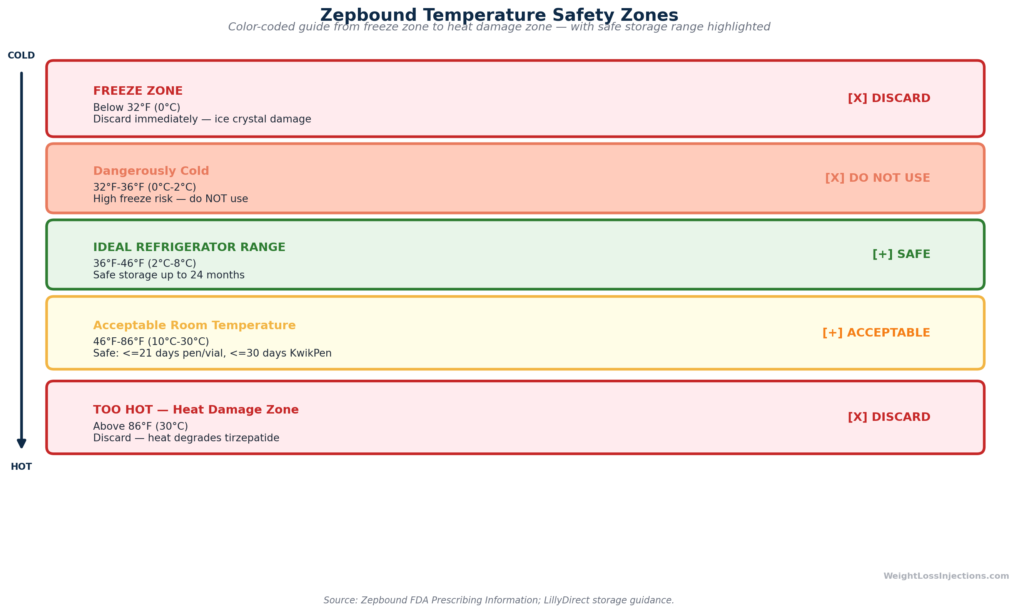
Temperature danger zones diagram
Refrigerator Thermometers
A simple analog or digital refrigerator thermometer ($5–$25) placed near your Zepbound storage spot eliminates guesswork about whether the fridge is within the 36°F–46°F safe range. Set it next to the pen in the middle shelf and check it occasionally. This single tool has prevented countless temperature excursions for insulin-dependent patients, it is equally useful for Zepbound.
Data Loggers and Shipping Temperature Indicators
For travel or transit situations, USB temperature data loggers ($15–$40) record temperature continuously and let you verify no excursion occurred. Bluetooth-enabled sensors that alert via smartphone app are also widely available for patients doing extended international travel. If you order Zepbound by mail regularly, ask your pharmacy about shipping temperature indicator cards, many specialty pharmacies include single-use freeze indicators in cold-chain shipments. A card that has changed color on arrival tells you definitively that an excursion occurred.
Insurance and Replacement Procedures
Losing a Zepbound pen to a freeze event is a financial loss in addition to a clinical disruption. Understanding how to navigate the replacement process can reduce both the cost and the delay.
Does Insurance Cover Frozen-and-Discarded Pens?
This depends on your plan. Most commercial plans do not automatically cover a replacement without documentation — typically a provider note, pharmacy documentation of any cold-chain failure, and confirmation the original pen was discarded per FDA label instructions. The approximately 43–45% of commercial plans that cover Zepbound for weight management, per Pandameds insurance coverage analysis (March 2026), each have their own replacement claim processes — contact your plan’s member services line.
Self-Pay Replacement Costs
For self-pay patients using LillyDirect, a replacement single-dose vial at the 7.5–15 mg maintenance dose costs $449/month under the Self Pay Journey Program, with 2.5 mg vials at $299/month and 5 mg vials at $399/month, per CNBC’s December 2025 pricing report. The multi-dose KwikPen is available at the same price tiers, per CNBC’s KwikPen launch coverage. Note that program enrollment and adherence to the refill schedule are required to maintain these prices.
For commercially insured patients who have a valid savings card, the as-low-as $25/month co-pay for covered patients applies to replacement fills as with any other fill, provided the annual savings maximum (approximately $1,300 for 2026) has not been exhausted, per Lilly savings program information.
Contact Points
- Lilly Medical Information: 1-800-545-5979 — for questions about whether a specific storage excursion is likely to have compromised your medication
- LillyDirect: Available through the Lilly app or website for direct purchase replacement
- Your prescribing provider: For replacement prescription authorization
- WeightLossInjections.com: Patients enrolled in [service detail] can contact our telehealth team directly for a replacement prescription at [$X/month]
Our Take at WeightLossInjections.com
Our take at WeightLossInjections.com: The “never freeze” rule is the most unambiguous storage instruction in all of Zepbound’s labeling, and yet freeze events happen to real patients with surprising regularity, almost always from one of the same handful of situations: a hotel mini-fridge running too cold, a winter mail delivery left on a porch, a carry-on bag accidentally checked at the gate.
The key shift in thinking is this: protecting your Zepbound from freezing requires the same proactive attention you’d give your phone battery in extreme cold. You wouldn’t leave your phone in a subfreezing car overnight because you know it would be damaged. Zepbound deserves the same mindset.
Our practical recommendations for every patient:
- Write the removal date on every pen or carton when you take it out of the fridge. A piece of medical tape and a ballpoint pen takes five seconds and eliminates all ambiguity about the 21-day (or 30-day) window.
- Place a $5 refrigerator thermometer next to your Zepbound in the middle shelf of your fridge. Check it occasionally. If it ever reads below 36°F, move the pen immediately and check whether it has been sitting in freeze-zone temperatures.
- Book carry-on space deliberately when flying. This is not an item that goes in checked baggage — ever.
- Treat hotel mini-fridges with appropriate skepticism. The door shelf, not the back wall. Or room temperature if the trip is within the RT window.
- If you are uncertain, discard and replace. At WeightLossInjections.com, patients working with our telehealth providers through [service detail] have same-day prescription access for exactly this scenario. One replaced pen costs far less than a missed week of treatment at the tirzepatide dosing levels that drove the weight loss results in SURMOUNT-1 (Jastreboff et al., New England Journal of Medicine, 2022), where average weight reduction reached 20.9% at the 15 mg dose at 72 weeks.
The molecular science is clear: frozen tirzepatide is irreparably damaged tirzepatide. But with awareness of the common failure scenarios and a few simple habits, this is entirely preventable.
WeightLossInjections.com editorial note: The molecular explanation of freeze-thaw peptide denaturation in this article is a simplified description intended for patient understanding. If you have specific clinical questions about a storage excursion with your Zepbound, consult your prescribing provider directly. The guidance in this article is consistent with current FDA labeling but does not replace individualized clinical judgment.
Frequently Asked Questions
No. The Zepbound prescribing information states: “Do not use if frozen.” This instruction applies even after the pen or vial has completely thawed. Freezing permanently denatures tirzepatide’s peptide structure through ice crystal formation and protein aggregation — processes that are not reversed by thawing. Injecting a previously-frozen pen risks receiving a dose with substantially reduced or absent pharmacological activity. The medication should be discarded in a sharps container and replaced.
Anything below 36°F (2°C) is outside the recommended range, per the Zepbound prescribing information. Freezing begins at 32°F (0°C), but the buffer zone between safe and dangerous is only 4 degrees. The safe refrigerator range is 36°F–46°F (2°C–8°C). Avoid storing Zepbound near the back wall or at the bottom of a refrigerator where the cooling element may create localized temperatures below 36°F. The temperature danger zone below 32°F is where ice crystal formation begins and peptide denaturation becomes irreversible.
Single-dose auto-injector pens and single-dose vials can remain at room temperature, at or below 86°F (30°C), for up to 21 days, per the Zepbound prescribing information. The multi-dose KwikPen, launched February 23, 2026, has a longer window: up to 30 days at the same temperature ceiling, per Eli Lilly’s KwikPen launch documentation. Once any device has been stored at room temperature, it must not be returned to the refrigerator. Discard any pen or vial that exceeds its applicable room-temperature window.
Per the Zepbound single-dose pen Instructions for Use (IFU), the solution should be colorless to slightly yellow and clear before every injection. Do not use Zepbound if it is cloudy, hazy, contains visible particles or floating debris, or has changed to an unexpected color. These are signs of potential degradation. However, note that a pen that has been frozen and thawed may sometimes still appear visually normal while the tirzepatide has already been denatured at the molecular level. Visual inspection is a necessary check but not a sufficient guarantee of integrity, which is why discarding a confirmed-frozen pen is required regardless of how it looks.
Not necessarily. Cloudiness or visible particles can appear after a freeze-thaw event as a result of protein aggregation, and when they do, they are a definitive discard signal. However, a thawed pen may look completely normal, clear and colorless, while the tirzepatide inside has already been structurally compromised. You cannot rely on visual inspection alone to determine whether a confirmed freeze event has rendered the medication ineffective. Per the Zepbound prescribing information, “do not use if frozen” is unconditional, it does not depend on how the solution looks after thawing.
Melted ice packs typically mean the product was at or near room temperature for part of its transit. If temperatures did not exceed 86°F (30°C) and the product was not frozen, the medication is generally fine if used within the applicable room-temperature window: 21 days for single-dose pens and vials, 30 days for the KwikPen, per the Zepbound prescribing information. The concern goes in both directions: if ice packs arrived completely frozen solid, with no melting at all, that suggests the package interior was very cold and the medication may have reached freezing temperatures. In that case, inspect the solution carefully, contact your pharmacy to report the cold-chain concern, and follow their guidance. When in doubt, call Eli Lilly at 1-800-545-5979 or your dispensing pharmacy before injecting.