![Unbranded [pillar-drug-class] injection pen on a neutral background — WeightLossInjections.com editorial hero](https://weightlossinjections.com/wp-content/uploads/2026/04/hero_ozempic_c4_compare-1200x675.png)
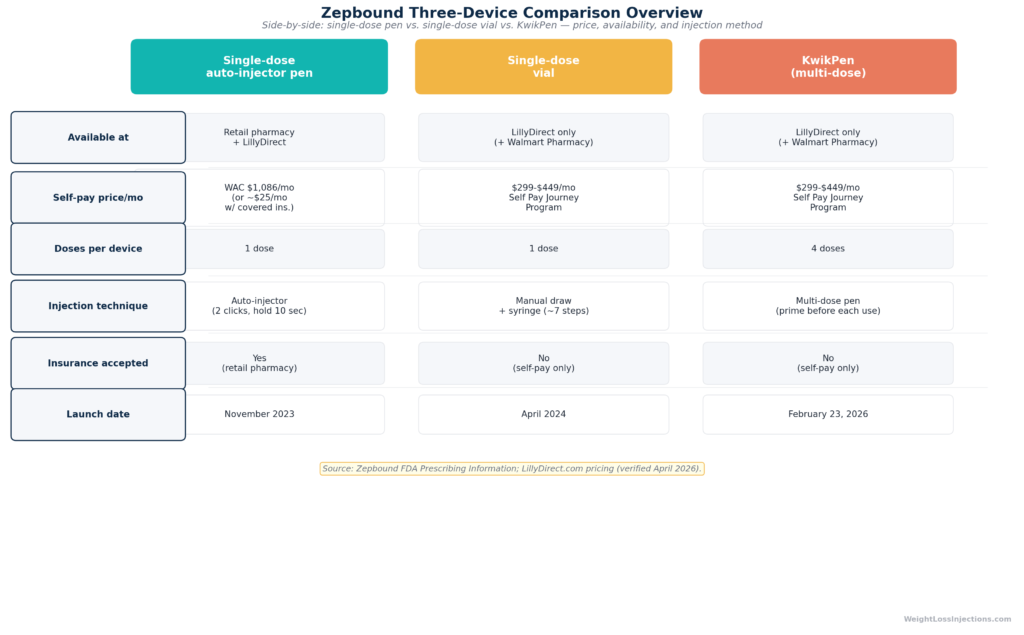
Three-Device Comparison Overview
As of 2026, Zepbound comes in three distinct delivery formats: the original single-dose auto-injector pen, a single-dose vial that requires a separate syringe, and the new multi-dose KwikPen launched February 23, 2026. All three contain identical tirzepatide at the same dose strengths and concentrations, clinical efficacy is the same.
What differs dramatically is cost and access: commercially insured patients using the savings card can get pens for as little as $25/mo, while self-pay patients using LillyDirect can access vials or the KwikPen for $299–$449/mo, less than a third of the $1,086/mo list price. The format you choose hinges entirely on your insurance status, injection comfort, and where you prefer to pick up your medication.
The Three Zepbound Formats Explained
Eli Lilly has quietly built out one of the more flexible delivery portfolios in the GLP-1 space. Understanding exactly what each format is, and is not, removes a lot of confusion before you ever speak to a provider.
Single-Dose Auto-Injector Pen (November 2023)
The single-dose auto-injector pen is the original Zepbound device and remains the only format available through commercial insurance at a retail pharmacy. It was FDA-approved alongside Zepbound itself on November 8, 2023.
Each pen is prefilled and self-contained. One pen equals one weekly injection. The device delivers 0.5 mL of tirzepatide subcutaneously with a two-click mechanism: the first click initiates the injection, the second click confirms completion. Per the Zepbound pen Instructions for Use, you hold the pen against the skin for up to 10 seconds after the second click to ensure complete dose delivery.
The pen is color-coded by strength to reduce dosing errors:
- 2.5 mg — Dark gray
- 5 mg — Dark purple
- 7.5 mg — Dark teal
- 10 mg — Pink
- 12.5 mg — Blue
- 15 mg — Red
All six strengths share the same 0.5 mL volume per dose, concentration varies, volume does not. This matters practically: you inject the same amount regardless of which dose you are on. The pen is available at virtually all retail pharmacy chains, CVS, Walgreens, Costco, Walmart, and most independent pharmacies, and it is the only format through which commercial insurance can be billed.
Single-Dose Vial (April 2024)
The single-dose vial launched in April 2024 through LillyDirect initially at 2.5 mg and 5 mg, with higher dose strengths added progressively through mid-2025 until all six were available, per LillyDirect platform history documented in Pharmaceutical Executive, June 2025.
Unlike the pen, the vial does not include an injector. Each vial contains one dose (0.5 mL), but you must purchase a syringe and needle separately. The injection technique is manual: attach needle, draw air, inject air into the vial to create pressure, draw medication to the 0.5 mL line, expel air bubbles, inject subcutaneously, then dispose of the syringe and empty vial in a sharps container. That process involves roughly seven discrete steps versus the pen’s two.
The vial is available exclusively through LillyDirect and, as of October 29, 2025, for retail pick-up at Walmart Pharmacy through the LillyDirect partnership. Insurance cannot be billed for the vial under any circumstances, it is a self-pay product.
One practical note: syringes and needles are not prohibitively expensive, but they are an additional supply cost and logistics consideration. Most patients use 1 mL insulin syringes with a 28–31-gauge, 4–8 mm needle for subcutaneous injection, though you should confirm the appropriate needle gauge with your prescribing provider.
Multi-Dose KwikPen (February 23, 2026)
The KwikPen is the newest and, for self-pay patients, potentially the most convenient format. It launched on February 23, 2026 through LillyDirect following an FDA label expansion, per CNBC’s coverage of the launch. Unlike the single-dose pen, one KwikPen contains four weekly doses, an entire month of treatment in a single device.
The KwikPen requires priming before each use, a procedure already familiar to patients who have used Mounjaro (Eli Lilly’s tirzepatide formulation for type 2 diabetes). Priming ensures proper dose delivery by removing air from the needle. After priming, you inject subcutaneously using the pen mechanism, no syringe or needle is required beyond the pen’s built-in delivery system.
The KwikPen is available in all six strengths (2.5 mg through 15 mg) through LillyDirect and at Walmart Pharmacy as a pickup option. Like the vial, it is self-pay only and cannot be billed to insurance as of April 2026, per CNBC’s KwikPen launch reporting.
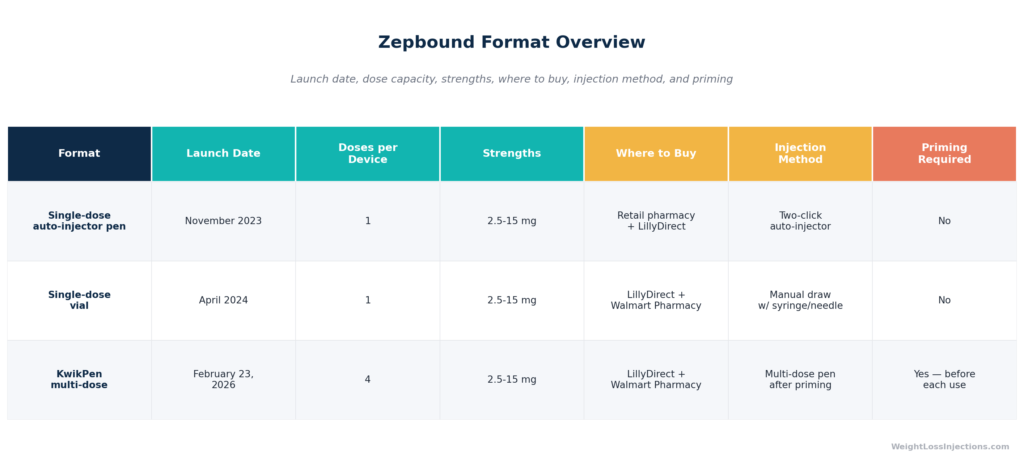
Zepbound Format Overview Table
Pricing Comparison: Pen vs. Vial vs. KwikPen
This is the core practical question for most patients, and the answer is more nuanced than most sources convey, because the cheapest format depends entirely on whether your insurance covers Zepbound.
The List Price (WAC): $1,086/mo for All Formats
All three Zepbound formats share the same Wholesale Acquisition Cost: $1,086/mo for a 28-day supply at any dose strength, per Eli Lilly’s pricing page. The list price is the same whether you buy a box of four single-dose pens, four single-dose vials, or one KwikPen containing four doses. Nobody with access to a manufacturer program or insurance benefit should be paying this price.
With Commercial Insurance and the Savings Card: As Low as $25/mo (Pen Only)
If your commercial insurance plan covers Zepbound for weight management, you can use Eli Lilly’s savings card to pay as little as $25/mo for the single-dose pen at a retail pharmacy. The 2026 card terms cap annual savings at approximately $1,300 (down from $1,950 in 2025), with a maximum of 13 fills per calendar year, per Zepbound savings card program terms verified December 2025.
Critical restriction: The savings card works only with the single-dose auto-injector pen dispensed at a retail pharmacy under commercial insurance. Vials and the KwikPen are ineligible, they are self-pay products outside the retail pharmacy system.
Approximately 43–45% of commercial insurance plans cover Zepbound for weight management (BMI ≥30 or ≥27 with a comorbidity), and employer-sponsored plans show roughly 55% approval after prior authorization, per Pandameds insurance coverage analysis, March 2026. That means a meaningful portion of commercially insured patients will not qualify for the $25/mo rate and should consider the LillyDirect self-pay route instead.
For commercially insured patients whose plan does not cover Zepbound, a separate savings card tier applies: as low as $499/mo for single-dose pens under the non-covered benefit card, per PrescriberPoint’s Zepbound savings program documentation. This is substantially more expensive than LillyDirect’s self-pay pricing, a fact many patients do not realize.
LillyDirect Self-Pay (Vials and KwikPen): $299–$449/mo
For patients without insurance coverage for Zepbound, or who prefer to bypass insurance entirely, LillyDirect’s Self Pay Journey Program offers the most affordable legal access to brand-name tirzepatide. Pricing effective December 1, 2025, per CNBC’s reporting on the LillyDirect price cut:
| Dose Strength | LillyDirect Self Pay Journey Program |
|---|---|
| 2.5 mg | $299/mo |
| 5 mg | $399/mo |
| 7.5 mg | $449/mo |
| 10 mg | $449/mo |
| 12.5 mg | $449/mo |
| 15 mg | $449/mo |
This pricing applies to both single-dose vials and KwikPens — the two formats are price-equivalent at every dose level, per CNBC’s KwikPen launch coverage. The program requires active enrollment on the LillyDirect platform and adherence to the refill window. Outside the Journey Program, regular LillyDirect prices are substantially higher: $599 for 7.5 mg, $699 for 10 mg, $849 for 12.5 mg, and $1,049 for 15 mg.
Full Cost Comparison Table
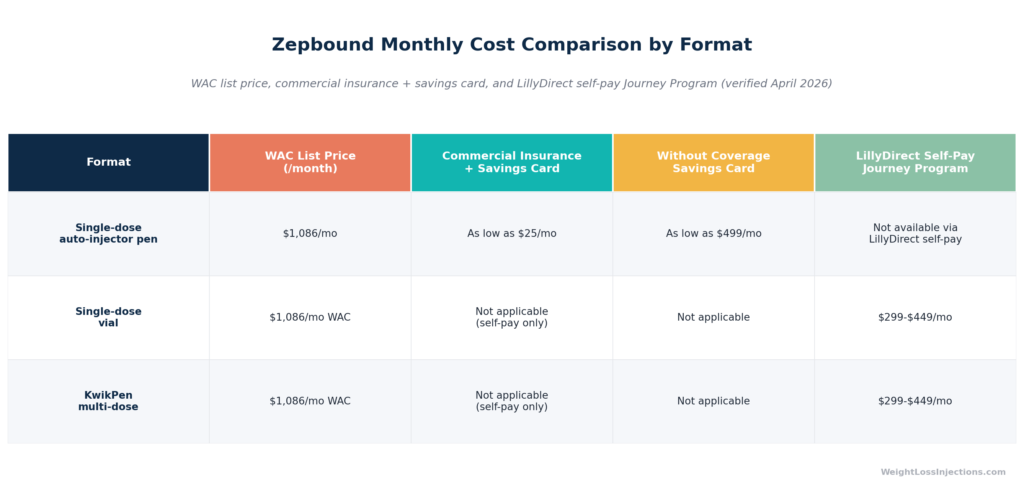
Zepbound Cost Comparison Table
The single most important number in that table: if your insurance covers Zepbound, the pen at $25/mo beats the vial’s $299–$449/mo handily. If your insurance does not cover Zepbound, the vial or KwikPen at $299–$449/mo beats the pen’s $499/mo non-covered savings card rate. The insurance routing difference is not a technicality, it is the primary financial decision.
Injection Technique: A Step-by-Step Comparison
Most patients considering the vial or KwikPen want to know exactly how much harder they are to use than the standard pen. The honest answer: the vial requires real technique practice; the KwikPen adds one step over the pen; and the auto-injector pen is genuinely the simplest self-injection device on the market.
Single-Dose Auto-Injector Pen: Two Clicks and Done
The pen is designed for patients with no injection experience. The Zepbound pen Instructions for Use lay out the sequence:
- Prepare the site. Remove the pen from the refrigerator 30 minutes before injection to bring it to room temperature. Clean the injection site with an alcohol swab. Choose the abdomen, outer thigh, or back of the upper arm (upper arm requires a second person or mirror).
- Remove the base cap. Pull off the gray base cap — do not replace it after removal.
- Position the pen. Hold the clear base flat and firm against the skin at the injection site.
- First click. Press the purple injection button. You will hear and feel the first click — injection has begun.
- Hold for 10 seconds. Keep the pen pressed against the skin while counting. A yellow indicator fills the window during the injection.
- Second click. After 10 seconds, you will hear the second click — the injection is complete.
- Remove and dispose. Lift the pen away and discard it in a sharps container.
The entire process from preparation to disposal takes most patients under two minutes once they have done it a few times. The color-coded labels and auto-retractable needle add additional safeguards against accidental needlestick and dosing mix-ups.
Single-Dose Vial: Manual Draw Requires Technique
The vial process is more involved and requires comfort with syringe-based injection. While the Zepbound prescribing information specifies the formulation, the preparation steps follow standard subcutaneous injection technique:
- Gather supplies. You need the vial, a 1 mL syringe, a 28–31-gauge subcutaneous needle, an alcohol swab, and a sharps container.
- Inspect the vial. The solution should be colorless to slightly yellow and clear. Do not use if it is cloudy or contains particles, per the Zepbound pen Instructions for Use (same visual criteria apply to vials).
- Clean the rubber stopper with an alcohol swab.
- Draw air. Pull back the syringe plunger to the 0.5 mL mark to draw air into the syringe.
- Inject air into the vial. Insert the needle through the stopper and push the plunger to inject air, creating positive pressure that makes drawing easier.
- Invert the vial and draw medication to exactly the 0.5 mL line.
- Remove air bubbles. Tap the syringe and gently push the plunger to expel any air. Confirm volume is still at 0.5 mL.
- Inject subcutaneously. Use the same sites as the pen (abdomen, outer thigh, upper arm).
- Dispose. Place the used syringe, needle, and empty vial in a sharps container.
The risk in vial use is step 6, drawing an incorrect volume. Drawing too little means a partial dose; drawing too much poses an overdose risk. Patients who have administered insulin or other injectable medications will find this familiar. Those who have never used a syringe before should expect a learning curve and consider asking a nurse or pharmacist to demonstrate the technique before their first self-injection.
Multi-Dose KwikPen: Prime, Then Inject
The KwikPen bridges the gap between the vial’s technique burden and the auto-injector pen’s simplicity. Because it contains four doses in a multi-dose cartridge, it requires priming to ensure the first dose from a new pen, or after storage — delivers the correct volume.
The priming process is the same as for Mounjaro’s KwikPen, which many patients already know. In brief:
- Attach a new needle to the KwikPen before each injection.
- Prime the pen by dialing the dose selector and performing the priming shot per the device’s Instructions for Use until a steady stream of medication appears. This removes air from the cartridge and needle.
- Dial your prescribed dose.
- Inject subcutaneously at the same sites as the pen or vial.
- Remove and dispose of the needle in a sharps container after each use. The pen itself is stored and reused for up to four doses.
Because you attach and remove a needle with each use rather than disposing of the entire device, the KwikPen generates less sharps waste over a month than the single-dose pen. One KwikPen replaces four single-dose pens; one full box of KwikPens replaces a full month’s supply. Per CNBC’s KwikPen launch reporting, the pen is also the format most likely to be familiar to patients who previously used Mounjaro.
Availability and Where to Get Each Format
Where you can actually obtain each format is arguably as important as its price or technique profile.
Single-Dose Pen: Retail Pharmacy (Nationwide)
The single-dose auto-injector pen is available at essentially any retail pharmacy with a Zepbound prescription — CVS, Walgreens, Costco, Walmart, Rite Aid, and most independent pharmacies. If your insurance covers Zepbound, the pen is the only format through which your plan can be billed. If your plan requires prior authorization (most do), your prescribing provider will need to submit the PA before the pharmacy can dispense.
From a practical standpoint, the pen’s retail availability means same-day or next-day pickup is often possible, insurance adjudication happens in real time at the counter, and you can use GoodRx or similar tools to check cash prices at nearby pharmacies if you lose your savings card eligibility.
WeightLossInjections.com telehealth providers can send Zepbound pen prescriptions electronically to any retail pharmacy in your network, covering [service detail].
Single-Dose Vial and KwikPen: LillyDirect (and Walmart Pharmacy)
Both the vial and the KwikPen are exclusively available through LillyDirect, Eli Lilly’s direct-to-consumer pharmacy platform — or as a pickup option at Walmart Pharmacy locations nationwide via the LillyDirect partnership launched October 29, 2025, per Walmart’s corporate announcement.
LillyDirect requires:
- A valid Zepbound prescription from a licensed U.S. provider
- Active enrollment in the Self Pay Journey Program for discounted pricing
- Adherence to the refill window (approximately every 45 days) to maintain program pricing
- Self-pay at the point of order — no insurance billing
Orders through LillyDirect ship to your home or are available for pickup at a participating Walmart Pharmacy. Lead times vary but typically run 2–5 business days for home delivery.
Important: LillyDirect does not accept insurance for vials or KwikPens. If you have commercial insurance that covers Zepbound and you try to order vials through LillyDirect, you will pay the self-pay price, you cannot simultaneously use your insurance benefit.
Insurance Coverage: The Most Decision-Critical Difference
No other factor matters more to the format decision than insurance routing. This is the single gap in most competitor articles, so we will be direct about the mechanics.
The Pen Is the Only Insurance-Compatible Format
The Zepbound single-dose auto-injector pen is the only format currently processable through commercial insurance at a retail pharmacy. When your insurer approves Zepbound for weight management (BMI ≥30, or ≥27 with hypertension, type 2 diabetes, or dyslipidemia, per the FDA indication language), the approved formulary product is the pen — dispensed through the retail pharmacy benefit, not a specialty or direct channel.
About 43–45% of commercial plans cover Zepbound, per Pandameds’ March 2026 insurance analysis. If yours does, pens at $25/mo via the savings card are significantly cheaper than anything LillyDirect offers.
Vials and KwikPen Are Self-Pay Only, Even at Walmart
Neither the single-dose vial nor the KwikPen can be billed to insurance under any current billing pathway as of April 2026. This applies even at Walmart Pharmacy, where the LillyDirect pickup option prices are available, you are paying the LillyDirect self-pay price directly, not running it through your plan. Insurance status is irrelevant for these two formats.
This means the Zepbound savings card, including both the covered-benefit ($25/mo) and non-covered-benefit ($499/mo) tiers — does not apply to vials or KwikPens, per CNBC’s reporting on LillyDirect pricing structure.
Medicare: A Separate Situation
Medicare does not cover Zepbound for the weight management indication under its standard Part D benefit as of April 2026, per American College of Gastroenterology analysis, April 2025. This affects format choice directly: Medicare patients cannot use the insurance-linked pen pathway.
A temporary exception runs July 1–December 31, 2026: CMS’s Medicare GLP-1 Bridge program covers Zepbound for eligible Part D enrollees at a $50 copayment. Eligibility requires BMI ≥35, or BMI ≥27 with qualifying clinical criteria. Importantly, this Bridge program operates outside the standard Part D benefit and does not count toward the $2,100 out-of-pocket cap, per KFF’s Medicare GLP-1 Bridge analysis, March 2026. Medicare patients qualifying for the Bridge program should confirm with their plan which format and pharmacy is covered under the Bridge, the program applies to commercially available formats.
Medicare Part D plans may separately cover Zepbound when prescribed specifically for the OSA indication (approved December 20, 2024), subject to individual plan formulary, per Wellcare Medicare coverage guidance. OSA-indication coverage typically channels through the retail pharmacy (pen format).
Dosing Accuracy: Can You Trust the Vial?
A reasonable concern about the vial is whether a patient drawing their own dose will consistently deliver the same 0.5 mL as the pen. The honest answer: yes, if they are properly trained, but with more room for error than the pen.
The pen is a closed system. The volume is preset, you cannot over-inject or under-inject through normal use. The vial is an open system that relies on accurate syringe graduation reading and disciplined air-bubble removal. Errors are possible, particularly early in a patient’s experience with manual injection.
From a pharmacological standpoint, the drug itself is identical. Lilly Medical Affairs has confirmed that there are no data showing differences in injection-site reactions between the vial and the pen, the tirzepatide solution has the same chemical and analytical attributes in both formats. What differs is the delivery mechanism, not the drug.
For patients new to injection who choose the vial for cost reasons, a brief training session with a nurse, pharmacist, or telehealth provider is strongly recommended before the first self-injection.
Our Top 3 · September 2026
The best GLP-1 providers right now
Independently reviewed. Ranked by price, medication access, provider quality, and patient outcomes.
Renew GLP
Personalized GLP-1, GIP plans: Semaglutide & Tirzepatide.
Medvi
No membership or hidden fees. Everything you need is included.
Trimi
US-licensed clinicians and shipped to your door, from $99/mo.
Storage: All Three Need the Fridge, With Important Differences
Storage requirements for all three formats are fundamentally similar, cold chain required, but the room-temperature tolerances differ in a clinically meaningful way for patients who travel or do not have consistent refrigerator access.
Refrigerator Storage (All Three Formats)
All three formats must be stored at 2°C to 8°C (36°F to 46°F) in the original carton to protect from light, per the Zepbound prescribing information. Shelf life when refrigerated is 24 months from manufacture. Never freeze any Zepbound format — frozen product must be discarded.
Room-Temperature Tolerance
This is where the three formats diverge:
- Single-dose pen and single-dose vial: May be stored at room temperature up to 30°C (86°F) for up to 21 days, per Zepbound.lilly.com storage guidance. Once moved to room temperature, do not return to the refrigerator.
- KwikPen: Room-temperature tolerance is up to 30 days at temperatures not exceeding 30°C (86°F), per CNBC’s KwikPen launch reporting. The longer tolerance makes sense given that the pen contains an entire month’s supply.
The practical implication: if you travel frequently or inject at room temperature, the KwikPen’s 30-day room-temperature window provides more flexibility than the pen or vial’s 21-day limit. All three should remain in the refrigerator until they are needed. Always inspect the solution before injection, if it appears cloudy or contains particles, do not use it, per the Zepbound pen Instructions for Use.
Safety: Are Vials as Safe as Pens?
The fundamental pharmacological answer is yes, with a caveat about technique. Lilly Medical Affairs states explicitly that there is no data suggesting differences in injection-site reactions between the vial and the pen. Both contain the same tirzepatide formulation with identical analytical attributes. The drug that reaches your subcutaneous tissue is the same regardless of format.
The safety distinction is technique-dependent, not pharmacological:
Pen safety advantages: Closed-system delivery prevents contamination exposure. Auto-retractable needle prevents accidental needlestick after use. No risk of drawing incorrect volume. Color-coded labels prevent accidental strength mix-ups.
Vial safety considerations: Open-system preparation creates small contamination risks if aseptic technique is not followed. Risk of incorrect volume if the syringe is misread or bubbles are not fully expelled. Multiple supplies (vial, syringe, needle) introduce more opportunities for error.
KwikPen safety: The priming requirement introduces a step where medication is intentionally expelled, this should not be performed near the face or mucous membranes, and the primed dose volume should not be re-injected. Otherwise, safety profile is similar to the pen.
All three formats share the same contraindications and boxed warning as Zepbound FDA-labeled: contraindicated in patients with a personal or family history of medullary thyroid carcinoma (MTC) or Multiple Endocrine Neoplasia syndrome type 2 (MEN 2). The black box warning, risk of thyroid C-cell tumors observed in rats at clinically relevant exposures, applies to all three formats. Do not use any Zepbound format concurrently with Mounjaro or any other GLP-1 receptor agonist, per FDA approval language.
Sharps Disposal
Regardless of format, all components that contact skin or medication must be disposed of in an FDA-cleared sharps container.
- Single-dose pen: Dispose of the entire pen (needle retracts automatically) in a sharps container after each weekly injection. Four pens per month.
- Single-dose vial: Dispose of the syringe and needle as one unit, plus the empty vial, in a sharps container. Four syringes + four needles + four vials per month.
- KwikPen: Dispose of only the needle after each injection — the pen body is retained for four uses. One pen body per month; four needles per month.
The KwikPen generates the least sharps waste of the three formats. If sharps disposal is logistically challenging in your location, this may factor into your choice.
Most states require sharps to be placed in a puncture-resistant, leak-proof container. Mail-back programs and community drop-off locations (pharmacies, hospitals) are available nationwide. Your prescribing provider or pharmacist can direct you to a local option.
Who Should Choose Which Format? A Decision Guide
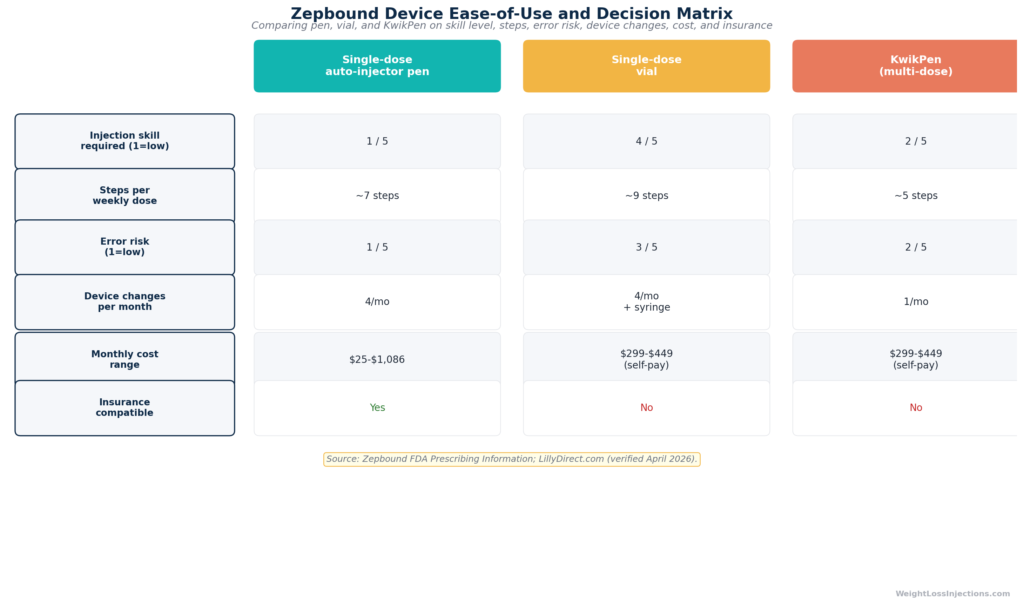
Ease-of-Use and Decision Matrix
Choose the Single-Dose Auto-Injector Pen If:
You have commercial insurance that covers Zepbound. This is the dominant consideration. If your plan covers Zepbound and you qualify for the savings card, pens at $25/mo represent savings of $274–$424/mo compared to the LillyDirect self-pay alternatives. There is no meaningful advantage to switching to a vial or KwikPen when insurance makes the pen dramatically cheaper.
You are new to self-injection. The pen’s two-click mechanism, auto-retractable needle, and color-coded labels eliminate most opportunities for user error. Patients who have never self-injected before consistently find the pen the most accessible format.
You want maximum flexibility on where to fill your prescription. Any retail pharmacy can fill a Zepbound pen prescription. If you travel, move, or need to refill in a different city, the retail availability of the pen is a significant practical advantage.
You want a straightforward backup if LillyDirect has delays. LillyDirect’s supply and shipping can occasionally experience delays. Commercially insured patients can always fall back to a retail pharmacy pen fill.
Choose the Single-Dose Vial If:
You are paying out of pocket and you are comfortable with manual injection. The vial and KwikPen have identical pricing under the Self Pay Journey Program. If you have prior experience drawing medications from vials, insulin users are the clearest example, the vial’s technique burden is not a barrier, and you may prefer the familiarity of a standard syringe.
Your provider or clinic already trains patients in vial technique. Some weight management clinics have established vial training protocols. If you are receiving supervised support for injection technique, the vial is a viable lower-cost format.
You prefer the smallest device per injection. The vial is more compact than the pen or KwikPen and may be easier to store in limited refrigerator space.
Choose the KwikPen If:
You are paying out of pocket and want a pen-like experience. The KwikPen eliminates the syringe-drawing step while delivering the same $299–$449/mo pricing as the vial. If you want the convenience of a pen without the insurance compatibility requirement, the KwikPen is the logical choice.
You want fewer device changes per month. One KwikPen per month versus four single-dose pens or four vial-plus-syringe setups. For patients who travel frequently or manage complex medication regimens, the reduced logistics of a monthly device simplifies adherence.
You are already familiar with the KwikPen from Mounjaro. Patients transitioning from Mounjaro to Zepbound for weight management will find the KwikPen immediately familiar, same device, same priming process.
Medicare Patients (Without Bridge Program Access)
Medicare patients who do not qualify for the July–December 2026 Bridge program, and whose plan does not cover Zepbound for the OSA indication, face the highest out-of-pocket cost regardless of format. The LillyDirect Self Pay Journey Program ($299–$449/mo for vials or KwikPen) currently represents the most affordable legal access path for Medicare patients paying entirely out of pocket, per KFF’s Medicare GLP-1 analysis.
How to Switch Formats
Switching between Zepbound formats is medically straightforward, all three contain the same drug and dose strengths. The process is administrative rather than clinical.
Switching from pen (retail pharmacy) to vial or KwikPen (LillyDirect):
Your current prescription is likely written generically for “Zepbound [dose] mg injection.” However, LillyDirect requires a prescription submitted through its platform, and your prescribing provider may need to specify the format (vial or KwikPen) depending on LillyDirect’s current intake requirements. Contact your provider to request a new prescription routed to LillyDirect and enroll in the Self Pay Journey Program before ordering. Note that switching formats means leaving the commercial insurance pathway, you cannot use your savings card for LillyDirect formats.
Switching from vial or KwikPen (LillyDirect) to pen (retail pharmacy):
If your insurance coverage changes — or you gain new employer coverage with Zepbound on formulary, you can transition to the retail pharmacy pen. Ask your prescribing provider to send the prescription to your preferred retail pharmacy and apply for the savings card at LillyDirect’s savings portal if you have not already done so. Your LillyDirect Self Pay Journey Program enrollment does not affect your ability to fill a retail pharmacy prescription.
Switching between vial and KwikPen (within LillyDirect):
Both formats are available through the same platform at identical prices. Contact LillyDirect customer support to switch your format preference on your existing prescription. You may need an updated prescription specifying the KwikPen if your current Rx specifies the vial.
In all cases, your dose does not change when you change formats, you are receiving the same tirzepatide concentration regardless of device.
Our Take at WeightLossInjections.com
Our take at WeightLossInjections.com: The format question is almost entirely a financial and logistics question, not a clinical one. Eli Lilly has built three delivery systems around the same molecule, and all three work. What they do differently is optimize for different situations.
The pen is the right choice if your insurance covers Zepbound. At $25/mo with a savings card, no other format comes close. If your insurance does not cover it, the pen’s non-covered savings card rate of $499/mo is actually more expensive than LillyDirect’s vial or KwikPen options, a counterintuitive fact that trips up many patients who assume the insurance route is always better.
For self-pay patients, the choice between vial and KwikPen is genuinely a preference question, they cost the same. We lean toward recommending the KwikPen for most self-pay beginners: it eliminates the syringe-drawing technique burden of the vial, it generates less sharps waste, and the once-monthly device change reduces the weekly friction of staying on treatment. Patients who are already comfortable with syringe injection, insulin users in particular, may prefer the vial’s familiarity.
One underemphasized fact: compounded tirzepatide is no longer legally available to most patients. Both the 503A and 503B compounding windows closed in early 2025, and FDA enforcement is active against unlicensed compounders as of April 2026, per FDA’s clarification on compounding policies. Patients previously using compounded tirzepatide need to transition to one of these three brand-name formats.
If you are not sure which format or pricing path makes sense for your situation, WeightLossInjections.com’s licensed telehealth providers can evaluate your coverage and route your prescription to the format that saves you the most money. Our program costs [$X/month] and includes [service detail].
Frequently Asked Questions
No. All three formats, single-dose pen, single-dose vial, and KwikPen, contain identical tirzepatide solution at the same concentrations and volumes (0.5 mL per dose). Lilly Medical Affairs has confirmed that there are no data showing differences in injection-site reactions or drug attributes between vial and pen formats. The clinical efficacy data from the SURMOUNT trial program — including the 15 mg result of −20.9% body weight reduction at 72 weeks in SURMOUNT-1, published in NEJM 2022 — applies equally to all three formats.
Without insurance, the single-dose vial and KwikPen through LillyDirect’s Self Pay Journey Program cost $299–$449/mo depending on dose, compared to the $1,086/mo WAC list price for pens and the $499/mo non-covered savings card rate, per CNBC’s LillyDirect pricing coverage and PrescriberPoint savings program data. With commercial insurance and the savings card, pens drop to as low as $25/mo — less than any LillyDirect format. The cost winner depends entirely on insurance status.
No. The single-dose vial and KwikPen are currently available only through LillyDirect as self-pay products. Commercial insurance cannot be billed for these formats, and the Zepbound savings card does not apply to them, as of April 2026. If you have insurance coverage for Zepbound, the single-dose auto-injector pen dispensed at a retail pharmacy is the only format through which your benefit can be applied, per CNBC’s LillyDirect pricing reporting.
The Zepbound KwikPen is a multi-dose, single-patient-use pen containing four weekly doses — one full month of treatment, per device. It launched on February 23, 2026 through LillyDirect for self-pay patients following an FDA label expansion, per CNBC’s coverage of the KwikPen launch. It is available in all six dose strengths (2.5 mg through 15 mg), requires priming before each use, and costs the same as the vial under the Self Pay Journey Program: $299/mo for 2.5 mg and up to $449/mo for higher doses.
A standard Zepbound prescription sent to a retail pharmacy will be filled as the single-dose auto-injector pen, this is the default commercial format. If you want vials or the KwikPen, you must access them through LillyDirect as a self-pay patient and may need your provider to route or rewrite the prescription accordingly. Discuss with your prescribing provider which format best fits your budget and injection comfort level before the prescription is sent.
Each Zepbound pen strength has a distinct label color, dark gray (2.5 mg), dark purple (5 mg), dark teal (7.5 mg), pink (10 mg), blue (12.5 mg), and red (15 mg), per the Zepbound pen Instructions for Use. The color-coding allows quick visual confirmation that you are injecting the correct dose strength and helps caregivers or partners verify the right pen is being used. If you advance your dose mid-titration and have both old and new strength pens in your refrigerator, the color difference is an important safety check before each injection.