Tirzepatide Pharmacokinetics and Half-Life: The Science Behind Once-Weekly Dosing
Medically reviewed by WeightLossInjections.com Staff•Updated July 23, 2026•26 min readMedically reviewed
⤢
This article provides an in-depth explanation of tirzepatide’s pharmacokinetic profile for educational purposes. It is not a substitute for individualized prescribing guidance. Our clinical team has reviewed this article for clinical accuracy as of June 2026. All numeric data are sourced from FDA clinical pharmacology review documents and peer-reviewed literature. This content is for informational purposes only and does not constitute medical advice. Consult a licensed healthcare provider.
Exponential decay curve: tirzepatide plasma concentration (% of peak) vs. days post-injection. The ~5-day half-life midpoint and Day 7 next-dose marker (37% remaining) are annotated.
Tirzepatide has a half-life of approximately 5 days (120 hours) — the fundamental pharmacokinetic property that makes once-weekly subcutaneous injection possible. (FDA Clinical Pharmacology Review NDA 215866)
That extended half-life is not accidental. It is engineered via a C20 fatty diacid modification that causes tirzepatide to bind reversibly to albumin — the most abundant protein in human plasma — sheltering the drug from rapid degradation and renal clearance.
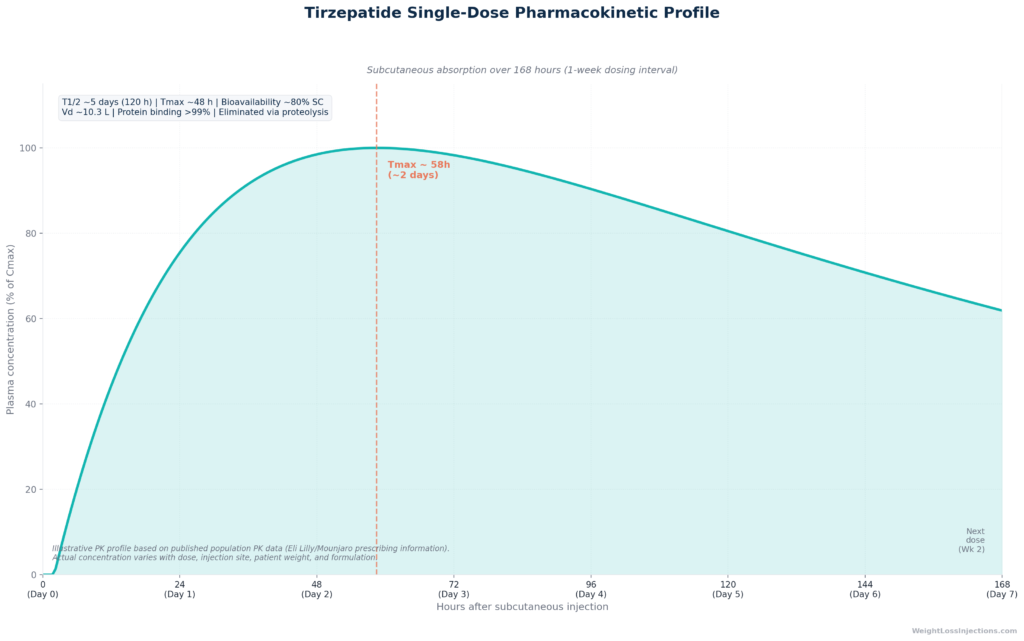
Peak plasma concentration (Tmax) is reached 8–72 hours after subcutaneous injection, with a median of approximately 24–48 hours. (StatPearls / NCBI Bookshelf)
Tirzepatide is metabolized by proteolytic cleavage and fatty acid beta-oxidation — not via CYP450 enzymes — meaning minimal drug-drug interaction potential via the hepatic metabolism pathway. (FDA Clinical Pharmacology Review NDA 215866)
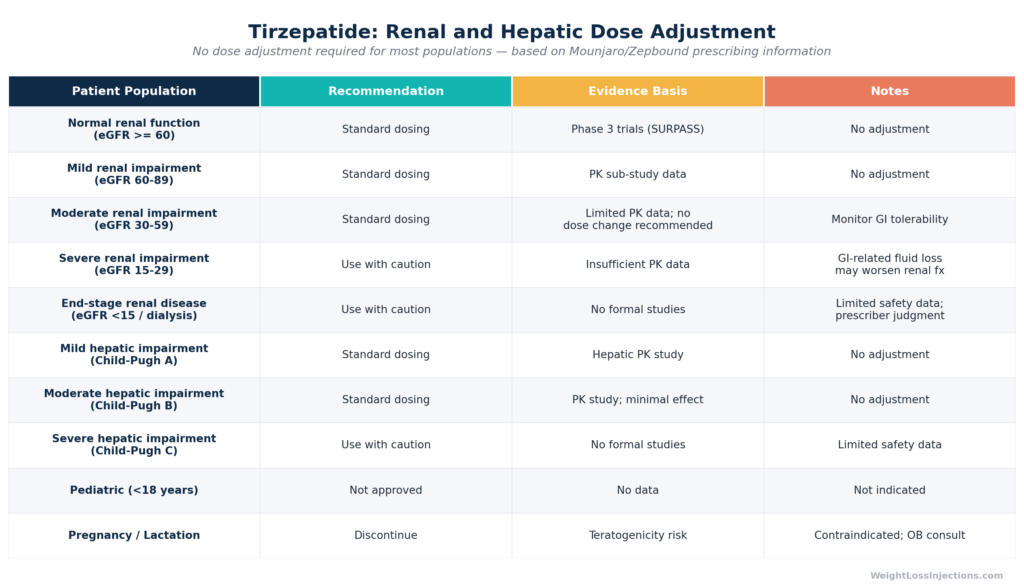
No dose adjustment is required for renal impairment, hepatic impairment, older age, or varying body weight. (PMC — Population PK Tirzepatide 2024)
After the last dose, tirzepatide reaches approximately 97% elimination in ~25 days and essentially complete washout (~99%) in approximately 35 days.
Compounded tirzepatide (when lawfully prepared under the narrow 503A personalized-medicine exception) contains the same active pharmaceutical ingredient and carries the same pharmacokinetic profile — with caveats around salt form and reconstitution precision discussed below.
Introduction
If you have ever wondered why tirzepatide is injected once a week — while most insulins require daily injection, and the body’s natural gut hormones are gone within two minutes of being secreted — the answer is precisely engineered into one molecular feature: a C20 fatty diacid chain attached to tirzepatide’s 39-amino-acid backbone. This single structural choice extends what would otherwise be a minutes-long drug lifetime to approximately five days, transforming tirzepatide from a pharmacological curiosity into a clinically practical chronic-therapy medication.
Pharmacokinetics — the science of what the body does to a drug after it is administered — encompasses absorption, distribution, metabolism, and excretion. For patients and prescribers, it answers questions that matter deeply in practice: How long does tirzepatide stay in the system? When does it reach full therapeutic effect? What changes if a dose is missed? Does kidney disease affect the dose? Is the pharmacology different if a compounded vial is used instead of the branded KwikPen?
This article is a comprehensive pharmacokinetic reference built from the FDA clinical pharmacology review submitted for Mounjaro’s NDA 215866, the FDA prescribing information, and peer-reviewed population pharmacokinetic modeling published in 2024. It is written for two audiences simultaneously: practitioners who want precise numeric data with sources, and motivated patients who want to understand their medication at a deeper level than the package insert provides. Technical terms are defined when introduced; plain-language translations follow quantitative data.
A note on compounded tirzepatide: since June 2026, mass-market compounded tirzepatide is not lawful. A narrow exception under Section 503A permits a state-licensed pharmacy to compound tirzepatide for an individual patient when the prescriber documents a specific clinical need not met by the commercial product — such as an allergy to an inactive ingredient (cresol, found in branded pens), or a dose strength unavailable commercially. Under this lawful narrow pathway, the active pharmaceutical ingredient is the same molecule with the same pharmacokinetic properties. The distinction between branded and compounded pharmacokinetics is addressed specifically in its own section below.
H2 1: Tirzepatide’s Half-Life — Approximately 5 Days Explained
What “half-life” means
Before discussing tirzepatide’s specific numbers, it helps to understand what a drug’s half-life actually measures. Half-life is the time required for the plasma concentration of a drug to decrease by 50% — that is, for half of the drug currently circulating to be eliminated from the body. The concept is not unique to pharmacology: it is the same mathematical relationship used to describe radioactive decay, and the arithmetic works identically.
Here is the clinical significance: after one half-life, 50% of peak concentration remains. After two half-lives, 25% remains. After three half-lives, approximately 12.5% remains. After five half-lives, approximately 3% remains — meaning roughly 97% of a single dose has been eliminated. Five half-lives is the pharmacological convention for considering a drug essentially “cleared” from the system. After seven half-lives (~99% cleared), the drug is, for all practical purposes, gone.
Tirzepatide’s half-life: ~5 days (120 hours)
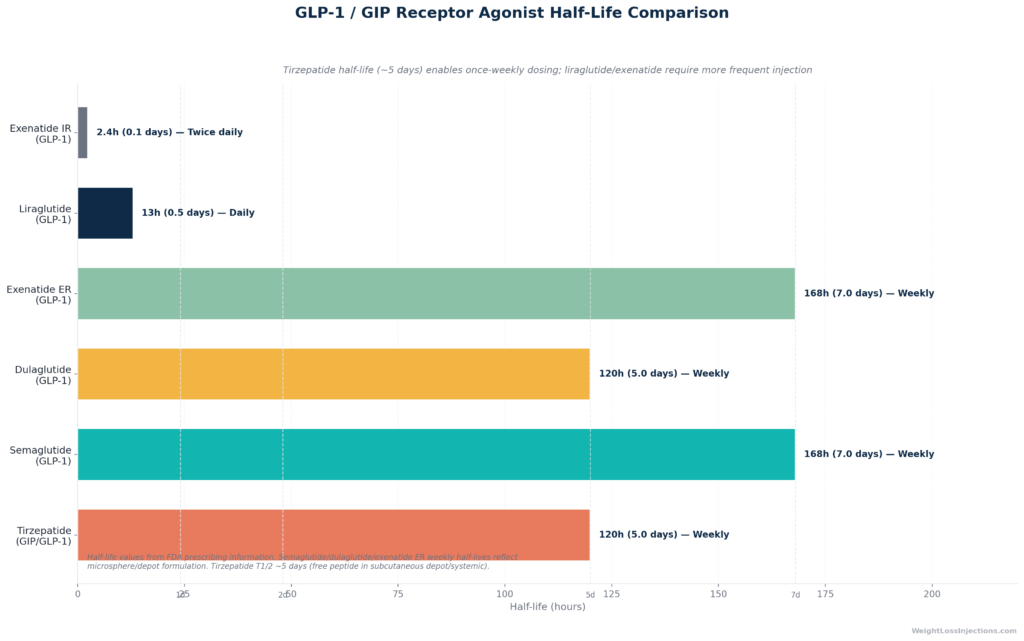
Tirzepatide has a half-life of approximately 5 days, equivalent to 120 hours, as established in the FDA clinical pharmacology review filed for Mounjaro NDA 215866. (FDA Clinical Pharmacology Review NDA 215866) This is the key number that enables weekly dosing: with a half-life longer than the dosing interval, substantial drug concentration remains at the time of each new injection — maintaining continuous receptor activation throughout the week.
To put this number in context: native glucagon-like peptide-1 (GLP-1), the gut hormone tirzepatide partially mimics, has an endogenous half-life of approximately 1–2 minutes in the circulation before being cleaved by the enzyme dipeptidyl peptidase-4 (DPP-4). Tirzepatide’s engineered half-life of 120 hours is approximately 3,600–7,200 times longer than the natural hormone. That amplification is the entire pharmaceutical achievement of the molecule’s design.
For comparison, semaglutide (the GLP-1 receptor agonist in Ozempic and Wegovy) has a half-life of approximately 7 days — slightly longer than tirzepatide, also enabled by a fatty-acid albumin-binding modification on its backbone, though with different structural specifics.
Half-life decay in practice
The following table shows the approximate percentage of peak plasma concentration remaining at key time points after a single tirzepatide injection, calculated from the ~5-day half-life:
Time after injection
Approximate % of peak concentration remaining
Day 1 (24 hours)
~90%
Day 5 (1 half-life)
~50%
Day 7 (next injection due)
~37%
Day 10 (2 half-lives)
~25%
Day 21 (end of 3 half-lives)
~12%
Day 28 (end of ~4 half-lives)
~6%
Day 35 (~7 half-lives)
~1%
The Day 7 row is clinically meaningful: when the next weekly injection is administered, approximately 37% of the previous week’s concentration remains. This residual drug is why weekly dosing produces a smooth pharmacological effect rather than the peaks and troughs typical of shorter-acting medications.
Why weekly dosing works — and why daily dosing is unnecessary
A drug’s dosing interval must be matched to its half-life. A drug with a 6-hour half-life must be dosed multiple times daily to maintain therapeutic levels. A drug with a 5-day half-life can be dosed weekly and still maintain ~37% of peak concentration at the trough (just before the next dose), enough to sustain meaningful receptor activation throughout the week.
If tirzepatide had the same half-life as natural GLP-1 — a few minutes — it would require near-continuous infusion for therapeutic effect, which is impractical for any chronic outpatient medication. The C20 fatty diacid modification that produces albumin binding is therefore not a cosmetic feature of the molecule but the pharmacokinetic engineering prerequisite for it to be a useful drug at all.
H2 2: The C20 Fatty Diacid Moiety — Why Albumin Binding Is the Key
Tirzepatide’s molecular structure
Tirzepatide is a synthetic 39-amino-acid peptide — a sequence of amino acids assembled to function as a receptor agonist at both the GIP (glucose-dependent insulinotropic polypeptide) receptor and the GLP-1 receptor simultaneously. (StatPearls / NCBI Bookshelf) Its backbone is structurally analogous to native GIP, which itself is 42 amino acids long — though tirzepatide’s sequence has been optimized for receptor affinity, metabolic stability, and pharmacokinetic performance rather than exact structural replication.
The critical pharmacokinetic modification is not within the amino acid chain itself but attached to it: a C20 fatty diacid chain (a 20-carbon dicarboxylic fatty acid) connected via a linker to the lysine residue at position 20 of the peptide backbone. This fatty acid moiety is structurally similar in concept to the modification used in semaglutide (which uses a C18 fatty acid) and long-acting insulin analogs such as insulin detemir — the strategy of attaching a fatty acid to prolong action through albumin binding is well-established in pharmaceutical design, though the specific structural details differ across each molecule.
Conceptual schematic of tirzepatide: 39-amino-acid backbone (blue), C20 fatty diacid moiety at position 20 (amber), linker connecting the two, and albumin as the reversible plasma binding partner (gray). This structural arrangement is what enables the ~5-day half-life.
How albumin binding extends half-life
Albumin is the most abundant protein in human plasma, circulating at approximately 35–50 g/L. It serves as a transport protein for a wide range of endogenous molecules and drugs — fatty acids, bilirubin, hormones, and many pharmaceuticals bind to albumin reversibly, using it as a carrier. Albumin itself has a half-life of approximately 19–21 days — far longer than most drugs.
When tirzepatide’s C20 fatty diacid tail binds to albumin, three pharmacokinetic consequences follow:
Protection from renal filtration. The albumin-tirzepatide complex is too large to pass through the renal glomerular filtration barrier, which protects small free molecules. Without albumin binding, tirzepatide would be filtered by the kidney and excreted rapidly. Bound to albumin, it circulates protected.
Protection from enzymatic degradation. Proteolytic enzymes that cleave peptides have reduced access to albumin-bound tirzepatide. The fatty acid-albumin interaction effectively shields the peptide from the rapid cleavage by DPP-4 and other peptidases that would otherwise destroy it in minutes.
Slow-release reservoir. Albumin binding is reversible. Tirzepatide constantly dissociates from albumin back into its free (unbound) form, where it can interact with GIP and GLP-1 receptors on cell surfaces. The equilibrium between bound and free forms acts as a slow-release depot — the free fraction is pharmacologically active, and the bound fraction is the reservoir. This reversible binding is essential: if tirzepatide bound permanently to albumin, it could not reach its receptors.
DPP-4 resistance: a parallel mechanism
Albumin binding alone is not the only reason for tirzepatide’s extended half-life. The peptide backbone has also been deliberately engineered with alpha-aminoisobutyric acid (Aib) substitutions at positions that are naturally targeted for cleavage by DPP-4. DPP-4 is the circulating enzyme that rapidly cleaves the first two amino acids from the N-terminus of native GLP-1 and GIP, inactivating them. Tirzepatide’s modified N-terminus is resistant to this cleavage. (PMC — Tirzepatide mechanism review 2025)
The clinical implication: tirzepatide’s half-life extension is the product of two independent engineering strategies working in parallel — albumin binding via the fatty acid tail, and DPP-4 resistance via amino acid substitution. Neither alone would achieve the same ~5-day result; together, they produce a pharmacokinetically stable molecule suitable for once-weekly dosing.
Volume of distribution: albumin keeps tirzepatide in the plasma
Tirzepatide has a low volume of distribution — approximately 10–15 liters, roughly the plasma and interstitial fluid volume. (FDA Clinical Pharmacology Review NDA 215866) This is consistent with what albumin binding predicts: rather than distributing widely into tissues (which would give a much higher volume of distribution), tirzepatide stays predominantly in the vascular and interstitial compartment, tethered to albumin. Drugs with high tissue affinity typically have volumes of distribution of hundreds of liters; tirzepatide’s ~10–15 L confirms it does not significantly penetrate tissues beyond the plasma and interstitial space.
Plain-English translation: Think of tirzepatide as a molecule that prefers to stay in the “central compartment” — your bloodstream — rather than diffusing into muscles, fat, or other tissues. Albumin is its anchor in that compartment. This is quite different from lipophilic small-molecule drugs (like many statins or antibiotics) that dissolve into fatty tissues throughout the body and require larger volumes of distribution.
Protein binding: 99% albumin-bound
Approximately 99% of tirzepatide in the plasma is bound to albumin at any given time; only ~1% exists in the free (unbound) form. (FDA Clinical Pharmacology Review NDA 215866) This degree of protein binding is clinically relevant in one specific context: drug-drug interactions via protein-binding displacement. In general, highly protein-bound drugs can, in theory, displace each other from albumin binding sites — temporarily increasing the free fraction of both drugs. However, because the body rapidly redistributes and eliminates the temporarily displaced free drug, this phenomenon is rarely clinically significant in practice, and no protein-binding displacement interactions have been identified as clinically meaningful for tirzepatide.
H2 3: Peak Plasma Concentrations, Tmax, and Steady-State
Time to peak (Tmax): 8–72 hours
After subcutaneous injection, tirzepatide is slowly absorbed from the injection site depot into the systemic circulation. The time from injection to peak plasma concentration (Tmax) ranges from 8 to 72 hours, with a median of approximately 24–48 hours for most patients. (StatPearls / NCBI Bookshelf)
The wide range reflects genuine biological variability in subcutaneous absorption rates — differences in blood flow to the injection site, subcutaneous tissue characteristics, hydration status, body composition, and injection technique all influence how quickly tirzepatide moves from subcutaneous depot into the circulation. This variability is normal and does not indicate inconsistent drug delivery; overall exposure (measured as area under the plasma concentration–time curve, or AUC) is much less variable than Tmax.
Injection site and Tmax
The three FDA-approved subcutaneous injection sites — abdomen, thigh, and upper arm — produce slightly different Tmax values, though AUC (total drug exposure) is similar across sites:
Abdomen: Historically associated with slightly faster absorption (earlier Tmax), likely due to higher local blood flow.
Thigh and upper arm: Similar AUC; Tmax may be slightly delayed compared to abdominal injection, but the difference is not clinically meaningful for most patients.
Clinical guidance: Patients may rotate among all three sites to reduce injection site reactions; no dose adjustment is needed based on site selection. (FDA Mounjaro Label NDA 215866)
What Tmax means clinically
Peak appetite suppression and the most pronounced effects on blood glucose roughly track peak plasma concentration — most patients notice the strongest appetite reduction and greatest early fullness in the 1–3 days following injection. This is consistent with the 24–72 hour Tmax window. By Day 6–7, plasma concentrations are at their weekly trough (~37% of peak at steady state), and some patients notice a modest return of appetite before the next dose. This is a normal pharmacokinetic consequence, not a sign that the drug is failing.
Bioavailability: approximately 80%
Subcutaneous tirzepatide has an absolute bioavailability of approximately 80% — meaning roughly 80% of the injected dose reaches systemic circulation as active drug. (FDA Clinical Pharmacology Review NDA 215866) The remaining ~20% is degraded at or near the injection site before reaching systemic circulation. This is a high bioavailability for a subcutaneous peptide drug, and it is consistent across injection sites, reinforcing that the three approved sites are therapeutically equivalent.
Steady-state: achieved at approximately 4 weeks
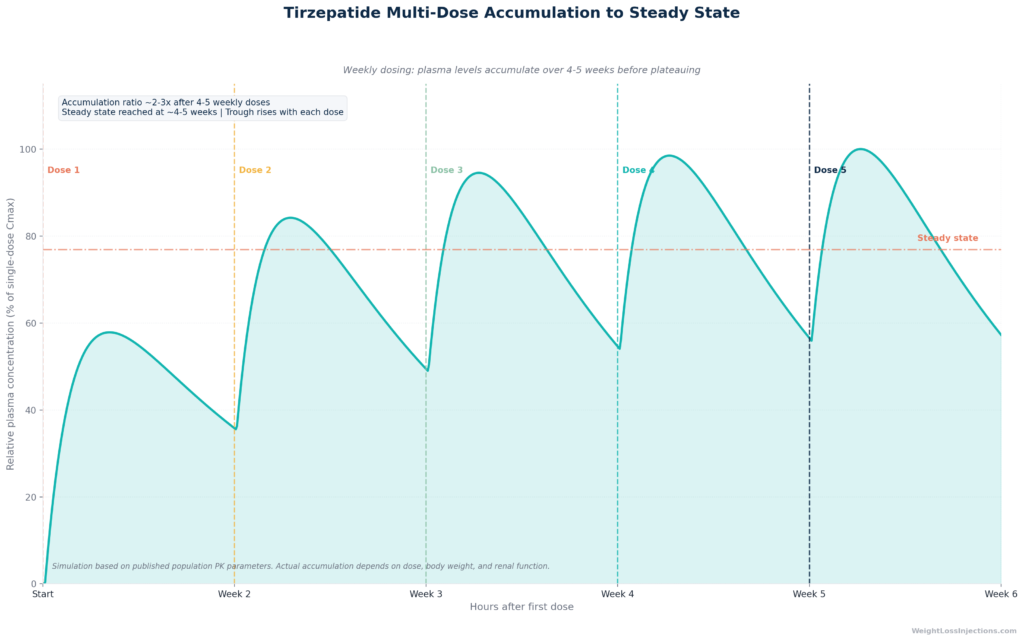
With once-weekly dosing and a ~5-day half-life, each weekly injection adds drug to the system before the previous dose has fully cleared. Over successive weeks, plasma concentrations build until input (each new weekly dose) equals output (weekly elimination), a condition called steady state.
The mathematics: with a half-life of approximately 0.7 weeks (5 days), and a dosing interval of 1 week, it takes approximately 4–5 half-lives — or 4–5 weeks of consecutive weekly injections — to reach steady state. (FDA Clinical Pharmacology Review NDA 215866) At steady state, each weekly trough concentration is approximately 2–3 times higher than the single-dose trough, because residual drug from prior doses accumulates until equilibrium is reached.
Steady-state accumulation: simulated plasma concentration over 6 weeks of once-weekly tirzepatide dosing. Each injection (vertical dotted lines) adds to residual drug from the prior week. Steady state is achieved approximately at week 4–5, with each new peak and trough level plateauing.
Why the 4-week dose escalation step makes pharmacological sense
The standard tirzepatide titration schedule — holding at each dose level for at least 4 weeks before escalating — is not arbitrary. It is calibrated so that each dose step is assessed at or near its steady-state exposure before advancing. Evaluating a new dose before steady state is reached would underestimate both its therapeutic effect and its side-effect burden. The 4-week minimum between dose increases ensures that clinicians and patients are observing a drug level that is representative of what long-term therapy at that dose will look like, not a transient underdose period.
Plain-English translation: If you start 2.5 mg/week on day 1, your body is still building toward steady state through week 4. The appetite-suppressive effect in week 1 is genuinely less than it will be at week 4 — not because the drug isn’t working yet, but because plasma levels are still accumulating. Maximum effect of any given dose is not seen until steady state is reached at approximately 4 weeks.
H2 4: Metabolism, Elimination, and Organ System Considerations
Metabolic pathway: proteolysis and beta-oxidation, not CYP450
Tirzepatide is a peptide drug, and its primary metabolic fate is proteolytic catabolism — the same biochemical process that breaks down dietary proteins. Enzymes called peptidases (proteolytic enzymes distributed throughout the body and blood) cleave the peptide backbone of tirzepatide into its constituent amino acids and short peptide fragments, which are then metabolized via normal amino acid pathways. The C20 fatty diacid moiety undergoes beta-oxidation — the standard pathway for fatty acid metabolism — producing acetyl-CoA units that enter the citric acid cycle. (FDA Clinical Pharmacology Review NDA 215866)
Neither of these metabolic pathways involves cytochrome P450 (CYP450) enzymes — the liver-based enzyme family responsible for metabolizing most small-molecule drugs. This absence of CYP450 involvement is clinically important because it means:
Tirzepatide does not inhibit or induce CYP450 enzymes, so it does not alter the metabolism of CYP-metabolized co-medications.
CYP enzyme inhibitors or inducers (e.g., certain antibiotics, antifungals, antiepileptics) do not meaningfully affect tirzepatide’s metabolism.
The drug-drug interaction profile of tirzepatide, from a metabolic standpoint, is minimal compared to small-molecule pharmaceuticals that compete for CYP enzyme pathways. (FDA Clinical Pharmacology Review NDA 215866)
Excretion: mixed renal and fecal routes
Tirzepatide’s metabolites (not the parent drug) are excreted primarily via two routes: approximately 33% via renal excretion (in urine) and the remainder via fecal/biliary routes and other pathways. The intact parent compound (full-length tirzepatide) is not significantly present in urine because its albumin-bound state prevents glomerular filtration; what is excreted renally are the small-peptide catabolites generated by proteolytic cleavage.
Clearance
Tirzepatide’s systemic clearance is approximately 0.06 L/hr — a very low clearance rate, consistent with the extended half-life. (FDA Clinical Pharmacology Review NDA 215866) Low clearance combined with a small volume of distribution produces the observed long half-life. This is not a coincidence — the molecular engineering that produces albumin binding is precisely what restricts clearance.
Renal impairment: no dose adjustment required
Population pharmacokinetic modeling conducted across patients with mild, moderate, and severe renal impairment — including patients with end-stage renal disease on dialysis — found no clinically significant difference in tirzepatide exposure (AUC, Cmax, or Tmax) compared to patients with normal renal function. (PMC — Population PK Tirzepatide 2024)
No dose adjustment is required for any degree of renal impairment per the current prescribing information. (FDA Mounjaro Label NDA 215866)
This is a particularly reassuring pharmacokinetic property for the tirzepatide patient population. Obesity and type 2 diabetes are leading causes of chronic kidney disease (CKD). A substantial proportion of patients who are candidates for tirzepatide therapy will have some degree of renal impairment. The finding that tirzepatide pharmacokinetics are unaffected by kidney function — from mild CKD all the way to dialysis-dependent ESRD — means no dose adjustment is needed and no additional pharmacokinetic monitoring is required based on renal function alone.
Plain-English translation: If you have kidney disease, including severe CKD, you take the same tirzepatide doses as someone with healthy kidneys. The drug’s behavior in your body is not meaningfully different.
The mechanism underlying this finding is intuitive: because tirzepatide is not renally filtered as intact drug (albumin binding prevents that), the kidneys’ ability to filter it is not relevant to its elimination. Tirzepatide is eliminated primarily by proteolytic catabolism of the peptide, not by renal excretion of the parent molecule. Renal impairment does not impair this catabolic pathway.
Hepatic impairment: no dose adjustment required
Similarly, population PK analysis found no clinically relevant effect of hepatic impairment on tirzepatide exposure. (PMC — Population PK Tirzepatide 2024) Because tirzepatide is not metabolized by hepatic CYP450 enzymes (which are the primary route affected by liver disease), hepatic function does not substantially alter tirzepatide clearance. No dose adjustment is required for patients with hepatic impairment.
Age: no dose adjustment required
Population PK modeling found no clinically meaningful effect of patient age on tirzepatide pharmacokinetics. Elderly patients — including those over 75 — do not require a different tirzepatide dose than younger adults based on PK considerations alone. (PMC — Population PK Tirzepatide 2024) Prescribers may still choose to titrate more cautiously in older patients based on tolerability, but this is not a pharmacokinetic indication.
Body weight and BMI effects: modest, no dose adjustment
Body weight is a covariate in population PK models — lower body weight is associated with modestly higher tirzepatide exposure (higher AUC per mg dose), and higher body weight with slightly lower exposure. (PMC — Population PK Tirzepatide 2024) However, the effect size is not large enough to require weight-based dosing. Tirzepatide is given at fixed weekly doses regardless of patient weight or BMI, and the modest weight-driven variability in exposure is clinically acceptable within the therapeutic window established in clinical trials.
Sex and race: no dose adjustment required
Population PK analysis found no clinically significant differences in tirzepatide pharmacokinetics by sex or race. (PMC — Population PK Tirzepatide 2024) No dose adjustments are recommended on these grounds.
Pediatric pharmacokinetics
Tirzepatide (as Mounjaro) is approved for type 2 diabetes in pediatric patients aged 10–17 years, with a maximum dose of 10 mg once weekly. Zepbound is approved for adults only as of June 2026. Limited pediatric-specific PK data are available, and prescribers should consult the current Mounjaro prescribing information for pediatric-specific guidance. (FDA Mounjaro Label NDA 215866)
Our Top 3 · October 2026
The best GLP-1 providers right now
Independently reviewed. Ranked by price, medication access, provider quality, and patient outcomes.
H2 5: How Pharmacokinetics Differ Between Compounded Vials and the Branded KwikPen
This section addresses a question that frequently arises from patients who have used or are considering compounded tirzepatide: does the pharmacokinetic profile differ from the branded Mounjaro or Zepbound KwikPen?
The short answer is that the active pharmaceutical ingredient is the same molecule, and the same PK parameters apply to the molecule regardless of who manufactures it. The practical answer, however, requires important nuance around salt forms, formulation precision, and dose delivery accuracy — because these factors can meaningfully affect real-world PK outcomes even when the underlying molecule is identical.
The branded KwikPen: standardized formulation
Mounjaro and Zepbound are delivered via a single-dose autoinjector pen (KwikPen) containing tirzepatide in a validated aqueous solution. Each pen is manufactured under FDA Current Good Manufacturing Practice (CGMP) standards to a precise API concentration, validated for stability, sterility, and accurate dose delivery. The device actuates a fixed dose with each use, removing human measurement error from the delivery equation. (FDA Mounjaro Label NDA 215866)
The PK parameters discussed throughout this article — half-life ~5 days, Tmax 8–72 hours, bioavailability ~80%, steady state at 4 weeks — are all derived from clinical studies using the branded formulation.
Compounded aqueous multi-dose vials
When a 503A pharmacy lawfully compounds tirzepatide for an individual patient, the product is most commonly an aqueous solution in a multi-dose vial. From a pharmacokinetic standpoint, the absorption, distribution, metabolism, and elimination profile should approximate the branded product if the API concentration and salt form are equivalent, the formulation is correctly prepared, and the patient uses accurate self-injection technique with appropriate needle gauge and injection depth.
However, several factors introduce variability:
Multi-dose vial contamination risk: Each time a needle is inserted to withdraw a dose, there is a risk of introducing microorganisms. Compounded multi-dose vials typically have shorter beyond-use dates than single-dose devices and require careful aseptic technique.
Dose precision by syringe: Unlike the KwikPen, which delivers a pre-set volume, compounded vials require patients to draw up the intended dose volume using an insulin syringe. Measurement errors — particularly with small volumes — add variability on top of the biological variability already present in subcutaneous absorption. A 10% syringe measurement error at a 5 mg dose results in anywhere from 4.5 to 5.5 mg delivered, a range that matters at lower doses more than at maintenance.
Lyophilized powder: the reconstitution risk
Compounded tirzepatide has also been distributed as lyophilized (freeze-dried) powder requiring patient-performed reconstitution with bacteriostatic water before injection. This formulation introduces a more serious dose accuracy risk. The FDA has documented adverse event reports where improper reconstitution — using an incorrect diluent volume, incomplete dissolution of the powder, or calculation errors — delivered 5–10 times the intended dose, resulting in severe hypoglycemia and other serious adverse events. (FDA GLP-1 Compounding Clarification Page)
This is a pharmacokinetic safety issue, not merely a quality-of-care issue: a superpotent dose produces a Cmax far above the therapeutic range, with proportionally higher risk of GI toxicity, hypoglycemia (particularly if on concurrent insulin or sulfonylureas), and other adverse effects. The half-life remains the same ~5 days, but if the initial dose is 5–10× the intended amount, the area under the curve is similarly elevated throughout that entire 5-day period.
Salt form variability
Branded tirzepatide uses a specific salt form validated in the clinical trial program. Compounded products have historically been prepared using tirzepatide free base, tirzepatide hydrochloride, or tirzepatide acetate — and bioequivalence between these salt forms has not been formally established. Different salt forms can differ in solubility, stability, and absorption rate, potentially affecting Tmax and overall AUC relative to the branded formulation. The FDA has cited salt form variability as a pharmacokinetic concern in compounded GLP-1 receptor agonist preparations. (FDA GLP-1 Compounding Clarification Page)
Bottom line: same molecule, higher delivery uncertainty
For patients receiving compounded tirzepatide through the narrow lawful 503A pathway — from a licensed pharmacy, under a specific patient-tailored prescription, using accurate self-injection technique — the pharmacokinetic profile is substantially similar to branded. The same molecule enters the same albumin-binding equilibrium, undergoes the same proteolytic catabolism, and produces the same ~5-day half-life.
The difference is in delivery precision and formulation reliability: the branded KwikPen eliminates device-level variability in dose accuracy; compounded vials introduce it. For most experienced self-injectors using correctly prepared aqueous compounded vials at the same dose as a branded pen, real-world PK will closely approximate the branded product. The risk increases with lyophilized powder, uncertain salt forms, and patients new to self-injection.
H2 6: What Happens Pharmacokinetically When You Miss a Dose
Missing a weekly tirzepatide injection is not a pharmacological emergency — and the ~5-day half-life is the reason. Understanding what happens at the plasma level when a dose is skipped helps patients and prescribers calibrate the appropriate clinical response.
Missed-dose decision flowchart based on FDA Mounjaro prescribing information. Always verify current guidance with your prescriber or pharmacist.
The pharmacokinetic picture at the missed-dose threshold
At Day 7 — when a weekly dose is due — approximately 37% of the previous week’s peak concentration remains. If that dose is not taken, the plasma concentration continues to decline along the exponential decay curve. By Day 10 (two days after the missed injection), approximately 25% of the original dose remains. By Day 14 (one week after the missed dose), approximately 12–13% remains — now well below the trough concentrations typical of steady-state dosing.
The gradual nature of this decline is exactly why tirzepatide does not produce an abrupt loss of effect when a single dose is missed: plasma levels decline over days, not hours.
Missed dose guidance per prescribing information
The FDA-approved Mounjaro prescribing information provides specific missed-dose instructions based on how many days have elapsed since the missed injection: (FDA Mounjaro Label NDA 215866)
If ≤4 days (96 hours) have passed since the missed dose: Take the missed dose as soon as possible, then resume the regular weekly schedule. The next scheduled injection date does not change.
If >4 days (more than 96 hours) have passed since the missed dose: Skip the missed dose entirely. Resume at the next regularly scheduled injection date. Do not take two doses within 3 days of each other.
The 4-day threshold is pharmacokinetically grounded: within 4 days, substantial drug concentration remains (~50% of peak at day 5), and re-dosing at the normal schedule after a short gap minimally disrupts steady state. Beyond 4 days, plasma levels are low enough that taking the missed dose and then the regularly scheduled dose in rapid succession (within a few days) would produce an excessive cumulative dose — hence the instruction to skip and resume on schedule.
Critical rule: never double-dose. Taking two doses in close succession does not restore lost steady-state levels faster; it simply delivers twice the single-dose exposure over an abbreviated time window, increasing GI side effects and hypoglycemia risk without proportional clinical benefit.
What patients typically experience after a missed dose
Appetite suppression gradually lessens as plasma concentrations fall below steady-state trough levels, typically noticeable by Day 10–12 without re-dosing.
Blood glucose control may worsen in patients with type 2 diabetes, as tirzepatide’s insulin-stimulating and glucagon-suppressing effects diminish with falling plasma concentrations.
GI effects may temporarily return when resuming after a prolonged gap. If plasma levels have fallen significantly and steady state must be partially re-established, the reintroduction of effective tirzepatide concentrations may produce nausea or other GI symptoms similar to those experienced during initial titration. Patients who experienced significant GI side effects early in treatment may want to discuss resumption protocols with their prescriber after a prolonged interruption.
Steady-state disruption and recovery
A single missed dose modestly disrupts steady state — plasma levels at the subsequent week’s trough are somewhat lower than they would have been — but do not meaningfully alter the overall steady-state equilibrium. Two to three consecutive missed doses bring plasma levels back toward single-dose (non-steady-state) concentrations. Resuming weekly injections after a multi-week interruption will re-establish steady state within approximately 3–4 weeks, following the same initial accumulation curve described earlier.
“How long does tirzepatide stay in your system?” — the calculation
Based on the ~5-day half-life:
Half-lives elapsed
Days since last dose
% remaining
Status
1
~5
~50%
Drug still clinically active
2
~10
~25%
Appetite suppression noticeably declining
3
~15
~12%
Minimal clinical effect
5
~25
~3%
Drug considered essentially cleared
7
~35
~1%
Drug essentially absent
For surgical planning: Anesthesiologists frequently ask about GLP-1/GIP agonist use prior to procedures due to the risk of delayed gastric emptying and aspiration under anesthesia. The pharmacokinetically relevant question is not only “has the drug been eliminated?” but also “has gastric motility returned to baseline?” — which may lag plasma level clearance. Current anesthesiology guidance (which evolves; patients should follow their specific anesthesiologist’s pre-operative instructions) generally recommends disclosing tirzepatide use and discussing an appropriate pre-operative hold period. Patients should always inform their surgical team and anesthesiologist of tirzepatide use at the pre-operative consult.
Discontinuation kinetics and washout
If tirzepatide is permanently discontinued, weight regain typically begins within 2–4 weeks as plasma concentrations fall below therapeutically effective levels. Clinical effects on appetite and blood glucose diminish meaningfully within 2–3 weeks. The SURMOUNT-4 withdrawal study demonstrated that patients who discontinued tirzepatide after 36 weeks regained an average of +14.0% body weight from their week-36 baseline over the subsequent 52 weeks — illustrating that weight loss is not maintained after discontinuation. (SURMOUNT-4 — JAMA 2024) The pharmacokinetics of washout are straightforward: drug levels decline along the same half-life decay curve, and clinical effects track that decline.
Frequently Asked Questions
Tirzepatide has a half-life of approximately 5 days (120 hours). This extended half-life, engineered via a C20 fatty diacid structure that binds reversibly to albumin in the blood, is what allows once-weekly subcutaneous injection. After each injection, tirzepatide plasma concentration decreases gradually over the following days, with approximately 37% of peak concentration remaining when the next dose is due on Day 7. (FDA Clinical Pharmacology Review NDA 215866)
Based on the ~5-day half-life, tirzepatide reaches approximately 97% elimination after 25 days (5 half-lives) following the last injection, and is essentially fully cleared (>99%) after approximately 35 days (7 half-lives). Clinical effects on appetite and blood sugar typically diminish meaningfully within 2–3 weeks of stopping. (FDA Clinical Pharmacology Review NDA 215866)
Steady state is reached after approximately 4–5 weeks of consecutive once-weekly dosing. At steady state, each weekly dose adds to residual drug from prior weeks, resulting in peak and trough plasma concentrations approximately 2–3× higher than those from a single dose alone — which is why full therapeutic effect is not experienced in the first 1–2 weeks of treatment. (FDA Clinical Pharmacology Review NDA 215866)
No. Population pharmacokinetic studies found no clinically significant difference in tirzepatide exposure across patients with mild, moderate, or severe renal impairment, including end-stage renal disease on dialysis. No dose adjustment is required for any level of renal impairment. This is because tirzepatide is eliminated by proteolytic catabolism of the peptide, not by direct renal filtration of the parent molecule. (PMC — Population PK Tirzepatide 2024)
Per the Mounjaro prescribing information: if ≤4 days (96 hours) have passed since the missed dose, take it as soon as you remember and resume your regular weekly schedule. If more than 4 days have passed, skip the missed dose and resume at the next planned injection date. Never take two doses within 3 days of each other. (FDA Mounjaro Label NDA 215866)
No. Tirzepatide is metabolized by proteolytic cleavage of the peptide backbone and fatty acid beta-oxidation — not by CYP450 enzymes. It does not inhibit or induce hepatic drug-metabolizing enzymes, so it does not create the drug-drug interaction profile common with many small-molecule pharmaceuticals that compete for CYP pathways. (FDA Clinical Pharmacology Review NDA 215866)
Summary: Key Pharmacokinetic Parameters at a Glance
FDA GLP-1 Compounding Clarification Page — Source for compounding adverse event data (superpotency from lyophilized powder), salt form safety concerns, and current 503A/503B legal framework.
SURMOUNT-4 — JAMA 2024 (PubMed) — Source for weight regain data post-discontinuation, establishing clinical consequences of drug washout.
This content is for informational purposes only and does not constitute medical advice. Consult a licensed healthcare provider before starting, stopping, or changing any medication. WeightLossInjections.com is a health information resource, not a prescribing service.

![Unbranded [pillar-drug-class] injection pen on a neutral background — WeightLossInjections.com editorial hero](https://weightlossinjections.com/wp-content/uploads/2026/07/hero_tirzepatide_c2_dosing-1200x675.png)