![Unbranded [pillar-drug-class] injection pen on a neutral background — WeightLossInjections.com editorial hero](https://weightlossinjections.com/wp-content/uploads/2026/07/hero_tirzepatide_c3_safety-1200x675.png)
Medical & Legal Disclaimer: This article discusses compounded tirzepatide, including products that are no longer legally available in most circumstances due to FDA regulatory changes in 2025. This content is for informational and harm-reduction purposes and does not constitute medical advice. Consult a licensed healthcare provider for treatment guidance. The legal information here is educational — consult a healthcare attorney or pharmacist for specific legal questions.
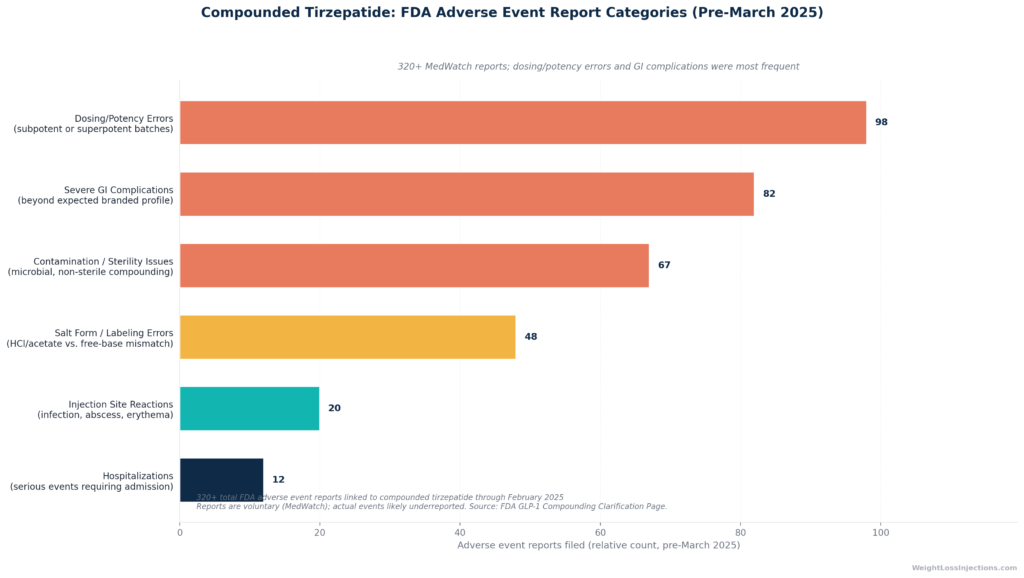
Horizontal bar chart titled “Types of Adverse Events Reported with Compounded Tirzepatide (Pre-March 2025)” — categories: Dosing/Potency Errors, Severe GI Complications, Contamination/Sterility…
- The tirzepatide molecule itself has a well-established safety profile confirmed across tens of thousands of patients in the SURMOUNT and SURPASS clinical trial programs. The safety concerns covered in this article are largely specific to how compounded tirzepatide was manufactured and handled — not the drug’s pharmacology.
- The FDA received more than 320 adverse event reports linked to compounded tirzepatide through February 2025, primarily involving dosing errors, contamination, and quality-control failures that are not observed with branded Zepbound. (FDA GLP-1 Compounding Clarification Page)
- A key risk was superpotency from lyophilized powder reconstitution errors — patients who self-mixed dry powder with diluent could inadvertently receive 5–10 times the intended dose.
- The salt form controversy — some pharmacies used tirzepatide hydrochloride or acetate instead of the free-base form in branded products — created additional dose-accuracy gaps that the FDA specifically flagged.
- Mass-market compounding ended in February–March 2025 after the FDA declared the tirzepatide shortage resolved in December 2024. (FDA Declaratory Order — PDF)
- A narrow 503A personalized-medicine exception survives for documented cases (e.g., cresol allergy) at ≤4 prescriptions per pharmacy per month. This is not a consumer pathway — it is a genuine edge-case exception. (FDA GLP-1 Compounding Clarification Page — April 1, 2026 update)
- The safest, most legally straightforward path in 2026 is FDA-approved Zepbound, now available through LillyDirect self-pay at $299–$699/month — dramatically below the retail pharmacy price of $1,086/month. (Healthy Meals Incentives — Tirzepatide cost 2026)
- If you experienced unusual or severe symptoms while using compounded tirzepatide before March 2025, this article explains what likely happened — and when to seek medical evaluation.
The Legal Landscape First: Why Most Compounded Tirzepatide No Longer Exists
Before we can meaningfully discuss the safety of compounded tirzepatide, we have to establish what product we’re talking about — because the answer to “is compounded tirzepatide safe in 2026?” depends heavily on where the tirzepatide came from and when.
From late 2022 through early 2025, compounded tirzepatide was widely available through telehealth platforms and compounding pharmacies at a fraction of the branded drug’s cost. This market was large, active, and — crucially — legal. It was legal because tirzepatide appeared on the FDA’s official Drug Shortage List, and federal law permits compounding pharmacies to produce essentially-copy versions of FDA-approved drugs when those drugs are on the shortage list. Tirzepatide was added to the shortage list on December 15, 2022, shortly after Mounjaro’s explosive commercial launch overwhelmed Eli Lilly’s manufacturing capacity. (FDA Declaratory Order, Dec 19, 2024 — PDF)
That legal basis closed when the FDA formally resolved the shortage. Here is the full timeline of how that happened:
| Date | Regulatory Event |
|---|---|
| Dec 15, 2022 | Tirzepatide added to FDA Drug Shortage List; 503A/503B compounding authority begins |
| Dec 19, 2024 | FDA issues Declaratory Order reaffirming shortage resolved; shortage-exemption basis for compounding ends (FDA Declaratory Order — PDF) |
| Feb 18, 2025 | 503A (state-licensed pharmacy) enforcement grace period ends; mass compounding by traditional pharmacies subject to enforcement (FDA GLP-1 Compounding Clarification Page) |
| Mar 10, 2025 | Federal court denies OFA’s preliminary injunction; 503A legal challenge collapses (Alliance for Pharmacy Compounding — a4pc.org) |
| Mar 19, 2025 | 503B (outsourcing facility) grace period ends; all 503B tirzepatide compounding categorically prohibited (FDA GLP-1 Compounding Clarification Page) |
| Apr 1, 2026 | FDA clarifies narrow ≤4 Rx/month 503A personalized-medicine exception (FDA GLP-1 Compounding Clarification Page — April 1, 2026 update) |
| Apr 30, 2026 | FDA proposes formal exclusion of tirzepatide from 503B Bulks List; comment period closes June 29, 2026 (FDA Press Announcement, April 30, 2026) |
What still legally exists in 2026: A single, narrow pathway. A licensed 503A compounding pharmacy may compound tirzepatide for an individual patient if a prescriber documents a clinically significant difference — such as a documented allergy to cresol, the preservative in branded Zepbound and Mounjaro pens — and the pharmacy fills no more than four such prescriptions per calendar month. (FDA GLP-1 Compounding Clarification Page — April 1, 2026 update) Cost preference, vial format preference, and generic “personalization” language do not qualify. The ≤4 Rx/month cap per pharmacy is designed to ensure this remains a genuine edge-case exception, not a population-scale alternative to branded tirzepatide.
Be explicit about what doesn’t qualify: If you are being offered compounded tirzepatide through a subscription service, a bulk-discount program, or without documented individualized clinical justification, that product is not compliant with current FDA rules. This matters for safety, because non-compliant compounding carries real quality-control risks that FDA-inspected manufacturing does not. For a complete legal analysis, see our companion article Is compounded tirzepatide legal in 2026?.
Many readers searching for “compounded tirzepatide safety” in 2026 are doing so because they used this product before March 2025, when it was legal and widely prescribed. Others may still be encountering it from gray-market vendors, overseas sources, or pre-March 2025 stockpiles still circulating. This article addresses the safety data from both the historic period and the risks from ongoing non-compliant sources — so you have the complete picture regardless of your situation.
What the FDA Adverse Event Data Shows
Vertical timeline infographic titled “FDA Tirzepatide Compounding Enforcement Timeline” — key milestones from Dec 2022 (shortage listed) through Apr 2026 (503A clarification) and Apr 2026 (503B…
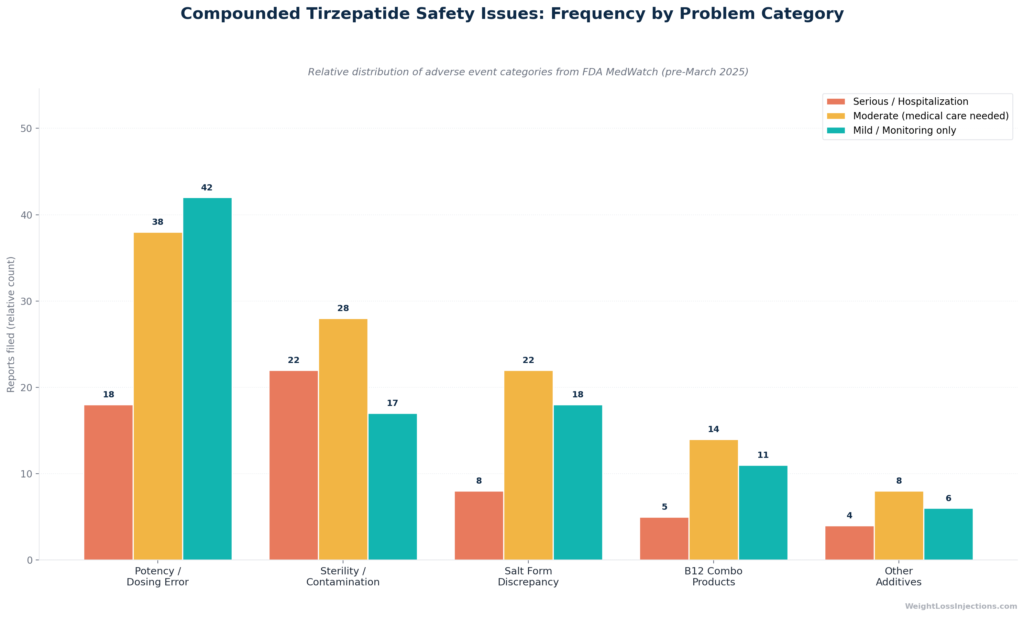
The most important safety dataset for compounded tirzepatide comes from the FDA’s MedWatch voluntary adverse event reporting system. Through February 2025 — the period during which compounded tirzepatide was at peak market penetration — the FDA received more than 320 adverse event reports linked to compounded tirzepatide. (FDA GLP-1 Compounding Clarification Page) Understanding this data requires both an honest look at what it shows and appropriate caution about what it doesn’t.
The Four Categories of Documented Problems
The FDA documented four primary categories of compounded tirzepatide adverse events:
1. Dosing and potency errors. This was the most consequential category. Two distinct problems appeared: subpotent batches, where patients received less active drug than labeled — resulting in inadequate clinical response and wasted money — and superpotent batches, where patients received dramatically more drug than intended. The superpotency cases were particularly concerning. Some compounded tirzepatide was dispensed as a lyophilized (freeze-dried) powder that patients were required to reconstitute themselves by mixing with bacteriostatic water or saline. A reconstitution error — drawing the wrong diluent volume, misreading a syringe, or using an incorrect technique — could result in a patient injecting 5 to 10 times the intended dose. (FDA GLP-1 Compounding Clarification Page) Branded Zepbound and Mounjaro are supplied as pre-mixed, ready-to-inject solutions — no patient reconstitution is involved, and this category of error is structurally impossible with the branded product.
2. Severe gastrointestinal events. GI side effects — nausea, vomiting, diarrhea — are expected with tirzepatide and are dose-dependent and well-characterized in the clinical trial literature. The SURMOUNT program reported GI adverse events in 39% to 49% of participants at various doses. (Dr. Oracle — Tirzepatide adverse effects) What the FDA’s compounding adverse event reports showed was a pattern of severe GI events at a rate and intensity inconsistent with the drug’s known clinical profile — strongly suggesting superpotency as the cause. Patients who inadvertently received 5–10× their intended dose would experience GI effects proportional to that overdose, not to the labeled dose.
3. Contamination and sterility failures. Tirzepatide is an injectable drug administered subcutaneously — which means sterility is non-negotiable. The FDA’s adverse event reports included cases of microbial contamination from compounding environments that did not meet the sterility standards required for injectable preparations. Contaminated injectables can cause local infections at the injection site and, in severe cases, systemic infections. These events are not a property of tirzepatide as a molecule — they are entirely attributable to manufacturing environment failures in non-FDA-inspected compounding operations. (FDA MedWatch database)
4. Salt form and labeling errors. Some compounded tirzepatide products were manufactured using a different chemical form of the API than the branded product, and labeled in ways that may not have accurately reflected the amount of active drug. This category — the salt form controversy — is important enough to warrant its own section below.
How to Interpret This Data Accurately
The 320+ MedWatch reports deserve context. The MedWatch system is a voluntary reporting mechanism — healthcare providers, patients, and pharmacies submit reports when they observe adverse events, but there is no legal requirement to do so. This means the actual number of adverse events associated with compounded tirzepatide is almost certainly higher than the reported figure. The FDA uses these reports to identify safety signals, not to calculate true population incidence rates. (Potere Health MD overview, 2026)
At the same time, the fact that 320+ reports emerged in the context of a drug with an otherwise well-established, predictable safety profile — confirmed across tens of thousands of patients in controlled clinical trials — indicates a real quality-control problem specific to the compounded supply chain. These were not events that would have appeared in Eli Lilly’s clinical trial data. They were events generated by manufacturing practices that the clinical trial program, with its rigorous CGMP manufacturing, was never designed to replicate.
The key interpretive frame: the tirzepatide molecule is not the variable. The adverse events documented in the compounding era were not evidence that tirzepatide itself is unsafe when properly manufactured. They were evidence of quality-control failures in an unregulated supply chain. Branded Zepbound’s side effect profile — well-characterized GI effects, dose-dependent and manageable — remained consistent throughout. The compounding adverse events represented a different, superimposed risk layer.
What Was Hospitalized?
A subset of the 320+ adverse event reports included hospitalizations. (FDA GLP-1 Compounding Clarification Page) The precise number of hospitalizations is not publicly disaggregated in FDA public documents, but their presence in the signal confirms that at least some adverse events from compounded tirzepatide were serious enough to require acute medical care. Given the superpotency data — patients potentially receiving 5–10× intended doses — this is not surprising. Severe nausea and vomiting at that exposure level can cause dehydration, electrolyte imbalance, and in susceptible patients, acute kidney injury secondary to volume depletion. (NCBI LiverTox — Tirzepatide)
Quality-Control Differences — FDA-Approved vs. Compounded Tirzepatide
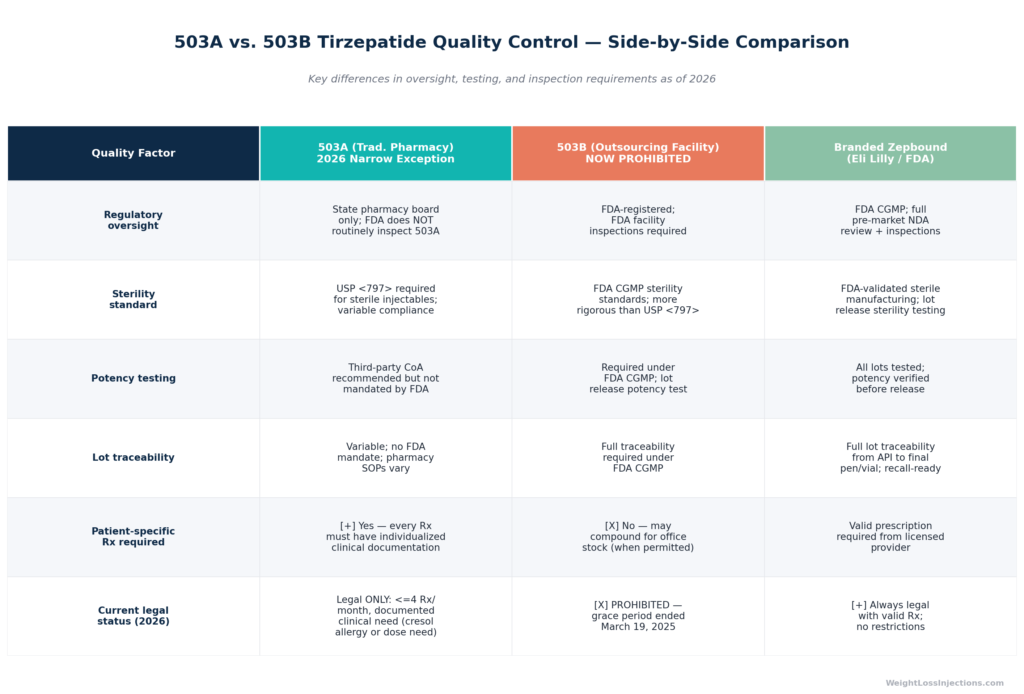
To understand why the safety profiles differ so substantially, you need to understand the structural differences between how branded tirzepatide is manufactured and how compounded tirzepatide was produced. These are not minor regulatory distinctions — they represent fundamentally different quality-assurance architectures.
How Branded Zepbound Is Manufactured
Zepbound and Mounjaro are manufactured by Eli Lilly under Current Good Manufacturing Practice (CGMP) regulations — the FDA’s most stringent manufacturing standard, which governs pharmaceutical manufacturing for commercial drugs. CGMP requires: (FDA Mounjaro label NDA 215866 — PDF)
- Full lot release testing before any batch ships: potency testing confirms each lot contains the labeled amount of active tirzepatide within tight specifications; sterility testing confirms freedom from microbial contamination; identity testing confirms the correct molecule was used; purity testing identifies and quantifies any impurities; stability testing validates shelf life under specified storage conditions.
- Full lot traceability from API sourcing through final pen assembly — every manufacturing step is documented and auditable.
- FDA facility inspections on a regular cycle; Lilly’s manufacturing compliance history is publicly accessible through the FDA’s inspection database.
- Validated stability data: the shelf life and storage conditions printed on every Zepbound pen are not estimates — they are derived from controlled stability studies confirming potency and sterility through the stated expiration date.
When you inject a Zepbound pen, you can be confident the labeled dose is what you’re getting, the product is sterile, and it has been manufactured under the most rigorous quality system available for pharmaceutical products. (StatPearls / NCBI Bookshelf)
How 503A Compounding Pharmacies Operated
Traditional 503A compounding pharmacies operate under a fundamentally different regulatory architecture. They are licensed and inspected by state pharmacy boards, not by the FDA. For 503A pharmacies, there is no federal requirement for lot release testing before product ships. There is no FDA facility inspection on a predictable schedule. The quality-assurance infrastructure varies substantially from pharmacy to pharmacy — some 503A operations invest in rigorous third-party testing and clean-room environments that approximate pharmaceutical-grade standards; others do not. (FDA GLP-1 Compounding Clarification Page)
What 503A pharmacies are required to do for sterile injectables: comply with USP \<797>, the U.S. Pharmacopeia’s sterile compounding standards, which govern clean-room design, personnel gowning, environmental monitoring, beyond-use dating, and quality testing for sterile injectable preparations. USP \<797> compliance is enforced through state board inspections. The standard sets a meaningful floor — but it is not CGMP, and the inspection frequency and rigor varies significantly by state.
The practical result is significant variability. A 503A pharmacy with PCAB (Pharmacy Compounding Accreditation Board) accreditation, rigorous third-party testing, and a well-run USP \<797>-compliant clean room can produce high-quality sterile injectables. A 503A pharmacy with minimal state oversight, no third-party CoA, and inadequate clean-room practices can produce product that poses real contamination and potency risks. From the outside, patients had limited ability to distinguish between these operations.
503B Outsourcing Facilities — A Middle Tier Now Prohibited
503B outsourcing facilities occupied a middle ground: FDA-registered and subject to CGMP inspections, with more robust quality infrastructure than most 503A pharmacies. They served the wholesale side of the compounded tirzepatide market, supplying clinics and telehealth platforms in bulk. Their quality standards were meaningfully higher than most 503A operations — but their authority to compound tirzepatide ended entirely on March 19, 2025, with no exceptions remaining. (FDA GLP-1 Compounding Clarification Page) On April 30, 2026, the FDA proposed formally excluding tirzepatide from the 503B Bulks List, which would permanently codify this prohibition. (FDA Press Announcement, April 30, 2026)
The Reconstitution Problem in Detail
A specific quality-control failure point that drove a significant portion of the adverse event signal deserves direct attention: the lyophilized powder reconstitution problem.
Some compounding pharmacies dispensed tirzepatide as freeze-dried powder in a vial, requiring the patient to add a diluent (typically bacteriostatic water) before injection. This format was less expensive to produce and ship. The problem: reconstitution requires precise measurement. If a patient is instructed to add 1 mL of diluent to a vial containing, say, 10 mg of tirzepatide — and they add 0.1 mL by mistake — they have just created a 10× concentrated solution. Each unit-volume they draw up for injection will contain ten times the intended dose.
Reconstitution errors are well-documented causes of medication errors across all injectable compounded drugs. In the tirzepatide context, the consequences could be severe GI toxicity (driven by the known dose-response relationship of tirzepatide’s GI effects), cardiovascular symptoms, dehydration, and hospitalization. Branded Zepbound and Mounjaro autoinjector pens contain a pre-mixed, pre-calibrated solution — there is no patient reconstitution step, and this entire category of error does not exist. (FDA GLP-1 Compounding Clarification Page)
Our Top 3 · October 2026
The best GLP-1 providers right now
Independently reviewed. Ranked by price, medication access, provider quality, and patient outcomes.
Renew GLP
Personalized GLP-1, GIP plans: Semaglutide & Tirzepatide.
Medvi
No membership or hidden fees. Everything you need is included.
Trimi
US-licensed clinicians and shipped to your door, from $99/mo.
The Salt Form Controversy — Tirzepatide Base vs. Hydrochloride vs. Acetate
Styled side-by-side comparison table titled “Branded vs
One of the more technically nuanced — and practically important — safety issues associated with compounded tirzepatide involves the salt form of the API used. This issue drove significant discussion on patient forums and medical websites during the compounding era and was specifically flagged by the FDA.
What “Salt Form” Means in Plain Language
Think of salt form as the chemical packaging around the active molecule. The active ingredient in branded Zepbound and Mounjaro is tirzepatide in its free-base form — essentially the pure drug molecule without any attached chemical counterion. Some compounding pharmacies, however, sourced their tirzepatide API as the hydrochloride salt (tirzepatide HCl) or the acetate salt (tirzepatide acetate). These are the same active ingredient — tirzepatide — but packaged differently at the molecular level.
Here is why this matters for dosing: different salt forms have different molecular weights. The free base of tirzepatide has a specific molecular weight; when you attach a hydrochloride or acetate counterion to form a salt, the total molecular weight increases. A “5 mg” vial labeled based on the salt form weight therefore contains less active tirzepatide than a “5 mg” dose of the free-base form, because some of that 5 mg is the counterion rather than the active drug.
The Dose-Accuracy Gap
If a compounding pharmacy labeled its doses based on the salt form weight — that is, called a vial “5 mg tirzepatide HCl” — but patients and prescribers interpreted that as equivalent to 5 mg of tirzepatide free base, the patient was receiving a lower amount of active drug than intended. This could explain cases where patients on compounded tirzepatide reported reduced efficacy compared to their experience with the branded product — not because tirzepatide doesn’t work, but because they were effectively on a lower dose than their prescription specified.
Conversely, if a pharmacy used the free-base weight calculations for a salt-form preparation — labeling based on free-base equivalent weight — and the resulting concentration was slightly off, patients could receive more drug than intended.
The FDA has been explicit about this issue: branded Zepbound and Mounjaro contain tirzepatide in the free-base form. Compounded products using alternative salt forms without documented equivalence testing create a dose-accuracy gap that the FDA considers a compliance and safety concern. (FDA GLP-1 Compounding Clarification Page) The agency specifically flagged combination products (such as tirzepatide + B12) and alternative salt-form preparations as areas where essentially-copy standards are most likely to be violated.
How This Interacted with the B12 Combination Trend
The salt form issue intersected with another common compounding trend: the tirzepatide + vitamin B12 combination, which was marketed heavily during the compounding era as offering enhanced efficacy or tolerability. The FDA’s position is clear: a tirzepatide combination product formulated at a strength within 10% of a commercially available Zepbound dose is considered an essentially-copy product under the agency’s definition, regardless of the added ingredient. (FDA GLP-1 Compounding Clarification Page — April 1, 2026 update) The evidence base for B12 co-administration with tirzepatide is also nonexistent from a clinical standpoint — no RCT has evaluated it. Chronic high-dose cyanocobalamin carries its own risk profile in renally impaired patients.
Current Relevance
For patients who received compounded tirzepatide before March 2025, the salt form question may partially explain experiences with reduced efficacy or unexpected side effects — depending on what your pharmacy used and how they labeled their product. For the narrow population exploring the 503A exception in 2026, asking the pharmacy explicitly about the API source and salt form is appropriate and prudent. Any compliant pharmacy using tirzepatide as an API should be able to confirm whether they are working with the free base or a salt form and explain how they account for this in their dosing.
How to Evaluate a Compounding Pharmacy’s Quality Standards (2026)
This section is written specifically for the narrow population of patients who may legitimately qualify for the 503A personalized-medicine exception — primarily those with a documented allergy to cresol (the preservative in branded tirzepatide pens) or a documented need for a non-standard intermediate dose strength their prescriber has determined cannot be met by the commercially available Zepbound titration schedule.
For the majority of patients who were using compounded tirzepatide primarily for cost reasons, this section will be less immediately applicable — the narrow exception is not a cost pathway, and “I prefer a less expensive option” does not meet the clinical documentation standard. The most accessible legal path for that larger group is LillyDirect self-pay, discussed in the next section.
For those in the narrow qualifying group, here is a step-by-step evaluation framework:
Step 1: Verify the pharmacy’s active state license. Every legitimate compounding pharmacy has a state board of pharmacy license that you can verify independently. Go to the relevant state’s pharmacy board website, enter the pharmacy’s name or license number, and confirm the license is active and has no disciplinary history. The National Association of Boards of Pharmacy (NABP) also offers a lookup tool at nabp.pharmacy that can help identify licensed pharmacies. If a pharmacy cannot provide a specific license number, that is an immediate disqualifying red flag.
Step 2: Check for PCAB accreditation. The Pharmacy Compounding Accreditation Board (PCAB) is a voluntary accreditation program that signals a compounding pharmacy has met quality standards above the state board minimum. PCAB accreditation is not required, but its presence is a meaningful positive signal for quality. You can verify PCAB accreditation directly at pcabaccreditation.org.
Step 3: Confirm 503A (not 503B) status. Because 503B outsourcing facilities cannot legally compound tirzepatide under any circumstances, and some may still be attempting to do so in violation of FDA guidance, it is important to confirm that the facility filling your prescription is a traditional 503A pharmacy — not a 503B outsourcing facility. The FDA maintains a searchable database of registered outsourcing facilities at FDA.gov. If the facility you’re considering appears in that database, it is a 503B and cannot legally compound tirzepatide. (FDA GLP-1 Compounding Clarification Page)
Step 4: Require a Certificate of Analysis (CoA) from an ISO 17025-accredited laboratory. A legitimate 503A compounding pharmacy preparing sterile injectable tirzepatide should provide a third-party CoA for each batch confirming: API identity (confirming the correct molecule), potency (confirming the labeled amount is present, within ±10%), sterility (confirming freedom from microbial contamination), and endotoxin testing. The laboratory issuing this CoA should hold ISO 17025 accreditation — the international standard for analytical testing laboratories. In-house testing by the pharmacy itself does not substitute for independent third-party analysis. If a pharmacy cannot or will not provide a CoA, do not use their product.
Step 5: Confirm USP \<797> sterile compounding compliance. Injectable compounded preparations must be prepared in a USP \<797>-compliant clean room. You can ask the pharmacy for their most recent state board inspection report and their USP \<797> compliance documentation. A legitimate operation running a sterile compounding suite will have this documentation available and will share it with patients and prescribers on request.
Step 6: Verify the prescription documentation. A legitimate 503A tirzepatide prescription must include a specific, individualized clinical justification — not a generic “patient preference” or cost rationale. The Rx should read something like “patient has documented hypersensitivity to cresol preservative, confirmed via allergy testing dated [date]” or “patient requires 3 mg intermediate dose due to documented inability to tolerate standard 2.5 mg → 5 mg titration.” A boilerplate note does not satisfy the legal or clinical standard.
Red flags that require walking away immediately:
- No prescription required, or prescription can be obtained after purchase
- Product shipped internationally (from China, India, or any overseas supplier) — imported tirzepatide is not FDA-regulated and cannot be legally dispensed in the U.S.
- Marketed as “tirzepatide peptide,” “research-grade tirzepatide,” or “research chemical” — these labels are legal fictions used to circumvent prescription drug requirements
- No pharmacy license number provided or verifiable
- Cannot or will not provide a Certificate of Analysis from a third-party accredited lab
- Subscription model with bulk discounts at any dose and any quantity — this model cannot comply with the ≤4 Rx/month limit per pharmacy
What “Safe” Compounded Tirzepatide Looks Like in 2026 — and What to Do If You’re Already on It
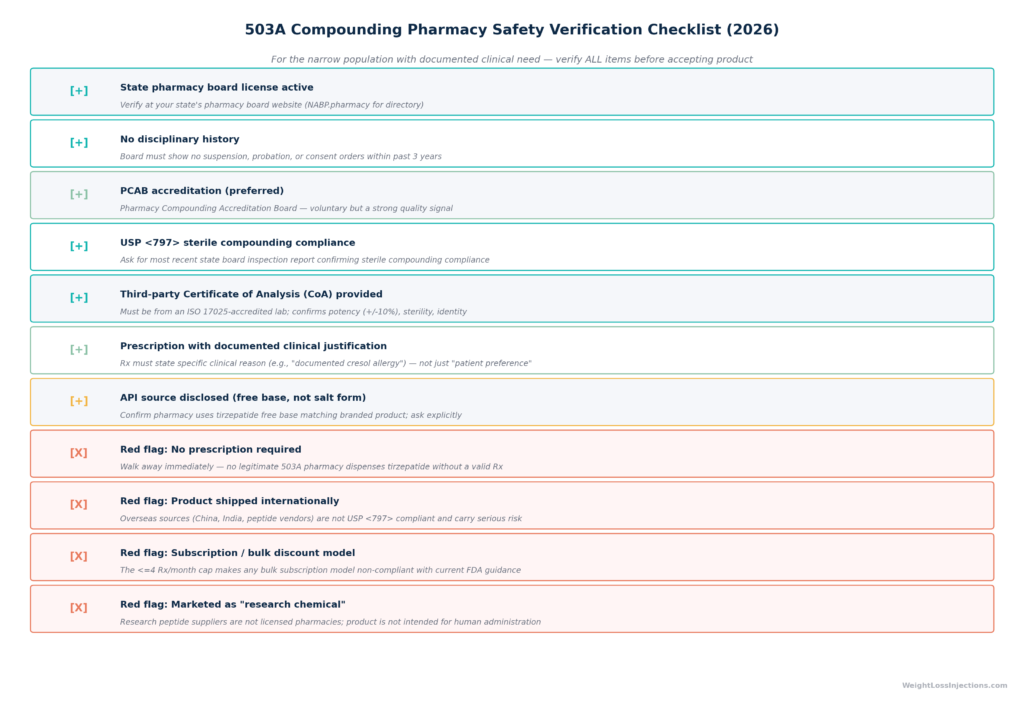
Styled checklist graphic titled “2026 503A Pharmacy Evaluation Checklist” — items with checkbox icons: State pharmacy board license verified (no disciplinary history), PCAB accreditation confirmed,…
For Patients Qualifying for the Narrow 503A Exception
If you genuinely qualify for the personalized-medicine exception — and your prescriber has documented the specific clinical basis in your medical record and on the prescription — here is what the safest possible version of this pathway looks like:
Work exclusively through your licensed healthcare provider, not by approaching a pharmacy directly. The clinical documentation that justifies the 503A exception must originate with a prescriber who has evaluated you individually, reviewed your allergy history or dose-tolerance history, and made a documented clinical judgment that the branded product cannot meet your specific need. A provider at WeightLossInjections.com [service detail] can evaluate whether you meet the documented clinical criteria and guide you through a compliant process if you do.
Use only a 503A pharmacy that passes the full checklist above: active state board license, PCAB accreditation, USP \<797> compliance documentation, and third-party CoA available before you inject. Expect this product to be priced accordingly — quality 503A sterile compounding is not cheap, and the narrow patient population served under this exception means volume-based cost savings are not part of this equation.
Consider LillyDirect as a cost comparison point. Zepbound vials via LillyDirect are available at $299–$699/month depending on dose. (Healthy Meals Incentives — Tirzepatide cost 2026) For many patients who thought they qualified for the exception primarily on cost grounds, the LillyDirect pricing may substantially close the gap while providing complete FDA quality assurance. Talk to a WeightLossInjections.com provider [service detail] to evaluate your options at [$X/month].
For Patients Still Using Gray-Market or Non-Compliant Compounded Tirzepatide
This is the harder conversation, but it is an important one. If you are currently obtaining compounded tirzepatide from a source that does not meet the compliance standards described above — whether from an overseas vendor, a subscription service that doesn’t ask about clinical justification, or a source you found online — you are using a product whose quality is unverifiable.
The safety risks are specific and real: unknown potency (subpotent or superpotent), possible microbial contamination, potentially incorrect salt form, and possibly counterfeit API with no tirzepatide at all. The FDA adverse event signal from the 2022–2025 compounding era came largely from domestic 503A pharmacies operating under state oversight — the risks from completely unregulated overseas or gray-market sources are likely higher, not lower. (FDA GLP-1 Compounding Clarification Page)
We are not here to shame patients who used compounded tirzepatide in any form before March 2025 — that product was legal, widely prescribed, and represented the only affordable access path for many people who were genuinely helped by it. But the situation has changed, and continuing to use a non-compliant source in 2026 carries risks without the legal protection that existed before.
The recommended path forward: Transition to FDA-approved Zepbound. Discuss LillyDirect self-pay options with a licensed provider at WeightLossInjections.com [service detail]. The self-pay vial program at $299–$699/month represents a dramatic reduction from the retail pharmacy price of $1,086/month, and the product quality difference is not small — it’s the difference between a CGMP-manufactured, lot-release-tested injectable and an unverified source with unknown potency. (Healthy Meals Incentives — Tirzepatide cost 2026)
If you have experienced unusual symptoms: If you experienced severe nausea, uncontrollable vomiting, significant injection-site pain, signs of infection, or cardiovascular symptoms (racing heart, lightheadedness) while using compounded tirzepatide, those symptoms may have reflected a superpotent batch or contamination event. Seek medical evaluation if you have any concerns. These events are not expected with properly dosed tirzepatide — the SURMOUNT-4 trial confirmed that even stopping tirzepatide entirely results in GI symptom resolution, though weight regain follows: the placebo arm of SURMOUNT-4 (patients who discontinued tirzepatide after a 36-week lead-in) regained a mean of 14.0% of body weight over 52 weeks. (SURMOUNT-4 — JAMA 2024) Stopping is pharmacologically safe; the consequences are metabolic, not toxic.
The Branded Alternative — Zepbound Safety Profile in Context
For completeness — and because this article is fundamentally about comparing safety profiles — the branded tirzepatide safety record from clinical trials provides the baseline that compounded tirzepatide’s adverse event data should be measured against.
The tirzepatide molecule has been studied extensively. The SURMOUNT program enrolled over 5,000 patients across four major trials; the SURPASS program enrolled approximately 6,000 patients with type 2 diabetes across multiple comparator arms. The resulting safety profile is well-characterized, predictable, and dose-dependent.
GI effects are the dominant adverse event. Nausea, diarrhea, vomiting, and constipation are common and peak during dose escalation, then attenuate as patients adjust to each dose level. GI adverse events occur in 39% of patients at the 5 mg dose, 46% at 10 mg, and 49% at 15 mg across pooled SURPASS data. (Dr. Oracle — Tirzepatide adverse effects) These effects are manageable with the standard titration schedule — 2.5 mg increments no faster than every 4 weeks — and discontinuation rates due to adverse events are dose-dependent, reaching up to approximately 10% at the 15 mg dose. (Dr. Oracle — Tirzepatide adverse effects)
Serious adverse events with the branded molecule are rare. Acute pancreatitis has been observed: the SURPASS clinical program documented 14 pancreatitis events in 13 tirzepatide patients, a rate of 0.23 per 100 patient-years versus 0.11 per 100 patient-years in comparators. (Dr. Oracle — Tirzepatide adverse effects) Gallbladder disease — likely related to rapid weight loss rather than the drug itself — occurs at ≤1% across doses. (StatPearls / NCBI Bookshelf) Hypoglycemia risk is minimal as monotherapy due to tirzepatide’s glucose-dependent mechanism. Acute kidney injury is rare and typically secondary to dehydration from severe GI effects. (NCBI LiverTox — Tirzepatide)
The boxed warning applies to both branded and compounded tirzepatide. Tirzepatide carries an FDA boxed warning for thyroid C-cell tumors, based on rodent studies showing dose- and duration-dependent thyroid C-cell adenomas and carcinomas at clinically relevant exposures. The human relevance is undetermined. Tirzepatide is contraindicated in patients with a personal or family history of medullary thyroid carcinoma (MTC) or multiple endocrine neoplasia syndrome type 2 (MEN 2). (FDA Mounjaro label NDA 215866) This warning applies to the tirzepatide molecule regardless of formulation — it is not a manufacturing-related risk.
The critical safety comparison: the adverse events that the FDA documented in the compounding era — severe overdose-level GI toxicity, contamination events, hospitalization from superpotent batches — are not in Zepbound’s clinical trial safety data. They are not a known risk of properly dosed tirzepatide. They are exclusively the result of quality-control failures in an unregulated compounding supply chain.
Our Take at WeightLossInjections.com
The history of compounded tirzepatide safety is, at its core, a story about what happens when quality-control infrastructure fails to match the scale of demand. Tirzepatide is a remarkable drug — the SURMOUNT-1 trial showed mean weight loss of up to 20.9% at 72 weeks at the 15 mg dose versus −3.1% for placebo (SURMOUNT-1 — NEJM 2022), and the SURMOUNT-5 head-to-head confirmed tirzepatide produces approximately 47% greater weight loss than semaglutide at maximum tolerated doses. (SURMOUNT-5 — NEJM 2025) Patients who accessed compounded tirzepatide before March 2025 were not acting irrationally. They were trying to access a drug with extraordinary clinical data at a price they could actually afford — and for hundreds of thousands of patients, it worked.
The adverse event data does not say tirzepatide is dangerous. It says that compounding without adequate quality controls is dangerous, and that the risks are concentrated in manufacturing practices, not pharmacology. A patient who received properly potent, sterile compounded tirzepatide from a high-quality 503A pharmacy with rigorous third-party testing likely had an experience closely approximating the branded product’s safety profile. A patient who received lyophilized powder from a low-quality source, reconstituted it imprecisely, and injected a superpotent solution had a materially different experience.
For 2026 and beyond, the safety calculus is straightforward: the safest path to tirzepatide is FDA-approved Zepbound, manufactured by Eli Lilly under CGMP, lot-release tested before shipping, and pre-mixed in a calibrated autoinjector pen or single-dose vial that eliminates reconstitution error entirely. LillyDirect has made this option significantly more accessible at $299–$699/month — a meaningful concession from the $1,086 retail pharmacy price. (Healthy Meals Incentives — Tirzepatide cost 2026)
For the narrow group of patients with genuine documented clinical reasons that preclude branded tirzepatide — a confirmed cresol allergy, a documented need for an intermediate dose — the 503A exception exists, but using it responsibly means subjecting your pharmacy to the full verification checklist above and working through a licensed provider who will document the clinical basis rigorously.
WeightLossInjections.com’s approach is to connect you with licensed providers [service detail] who understand today’s regulatory landscape, can evaluate whether you qualify for the narrow exception or are best served by LillyDirect, and can provide the clinical oversight that safe tirzepatide use — branded or compounded — requires. Our program starts at [$X/month].
The bottom line: tirzepatide is a safe, effective drug when properly manufactured and dosed. The compounding safety record is a cautionary tale about manufacturing standards, not molecular pharmacology. In 2026, the infrastructure for safely accessing tirzepatide at reasonable cost exists through legal, FDA-approved channels. That is where we recommend you start.
FAQ
Q1: Is compounded tirzepatide safe?
The tirzepatide molecule itself has an established safety profile from large clinical trials enrolling tens of thousands of patients. However, compounded tirzepatide — particularly gray-market and mass-market versions available before March 2025 — was associated with more than 320 adverse event reports to the FDA, primarily involving dosing errors, contamination, and sterility failures from unregulated compounding environments. FDA-approved branded tirzepatide (Zepbound), manufactured by Eli Lilly under CGMP standards, undergoes rigorous lot-release testing not required of compounding pharmacies. The safety of any compounded product depends entirely on the quality of the pharmacy that produced it, and quality varied substantially across the compounding market. (FDA GLP-1 Compounding Clarification Page)
Q2: Is compounded tirzepatide still legal in 2026?
In very limited circumstances, yes. A licensed 503A compounding pharmacy may compound tirzepatide for an individual patient if the prescriber documents a specific clinical need the branded product cannot meet — such as a documented allergy to cresol, a preservative in branded Zepbound and Mounjaro pens — and the pharmacy fills no more than four such prescriptions per calendar month. Mass-market, subscription-based, and volume compounding of tirzepatide is not lawful as of 2026. 503B outsourcing facilities have zero authority to compound tirzepatide under any circumstances. (FDA GLP-1 Compounding Clarification Page — April 1, 2026 update)
Q3: What were the main safety problems with compounded tirzepatide?
The FDA documented four main problem categories: (1) dosing errors from lyophilized powder reconstitution, resulting in doses 5 to 10 times higher than intended in some cases; (2) subpotent batches with too little active drug; (3) microbial contamination from non-sterile or inadequately sterile compounding environments; and (4) salt form discrepancies where the labeled dose did not accurately reflect the amount of active tirzepatide free base in the vial. A subset of these adverse events led to hospitalizations. (FDA GLP-1 Compounding Clarification Page)
Q4: What is the cresol allergy exception for compounded tirzepatide?
Branded Zepbound and Mounjaro pens contain cresol as a preservative. Patients with a documented hypersensitivity to cresol may qualify for the narrow 503A compounding exception. For this to be a valid basis: the allergy must be documented in the medical record through formal allergy evaluation (not merely self-reported), the prescriber must specifically document it on the prescription as the clinical rationale, and the dispensing 503A pharmacy must be within its four-prescriptions-per-month limit for that formulation. Consult a licensed provider for an individualized assessment. (FDA GLP-1 Compounding Clarification Page — April 1, 2026 update)
Q5: How do I verify a compounding pharmacy is safe to use for tirzepatide?
Key criteria: (1) active state pharmacy board license with no disciplinary history, verifiable through the state board’s online lookup; (2) PCAB accreditation from pcabaccreditation.org; (3) confirmed 503A (not 503B) status — 503B facilities cannot legally compound tirzepatide; (4) ability to provide a Certificate of Analysis from an ISO 17025-accredited third-party laboratory confirming potency, sterility, and API identity for your lot; (5) documented USP \<797> sterile compounding compliance, including state board inspection report; (6) prescription with individualized clinical documentation, not a generic preference statement. If any of these criteria are absent, do not use the pharmacy.
Q6: What is the safest way to get tirzepatide in 2026?
The safest option is FDA-approved Zepbound or Mounjaro, manufactured by Eli Lilly under CGMP standards with full lot-release testing, pre-mixed in calibrated autoinjector pens or single-dose vials requiring no patient reconstitution. LillyDirect self-pay vials are available at $299–$699/month depending on dose — significantly less than the retail pharmacy price of $1,086/month — without requiring insurance. (Healthy Meals Incentives — Tirzepatide cost 2026) Commercially insured patients with Zepbound coverage can access the savings card at as little as $25/fill. WeightLossInjections.com [service detail] can connect you with a licensed provider to evaluate your eligibility and identify the most cost-effective branded pathway at [$X/month].
This content is for informational purposes only and does not constitute medical advice. All regulatory information reflects verified primary sources as of June 2026. WeightLossInjections.com editorial team reviews content quarterly. Consult a licensed healthcare provider before starting, changing, or stopping any medication. [STATE-SPECIFIC DISCLAIMER]