
Key Takeaways
- Retatrutide (developer code LY3437943) is an investigational triple hormone receptor agonist developed by Eli Lilly and Company — it is not FDA-approved and is not currently available for prescription.
- It activates three separate metabolic receptors — GIP, GLP-1, and glucagon — making it the first drug of its kind to combine all three mechanisms.
- In the pivotal TRIUMPH-1 trial, participants on the 12 mg dose lost an average of 28.3% of body weight over 80 weeks, the largest reduction reported to date for an injectable weight-management drug.
- Eli Lilly expects to submit a New Drug Application (NDA) in Q4 2026, with a possible FDA decision in late 2027 and commercial launch projected for Q1–Q2 2028.
- The only legal way to access retatrutide today is by enrolling in an authorized clinical trial listed on ClinicalTrials.gov.
Investigational Status: Please Read Before Continuing
Retatrutide is not approved by the FDA or any other regulatory agency anywhere in the world as of July 2026. It remains an investigational compound studied under an active Investigational New Drug (IND) application with the FDA, and it does not yet have an assigned brand name — it is referred to by its generic name, retatrutide, or its developer code, LY3437943. Nothing in this article should be interpreted as guidance for acquiring, dosing, or using retatrutide outside of a registered clinical trial.
That distinction matters because retatrutide has generated enormous interest after early trial data showed weight-loss results that outpace every currently approved obesity medication, including tirzepatide (marketed as Zepbound) and semaglutide (marketed as Wegovy). But promising trial data is not the same as regulatory approval, and it is not the same as a drug being safe or appropriate for use outside a supervised study. This guide explains what retatrutide is, how it works, what the data shows so far, and when it might realistically become available — all according to verified public sources.
What Is Retatrutide, Exactly?
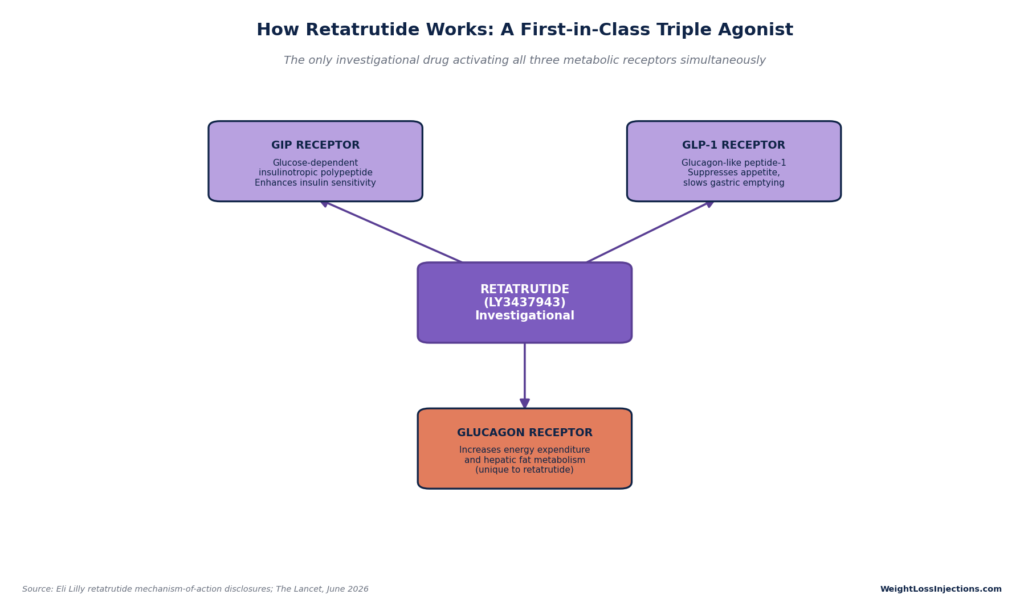
Retatrutide is an investigational, once-weekly, subcutaneously injected medication developed by Eli Lilly and Company for the treatment of obesity and, potentially, type 2 diabetes. Its scientific classification is a triple hormone receptor agonist, meaning it is designed to stimulate three separate receptors in the body simultaneously:
- GIP (glucose-dependent insulinotropic polypeptide) receptor
- GLP-1 (glucagon-like peptide-1) receptor
- Glucagon receptor
No other drug — approved or investigational — combines activity at all three of these receptors. That makes retatrutide the first-in-class agent in this category, distinguishing it from single-receptor drugs like semaglutide (GLP-1 only) and dual-receptor drugs like tirzepatide (GIP + GLP-1), the active ingredient behind Zepbound and Mounjaro.
The LY3437943 Code
Before a drug is named, it is typically tracked by an internal developer code throughout its clinical development. Retatrutide’s code, LY3437943, appears throughout scientific literature, ClinicalTrials.gov listings, and FDA correspondence. If you see “LY3437943” referenced in a study or press release, it refers to the same molecule as retatrutide — there is no difference between the two.
Why a Triple Agonist Is Considered Revolutionary
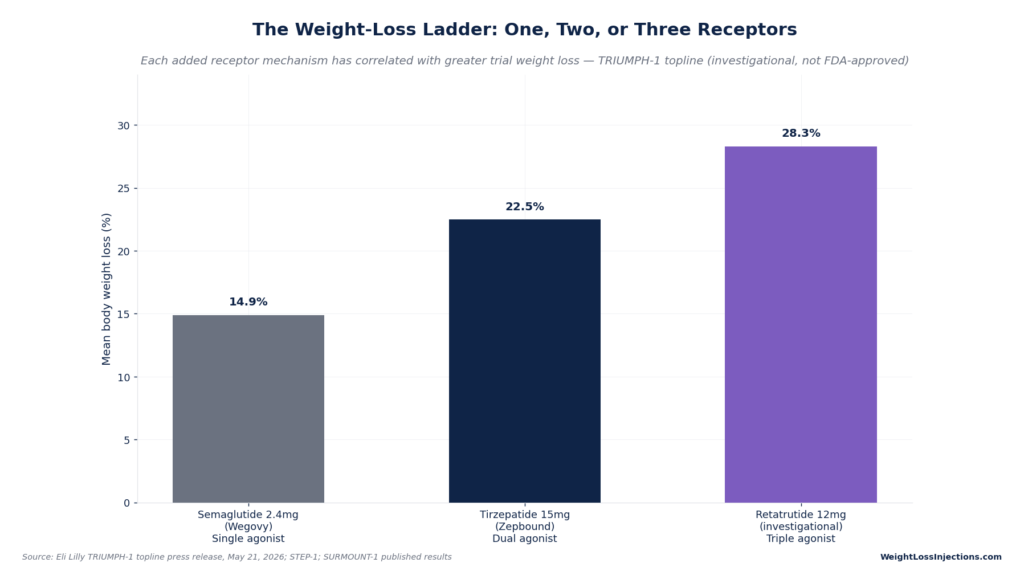
Weight-management drugs in the GLP-1 class have evolved rapidly over the past decade. Each new mechanism added to the molecule has, so far, correlated with greater average weight loss in trials:
- Single agonists (GLP-1 only) — semaglutide, the active ingredient in Ozempic and Wegovy, produced average weight loss of roughly 14.9% in the STEP-1 trial.
- Dual agonists (GIP + GLP-1) — tirzepatide, the active ingredient in Zepbound, produced average weight loss of roughly 22.5% in the SURMOUNT-1 trial.
- Triple agonists (GIP + GLP-1 + glucagon) — retatrutide, in the TRIUMPH-1 trial, produced average weight loss of 28.3% at the 12 mg dose.
The addition of glucagon receptor activity is the key mechanistic difference. Glucagon is traditionally known for raising blood sugar, but at the receptor level it also appears to increase energy expenditure and support fat metabolism in the liver. Researchers believe that combining glucagon receptor activity with the appetite-suppressing and insulin-sensitizing effects of GIP and GLP-1 helps explain why retatrutide’s trial results have exceeded those of dual- and single-agonist drugs. This is discussed in more depth in The Lancet’s June 2026 publication covering retatrutide’s diabetes trial data.
Comparison: Retatrutide vs. Approved GLP-1 Drugs
| Drug | Mechanism | Pivotal Trial | Mean Weight Loss | Duration | Approval Status |
|---|---|---|---|---|---|
| Retatrutide 12 mg | Triple agonist (GIP + GLP-1 + glucagon) | TRIUMPH-1 | 28.3% | 80 weeks | Investigational — not approved |
| Tirzepatide 15 mg (Zepbound) | Dual agonist (GIP + GLP-1) | SURMOUNT-1 | 22.5% | 72 weeks | FDA-approved |
| Semaglutide 2.4 mg (Wegovy) | Single agonist (GLP-1) | STEP-1 | 14.9% | 68 weeks | FDA-approved |
Weight-loss figures are trial averages under supervised, controlled conditions and are not guarantees of individual results. Data drawn from the Eli Lilly TRIUMPH-1 topline press release (May 21, 2026) and publicly reported SURMOUNT-1 and STEP-1 results.
Our Top 3 · September 2026
The best GLP-1 providers right now
Independently reviewed. Ranked by price, medication access, provider quality, and patient outcomes.
Renew GLP
Personalized GLP-1, GIP plans: Semaglutide & Tirzepatide.
Medvi
No membership or hidden fees. Everything you need is included.
Trimi
US-licensed clinicians and shipped to your door, from $99/mo.
Key Trial Results at a Glance
Eli Lilly’s retatrutide development program is built around a series of Phase 3 trials collectively branded TRIUMPH, alongside a diabetes-focused trial branded TRANSCEND. Here is what has been reported publicly so far:
TRIUMPH-1 (Pivotal Obesity Trial)
Announced in Eli Lilly’s May 21, 2026 press release, TRIUMPH-1 enrolled 2,339 adults with obesity but no diabetes over 80 weeks. At the 12 mg dose:
- Average weight loss reached 28.3%
- 45.3% of participants lost 30% or more of their body weight
- An extension analysis to 104 weeks, later detailed in the New England Journal of Medicine (Jastreboff et al., 2026), showed weight loss continuing to climb to an average of 30.3%, indicating no plateau at 80 weeks
- Discontinuation due to adverse events in the 12 mg group was 11.3%
TRIUMPH-4 (Obesity + Knee Osteoarthritis)
Reported December 11, 2025, this trial of roughly 445 participants combined obesity treatment with a knee osteoarthritis sub-study. The 12 mg dose produced 28.7% weight loss versus 2.1% for placebo, alongside a 75.8% reduction in knee pain scores.
TRANSCEND-T2D-1 (Type 2 Diabetes)
Published in The Lancet in June 2026, this 40-week trial in 537 adults with type 2 diabetes showed HbA1c reductions of up to 2.0 percentage points and weight loss between 11.5% and 16.8%, compared to 2.5% for placebo.
All of these trials are registered and can be reviewed on ClinicalTrials.gov under identifiers including NCT05929066 (TRIUMPH-1).
Safety Signals Reported So Far
The most commonly reported side effects in retatrutide trials mirror the rest of the GLP-1 drug class: nausea, vomiting, diarrhea, and constipation, generally most pronounced during dose escalation. One safety signal appears more unique to retatrutide’s mechanism: dysesthesia, or altered skin sensation, reported in 2.3% to 4.5% of participants, generally mild and possibly linked to glucagon receptor activation. Because these findings come from controlled trial settings with medical monitoring, they cannot be extrapolated to unsupervised or unauthorized use.
Expected Approval Timeline
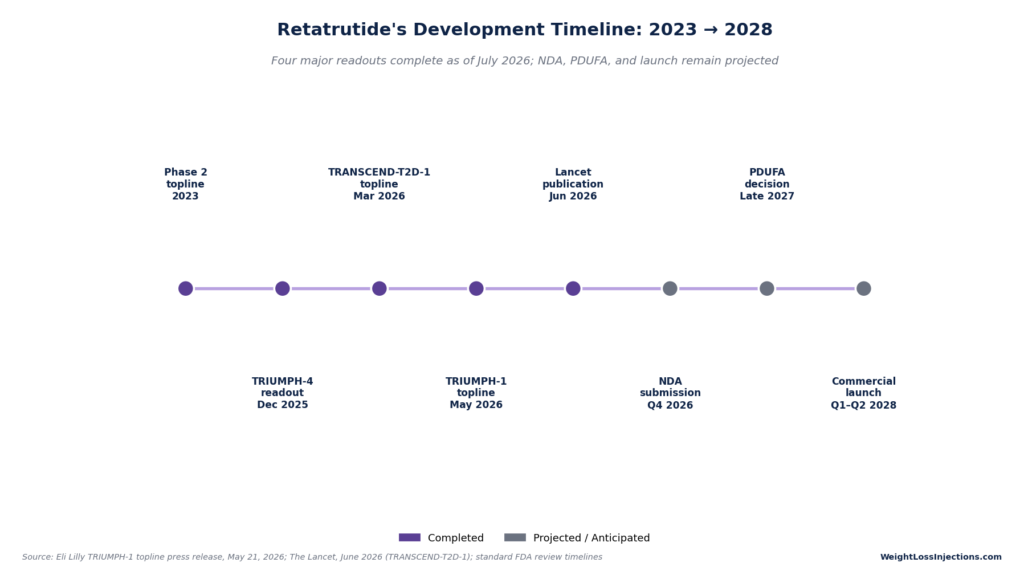
As of July 2026, retatrutide’s regulatory path looks like this:
- NDA submission: anticipated Q4 2026
- FDA acceptance for review: projected Q1 2027
- PDUFA decision date (potential approval): projected late 2027
- Commercial launch, if approved: projected Q1–Q2 2028
A full breakdown of this timeline, including every completed and pending trial milestone, is available in our companion article on the retatrutide FDA approval timeline.
Why You Cannot Get Retatrutide Today
Because retatrutide is investigational, it cannot legally be prescribed, purchased, or compounded. Retatrutide has no USP/NF compounding monograph and was not included in the FDA’s 2026 reclassification of eligible compounding substances, meaning 503A and 503B compounding pharmacies are not legally permitted to prepare it. Any product marketed as “retatrutide” outside of a clinical trial — including so-called “research use only” peptides — is not a legitimate, regulated pharmaceutical product and carries unknown risks. The only legitimate way to access retatrutide before FDA approval is enrollment in an authorized clinical trial through ClinicalTrials.gov. We cover how to evaluate and pursue trial enrollment in our guide to joining a retatrutide clinical trial.
If you are interested in currently approved treatment options, tirzepatide, marketed as Zepbound, and semaglutide, marketed as Ozempic and Wegovy, remain the most effective FDA-approved options available today.
Frequently Asked Questions
Is retatrutide the same as Mounjaro or Zepbound?
No. Retatrutide is a different molecule from tirzepatide (the active ingredient in Mounjaro and Zepbound). Tirzepatide is a dual GIP/GLP-1 agonist, while retatrutide adds a third mechanism — glucagon receptor activity — and is still investigational.
What does LY3437943 mean?
LY3437943 is Eli Lilly’s internal development code for retatrutide. It is the same compound; the code is commonly used in scientific papers, regulatory filings, and clinical trial listings before a drug receives a commercial brand name.
Can I buy retatrutide online right now?
No legitimate, regulated source of retatrutide exists for individual purchase. It has not been approved by the FDA, is not eligible for pharmacy compounding, and any product advertised online as retatrutide for personal use falls outside legal and regulatory oversight.
How is retatrutide different from semaglutide and tirzepatide?
Semaglutide activates one receptor (GLP-1). Tirzepatide activates two (GIP and GLP-1). Retatrutide activates three (GIP, GLP-1, and glucagon), which trial data suggests may explain its higher average weight-loss results.
When will retatrutide be available to patients?
If Eli Lilly submits its NDA on schedule in Q4 2026 and the FDA grants approval by late 2027, commercial availability is projected for Q1–Q2 2028. This timeline is not guaranteed and depends on the outcome of ongoing trials and FDA review.
Medical disclaimer: Retatrutide is an investigational drug not approved by the FDA or any other regulatory authority as of July 2026. It is available only through enrollment in authorized clinical trials. This article is for informational purposes only and does not constitute medical advice, endorsement, or a recommendation to obtain retatrutide outside of a registered clinical trial. Speak with your healthcare provider about currently approved weight-loss treatments. Content published by WeightLossInjections.com.