
Key Takeaways
- Retatrutide is investigational and not FDA-approved, so no insurer — commercial, Medicare, or Medicaid — currently covers it in any form.
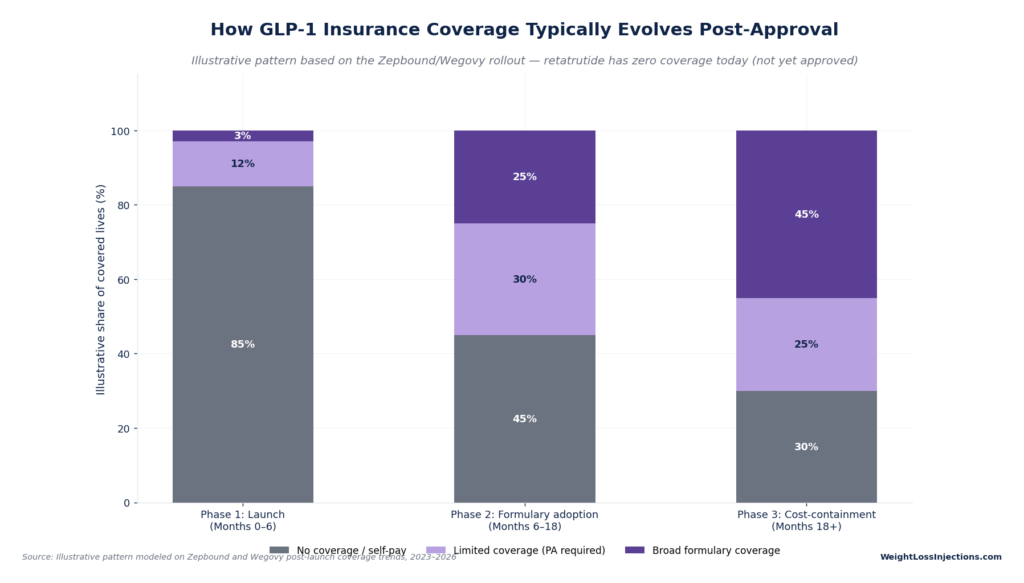
- Insurance coverage for GLP-1-class weight-loss drugs has historically taken 6–18 months post-approval to expand meaningfully, based on the Zepbound and Wegovy rollouts.
- Medicare Part D currently excludes weight-loss drugs by statute, a restriction that would likely apply to retatrutide’s obesity indication unless Congress changes the law or retatrutide is positioned around another approved indication.
- Medicaid coverage for GLP-1 weight-loss drugs varies significantly by state and is unlikely to be uniform for retatrutide either.
- Expect prior authorization requirements tied to BMI thresholds, documented comorbidities, and possibly step therapy once coverage does begin.
Why This Is a Pre-Launch Question
Retatrutide (developer code LY3437943), developed by Eli Lilly and Company, has not been approved by the FDA as of July 2026 and remains investigational. Insurance companies do not make coverage decisions for drugs that aren’t approved, so there is currently no insurance coverage of any kind for retatrutide — not through employer plans, marketplace plans, Medicare, or Medicaid. Any discussion of future coverage is necessarily speculative, grounded in how insurers have handled comparable drugs in the past.
This article uses the real-world coverage evolution of Zepbound (tirzepatide) and Wegovy (semaglutide) — both FDA-approved GLP-1-class weight-loss drugs from the same manufacturers — as the best available model for what retatrutide’s coverage landscape might look like if and when it’s approved, projected for late 2027 with a launch in Q1–Q2 2028. For background on that approval timeline, see our retatrutide FDA approval timeline guide.
How Wegovy and Zepbound Coverage Evolved After Approval
Phase 1: Limited Coverage at Launch
When Wegovy was approved in 2021 and Zepbound in late 2023, most commercial insurance plans did not immediately cover them for weight loss. Many payers classified these as “lifestyle” drugs initially, similar to how some plans historically treated other weight-management medications, and required significant evidence review before adding them to formularies.
Phase 2: Gradual Formulary Adoption
Over the following 12–18 months, a growing number of commercial and employer-sponsored plans added Wegovy and Zepbound to their formularies — usually with conditions attached (see prior authorization section below). Employers, in particular, faced pressure from employees and competition for talent, which pushed many large companies to add coverage despite high per-patient costs.
Phase 3: Cost-Containment Pushback
As utilization grew, some employers and insurers began tightening criteria, adding stricter prior authorization requirements, or in some reported cases dropping coverage altogether due to cost. This back-and-forth is ongoing in the Zepbound/Wegovy market and illustrates that coverage, once granted, isn’t necessarily permanent or unconditional.
If retatrutide follows a similar arc, initial coverage would likely be sparse, expanding over time but subject to the same cost-containment pressures — potentially amplified given retatrutide’s projected price point of $1,300–$1,600/month discussed in our retatrutide cost analysis.
Employer Plan Trends
Employer-sponsored insurance has been the most dynamic segment of GLP-1 coverage. Key trends likely to carry over to retatrutide:
- Large employers are more likely to cover GLP-1 weight-loss drugs than small businesses, partly due to negotiating leverage and employee retention concerns.
- Coverage increasingly comes with conditions — documented BMI thresholds, participation in a lifestyle/behavioral program, or physician attestation of medical necessity.
- Some employers have carved out obesity drugs entirely, citing cost, while others have expanded coverage citing long-term health savings.
- Retatrutide’s stronger trial results (28.3% average weight loss in TRIUMPH-1 vs. ~22.5% for tirzepatide) could make a cost-effectiveness case to employers, but only after real-world data — not trial data alone — typically influences these decisions.
Medicare Part D: The Weight-Loss Exclusion
Medicare Part D is statutorily restricted from covering drugs used solely for weight loss, a carryover from a broader historical exclusion of “drugs for weight loss” under Medicare law. This exclusion is one of the most significant barriers to broad GLP-1 access for older adults today.
Two important nuances:
- Medicare does cover GLP-1 drugs for other approved indications. For example, Medicare Part D can cover semaglutide when prescribed for type 2 diabetes (as Ozempic) or, in some cases, when a drug carries an additional FDA-approved indication like cardiovascular risk reduction. This has led to some Part D coverage for drugs primarily known as weight-loss treatments — but only when prescribed under a covered indication.
- If retatrutide eventually receives an additional approved indication — for example, related to its type 2 diabetes data from TRANSCEND-T2D-1, published in The Lancet — Medicare could potentially cover it under that indication, similar to how Ozempic is covered for diabetes but Wegovy (same molecule, weight-loss indication) faces the Part D exclusion.
Unless Congress passes legislation changing Medicare’s weight-loss drug exclusion — proposals like the Treat and Reduce Obesity Act have been introduced in past sessions but not enacted — Medicare beneficiaries would likely face the same exclusion for retatrutide’s obesity indication as they currently do for Wegovy and Zepbound.
Our Top 3 · September 2026
The best GLP-1 providers right now
Independently reviewed. Ranked by price, medication access, provider quality, and patient outcomes.
Renew GLP
Personalized GLP-1, GIP plans: Semaglutide & Tirzepatide.
Medvi
No membership or hidden fees. Everything you need is included.
Trimi
US-licensed clinicians and shipped to your door, from $99/mo.
Medicaid: Wide State-by-State Variability
Medicaid coverage of GLP-1 weight-loss drugs is decided at the state level, and the result is a patchwork:
- Some states cover Wegovy and/or Zepbound for obesity with prior authorization.
- Other states exclude weight-loss indications entirely, even while covering the same molecules for diabetes.
- State Medicaid programs frequently revisit these decisions based on budget pressure, given the high cost of GLP-1 drugs relative to state pharmacy budgets.
If retatrutide is approved, expect a similarly uneven rollout across state Medicaid programs, likely trailing commercial insurance adoption.
What to Expect: Prior Authorization Criteria
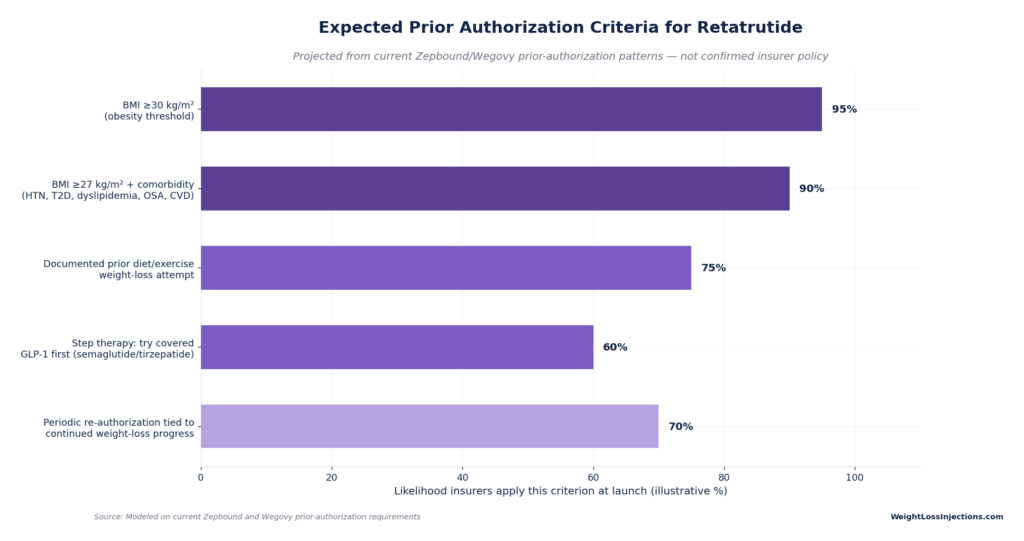
Based on current Zepbound and Wegovy prior authorization patterns, insurers considering retatrutide coverage would likely require documentation such as:
- BMI ≥30, or BMI ≥27 with at least one weight-related comorbidity (hypertension, type 2 diabetes, dyslipidemia, obstructive sleep apnea, or cardiovascular disease) — mirroring the enrollment criteria used in retatrutide’s own TRIUMPH trials
- Evidence of prior weight-loss attempts through diet and exercise
- Possibly step therapy, requiring patients to first try a less expensive, already-covered GLP-1 drug like semaglutide or tirzepatide before approving retatrutide
- Periodic re-authorization tied to continued weight-loss progress
Comparison: Coverage Patterns by Payer Type
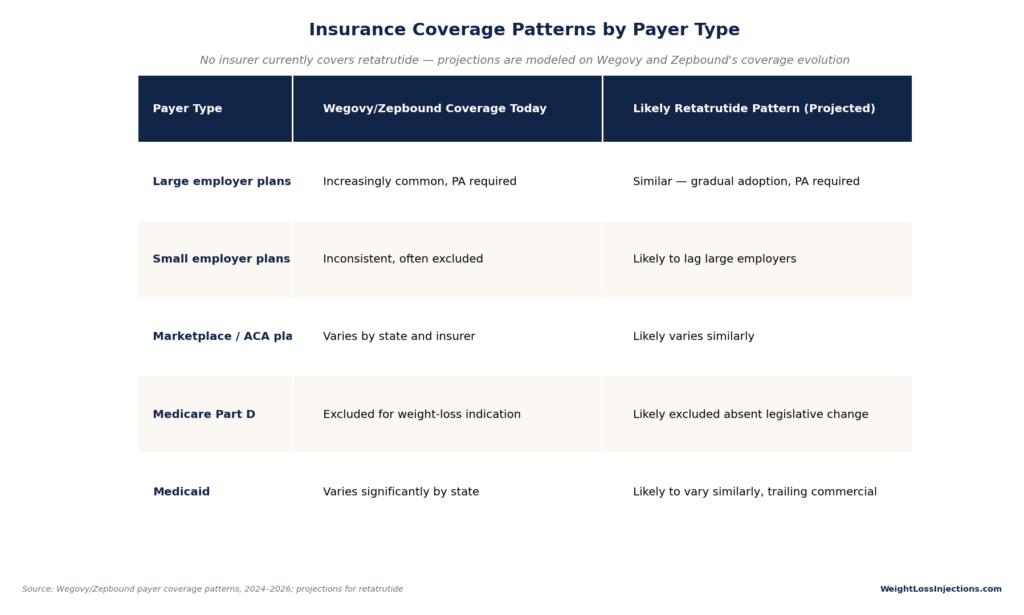
| Payer Type | Wegovy/Zepbound Coverage Today | Likely Retatrutide Pattern (Projected) |
|---|---|---|
| Large employer plans | Increasingly common, often with prior authorization | Similar — gradual adoption, PA required |
| Small employer plans | Inconsistent, often excluded | Likely to lag large employers |
| Marketplace/ACA plans | Varies by state and insurer | Likely varies similarly |
| Medicare Part D | Excluded for weight-loss indication | Likely excluded for weight-loss indication absent legislative change |
| Medicaid | Varies significantly by state | Likely to vary similarly, trailing commercial adoption |
What You Can Do Today
Because retatrutide is not approved, there is no insurance claim to file and no prior authorization to request. The only legitimate way to access retatrutide right now is enrollment in an authorized clinical trial, where the study drug and monitoring are provided under the trial protocol rather than billed through insurance — see our guide to joining a retatrutide clinical trial for details. If insurance coverage for weight-loss treatment is a priority now, currently approved options like tirzepatide (Zepbound) and semaglutide (Ozempic, Wegovy) already have established, if inconsistent, coverage pathways worth exploring with your provider and insurer today.
Frequently Asked Questions
Does insurance cover retatrutide right now?
No. Retatrutide is investigational and not FDA-approved, so no insurer — commercial, Medicare, or Medicaid — covers it in any form as of July 2026.
Will Medicare cover retatrutide for weight loss?
Likely not for the weight-loss indication alone, due to Medicare Part D’s statutory exclusion of weight-loss drugs — the same exclusion that currently applies to Wegovy. Coverage could be possible if retatrutide receives an additional approved indication, such as for type 2 diabetes.
How long after FDA approval does insurance typically start covering a new GLP-1 drug?
Based on Zepbound and Wegovy, meaningful coverage expansion has historically taken roughly 6 to 18 months after approval, as insurers evaluate the drug and negotiate formulary placement.
Will I need prior authorization for retatrutide?
Almost certainly, if past GLP-1 launches are any guide. Expect requirements similar to current Zepbound/Wegovy prior authorization: documented BMI thresholds, comorbidities, and evidence of prior weight-loss attempts.
What should I do now if I want retatrutide but I’m worried about cost?
Since retatrutide is not yet approved or priced, there’s nothing to secure coverage for today. The only legal access route is a clinical trial. In the meantime, review coverage options for currently approved treatments like Zepbound or Wegovy with your insurer.
Medical disclaimer: Retatrutide is an investigational drug not approved by the FDA or any other regulatory authority as of July 2026. It is available only through enrollment in authorized clinical trials. This article is for informational purposes only and does not constitute medical advice, endorsement, or a recommendation to obtain retatrutide outside of a registered clinical trial. Speak with your healthcare provider about currently approved weight-loss treatments. Content published by WeightLossInjections.com.