
Key Takeaways
- Retatrutide is an investigational triple hormone receptor agonist (GIP + GLP-1 + glucagon) that has not been approved by the FDA as of July 2026; tirzepatide (Zepbound, Mounjaro) is FDA-approved and commercially available.
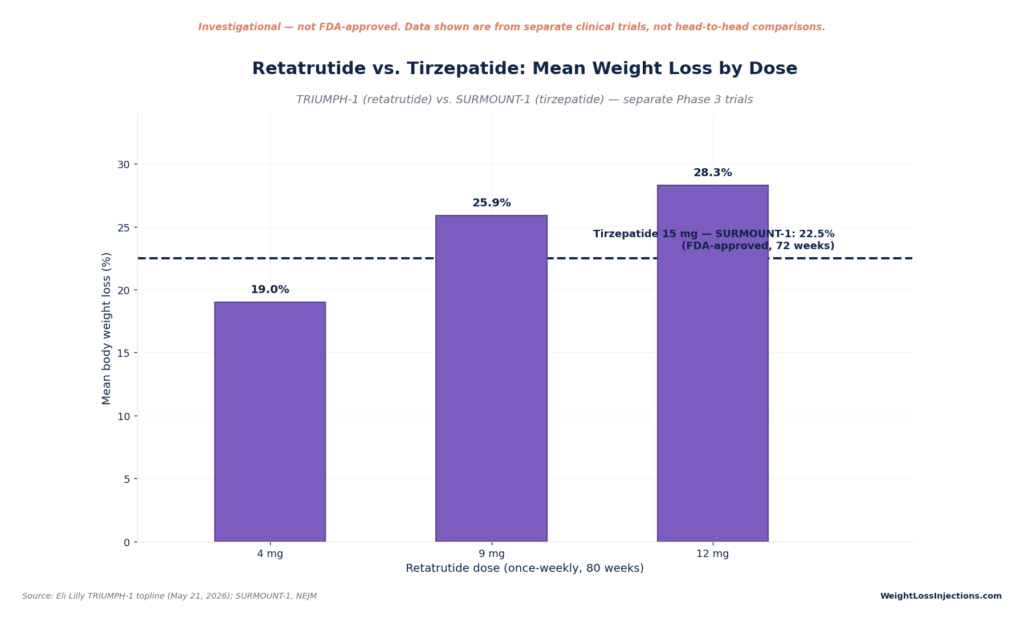
- In separate Phase 3 trials, the highest studied dose of retatrutide produced 28.3% mean weight loss at 80 weeks in TRIUMPH-1, compared with 22.5% mean weight loss at 72 weeks for tirzepatide 15 mg in the SURMOUNT-1 trial published in the New England Journal of Medicine.
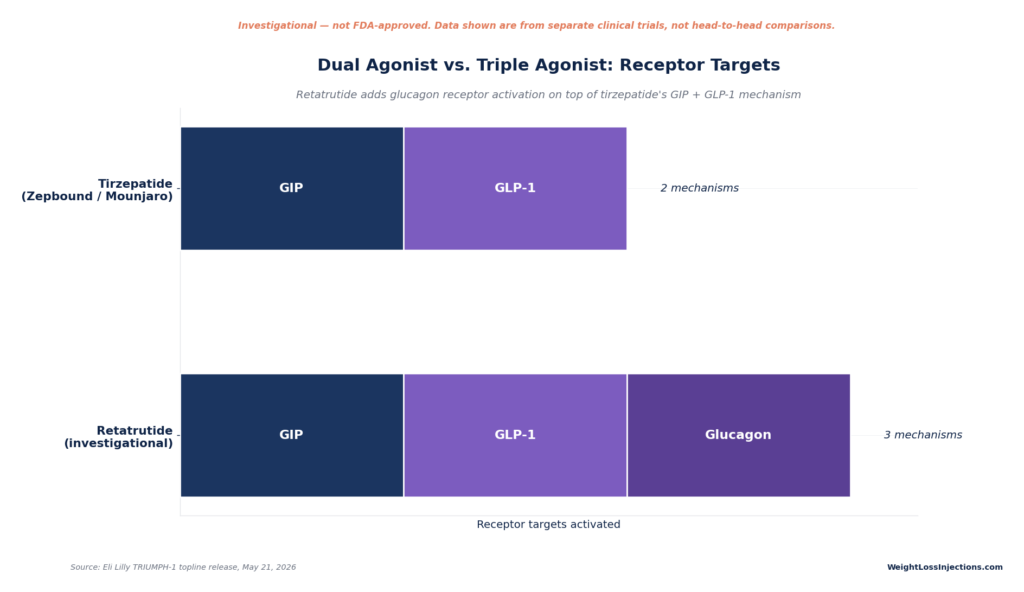
- Retatrutide adds a third mechanism — glucagon receptor agonism — on top of the GIP and GLP-1 activity that tirzepatide already provides.
- Retatrutide’s trials report a unique side effect, dysesthesia (altered skin sensation), in 2.3–4.5% of participants; this signal has not been reported with tirzepatide.
- These are cross-trial comparisons, not a single head-to-head study — differences in trial populations and design mean the numbers should be read as directional, not definitive.
- Retatrutide remains available only through clinical trial enrollment; it cannot legally be prescribed, compounded, or purchased.
This article compares publicly reported trial data. It does not recommend one treatment over the other and is not medical advice.
Patients researching next-generation weight-loss injections frequently ask how retatrutide, Eli Lilly’s experimental triple agonist, stacks up against tirzepatide, the dual GIP/GLP-1 agonist sold under the brand names Zepbound and Mounjaro. It’s an important question, but also an important disclaimer up front: retatrutide is investigational and has not been approved by the FDA or any other regulatory authority as of July 2026. It is not available by prescription, and it cannot legally be compounded. Tirzepatide, by contrast, is an FDA-approved medication that patients can currently obtain through a licensed prescriber.
With that distinction firmly in place, the trial data on both molecules is worth examining side by side, because it offers a preview of where obesity pharmacotherapy may be headed. This article walks through the mechanism differences, the efficacy numbers from each drug’s pivotal trials, the side effect profiles, projected costs, and — most importantly — the current availability gap between an approved drug and an experimental one.
Mechanism: Dual Agonist vs. Triple Agonist
Tirzepatide activates two receptors: the glucose-dependent insulinotropic polypeptide (GIP) receptor and the glucagon-like peptide-1 (GLP-1) receptor. This dual mechanism is part of why tirzepatide outperformed single-mechanism GLP-1 drugs like semaglutide in cross-trial comparisons.
Retatrutide goes a step further. It is a triple hormone receptor agonist, activating GIP and GLP-1 receptors like tirzepatide, plus a third receptor: glucagon. Glucagon receptor activation increases energy expenditure and hepatic glucose output, which appears to add an independent weight-loss effect on top of the appetite suppression driven by GLP-1 and GIP. This third mechanism is the leading scientific explanation for why retatrutide has shown larger mean weight loss in trials than tirzepatide, according to the Eli Lilly TRIUMPH-1 topline release from May 21, 2026.
| Feature | Retatrutide (investigational) | Tirzepatide (Zepbound/Mounjaro) |
|---|---|---|
| Receptor targets | GIP + GLP-1 + Glucagon | GIP + GLP-1 |
| Number of mechanisms | Triple agonist | Dual agonist |
| Regulatory status | Not FDA-approved; investigational | FDA-approved |
| Administration | Once-weekly subcutaneous injection | Once-weekly subcutaneous injection |
| Developer | Eli Lilly and Company | Eli Lilly and Company |
Efficacy: TRIUMPH-1 vs. SURMOUNT-1
The most direct comparison available comes from each drug’s flagship Phase 3 obesity trial. It’s important to note these are two separate trials with different participants, not a randomized head-to-head study — so the comparison is informative but not conclusive.
In TRIUMPH-1, 2,339 adults with obesity and no diabetes were followed for 80 weeks. At the highest studied dose (12 mg), participants lost a mean of 28.3% of body weight, compared with 2.2% for placebo. The 9 mg dose produced 25.9% loss, and the 4 mg dose produced 19.0% loss. Notably, 45.3% of participants on the 12 mg dose lost at least 30% of their starting body weight — a threshold once associated only with bariatric surgery.
In SURMOUNT-1, tirzepatide’s pivotal obesity trial published in the New England Journal of Medicine, participants on the highest studied dose (15 mg) lost a mean of 22.5% of body weight over 72 weeks.
| Trial | Drug | Dose | Duration | Mean Weight Loss | Placebo |
|---|---|---|---|---|---|
| TRIUMPH-1 | Retatrutide (investigational) | 12 mg | 80 weeks | 28.3% | 2.2% |
| TRIUMPH-1 | Retatrutide (investigational) | 9 mg | 80 weeks | 25.9% | 2.2% |
| TRIUMPH-1 | Retatrutide (investigational) | 4 mg | 80 weeks | 19.0% | 2.2% |
| SURMOUNT-1 | Tirzepatide (Zepbound) | 15 mg | 72 weeks | 22.5% | — |
Trial data shows a gap of roughly six percentage points between the top dose of each drug in their respective pivotal trials. Longer-term data reinforces the same pattern: in a 104-week extension of TRIUMPH-1, mean weight loss for the retatrutide 12 mg group was reported at 30.3%, suggesting the effect continues to build rather than plateau at 80 weeks, per Jastreboff et al., NEJM 2026.
Our Top 3 · October 2026
The best GLP-1 providers right now
Independently reviewed. Ranked by price, medication access, provider quality, and patient outcomes.
Renew GLP
Personalized GLP-1, GIP plans: Semaglutide & Tirzepatide.
Medvi
No membership or hidden fees. Everything you need is included.
Trimi
US-licensed clinicians and shipped to your door, from $99/mo.
Side Effect Comparison
Both drugs belong to the same broad family of incretin-based therapies and share a largely overlapping gastrointestinal side effect profile: nausea, vomiting, diarrhea, and constipation, most pronounced during dose escalation. These effects are well documented for tirzepatide in its FDA labeling and have also been reported in retatrutide’s Phase 3 program.
Where the two diverge is a side effect unique to retatrutide’s published data: dysesthesia, an altered or abnormal skin sensation, reported in 2.3% to 4.5% of participants across dose groups. Researchers believe this may be related to the added glucagon-receptor activity, since it has not been characterized as a notable signal in tirzepatide’s trials. Discontinuation due to adverse events in the retatrutide 12 mg group was 11.3% in TRIUMPH-1 — broadly comparable to discontinuation rates reported for tirzepatide’s highest dose in SURMOUNT-1.
| Side Effect Category | Retatrutide (investigational) | Tirzepatide (approved) |
|---|---|---|
| Nausea, vomiting, diarrhea, constipation | Common, mostly mild-to-moderate | Common, mostly mild-to-moderate |
| Dysesthesia (altered skin sensation) | 2.3%–4.5% reported | Not a characterized signal |
| Heart rate increase | Modest increase reported | Modest increase reported |
| Discontinuation (highest dose) | ~11.3% (TRIUMPH-1) | Comparable range reported in SURMOUNT-1 |
| Cardiovascular outcomes | Pending (TRIUMPH-3 ongoing) | Established in long-term use |
Because retatrutide’s long-term cardiovascular safety data is still being generated — the TRIUMPH-3 cardiovascular outcomes trial is ongoing per the SHARED_SPEC approval timeline — tirzepatide currently has a more mature real-world safety record simply by virtue of being on the market longer.
Cost Projection
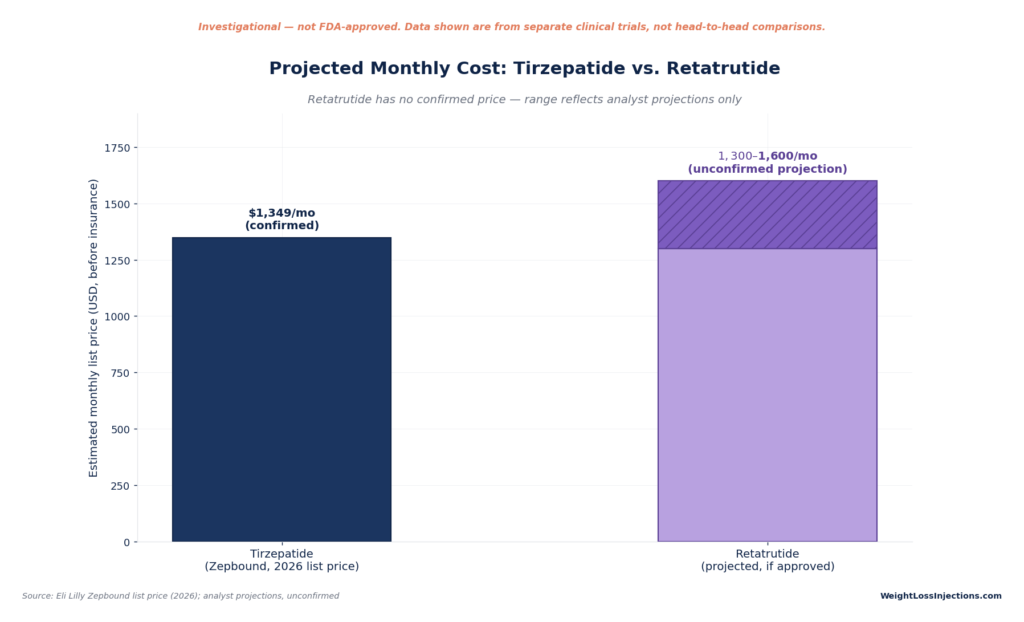
Tirzepatide’s list price for Zepbound in 2026 is approximately $1,349 per month without insurance. Retatrutide has no confirmed price because it is not approved, but analyst projections place an anticipated list price in the range of $1,300 to $1,600 per month once (and if) it reaches the market — figures that remain approximate and unconfirmed until Eli Lilly makes a formal pricing announcement closer to launch.
| Cost Factor | Retatrutide (investigational) | Tirzepatide (Zepbound) |
|---|---|---|
| List price (2026) | Not set; projected $1,300–$1,600/mo | ~$1,349/mo |
| Insurance coverage | Not applicable (not approved) | Varies by plan; prior authorization common |
| Current legal access | Clinical trial enrollment only | Pharmacy, by prescription |
Availability: The Critical Difference
No matter how the efficacy numbers compare, one fact overrides all others: tirzepatide is FDA-approved and can be prescribed today, while retatrutide cannot. As of July 2026, retatrutide is investigational under an active IND, has not been reviewed or approved by the FDA, EMA, or TGA, and has no USP/NF monograph — meaning it cannot legally be compounded by 503A or 503B pharmacies. The only legal way to access retatrutide currently is through enrollment in an authorized clinical trial listed on ClinicalTrials.gov.
Eli Lilly is expected to submit a New Drug Application in Q4 2026, with FDA acceptance projected for Q1 2027 and a potential approval decision in late 2027, followed by a commercial launch around Q1–Q2 2028 if approved. Until that process concludes, tirzepatide, along with semaglutide-based options like Wegovy and Zepbound, remain the only regulator-approved injectable options in this drug class.
FAQ
Is retatrutide better than tirzepatide?
Trial data shows retatrutide produced greater mean weight loss than tirzepatide in each drug’s respective pivotal trial (28.3% vs. 22.5%), but this comes from separate studies, not a direct head-to-head comparison, and retatrutide remains unapproved. “Better” cannot be established until both drugs are studied in the same trial or retatrutide completes the approval process.
Can I get retatrutide instead of tirzepatide right now?
No. Retatrutide is only available through enrollment in an authorized clinical trial. Tirzepatide (Zepbound, Mounjaro) is FDA-approved and available by prescription today.
Why does retatrutide show more weight loss in trials?
The leading explanation is its third mechanism — glucagon receptor agonism — which adds an energy-expenditure effect on top of the appetite-suppressing GIP and GLP-1 activity that tirzepatide already provides.
Does retatrutide have worse side effects than tirzepatide?
The two share a similar gastrointestinal side effect profile. Retatrutide’s trials additionally report dysesthesia in 2.3–4.5% of participants, a signal not characterized in tirzepatide’s data. Overall discontinuation rates for adverse events appear broadly comparable between the two at their highest doses.
When might retatrutide become available as an alternative to tirzepatide?
If development proceeds on schedule, Eli Lilly is expected to submit a New Drug Application in Q4 2026, with a potential approval decision in late 2027 and commercial launch around Q1–Q2 2028.
Medical disclaimer: Retatrutide is an investigational drug not approved by the FDA or any other regulatory authority as of July 2026. It is available only through enrollment in authorized clinical trials. This article is for informational purposes only and does not constitute medical advice, endorsement, or a recommendation to obtain retatrutide outside of a registered clinical trial. Speak with your healthcare provider about currently approved weight-loss treatments. Content published by WeightLossInjections.com.