
Key Takeaways
- Retatrutide is investigational and not approved by the FDA or any other regulatory authority as of July 2026 — all comparisons below are drawn from separate clinical trials, not head-to-head studies.
- Weight-loss drugs in this class fall into three mechanistic tiers: single agonists (semaglutide — GLP-1 only), dual agonists (tirzepatide — GIP + GLP-1), and triple agonists (retatrutide — GIP + GLP-1 + glucagon).
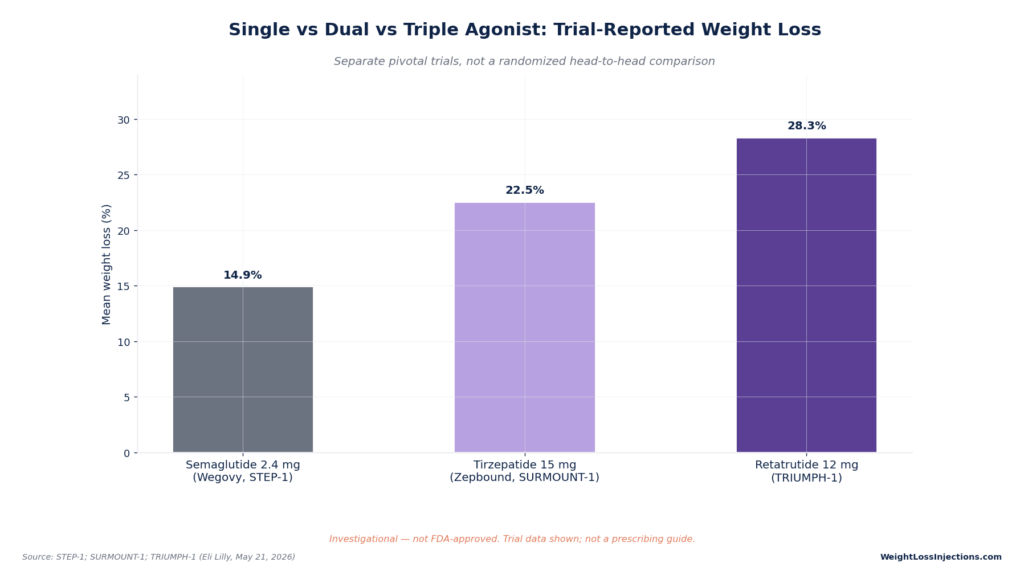
- Trial-reported mean weight loss rises with each added receptor: 14.9% (semaglutide, STEP-1) → 22.5% (tirzepatide, SURMOUNT-1) → 28.3% (retatrutide, TRIUMPH-1).
- The added glucagon receptor in retatrutide is believed to increase energy expenditure, a mechanism absent from single and dual agonists.
- These figures come from three separate trials with different designs, populations, and timeframes — not a single head-to-head comparison — so they should be read as directional evidence, not a precise ranking.
- Retatrutide is only accessible today through enrollment in an authorized clinical trial.
This article compares mechanisms and trial-reported outcomes for educational purposes. It is not a recommendation for any specific treatment, dose, or drug.
Why Receptor Count Has Become the Industry’s Efficacy Story
Over the past several years, the weight-loss drug industry has moved through a clear mechanistic progression: from drugs that activate one hormone receptor, to drugs that activate two, to the current investigational frontier of drugs that activate three. Retatrutide (LY3437943), developed by Eli Lilly, has not been approved by the FDA or any other regulatory authority as of July 2026 and remains under investigation, but its Phase 3 results have made it the most closely watched example of the “more receptors, more weight loss” hypothesis.
This article lays out how single-, dual-, and triple-receptor agonists differ mechanistically, and what the available trial data shows about the real-world effect of adding each additional pathway.
The Three Tiers of Incretin-Based Therapy
Tier 1: Single Agonists (GLP-1 Only)
Semaglutide — sold under the brand names Ozempic (diabetes) and Wegovy (weight management) — activates only the GLP-1 receptor. This pathway reduces appetite, slows gastric emptying, and improves glucose-dependent insulin release. It was the first incretin-based mechanism to demonstrate double-digit percentage weight loss in large trials and remains the most widely prescribed class of injectable weight-loss medication.
Tier 2: Dual Agonists (GIP + GLP-1)
Tirzepatide — sold as Zepbound for weight management — adds GIP receptor activation on top of GLP-1 activation. For years, scientists were unsure whether activating GIP would help or hurt weight-loss outcomes, since GIP had previously been associated with fat storage in some research contexts. Tirzepatide’s trial results settled much of that debate, showing that GIP receptor activation — when combined with GLP-1 activation — improves insulin sensitivity and appears to enhance the overall metabolic response beyond what GLP-1 activation achieves alone.
Tier 3: Triple Agonists (GIP + GLP-1 + Glucagon)
Retatrutide adds a third receptor target: glucagon. Unlike GLP-1 and GIP, which primarily act on appetite and insulin signaling, the glucagon receptor pathway is believed to increase energy expenditure by raising basal metabolic rate and promoting fat oxidation in the liver. This is a mechanistically distinct addition — rather than layering on more appetite suppression, it targets the energy-out side of the weight equation, which single and dual agonists do not directly address.
For a full explainer on this third pathway, see how retatrutide’s mechanism works.
Our Top 3 · October 2026
The best GLP-1 providers right now
Independently reviewed. Ranked by price, medication access, provider quality, and patient outcomes.
Renew GLP
Personalized GLP-1, GIP plans: Semaglutide & Tirzepatide.
Medvi
No membership or hidden fees. Everything you need is included.
Trimi
US-licensed clinicians and shipped to your door, from $99/mo.
The Efficacy Ladder: Comparing Trial-Reported Weight Loss
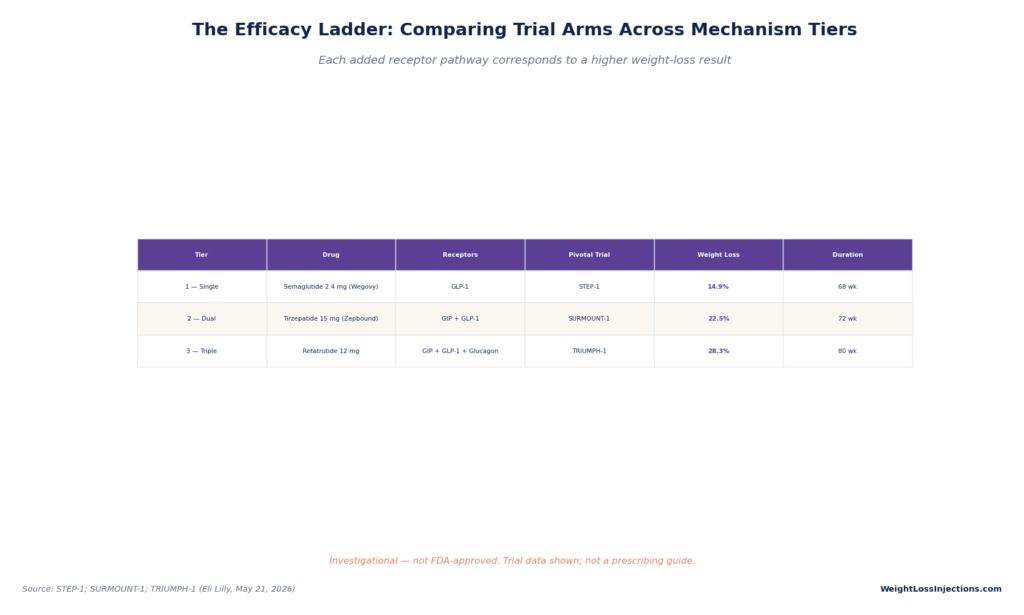
The clearest illustration of why receptor count matters comes from comparing the top-dose weight-loss results across each drug’s respective pivotal trial:
| Drug | Class | Receptors Targeted | Pivotal Trial | Mean Weight Loss | Duration |
|---|---|---|---|---|---|
| Semaglutide 2.4 mg (Wegovy) | Single agonist | GLP-1 | STEP-1 | 14.9% | 68 weeks |
| Tirzepatide 15 mg (Zepbound) | Dual agonist | GIP + GLP-1 | SURMOUNT-1 | 22.5% | 72 weeks |
| Retatrutide 12 mg | Triple agonist | GIP + GLP-1 + Glucagon | TRIUMPH-1 | 28.3% | 80 weeks |
Each step up in receptor count corresponds to a step up in trial-reported mean weight loss — roughly 7-8 additional percentage points at each tier. At the 12 mg dose in TRIUMPH-1, 45.3% of participants lost 30% or more of their body weight, and 104-week extension data showed the average climbing further to 30.3%, indicating the effect continued to build rather than plateau (Eli Lilly, May 21, 2026; NEJM, Jastreboff et al., 2026).
An Important Caveat: These Are Separate Trials, Not a Head-to-Head Study
It’s worth being direct about a limitation in this comparison: STEP-1, SURMOUNT-1, and TRIUMPH-1 are three different trials, run at different times, with different patient populations, different trial durations (68, 72, and 80 weeks respectively), and different statistical designs. None of them directly randomized patients to receive one of the three drugs head-to-head. This means the exact percentage-point gaps should be interpreted as directional evidence of a dose-response and mechanism-response relationship, not as a precise, controlled ranking. A true head-to-head trial would be needed to confirm the exact magnitude of retatrutide’s advantage over tirzepatide or semaglutide.
Why Adding Glucagon Appears to Produce a Bigger Jump Than Adding GIP Alone
One pattern worth noting: the jump from single to dual agonist (semaglutide to tirzepatide) was roughly 7.6 percentage points, and the jump from dual to triple agonist (tirzepatide to retatrutide) was roughly 5.8 percentage points. Both jumps are substantial, but the mechanistic explanation differs:
- Adding GIP to GLP-1 appears to enhance and extend the same general category of effect — improved insulin sensitivity and appetite regulation working together more effectively.
- Adding glucagon to GIP + GLP-1 introduces a mechanistically distinct effect — increased energy expenditure — that works on a different side of the energy-balance equation entirely.
This is the core argument for why three receptors may matter more than simply “more drug”: retatrutide isn’t just intensifying appetite suppression, it’s combining appetite suppression with an energy-expenditure effect that the other two drug classes don’t directly target.
The Trade-Off: Tolerability Also Changes Across Tiers
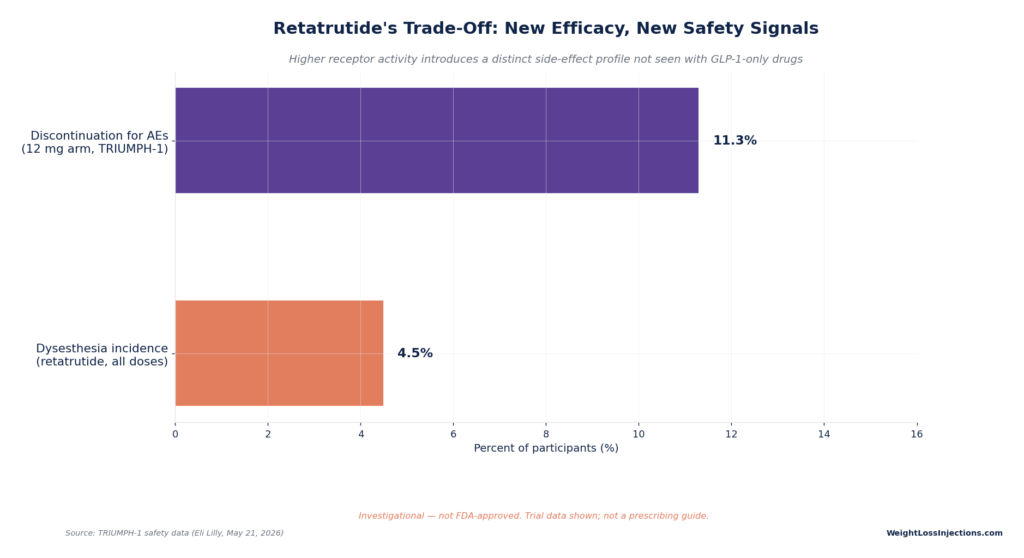
More receptors and more weight loss does not come without trade-offs. Retatrutide’s trials have reported the same class-wide gastrointestinal side effects seen with semaglutide and tirzepatide — nausea, vomiting, diarrhea, and constipation — generally more frequent at higher doses. TRIUMPH-1 reported an 11.3% discontinuation rate due to adverse events at the 12 mg dose. Retatrutide has also shown a side effect not commonly associated with GLP-1-only drugs: dysesthesia, an altered skin sensation reported in 2.3% to 4.5% of participants, thought to be linked to glucagon receptor activity. This underscores that adding receptor pathways can introduce new side-effect profiles alongside new efficacy gains — a trade-off regulators will weigh carefully during review.
What This Means While Retatrutide Remains Investigational
The efficacy ladder above is a useful way to understand the mechanistic logic behind retatrutide’s trial results, but it does not change retatrutide’s regulatory status. As of July 2026, retatrutide has not been approved by the FDA, has no assigned brand name, and cannot legally be prescribed or compounded. Eli Lilly anticipates submitting a New Drug Application in Q4 2026, with potential approval projected for late 2027 and commercial launch estimated for Q1–Q2 2028.
For readers currently seeking treatment, tirzepatide and semaglutide-based options remain the most advanced approved therapies in this drug class. Those interested in retatrutide specifically can only access it by enrolling in an authorized clinical trial through ClinicalTrials.gov.
FAQ
Is retatrutide proven to be better than tirzepatide and semaglutide?
Trial-reported mean weight loss is higher for retatrutide (28.3%) than for tirzepatide (22.5%) or semaglutide (14.9%), but these figures come from separate trials rather than a single head-to-head study, so a direct, controlled comparison hasn’t yet been published.
What does “triple agonist” actually add compared to a dual agonist?
The added component is glucagon receptor activation, which is believed to increase energy expenditure by raising basal metabolic rate — a mechanism distinct from the appetite-suppressing effects of GLP-1 and GIP receptor activation.
Does more receptors mean more side effects?
Retatrutide’s trials have reported the same general gastrointestinal side effects as semaglutide and tirzepatide, generally more common at higher doses, plus a distinct side effect — dysesthesia — that appears linked to the added glucagon receptor pathway.
When will there be a true head-to-head trial comparing these drugs?
No published head-to-head trial between retatrutide, tirzepatide, and semaglutide has been reported as of July 2026. Comparisons rely on separate pivotal trials (STEP-1, SURMOUNT-1, TRIUMPH-1).
Can I take retatrutide today because it appears more effective?
No. Retatrutide is investigational and not legally available outside of clinical trials, regardless of its trial results. The only legal access route is enrollment in an authorized study via ClinicalTrials.gov.
Medical disclaimer: Retatrutide is an investigational drug not approved by the FDA or any other regulatory authority as of July 2026. It is available only through enrollment in authorized clinical trials. This article is for informational purposes only and does not constitute medical advice, endorsement, or a recommendation to obtain retatrutide outside of a registered clinical trial. Speak with your healthcare provider about currently approved weight-loss treatments. Content published by WeightLossInjections.com.