
Key Takeaways
- Retatrutide is investigational and not approved by the FDA or any other regulatory authority as of July 2026 — the mechanism described here comes from clinical and preclinical research, not an approved drug label.
- Retatrutide is a first-in-class triple hormone receptor agonist, activating three separate receptors: GLP-1, GIP, and glucagon.
- The GLP-1 receptor pathway reduces appetite and slows stomach emptying, the same mechanism behind approved drugs like Ozempic and Wegovy.
- The GIP receptor pathway is believed to improve insulin sensitivity and influence how fat tissue stores and releases energy — the same target added in tirzepatide.
- The glucagon receptor pathway is retatrutide’s distinguishing feature — it is believed to increase energy expenditure by raising basal metabolic rate, which may explain why retatrutide has produced greater weight loss than dual or single agonists in trials so far.
- The only legal access point to retatrutide today is enrollment in an authorized clinical trial via ClinicalTrials.gov.
This article is a scientific explainer, not a treatment guide. Retatrutide’s mechanism is described here for educational purposes and does not imply availability, approval, or a recommendation for use.
An Investigational Drug With a Genuinely New Mechanism
Retatrutide (LY3437943), developed by Eli Lilly, has not been approved by the FDA or any other regulatory authority as of July 2026. It remains in Phase 3 clinical development, with a New Drug Application anticipated in Q4 2026 and potential approval projected for late 2027. Everything below describes how researchers believe the drug works based on its receptor-binding profile and the physiological effects observed in clinical trials — not a claim about an approved, prescribable therapy.
What makes retatrutide scientifically distinct is not just that it works — plenty of drugs affect appetite and metabolism — but how many biological pathways it works through at once. Understanding that mechanism helps explain why its trial results have consistently outpaced older single-pathway drugs.
Three Hormones, Three Receptors, One Injection
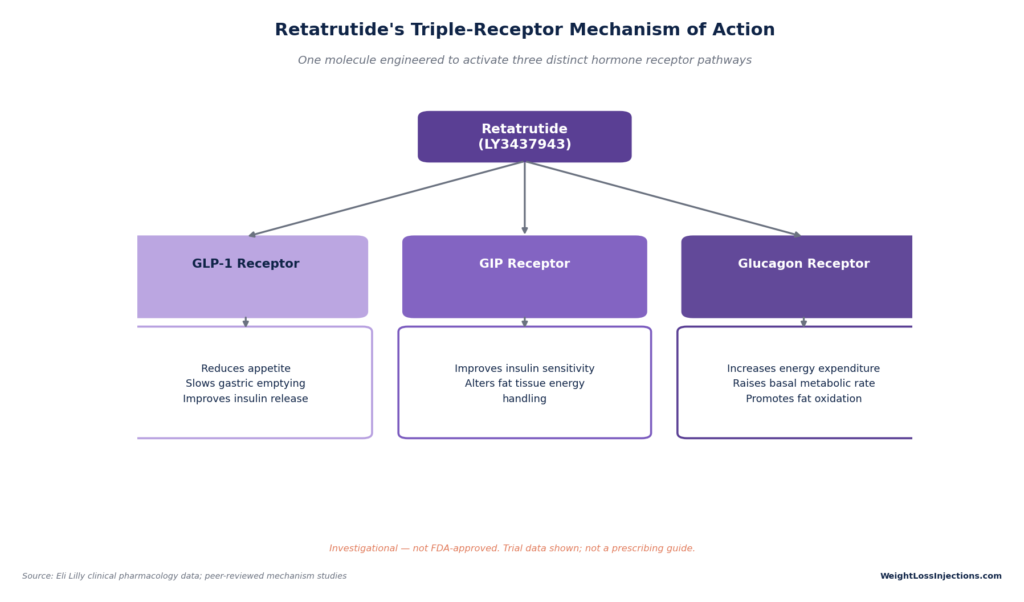
The human gut and pancreas naturally produce several hormones that regulate appetite, blood sugar, and energy use. Drug developers have spent the last two decades learning to mimic these hormones with long-acting synthetic peptides. Retatrutide is the most advanced attempt yet to mimic three of these hormone pathways simultaneously in a single molecule:
- GLP-1 (glucagon-like peptide-1)
- GIP (glucose-dependent insulinotropic polypeptide)
- Glucagon
Each of these plays a different physiological role, and retatrutide is engineered to activate all three receptors that respond to them. This is why it’s classified as a triple hormone receptor agonist — “agonist” simply means a molecule that activates a receptor, triggering the same downstream response the body’s natural hormone would.
Pathway 1: The GLP-1 Receptor — Appetite and Glucose Control
GLP-1 is a hormone released by the gut after eating. Its natural job is to help the body respond appropriately to a meal: it stimulates insulin release, slows the rate at which the stomach empties, and sends satiety signals to the brain. Pharmaceutical GLP-1 receptor agonists — the class that includes semaglutide (used in Ozempic and Wegovy) — mimic this hormone in a long-acting form, which is why they reduce appetite and produce meaningful weight loss.
In retatrutide, the GLP-1 receptor component contributes:
- Reduced appetite and earlier satiety during meals
- Slower gastric emptying, which prolongs the feeling of fullness
- Improved glucose-dependent insulin secretion, supporting blood sugar control
This is the most well-understood of retatrutide’s three mechanisms because it’s shared with an entire generation of approved drugs. It forms the foundation of the weight-loss effect, but on its own — as seen in GLP-1-only drugs — it produces smaller average weight loss than retatrutide’s full triple-receptor activation.
Our Top 3 · October 2026
The best GLP-1 providers right now
Independently reviewed. Ranked by price, medication access, provider quality, and patient outcomes.
Renew GLP
Personalized GLP-1, GIP plans: Semaglutide & Tirzepatide.
Medvi
No membership or hidden fees. Everything you need is included.
Trimi
US-licensed clinicians and shipped to your door, from $99/mo.
Pathway 2: The GIP Receptor — Insulin Sensitivity and Fat Tissue
GIP is a second gut hormone, released alongside GLP-1 after eating, but historically less well understood. For years, scientists debated whether activating the GIP receptor would even help with weight loss, since GIP had been associated with fat storage in some earlier research. That view shifted substantially after tirzepatide — a dual GIP/GLP-1 agonist marketed as Zepbound — outperformed GLP-1-only drugs in head-to-head-style trial comparisons.
The current scientific understanding is that GIP receptor activation, when combined with GLP-1 activation, contributes to:
- Improved insulin sensitivity, helping cells respond more efficiently to insulin
- Changes in how adipose (fat) tissue handles energy storage and release, potentially making fat tissue more metabolically responsive
- Possible synergistic appetite effects when paired with GLP-1 activation, though the exact mechanism is still an area of active research
Retatrutide incorporates this same GIP-receptor activation that helped tirzepatide outperform semaglutide-class drugs — but then adds a third pathway on top of it.
Pathway 3: The Glucagon Receptor — The Piece That Sets Retatrutide Apart
This is retatrutide’s defining innovation. Glucagon is usually known as the hormone that raises blood sugar — the functional opposite of insulin, released when blood glucose runs low. That reputation has historically made drug developers wary of adding glucagon receptor activity to a diabetes or obesity treatment, out of concern it could worsen blood sugar control.
Retatrutide’s developers took a different approach: by carefully balancing glucagon receptor activation against strong GLP-1 and GIP activity (which independently improve glucose control), the combination appears to avoid the blood-sugar-raising downside of glucagon while capturing its most therapeutically useful property for weight management — increased energy expenditure.
Why Glucagon Receptor Activation May Drive Extra Weight Loss
Glucagon receptors are present in the liver and other metabolic tissue, and activating them is believed to:
- Increase basal metabolic rate — the amount of energy the body burns at rest
- Promote hepatic fat oxidation, encouraging the liver to break down stored fat for energy
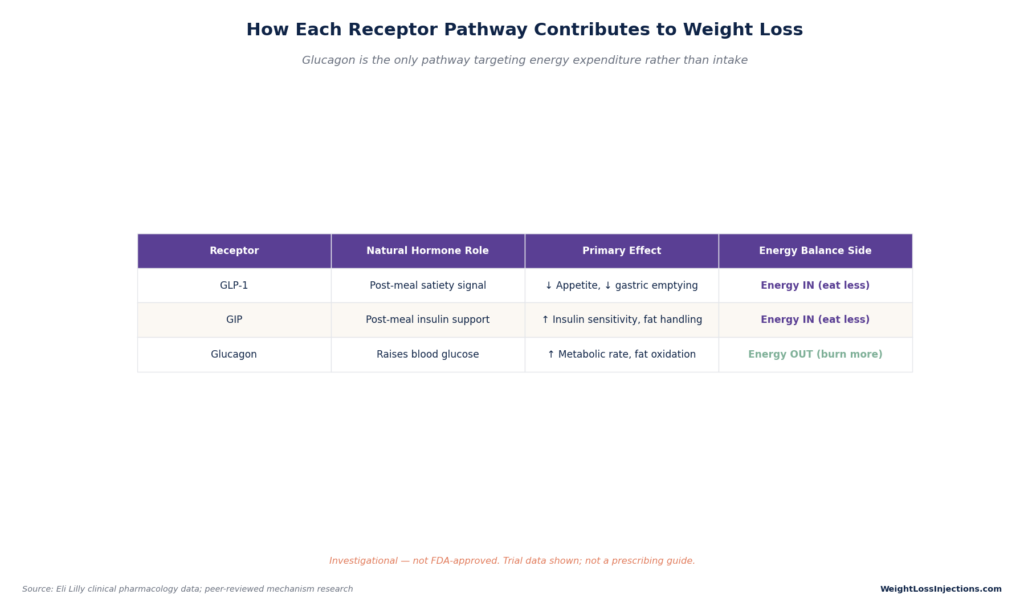
- Add an energy-expenditure effect on top of the appetite-reduction effect from GLP-1 and GIP activation
In other words, GLP-1 and GIP activation primarily work by reducing how much a person eats, while glucagon receptor activation is believed to work on the other side of the energy-balance equation — increasing how much energy the body burns. Researchers believe this dual-sided approach — less energy in, more energy out — is the leading explanation for why retatrutide has produced greater weight loss in trials than drugs acting on only one or two of these three pathways.
Putting the Three Pathways Together: What Trial Data Suggests
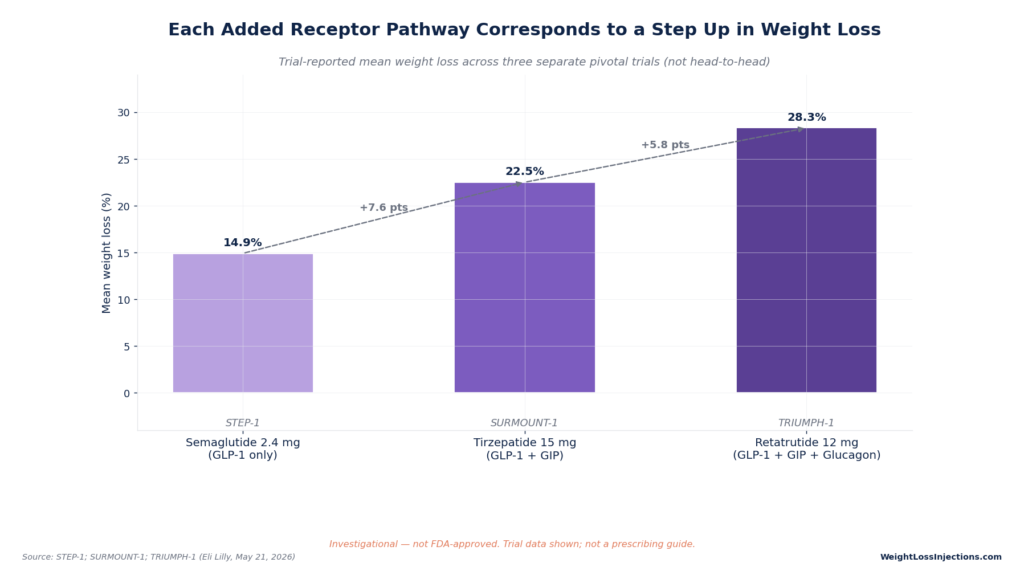
The clearest evidence for this “three pathways are better than two, which are better than one” theory comes from comparing trial results across drug classes:
- Semaglutide 2.4 mg (GLP-1 only) produced 14.9% mean weight loss in the STEP-1 trial
- Tirzepatide 15 mg (GLP-1 + GIP) produced 22.5% mean weight loss in the SURMOUNT-1 trial
- Retatrutide 12 mg (GLP-1 + GIP + glucagon) produced 28.3% mean weight loss in the TRIUMPH-1 trial (Eli Lilly, May 21, 2026)
Each added receptor pathway corresponds to a step up in trial-reported weight loss. This stepwise pattern is consistent with the mechanistic theory that each hormone pathway contributes something distinct — GLP-1 and GIP primarily reducing intake, and glucagon primarily increasing expenditure — rather than the three pathways simply duplicating each other’s effects.
Mechanism Also Explains a Unique Side Effect
The same glucagon receptor activity that appears to drive extra weight loss may also explain a side effect not commonly reported with GLP-1-only drugs: dysesthesia, an altered skin sensation reported in 2.3% to 4.5% of retatrutide trial participants. Researchers hypothesize this is tied to glucagon receptor activity in nerve-adjacent tissue, though the precise mechanism is still being studied. This is a useful example of how a drug’s mechanism can explain both its benefits and its distinctive risks.
Why This Mechanism Still Requires Regulatory Review
A promising mechanism is not the same as regulatory approval. The FDA requires large, controlled Phase 3 trials — like TRIUMPH-1, TRIUMPH-4, and TRANSCEND-T2D-1 — specifically because a drug’s biological rationale, however compelling, must be confirmed by real-world safety and efficacy data across thousands of patients before it can be prescribed. Retatrutide’s triple-agonist mechanism is well-supported by trial data so far, but the drug remains under review, with an NDA anticipated in Q4 2026 and potential approval projected for late 2027.
Readers who want to understand approved mechanisms in the meantime can review how semaglutide and tirzepatide work as single- and dual-agonist predecessors to retatrutide’s triple-agonist approach.
FAQ
What does “triple agonist” mean?
It means the drug activates three different hormone receptors — GLP-1, GIP, and glucagon — rather than one or two. “Agonist” refers to a molecule that triggers a receptor’s natural response.
Is the glucagon receptor pathway dangerous since glucagon raises blood sugar?
Glucagon’s blood-sugar-raising effect is a concern drug developers had to address. Trial data suggests that when combined with strong GLP-1 and GIP activity, retatrutide has shown favorable glucose control in diabetes trials (TRANSCEND-T2D-1), but this remains an area of ongoing research and regulatory review.
Why does retatrutide cause more weight loss than tirzepatide or semaglutide?
The leading mechanistic explanation is that adding glucagon receptor activation increases energy expenditure (calories burned) on top of the appetite-reduction effects of GLP-1 and GIP, producing a combined effect greater than either pathway alone.
Is retatrutide’s mechanism proven, or still theoretical?
The receptor-binding profile is well characterized in laboratory and clinical pharmacology studies, and the resulting effects on weight and blood sugar have been observed in Phase 3 trials. However, some specific downstream mechanisms — like the precise cause of dysesthesia — are still being studied.
Can I access retatrutide because I understand how it works?
No. Understanding the mechanism does not change its legal status. Retatrutide remains investigational, and the only legal access route is enrollment in an authorized clinical trial through ClinicalTrials.gov.
Medical disclaimer: Retatrutide is an investigational drug not approved by the FDA or any other regulatory authority as of July 2026. It is available only through enrollment in authorized clinical trials. This article is for informational purposes only and does not constitute medical advice, endorsement, or a recommendation to obtain retatrutide outside of a registered clinical trial. Speak with your healthcare provider about currently approved weight-loss treatments. Content published by WeightLossInjections.com.