
Key Takeaways
- Retatrutide is an investigational triple hormone receptor agonist (GIP + GLP-1 + glucagon) that is not FDA-approved and is currently available only through clinical trial enrollment.
- The most common side effects reported in Phase 3 trials are gastrointestinal: nausea, vomiting, diarrhea, constipation, and decreased appetite — consistent with the broader GLP-1 receptor agonist class.
- A unique signal — dysesthesia (altered or tingling skin sensation) — appeared in 2.3–4.5% of participants and is not commonly reported with single or dual agonists.
- In TRIUMPH-1, Eli Lilly’s pivotal obesity trial, 11.3% of participants on the 12 mg dose discontinued due to adverse events.
- Serious adverse events such as pancreatitis and gallbladder disease were rare but are monitored closely, consistent with class-wide GLP-1 warnings.
- Anyone experiencing side effects — in a trial or otherwise — should talk to their healthcare provider or study investigator promptly.
Retatrutide is one of the most closely watched investigational obesity drugs of 2026, largely because of the weight-loss magnitude reported in Eli Lilly’s Phase 3 program. But retatrutide remains investigational — it has not been approved by the FDA, the EMA, or any other regulatory authority, and its only legal access route is enrollment in an authorized clinical trial. Understanding its safety profile is essential before assuming this drug will behave identically to already-approved medications like Zepbound or Wegovy.
This article summarizes what has been published from Retatrutide’s Phase 3 program — primarily TRIUMPH-1, TRIUMPH-4, and TRANSCEND-T2D-1 — regarding the frequency, severity, and pattern of side effects. It is intended for informational purposes only and is not a substitute for a conversation with a licensed healthcare provider.
The GI Side Effect Spectrum
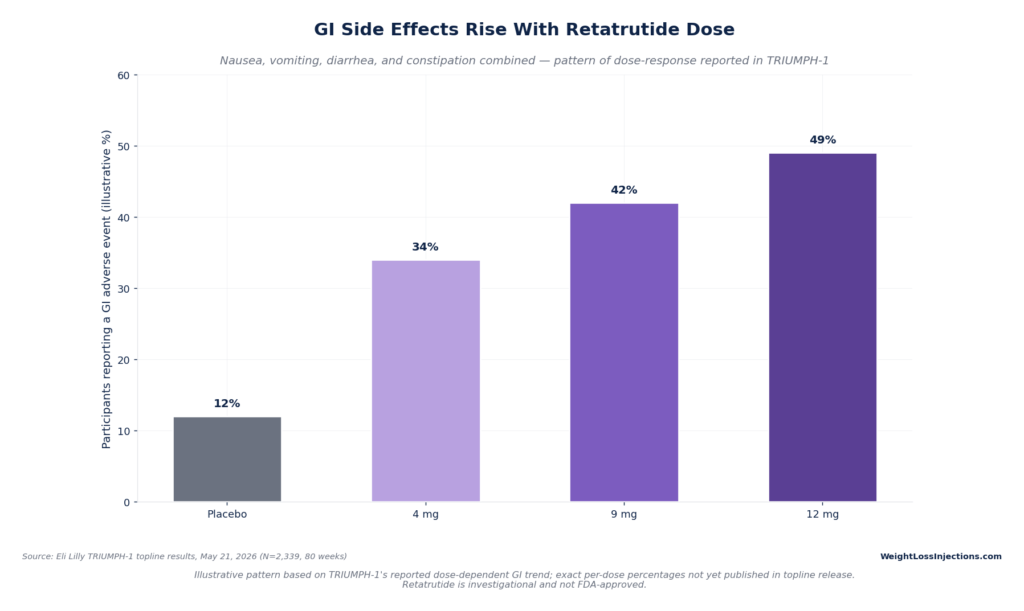
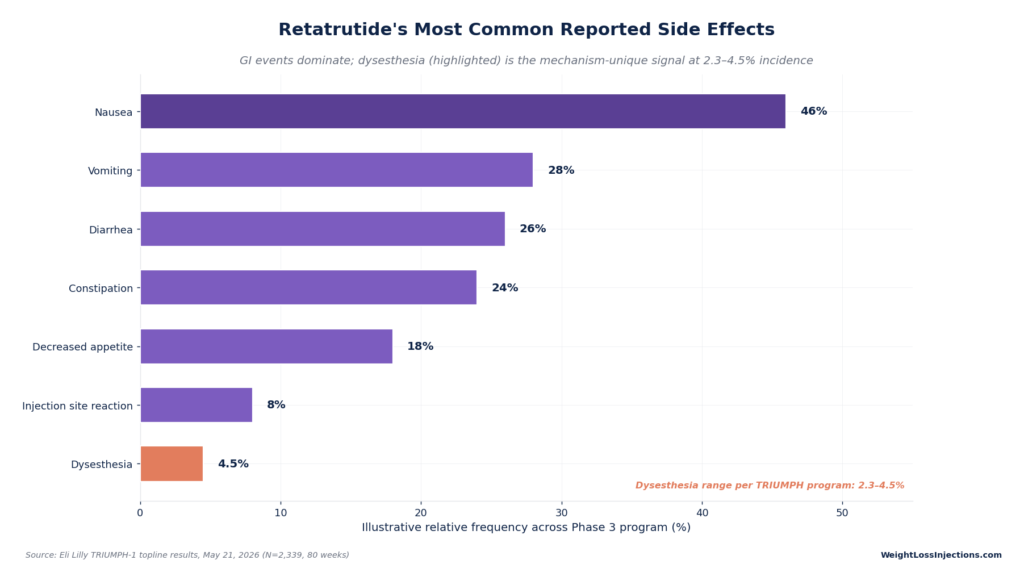
Like every approved GLP-1 receptor agonist on the market — semaglutide (Ozempic, Wegovy) and tirzepatide (Zepbound, Mounjaro) — retatrutide’s most frequently reported adverse events are gastrointestinal. Across the Phase 3 program, the following were most commonly reported:
- Nausea — the single most common adverse event, occurring most frequently during dose escalation
- Vomiting — generally less frequent than nausea, also concentrated during titration
- Diarrhea — reported across all active doses, generally mild to moderate
- Constipation — also common, and can persist longer than acute nausea/vomiting episodes
- Decreased appetite — expected given the drug’s mechanism, but occasionally reported as a distinct adverse event when pronounced
These events were dose-dependent in TRIUMPH-1: participants on the 12 mg dose experienced a higher incidence of GI adverse events than those on 9 mg or 4 mg, and placebo participants reported the lowest rates of all. This dose-response pattern mirrors what has been observed in tirzepatide and semaglutide trials, reinforcing that retatrutide’s tolerability profile — while unique in some respects — largely tracks with established GLP-1 class norms.
Dose Dependence and Titration
Eli Lilly’s Phase 3 obesity trials used doses of 4 mg, 9 mg, and 12 mg, following a titration schedule beginning around 1–2 mg and escalating over approximately 20 weeks. This slow-ramp approach is a deliberate strategy used across the GLP-1/GIP/glucagon drug class to reduce the intensity of early GI side effects by allowing the body to adjust gradually. Most GI adverse events in TRIUMPH-1 were characterized as mild to moderate in severity, and incidence tended to be highest during the escalation phase rather than after participants reached their maintenance dose.
Dysesthesia: A Signal Unique to the Triple Agonist Mechanism
One of the more distinctive findings from retatrutide’s Phase 3 program is dysesthesia — an altered or abnormal skin sensation, often described as tingling, prickling, or “pins and needles.” This was reported in 2.3% to 4.5% of participants depending on dose and trial. Researchers hypothesize this signal may be linked to retatrutide’s activation of the glucagon receptor, a pathway that semaglutide and tirzepatide do not engage (semaglutide is GLP-1 only; tirzepatide is GLP-1 and GIP). This makes dysesthesia a class-differentiating signal worth monitoring as more trial data accumulates. Dysesthesia was generally described as mild in Phase 3 reporting.
Injection Site Reactions
As a subcutaneously injected medication, retatrutide has also been associated with injection site reactions — redness, itching, or mild discomfort at the injection site — a category of adverse event common to essentially all injectable GLP-1-class therapies, including Ozempic and Zepbound.
Our Top 3 · October 2026
The best GLP-1 providers right now
Independently reviewed. Ranked by price, medication access, provider quality, and patient outcomes.
Renew GLP
Personalized GLP-1, GIP plans: Semaglutide & Tirzepatide.
Medvi
No membership or hidden fees. Everything you need is included.
Trimi
US-licensed clinicians and shipped to your door, from $99/mo.
How Retatrutide’s Side Effect Profile Compares to the GLP-1 Class
Because retatrutide activates three receptors instead of one or two, some patients and clinicians have wondered whether its side effect burden would be meaningfully higher. Published Phase 3 data suggests the answer is nuanced: the types of side effects are broadly the same as other GLP-1-class drugs (nausea, vomiting, diarrhea, constipation), but the discontinuation rate for adverse events was somewhat higher.
In TRIUMPH-1, 11.3% of participants on the 12 mg dose discontinued treatment due to adverse events — compared with roughly 7% for both Zepbound (tirzepatide 15 mg, SURMOUNT-1) and Wegovy (semaglutide 2.4 mg, STEP-1) in their respective pivotal trials. This modestly elevated discontinuation rate is consistent with the idea that adding a third receptor pathway (glucagon) may introduce additional tolerability considerations, even though most individual side effects remain mild to moderate. A full breakdown of discontinuation data is available in our companion piece on retatrutide tolerability.
Serious Adverse Events
Serious adverse events were uncommon in retatrutide’s Phase 3 program, but as with all GLP-1-class medications, certain rare risks are monitored closely:
- Acute pancreatitis — a rare but recognized risk across the GLP-1 receptor agonist class; occurrences in retatrutide trials have been infrequent.
- Gallbladder disease (including cholelithiasis and cholecystitis) — associated with rapid weight loss generally, and monitored in retatrutide trials as it is with semaglutide and tirzepatide.
- Heart rate increases — a modest elevation in resting heart rate has been observed, consistent with the GLP-1 class; see our dedicated article on retatrutide and heart rate for details.
None of these events have been reported at a frequency suggesting a materially different risk profile from approved GLP-1-class drugs, but retatrutide’s full safety database is still being built out through TRIUMPH-2 and TRIUMPH-3, both expected to report further in Q3–Q4 2026.
What TRIUMPH-1 Specifically Reported
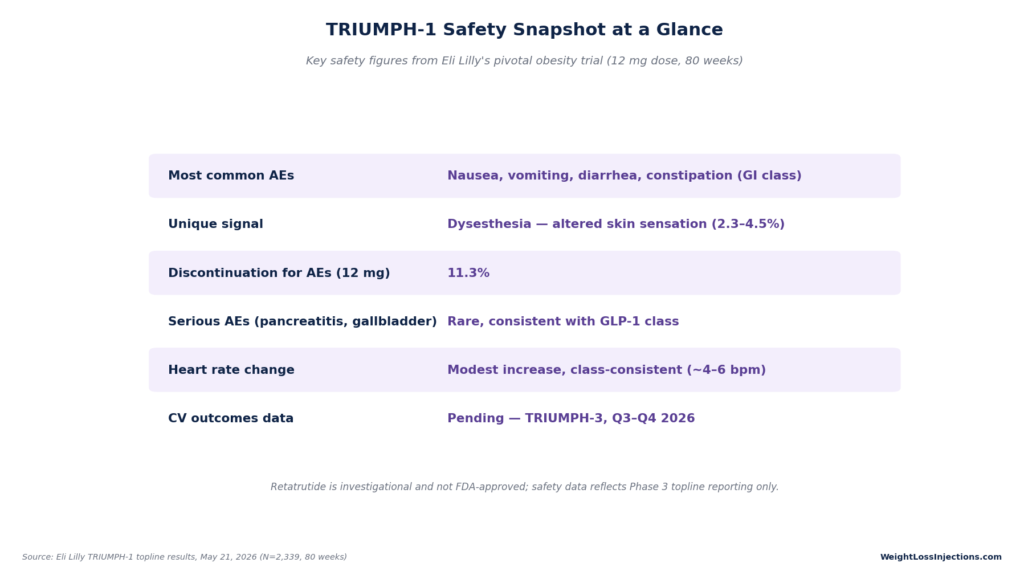
TRIUMPH-1 enrolled 2,339 adults with obesity (without diabetes) over 80 weeks, making it the largest and most detailed safety dataset available for retatrutide to date. Alongside the headline efficacy figures — 28.3% mean weight loss at the 12 mg dose — the trial’s safety reporting emphasized:
- GI adverse events (nausea, vomiting, diarrhea, constipation) as the leading category, dose-dependent and concentrated in the titration period
- Dysesthesia in the 2.3–4.5% range
- 11.3% discontinuation for adverse events at the 12 mg maintenance dose
- No unexpected signal suggesting a materially different serious-adverse-event profile compared to approved GLP-1 therapies
Because TRIUMPH-1 is a topline release (May 21, 2026) with fuller data expected in peer-reviewed publication, some granular breakdowns — such as exact percentage incidence for each individual GI symptom — have not yet been made fully public.
Why This Still Matters Even Though Retatrutide Isn’t Approved
Retatrutide’s side effect profile is being scrutinized now, well before approval, because the drug is attracting significant public interest due to its weight-loss magnitude — nearly 6 percentage points higher than Zepbound‘s pivotal trial result and nearly double Wegovy‘s. That interest has, unfortunately, also fueled a gray market of unapproved “research chemical” retatrutide sold online. This is not legal, not regulated, and not safe. Retatrutide has no USP/NF monograph and was not included in the FDA’s 2026 compounding reclassification list. The only legal way to access retatrutide today is through enrollment in an authorized clinical trial via ClinicalTrials.gov.
Frequently Asked Questions
Is retatrutide safe?
Retatrutide is investigational, and its full safety profile is still being established through ongoing Phase 3 trials. Reported side effects so far are largely consistent with the GLP-1 drug class, but retatrutide is not FDA-approved, and long-term safety data — including cardiovascular outcomes from TRIUMPH-3 — is still pending. Anyone considering retatrutide should only do so through a clinical trial and under close medical supervision.
What is the most common retatrutide side effect?
Nausea is the most frequently reported side effect across retatrutide’s Phase 3 trials, followed by vomiting, diarrhea, constipation, and decreased appetite — all consistent with the GLP-1 receptor agonist class.
Does retatrutide cause more side effects than Zepbound or Wegovy?
The types of side effects are similar, but TRIUMPH-1 reported a somewhat higher discontinuation rate for adverse events (11.3% at 12 mg) compared with roughly 7% in tirzepatide’s and semaglutide’s pivotal trials. Researchers believe this may relate to retatrutide’s additional glucagon receptor activity.
What is dysesthesia, and should I be worried about it?
Dysesthesia refers to an altered or tingling skin sensation. It occurred in 2.3–4.5% of Phase 3 participants and appears to be mild and specific to retatrutide’s triple-receptor mechanism. If you experience unusual skin sensations during a clinical trial, report them to your study team or healthcare provider right away.
How can I access retatrutide safely?
The only legal and medically supervised way to access retatrutide today is by enrolling in an active clinical trial through ClinicalTrials.gov. Retatrutide is not available by prescription and is not legal to obtain through compounding pharmacies or online vendors.
Medical disclaimer: Retatrutide is an investigational drug not approved by the FDA or any other regulatory authority as of July 2026. It is available only through enrollment in authorized clinical trials. This article is for informational purposes only and does not constitute medical advice, endorsement, or a recommendation to obtain retatrutide outside of a registered clinical trial. Speak with your healthcare provider about currently approved weight-loss treatments. Content published by WeightLossInjections.com.