
Key Takeaways
- Retatrutide is investigational and not FDA-approved — enrolling in an authorized clinical trial is the only legal way to receive it before approval.
- Eli Lilly’s Phase 3 program, branded TRIUMPH, includes multiple studies; some (like TRIUMPH-1) have completed enrollment, while others remain ongoing as of mid-2026.
- ClinicalTrials.gov is the authoritative, government-run registry for verifying which retatrutide trials are actively recruiting near you.
- Typical eligibility criteria include specific BMI thresholds, absence or presence of type 2 diabetes depending on the study arm, and a documented history of unsuccessful weight-loss attempts.
- Participants typically receive the study drug, regular medical monitoring, and sometimes compensation for time and travel — but trial participation carries real risks and requires informed consent, not a guarantee of benefit.
Why a Clinical Trial Is Your Only Legal Option
If you are interested in retatrutide (developer code LY3437943), it is essential to understand this up front: retatrutide has not been approved by the FDA or any other regulatory authority, and there is no legal prescription, pharmacy, or compounding pathway to obtain it. Retatrutide has no USP/NF compounding monograph and was explicitly excluded from the FDA’s 2026 reclassification of compoundable substances, meaning 503A and 503B compounding pharmacies cannot legally prepare it under any circumstance. Any product sold online as “retatrutide” — including so-called research or peptide-grade products — falls entirely outside regulatory oversight and is not a legitimate way to access this drug.
The only legal, medically supervised way to receive retatrutide today is enrollment in an authorized clinical trial conducted under Eli Lilly’s development program and registered with the FDA. This guide walks through how that process works, who qualifies, and what to expect — with the explicit goal of directing you toward the single legitimate access route rather than any gray-market alternative.
For background on what retatrutide is and why it’s attracted so much attention, see our foundational retatrutide guide. For the broader regulatory timeline, see when retatrutide might be FDA approved.
Understanding Eli Lilly’s TRIUMPH Trial Program
Eli Lilly’s Phase 3 development program for retatrutide is organized under the name TRIUMPH, encompassing several parallel studies targeting different patient populations:
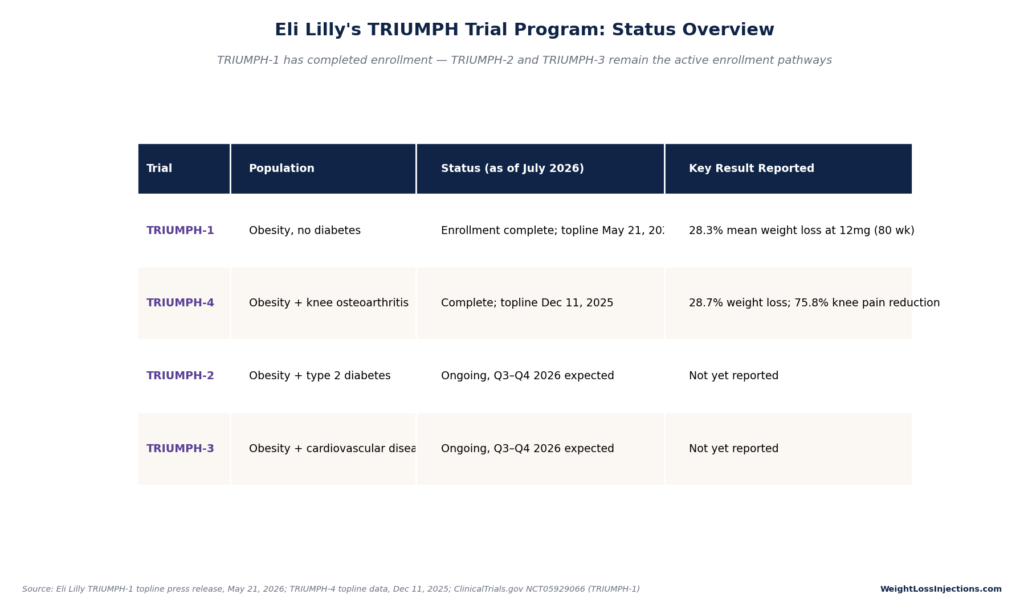
| Trial | Population | Status (as of July 2026) | Key Result Reported |
|---|---|---|---|
| TRIUMPH-1 | Adults with obesity, no diabetes | Completed enrollment; topline results reported May 21, 2026 | 28.3% mean weight loss at 12 mg (80 weeks) |
| TRIUMPH-4 | Adults with obesity + knee osteoarthritis | Completed; topline results reported Dec 11, 2025 | 28.7% weight loss; 75.8% knee pain reduction |
| TRIUMPH-2 | Adults with obesity + type 2 diabetes | Ongoing, Q3–Q4 2026 expected readout | Not yet reported |
| TRIUMPH-3 | Adults with obesity + cardiovascular disease | Ongoing, Q3–Q4 2026 expected readout | Not yet reported |
Table compiled from the Eli Lilly TRIUMPH-1 topline press release (May 21, 2026), TRIUMPH-4 topline data (Dec 11, 2025), and current enrollment status as of July 2026.
Important: TRIUMPH-1, the pivotal obesity trial referenced throughout retatrutide coverage, has already completed enrollment — it is no longer accepting new participants. This means that if you’re hoping to join a retatrutide trial today, TRIUMPH-1 itself is not an option. However, other studies in the TRIUMPH program, along with newer or substudy protocols, may still be open. Because enrollment status changes frequently, the only reliable way to check current recruitment status is directly through ClinicalTrials.gov, not through secondhand summaries — including this article.
Step-by-Step: How to Search ClinicalTrials.gov for Retatrutide Trials
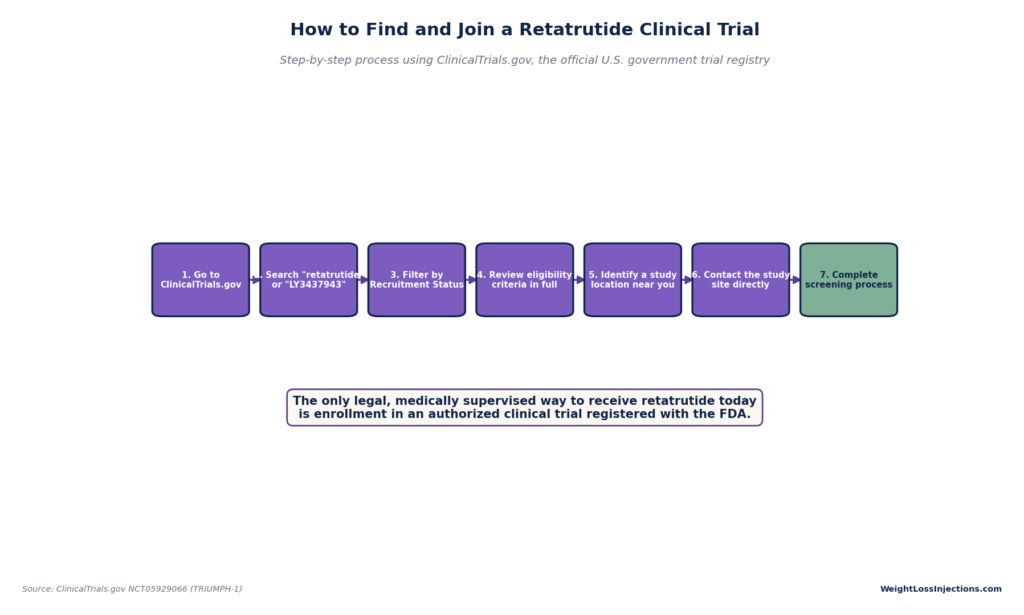
ClinicalTrials.gov is the U.S. government’s official registry of clinical studies, maintained by the National Library of Medicine. Here’s how to use it to find legitimate, currently enrolling retatrutide studies:
Step 1: Go to ClinicalTrials.gov
Navigate to clinicaltrials.gov directly, rather than a third-party site claiming to list trials — the official registry is the only source you should trust for enrollment decisions.
Step 2: Search “Retatrutide” or “LY3437943”
Use either term in the search bar. Both will surface Eli Lilly’s registered studies, since trials are indexed under both the generic name and the developer code.
Step 3: Filter by Recruitment Status
Use the “Recruitment Status” filter and select “Recruiting” or “Not yet recruiting” to exclude completed or closed studies like TRIUMPH-1. This step is critical, since many search results will show studies no longer accepting participants.
Step 4: Review the Full Eligibility Criteria
Each listing includes a detailed “Eligibility Criteria” section specifying inclusion and exclusion requirements — the authoritative source, more detailed than any general overview (including the one below).
Step 5: Identify a Study Location Near You
Trials list specific enrolling sites, often research centers, academic medical centers, or specialty clinics. Retatrutide trials have historically enrolled across the United States, Canada, the United Kingdom, Australia, and other countries — proximity to a site matters given the frequency of in-person visits.
Step 6: Contact the Study Site Directly
Each listing provides contact information for the study coordinator. Reach out to ask about current enrollment and screening steps. Eli Lilly also maintains a general clinical trials contact line (1-877-CTLILLY) for questions about its studies.
Step 7: Complete the Screening Process
If a site believes you may be a fit, you’ll typically undergo a more detailed medical evaluation — bloodwork, medical history review, and sometimes imaging — before formal enrollment.
Typical Eligibility Criteria (Illustrative — Always Verify Directly)
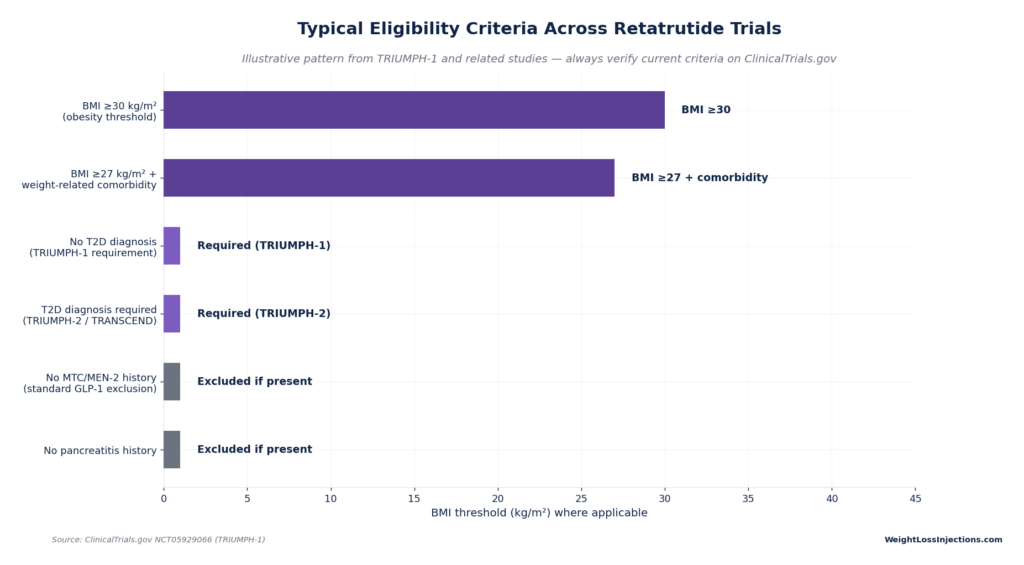
Based on the published eligibility criteria for TRIUMPH-1 and related studies, retatrutide trials have generally required:
BMI Thresholds
- BMI ≥30 kg/m² (meeting the clinical definition of obesity), or
- BMI ≥27 kg/m² with at least one weight-related comorbidity, such as hypertension, dyslipidemia, obstructive sleep apnea, or cardiovascular disease
Type 2 Diabetes Status
- Some studies (like TRIUMPH-1) specifically exclude participants with diabetes, focusing purely on obesity.
- Other studies (like TRIUMPH-2 and the TRANSCEND-T2D program) specifically require a type 2 diabetes diagnosis.
- Your eligibility depends entirely on which specific study you’re being screened for — there is no single “retatrutide trial” with one universal criteria set.
Other Common Requirements
- History of at least one prior unsuccessful attempt to lose weight through diet and exercise
- No significant unexplained weight change (commonly a 5 kg / 11 lb threshold) in the 90 days before screening, and no use of other weight-loss medications in that window
- No personal or family history of medullary thyroid carcinoma or MEN-2 — a standard GLP-1 class exclusion — and no history of pancreatitis
- Study-specific criteria for sub-studies (for example, knee X-ray grading for TRIUMPH-4’s osteoarthritis population, or sleep study results for nested OSA protocols)
These are illustrative patterns drawn from Eli Lilly’s TRIUMPH-1 listing on ClinicalTrials.gov — not a checklist to self-diagnose eligibility. Always verify current, study-specific criteria directly on ClinicalTrials.gov or with the study site.
Our Top 3 · September 2026
The best GLP-1 providers right now
Independently reviewed. Ranked by price, medication access, provider quality, and patient outcomes.
Renew GLP
Personalized GLP-1, GIP plans: Semaglutide & Tirzepatide.
Medvi
No membership or hidden fees. Everything you need is included.
Trimi
US-licensed clinicians and shipped to your door, from $99/mo.
What Participants Typically Receive
Clinical trial participation is structured differently from a normal prescription relationship. In past retatrutide trials, participants have generally received the investigational study drug (retatrutide or a placebo, depending on random assignment) at no cost as part of the research protocol; regular medical monitoring, including physical exams, bloodwork, and safety assessments, often more frequent than typical primary care visits; reimbursement for time and travel in many studies, though structures vary by trial and are disclosed during informed consent; and ongoing study coordinator support for questions and side-effect reporting.
Understanding the Risks and the Informed Consent Process
Participating in a clinical trial is not the same as being prescribed an approved medication. Before enrolling, every legitimate trial requires informed consent — a structured process where the study team explains:
- The investigational nature of the drug and what is and isn’t yet known about its safety and effectiveness
- The possibility of receiving a placebo instead of active drug, depending on trial design
- Known side effects reported in prior studies, including gastrointestinal effects (nausea, vomiting, diarrhea, constipation) common to the GLP-1 drug class, and dysesthesia (altered skin sensation), a signal reported in 2.3–4.5% of TRIUMPH-1 participants at the 12 mg dose
- Your right to withdraw from the study at any time, for any reason, without penalty
- How your personal health data will be used and protected
Take the informed consent process seriously and ask questions before signing — a legitimate trial site will never rush you through this step.
Risks vs. Potential Benefits: A Balanced View
Potential benefits: access to an investigational drug with substantial reported efficacy in prior trials (28.3% average weight loss in TRIUMPH-1 at the 12 mg dose), close medical monitoring throughout the study, and the chance to contribute to research that could help future patients if the drug is approved.
Real risks to weigh: you may receive a placebo rather than active drug depending on trial design; investigational drugs can carry unknown or incompletely characterized risks even after Phase 3 data, which is part of why FDA review exists; participation requires a real time commitment of frequent site visits and monitoring over many months; and discontinuation due to side effects occurred in about 11.3% of TRIUMPH-1’s 12 mg dose group, per the Eli Lilly press release and NEJM Jastreboff et al. 2026.
What This Guide Is Not
This guide is not a promise that you will be eligible for or accepted into any retatrutide trial, nor a guarantee that any currently listed study is still recruiting by the time you read this — enrollment status changes continuously, so always verify directly on ClinicalTrials.gov before making plans. It is also not an endorsement of any outcome from participation, and it does not replace a conversation with your own physician about whether a trial is right for your health situation.
If you are not able to find an enrolling retatrutide trial, or trial participation isn’t right for you, currently FDA-approved options such as tirzepatide (marketed as Zepbound) and semaglutide (marketed as Ozempic and Wegovy) remain legitimate, prescribable choices to discuss with your healthcare provider today.
Frequently Asked Questions
Is joining a clinical trial the only legal way to get retatrutide?
Yes. Retatrutide is not FDA-approved, has no legal compounding pathway under 503A or 503B rules, and cannot be legally prescribed or sold. Enrollment in an authorized clinical trial registered with the FDA is the only legitimate access route as of July 2026.
Is TRIUMPH-1 still enrolling participants?
No. TRIUMPH-1, the pivotal obesity trial, has completed enrollment and reported topline results on May 21, 2026. It is no longer accepting new participants. Other studies in Eli Lilly’s TRIUMPH program may still be recruiting — check ClinicalTrials.gov for current status.
What BMI do I need to qualify for a retatrutide trial?
Prior retatrutide studies have generally required a BMI of 30 or higher, or 27 or higher with a weight-related comorbidity such as hypertension or sleep apnea. Exact criteria vary by study — always check the specific trial listing.
Will I definitely get the real drug if I join a trial?
Not necessarily. Most retatrutide trials are placebo-controlled, meaning participants are randomly assigned to receive either the study drug or a placebo, and neither participants nor researchers typically know which group you’re in until the study concludes (or an interim safety review occurs).
Are there fees to join a retatrutide clinical trial?
Legitimate clinical trials do not charge participants to enroll; the study drug and required monitoring are typically provided as part of the research protocol, and some trials offer compensation for time and travel. Be cautious of any program claiming to offer “retatrutide access” that requires payment — that is a red flag for an illegitimate or unauthorized source.
Medical disclaimer: Retatrutide is an investigational drug not approved by the FDA or any other regulatory authority as of July 2026. It is available only through enrollment in authorized clinical trials. This article is for informational purposes only and does not constitute medical advice, endorsement, or a recommendation to obtain retatrutide outside of a registered clinical trial. Speak with your healthcare provider about currently approved weight-loss treatments. Content published by WeightLossInjections.com.