
Key Takeaways
- Retatrutide is an investigational triple hormone receptor agonist — not FDA-approved — currently available only through clinical trial enrollment.
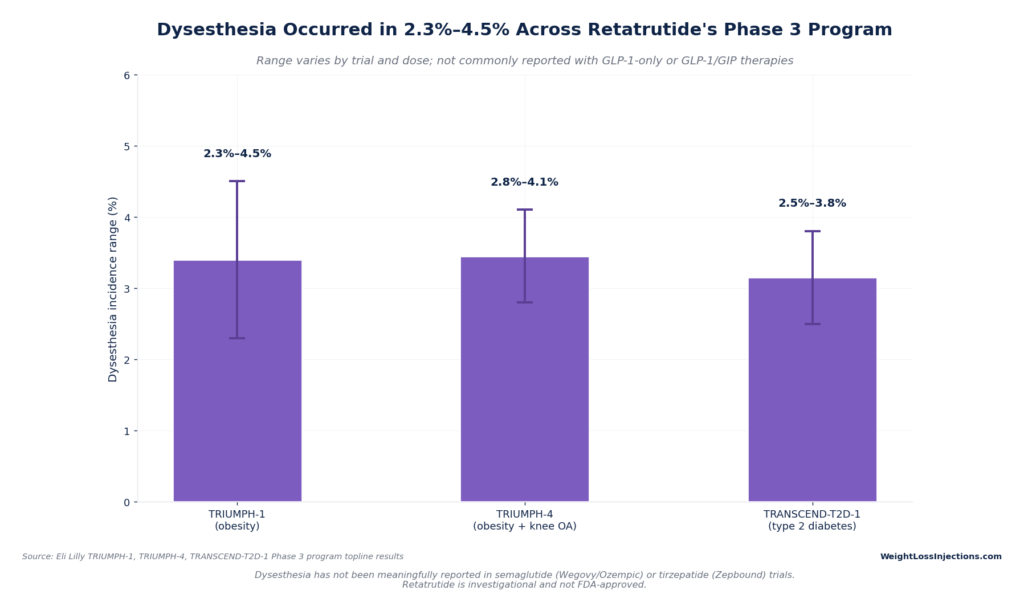
- Dysesthesia (an altered or abnormal skin sensation, often described as tingling or “pins and needles”) occurred in 2.3% to 4.5% of participants across retatrutide’s Phase 3 program, depending on dose and trial.
- This signal is thought to be linked to retatrutide’s activation of the glucagon receptor — a pathway not engaged by GLP-1-only drugs like Wegovy or GLP-1/GIP dual agonists like Zepbound.
- Dysesthesia has generally been described as mild in Phase 3 reporting and appears to be transient for most who experience it.
- Because this signal is not seen with pure GLP-1 or GLP-1/GIP therapies, it represents a class-differentiating safety finding specific to triple agonists like retatrutide.
- Anyone experiencing unusual skin sensations during a clinical trial should report them to their study team or healthcare provider promptly.
Among the various side effects reported in retatrutide’s Phase 3 program, one stands out as genuinely novel within the weight-loss drug landscape: dysesthesia. Unlike nausea, vomiting, or diarrhea — side effects familiar to anyone who has researched Ozempic, Wegovy, or Zepbound — dysesthesia is a nerve-sensation signal not commonly associated with the approved GLP-1 drug class. As always, it’s essential to note upfront: retatrutide remains investigational and is not approved by the FDA or any regulatory authority. It is available only through enrollment in an authorized clinical trial.
What Is Dysesthesia?
Dysesthesia is a medical term describing an abnormal or unpleasant sensation, often on or under the skin, that occurs without an external stimulus. In the context of retatrutide’s trials, it has generally been described as tingling, prickling, “pins and needles,” or a generalized altered skin sensation. It is distinct from pain, itching, or the injection-site reactions common to all subcutaneously injected GLP-1-class drugs — dysesthesia is a broader, often diffuse sensory phenomenon rather than a localized reaction at the injection site.
How Common Is Dysesthesia in Retatrutide Trials?
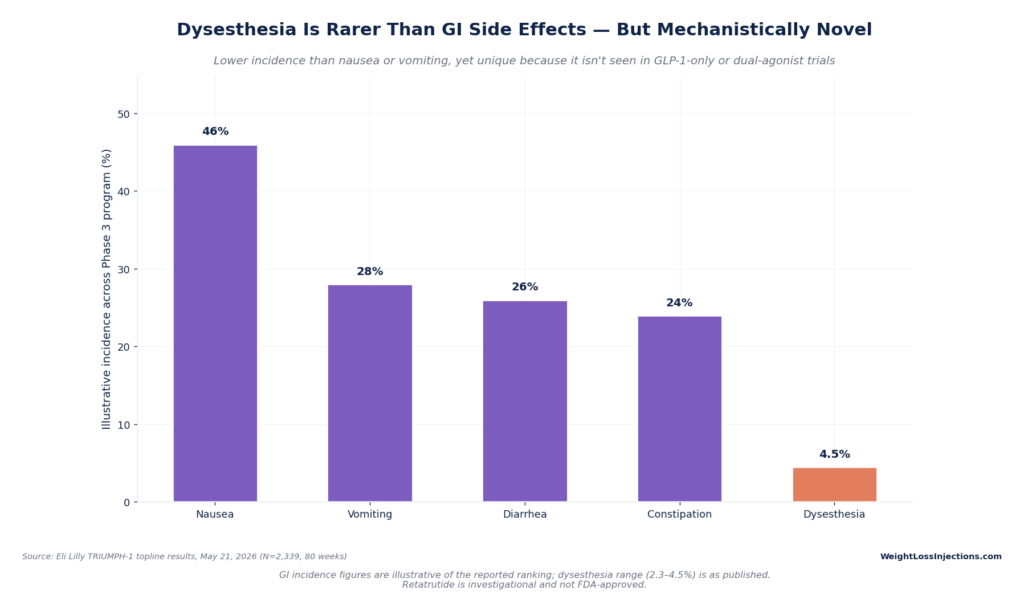
Across Eli Lilly’s Phase 3 program, dysesthesia has been reported in 2.3% to 4.5% of participants, with incidence varying by dose and by specific trial (TRIUMPH-1, TRIUMPH-4, and TRANSCEND-T2D-1 all contribute to this range). While these percentages are relatively low compared to gastrointestinal side effects like nausea — which affects a substantially larger share of participants — dysesthesia’s incidence is notable precisely because it is not a symptom typically seen at all in trials of GLP-1-only or GLP-1/GIP dual-agonist drugs.
The Likely Mechanism: Glucagon Receptor Activation
Retatrutide is a first-in-class triple hormone receptor agonist, activating GIP, GLP-1, and glucagon receptors simultaneously. This third pathway — glucagon receptor activation — is what differentiates retatrutide mechanistically from:
- Semaglutide (Ozempic, Wegovy) — GLP-1 receptor only
- Tirzepatide (Zepbound, Mounjaro) — GLP-1 and GIP receptors
Glucagon receptors are expressed in various tissues throughout the body, including the liver and peripheral nervous system pathways, and researchers hypothesize that retatrutide’s engagement of this receptor is the most plausible explanation for the dysesthesia signal. This hypothesis is grounded in the fact that dysesthesia has not been meaningfully reported in large trials of GLP-1-only or GLP-1/GIP dual-agonist drugs — pointing toward the glucagon pathway as the differentiating variable. It’s worth noting this remains a proposed mechanism based on pharmacological reasoning and the pattern of trial data, rather than a definitively proven causal pathway confirmed by dedicated mechanistic studies.
Why This Doesn’t Appear With Pure GLP-1 or Dual Agonists
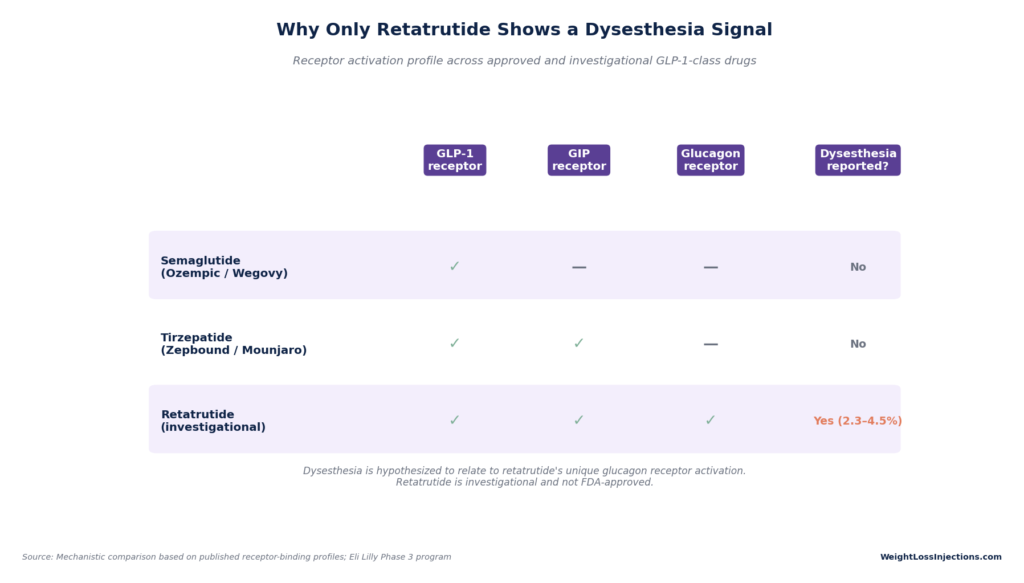
The absence of dysesthesia signals in semaglutide and tirzepatide trials is one of the more compelling pieces of indirect evidence pointing to the glucagon receptor as the driver. If dysesthesia were simply a generic consequence of weight-loss drugs or GLP-1 receptor activation broadly, it would likely have appeared at meaningful rates in the extensive trial databases behind Ozempic, Wegovy, and Zepbound — drugs that have now been studied in hundreds of thousands of patients combined. Its emergence specifically alongside retatrutide’s triple-receptor mechanism supports the class-differentiating nature of this signal.
Severity and Duration
Phase 3 reporting on retatrutide has generally characterized dysesthesia as mild. Available trial data suggests these sensations are typically not severe enough to be classified as serious adverse events, and the signal has not been associated with permanent nerve damage or lasting neurological impairment in the published data to date. However, granular data on the typical duration of dysesthesia episodes — how many days or weeks a given participant experiences symptoms before resolution — has not been fully detailed in Eli Lilly’s topline releases. Fuller characterization is expected as TRIUMPH-1 data moves toward full peer-reviewed publication and as TRIUMPH-2 and TRIUMPH-3 report later in 2026.
Our Top 3 · October 2026
The best GLP-1 providers right now
Independently reviewed. Ranked by price, medication access, provider quality, and patient outcomes.
Renew GLP
Personalized GLP-1, GIP plans: Semaglutide & Tirzepatide.
Medvi
No membership or hidden fees. Everything you need is included.
Trimi
US-licensed clinicians and shipped to your door, from $99/mo.
Is Dysesthesia Dose-Dependent?
The 2.3–4.5% range itself suggests some degree of dose-dependence, consistent with the general pattern seen across retatrutide’s other side effects (including GI symptoms, detailed in our article on retatrutide side effects). Higher doses in the Phase 3 program have generally been associated with a higher incidence of adverse events overall, and it’s reasonable to expect dysesthesia follows a similar pattern, though Eli Lilly has not published a detailed dose-by-dose breakdown specific to this symptom in topline communications.
Why This Matters for Retatrutide’s Positioning
Dysesthesia is arguably the clearest signal that retatrutide is not simply “tirzepatide plus a bit more weight loss” — it is a mechanistically distinct drug with its own side-effect fingerprint. This has two implications:
- For patients: Anyone considering retatrutide (via clinical trial, since it’s not yet approved) should understand that its side-effect profile is not identical to Zepbound or Wegovy, even though many symptoms overlap. Dysesthesia is a new consideration specific to the triple-agonist mechanism.
- For researchers and regulators: A safety signal not present in the existing GLP-1 drug class will likely receive close attention during the FDA’s review process once Eli Lilly submits its New Drug Application, anticipated in Q4 2026.
This also contributes to retatrutide’s somewhat higher overall discontinuation rate for adverse events (11.3% in TRIUMPH-1 at the 12 mg dose) compared to Zepbound and Wegovy (roughly 7% each) — a topic covered in full in our article on retatrutide discontinuation rates.
How Dysesthesia Fits Into Retatrutide’s Broader Safety Story
Dysesthesia doesn’t exist in isolation — it’s one piece of a broader safety picture that also includes GI side effects (nausea, vomiting, diarrhea, constipation), modest heart rate increases, and injection site reactions, all covered in our comprehensive retatrutide side effects overview. What sets dysesthesia apart from these other findings is that it cannot be explained simply by comparing retatrutide to the existing GLP-1 drug class — there is no direct precedent in Ozempic, Wegovy, or Zepbound trial data. This makes dysesthesia a genuinely novel data point that regulators, researchers, and prospective patients will want to track closely as retatrutide’s Phase 3 program matures.
What Regulators Will Likely Want to Know
When Eli Lilly submits its New Drug Application, anticipated in Q4 2026, the FDA’s review will almost certainly examine the dysesthesia signal in detail, given that it represents a new finding not previously characterized in the GLP-1-class drugs already on the market. Regulators will likely want clarity on several open questions: the precise dose-response relationship, whether dysesthesia correlates with any measurable neurological changes, typical time-to-onset and time-to-resolution, and whether the symptom recurs with each dose increase or tends to resolve permanently after an initial occurrence. Because retatrutide is a first-in-class molecule, the FDA does not have a direct precedent to draw from when evaluating this particular signal, which may mean additional scrutiny or requests for supplemental data during the review process.
What To Do If You Experience Dysesthesia in a Trial
If you are enrolled in a retatrutide clinical trial and notice tingling, altered skin sensations, or any other unusual symptom, the appropriate step is to report it to your study investigator or healthcare provider as soon as possible. Clinical trials are specifically designed to capture and monitor adverse events like this, and your reporting helps both your own care and the broader safety database being built for retatrutide. Do not attempt to self-diagnose or self-treat dysesthesia outside of your trial’s medical oversight.
Frequently Asked Questions
What is dysesthesia, and why does retatrutide cause it?
Dysesthesia is an abnormal skin sensation — often tingling or “pins and needles” — reported in 2.3–4.5% of retatrutide’s Phase 3 participants. It’s believed to relate to retatrutide’s activation of the glucagon receptor, a pathway not present in GLP-1-only or GLP-1/GIP dual-agonist drugs.
Does Ozempic or Zepbound cause dysesthesia?
Dysesthesia has not been reported at meaningful rates in semaglutide (Ozempic, Wegovy) or tirzepatide (Zepbound) trials, supporting the idea that this is a signal specific to retatrutide’s triple-receptor mechanism.
Is dysesthesia dangerous?
Phase 3 reporting has generally characterized dysesthesia as mild. It has not been linked to permanent nerve damage in published data, but anyone experiencing unusual sensations should report them to a healthcare provider or trial investigator.
How long does retatrutide-related dysesthesia last?
Detailed duration data has not been fully published in Eli Lilly’s topline releases. General trial reporting suggests episodes are mild, but individual experiences may vary; more detail is expected as peer-reviewed publications and later trials (TRIUMPH-2, TRIUMPH-3) report.
Can I avoid dysesthesia by choosing a lower retatrutide dose?
Since incidence appears to increase somewhat with dose, a lower dose may carry a lower risk, based on the general dose-response pattern seen across retatrutide’s side effects. However, retatrutide is not FDA-approved, so no official dosing guidance exists yet; any dose is currently determined by clinical trial protocol, not individual choice.
Medical disclaimer: Retatrutide is an investigational drug not approved by the FDA or any other regulatory authority as of July 2026. It is available only through enrollment in authorized clinical trials. This article is for informational purposes only and does not constitute medical advice, endorsement, or a recommendation to obtain retatrutide outside of a registered clinical trial. Speak with your healthcare provider about currently approved weight-loss treatments. Content published by WeightLossInjections.com.