
Boxed warning: Foundayo (orforglipron), Wegovy pill (oral semaglutide 25 mg), and Rybelsus (oral semaglutide 3/7/14 mg) all carry an FDA boxed warning for the risk of thyroid C-cell tumors, including medullary thyroid carcinoma (MTC). These drugs are contraindicated in people with a personal or family history of MTC or Multiple Endocrine Neoplasia syndrome type 2 (MEN 2), based on findings from rodent studies referenced in each drug’s FDA label (FDA Rybelsus/Ozempic labeling).
Key Takeaways
- All three FDA-approved oral GLP-1s — Foundayo, Wegovy pill, and Rybelsus — share the same core side effect profile: nausea, vomiting, diarrhea, and constipation, because they act on the same GLP-1 receptor pathway.
- Gastrointestinal side effects are most intense during dose titration and typically ease as the body adjusts, according to clinical trial data referenced in each drug’s FDA label.
- Foundayo’s most commonly reported side effects in prescribing information include nausea (26–35%), constipation (20–27%), diarrhea (21–25%), and vomiting (13–24%), with rates varying by dose (GoodRx summary of Foundayo prescribing information).
- All three carry the class-wide boxed warning for thyroid C-cell tumor risk and are contraindicated in patients with a personal or family history of MTC or MEN 2.
- Persistent, severe, or worsening symptoms should always be discussed with a healthcare provider — this article is not a substitute for medical advice.
The Shared Side Effect Profile Across Oral GLP-1s
Foundayo, Wegovy pill, and Rybelsus are all GLP-1 receptor agonists, even though they differ chemically — Foundayo is a small-molecule, non-peptide oral GLP-1, while Wegovy pill and Rybelsus are peptide formulations of semaglutide stabilized with an absorption enhancer (see the WeightLossInjections.com guide to oral GLP-1s for weight loss for the mechanism differences). Because all three activate the same GLP-1 receptor throughout the body, they produce a very similar side effect signature: slowed gastric emptying leads to nausea, vomiting, bloating, and altered bowel habits.
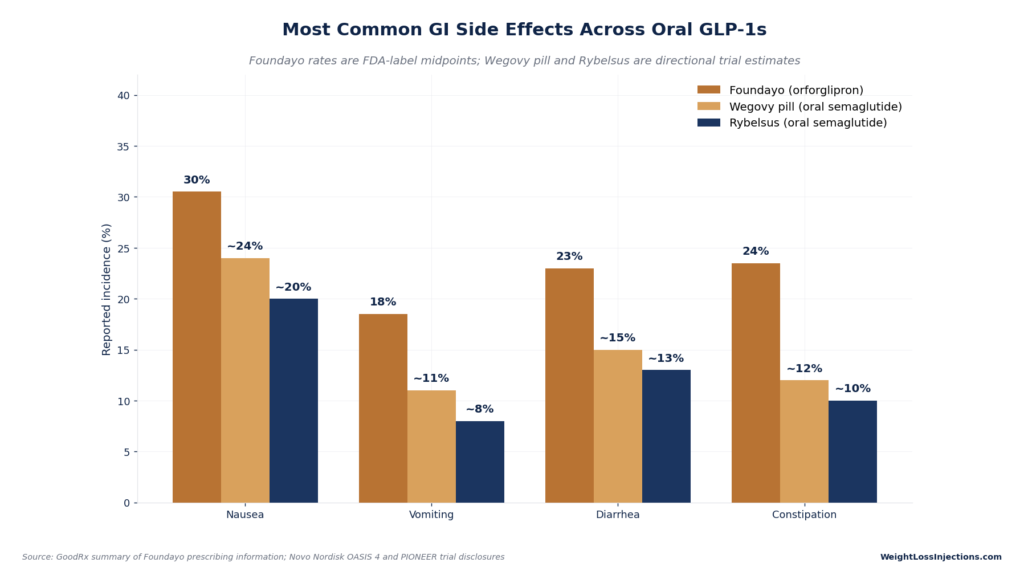
Most Common Side Effects (All Three Drugs)
- Nausea — the most frequently reported side effect across all three drugs’ clinical trials
- Vomiting
- Diarrhea
- Constipation
- Decreased appetite
- Abdominal pain / stomach discomfort
- Indigestion (dyspepsia)
- Belching, bloating, and gas
- Headache and fatigue
These effects are documented in the FDA prescribing information for each drug and in the pivotal trials: ATTAIN-1 for Foundayo, OASIS 4 for Wegovy pill, and the PIONEER program for Rybelsus (see the SHARED_SPEC trial references). The Wegovy pill approval announcement notes that “common adverse reactions were similar to those previously seen in clinical trials with Wegovy (semaglutide) injection 2.4 mg, including nausea, diarrhea, and vomiting” (Novo Nordisk press release via PR Newswire).
Comparing Incidence Rates Across the Three Drugs
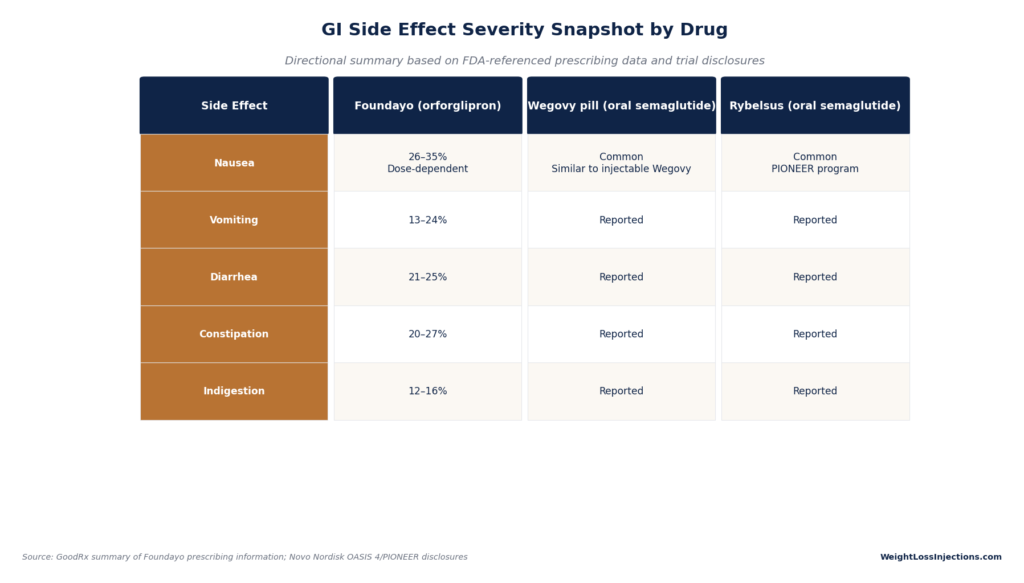
Reported incidence rates vary by trial design, dose, and population, so direct percentage-to-percentage comparisons should be read as directional rather than exact equivalents. Based on published prescribing information and trial summaries:
| Side Effect | Foundayo (orforglipron) | Wegovy pill (oral semaglutide) | Rybelsus (oral semaglutide) |
|---|---|---|---|
| Nausea | 26–35% | Common; similar to injectable Wegovy trials | Common in PIONEER program |
| Constipation | 20–27% | Reported | Reported |
| Diarrhea | 21–25% | Reported | Reported |
| Vomiting | 13–24% | Reported | Reported |
| Indigestion | 12–16% | Reported | Reported |
Foundayo’s specific incidence figures come from its FDA-referenced prescribing data as summarized by GoodRx. Wegovy pill and Rybelsus figures are drawn from Novo Nordisk’s OASIS 4 and PIONEER trial disclosures rather than a single head-to-head study, so exact rate comparisons between orforglipron and semaglutide products should be interpreted cautiously.
Titration-Related Patterns
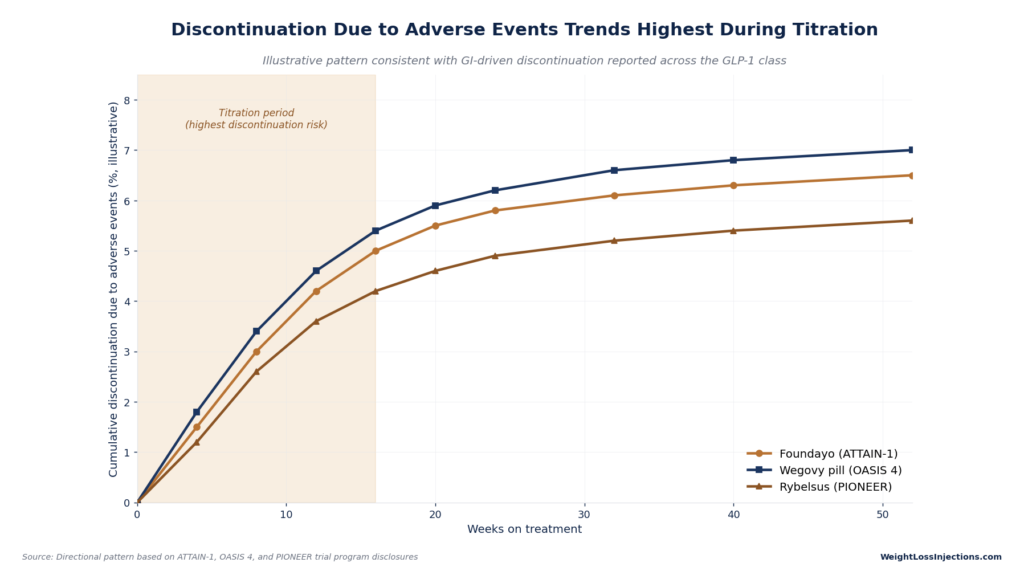
Across all three drugs, GI side effects tend to be most pronounced during the dose-escalation (“titration”) period rather than at a stable maintenance dose:
- Foundayo: Starts at a low dose and is titrated upward over a period defined in its FDA label; side effects most frequently peak in the weeks following each dose increase.
- Wegovy pill: Follows a titration schedule building to the 25 mg maintenance dose, with GI effects concentrated during escalation weeks.
- Rybelsus: Titrates from 3 mg → 7 mg → 14 mg over 30-day intervals; nausea and GI upset commonly cluster around each step-up.
This titration pattern is why prescribers generally advance doses gradually rather than starting patients at a target maintenance dose — a strategy referenced throughout the ATTAIN-1, OASIS 4, and PIONEER trial designs. For a full breakdown of each drug’s schedule, see the WeightLossInjections.com Foundayo dosing guide.
Our Top 3 · September 2026
The best GLP-1 providers right now
Independently reviewed. Ranked by price, medication access, provider quality, and patient outcomes.
Renew GLP
Personalized GLP-1, GIP plans: Semaglutide & Tirzepatide.
Medvi
No membership or hidden fees. Everything you need is included.
Trimi
US-licensed clinicians and shipped to your door, from $99/mo.
Less Common but Clinically Important Effects
Beyond the dominant GI symptoms, FDA labeling and trial data flag additional effects that are less frequent but warrant attention:
- Foundayo: Transaminase (liver enzyme) elevations have been noted in trial data, along with rare reports of pancreatitis and hypoglycemia; the FDA has also required Eli Lilly to conduct post-marketing studies specifically evaluating cardiovascular and liver safety signals (Pharmaphorum reporting on FDA post-marketing requirements).
- Wegovy pill and Rybelsus (semaglutide): Gallbladder problems (including gallstones), acute pancreatitis, hypoglycemia (particularly when combined with insulin or sulfonylureas), acute kidney injury related to dehydration from GI fluid loss, and diabetic retinopathy complications in patients with type 2 diabetes (FDA Wegovy prescribing information).
- All three: Hypersensitivity reactions, including rare but serious anaphylaxis or angioedema.
No Injection-Site Reactions
One consistent advantage across all three oral GLP-1s is the absence of injection-site reactions — redness, swelling, or irritation at a shot location — since none of these medications are injected. This is a meaningful quality-of-life difference compared with injectable GLP-1s like Wegovy or Zepbound. For more on how oral and injectable side effect profiles differ, see the WeightLossInjections.com comparison of oral vs. injection GLP-1 side effects.
When to Call Your Doctor
You should contact a healthcare provider promptly if you experience:
- Severe, persistent abdominal pain (possible sign of pancreatitis)
- Yellowing of the skin or eyes, dark urine, or unusual fatigue (possible liver concern)
- A lump or swelling in the neck, hoarseness, trouble swallowing, or shortness of breath (possible thyroid concern)
- Signs of a severe allergic reaction, such as swelling of the face, lips, tongue, or throat, or difficulty breathing
- Vomiting or diarrhea severe enough to cause dehydration
- Vision changes, if you have type 2 diabetes and are being treated for retinopathy
- Any new or worsening symptom that concerns you
This list is not exhaustive. Always review the full FDA-approved prescribing information for your specific medication and discuss any new symptoms with your prescriber rather than adjusting your dose on your own.
Understanding Why Titration Exists in the First Place
The gradual dose-escalation approach used across Foundayo, Wegovy pill, and Rybelsus is not arbitrary — it reflects lessons learned from years of clinical experience with the broader GLP-1 receptor agonist class, going back to injectable drugs like Ozempic and Wegovy. Starting at a low dose and slowly increasing gives the digestive system time to adapt to slowed gastric emptying, which is the underlying mechanism behind most GI side effects. Skipping steps in a titration schedule, or advancing too quickly, generally increases the likelihood and severity of nausea, vomiting, and related symptoms — which is why FDA-approved labels for all three drugs specify a structured titration schedule rather than allowing patients to start at a target maintenance dose.
This also explains why, anecdotally, many patients report that their worst symptoms occur in the first few days after a dose increase rather than being spread evenly throughout treatment. Symptom tracking during those early days after a dose change can help you and your prescriber decide whether to hold at a given dose longer before proceeding to the next step.
Special Considerations for Specific Populations
Certain groups may experience oral GLP-1 side effects differently or may face additional risk factors that a healthcare provider should evaluate before starting treatment:
- Patients with type 2 diabetes taking insulin or sulfonylureas: Adding a GLP-1 receptor agonist increases the risk of hypoglycemia (low blood sugar). Blood sugar monitoring and potential adjustment of other diabetes medications may be necessary.
- Patients with a history of gallbladder disease: Semaglutide-based products have been associated with increased occurrence of gallstones (cholelithiasis) and gallbladder inflammation (cholecystitis).
- Patients with reduced kidney function: Severe GI side effects causing dehydration can worsen kidney function; adequate hydration and prompt reporting of persistent vomiting or diarrhea are especially important in this group.
- Older adults: May be more susceptible to dehydration-related complications from GI side effects and may be taking other medications that increase interaction risk.
None of these considerations are meant to be self-assessed — they are exactly the kind of factors a healthcare provider reviews when determining whether an oral GLP-1 is appropriate for you and how closely you should be monitored.
Frequently Asked Questions
Are oral GLP-1 side effects different from injectable GLP-1 side effects?
The core gastrointestinal side effects are largely similar because both delivery forms activate the same GLP-1 receptor systemically. The main practical difference is that oral GLP-1s don’t cause injection-site reactions. See the WeightLossInjections.com deep dive on oral vs. injection side effects for details.
Which oral GLP-1 has the mildest side effects?
There is no head-to-head trial directly comparing side effect severity across all three drugs under identical conditions, so no definitive “mildest” answer exists. Each drug’s incidence rates come from separate trials (ATTAIN-1, OASIS 4, PIONEER) with different populations and doses. A healthcare provider can help weigh your individual risk factors.
Do side effects go away over time?
Clinical trial data across the GLP-1 class shows that GI side effects are most common during dose titration and tend to diminish once a stable maintenance dose is reached, though individual experiences vary.
Can I take an over-the-counter medication for nausea from an oral GLP-1?
Speak with your prescriber or pharmacist before adding any over-the-counter or prescription remedy, since interactions and appropriateness depend on your individual health profile. See the WeightLossInjections.com guide on managing oral GLP-1 nausea for general tolerability strategies studied in trials.
Is the thyroid tumor risk something I should worry about?
The boxed warning is based on findings in rodent studies; it is not established whether these drugs cause thyroid C-cell tumors in humans. However, the FDA requires this warning class-wide, and the drugs are contraindicated for anyone with a personal or family history of MTC or MEN 2. Discuss your personal and family medical history with your prescriber before starting any GLP-1 medication.
Medical disclaimer: This article is for informational purposes only and does not constitute medical advice, diagnosis, or treatment recommendations. Foundayo (orforglipron), Wegovy pill (oral semaglutide 25 mg), and Rybelsus (oral semaglutide 3/7/14 mg) are prescription medications with important safety information and contraindications. Discuss any medication decision with a qualified healthcare provider. Content published by WeightLossInjections.com, your complete resource for GLP-1 medications — injections and pills alike.
Sources: