
Rybelsus made history in September 2019 as the first oral GLP-1 medication ever approved by the FDA. But there’s an important detail many people searching for “Rybelsus for weight loss” miss: Rybelsus is approved only for type 2 diabetes management. Any use for weight loss — however common in practice — is considered off-label.
That doesn’t mean it’s ineffective or improper. Off-label prescribing is legal and common in medicine when a healthcare provider determines it’s clinically appropriate. But it does mean the drug’s dosing, insurance coverage, and expected results are all built around blood sugar control, not weight loss. This guide explains exactly what Rybelsus is approved for, what off-label use actually means in practice, and why Novo Nordisk eventually developed a separate, higher-dose oral option — the Wegovy pill — specifically for weight loss. As your complete GLP-1 resource — injections and pills alike — WeightLossInjections.com wants you to understand this distinction clearly before you talk to your provider.
Key Takeaways
- Rybelsus (oral semaglutide) was FDA-approved in September 2019 for type 2 diabetes only — it has never been approved for weight loss.
- Any prescription of Rybelsus for weight loss is considered off-label use, which is legal but not FDA-labeled.
- Standard dosing titrates from 3 mg to 7 mg to 14 mg, with 30 days at each step before increasing.
- Rybelsus requires the same strict morning, empty-stomach, low-water dosing as the Wegovy pill.
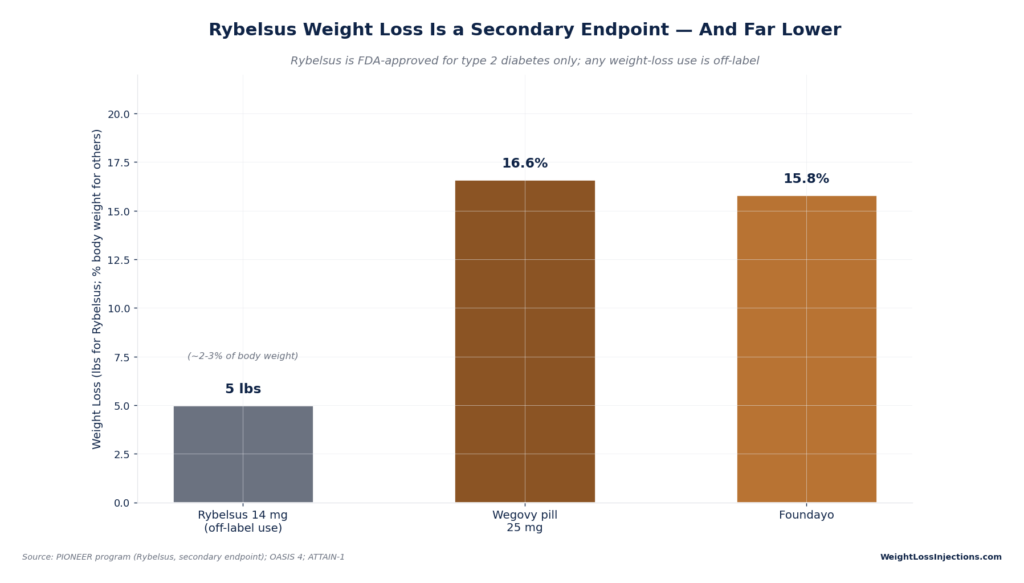
- Weight loss at the 14 mg dose was a secondary endpoint in the PIONEER program, averaging roughly 4-6 pounds — far less than weight-loss-labeled options.
- Because the 14 mg max dose is much lower than the Wegovy pill’s 25 mg, Novo Nordisk developed the Wegovy pill specifically to achieve weight-loss-level results.
- Off-label prescribing can affect insurance coverage — plans are more likely to cover Rybelsus for its approved diabetes indication than for weight loss.
What Rybelsus Is Actually Approved For
Rybelsus is the brand name for oral semaglutide, and it was the first-ever oral GLP-1 receptor agonist to reach the U.S. market, approved by the FDA in September 2019. Its approved indication is narrow and specific: improving blood sugar control in adults with type 2 diabetes, used alongside diet and exercise. That’s it. There is no FDA-approved indication for weight loss on the Rybelsus label, which stands in contrast to its molecular cousins, the Wegovy pill and injectable Wegovy, both of which are explicitly approved for chronic weight management. According to Drugs.com’s Rybelsus monograph, the drug’s clinical development program — called PIONEER — was built entirely around diabetes outcomes.
Why Rybelsus for Weight Loss Is “Off-Label”
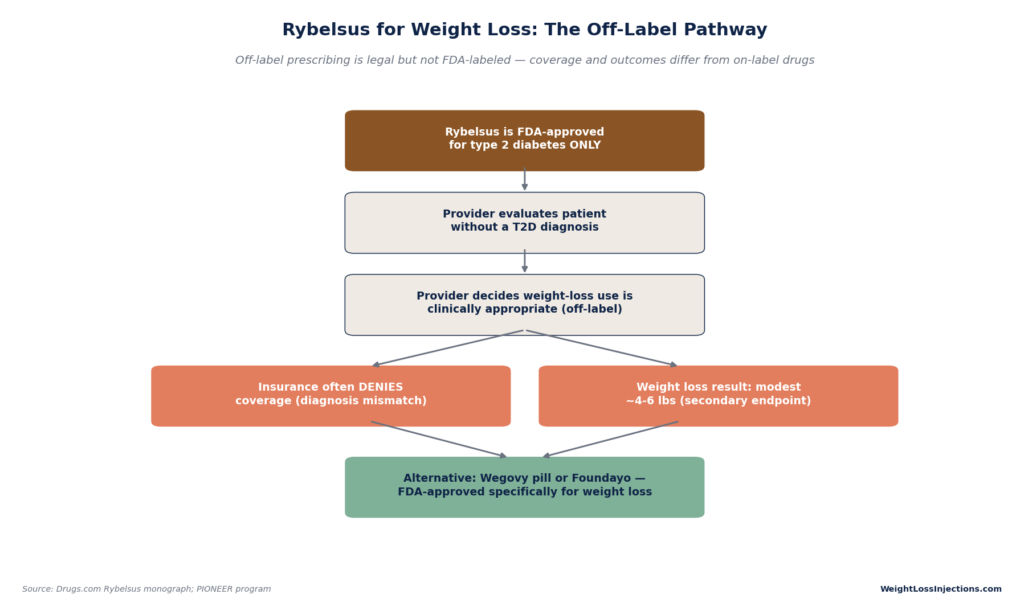
Off-label prescribing means a healthcare provider prescribes an FDA-approved drug for a purpose other than what’s on its official label. This is legal, common across many areas of medicine, and often based on solid clinical evidence — but it’s not the same as an FDA-approved use. Because Rybelsus shares its active ingredient (semaglutide) with Ozempic and the weight-loss-approved Wegovy pill, some clinicians prescribe it for weight management, particularly for patients who don’t have type 2 diabetes but want an oral semaglutide option. When this happens, it’s worth understanding that:
- The dose available (up to 14 mg) is lower than what weight-loss trials have shown to be most effective
- Insurance plans are far less likely to approve or cover it when the diagnosis code doesn’t match an approved indication
- Any prescriber offering Rybelsus for weight loss should be transparent that this is an off-label use, not an FDA-sanctioned one
Rybelsus Dosing: 3 mg to 14 mg
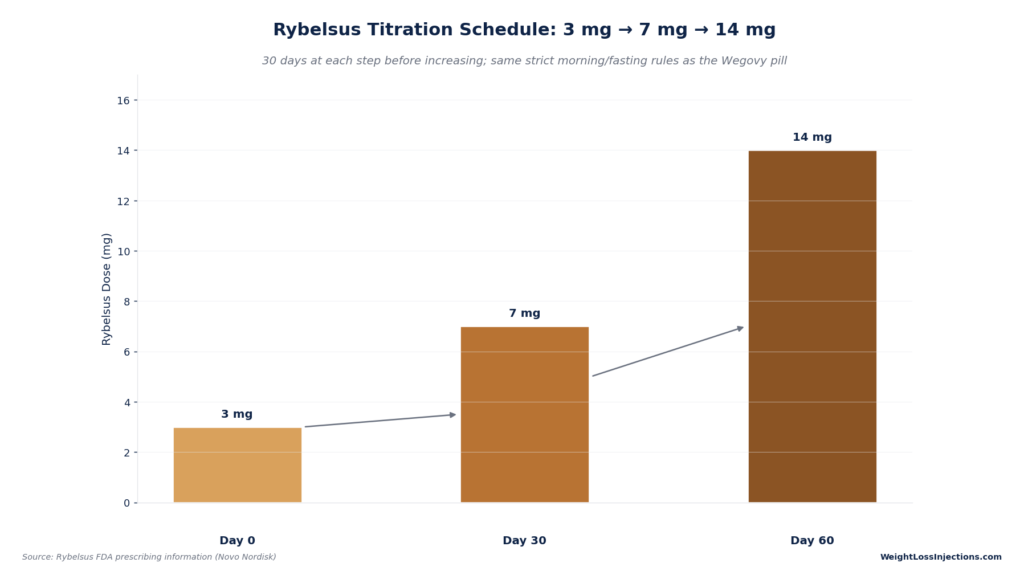
Rybelsus follows a fixed titration schedule designed to minimize gastrointestinal side effects:
- 3 mg once daily for the first 30 days (this starting dose is primarily for tolerability, not a therapeutic diabetes dose)
- 7 mg once daily after 30 days
- 14 mg once daily (maximum dose) after another 30 days, if additional glycemic control is needed
Like the Wegovy pill, Rybelsus must be taken first thing in the morning, on an empty stomach, with no more than 4 ounces of plain water, followed by a 30-minute wait before eating, drinking, or taking other oral medications. This is a meaningful daily commitment, and it’s identical to the Wegovy pill’s requirements — a key reason some patients on Rybelsus for weight loss find little practical difference in routine compared to the officially approved oral option.
Our Top 3 · September 2026
The best GLP-1 providers right now
Independently reviewed. Ranked by price, medication access, provider quality, and patient outcomes.
Renew GLP
Personalized GLP-1, GIP plans: Semaglutide & Tirzepatide.
Medvi
No membership or hidden fees. Everything you need is included.
Trimi
US-licensed clinicians and shipped to your door, from $99/mo.
How Much Weight Loss Can You Expect on Rybelsus?
In the PIONEER clinical trial program that supported Rybelsus’s diabetes approval, weight loss was tracked as a secondary endpoint — meaning it was measured and reported, but it wasn’t the primary goal the trials were designed around. At the 14 mg maximum dose, average weight loss was roughly 4-6 pounds. That’s a modest result compared to the double-digit percentage weight loss seen with weight-loss-labeled drugs. This gap exists largely because 14 mg is simply a lower dose of semaglutide than what’s needed to drive substantial weight loss — a gap Novo Nordisk closed with a dedicated, higher-dose product.
Why Novo Nordisk Built the Wegovy Pill
The most direct evidence that Rybelsus’s dose isn’t calibrated for weight loss is the existence of the Wegovy pill itself. Novo Nordisk developed oral semaglutide at 25 mg — nearly double Rybelsus’s maximum — specifically to replicate the kind of results seen with injectable weight-loss therapy. In the OASIS 4 trial, that higher dose produced average weight loss of about 16.6% at 64 weeks, dramatically higher than Rybelsus’s 4-6 pound secondary-endpoint result. If your goal is meaningful weight loss with an oral semaglutide product, the Wegovy pill — not Rybelsus — is the FDA-approved path built for that purpose. Read our full Wegovy pill guide for details.
Rybelsus vs. Wegovy Pill: Quick Comparison
| Feature | Rybelsus | Wegovy pill |
|---|---|---|
| Active ingredient | Semaglutide | Semaglutide |
| FDA-approved for | Type 2 diabetes | Weight loss + MACE reduction |
| Weight loss use | Off-label | On-label |
| Max dose | 14 mg | 25 mg |
| Fasting rules | Strict (same as Wegovy pill) | Strict |
| Weight loss (trial data) | ~4-6 lbs (secondary endpoint, PIONEER) | ~16.6% (OASIS 4) |
| Typical list price | ~$1,000/month | ~$1,349/month |
| Insurance coverage | Often better (approved diabetes drug) | Varies, weight-loss coverage inconsistent |
Insurance Implications of Off-Label Prescribing
Because Rybelsus is an FDA-approved, well-established diabetes medication, many insurance plans cover it more readily — provided the prescription is associated with a type 2 diabetes diagnosis. When Rybelsus is prescribed off-label for weight loss in someone without diabetes, insurers frequently deny coverage, since the claim doesn’t match an approved indication. This is one of the practical reasons some patients pursuing weight loss are steered toward the Wegovy pill or Foundayo instead — both carry a weight-loss indication that insurers can process accordingly, even though coverage for weight-loss drugs generally remains inconsistent across plans.
Safety Considerations
Rybelsus carries the same class-wide GLP-1 safety profile as other semaglutide products: nausea, vomiting, diarrhea, constipation, and decreased appetite, most common during the early titration weeks. It carries a boxed warning for the risk of thyroid C-cell tumors and is contraindicated in people with a personal or family history of medullary thyroid carcinoma or MEN 2 syndrome. Other precautions include risk of pancreatitis, gallbladder disease, and — particularly relevant for patients also on insulin or sulfonylureas — hypoglycemia. Review full prescribing details in the Drugs.com Rybelsus monograph and discuss your individual risk factors with your provider.
FAQ
Is Rybelsus approved for weight loss?
No. Rybelsus is FDA-approved only for type 2 diabetes management. Using it for weight loss is off-label — legal when a provider deems it clinically appropriate, but not an FDA-sanctioned use.
How much weight will I lose on Rybelsus?
In the PIONEER trial program, weight loss at the 14 mg maximum dose averaged roughly 4-6 pounds as a secondary endpoint — modest compared to weight-loss-labeled drugs like the Wegovy pill (~16.6% in OASIS 4) or Foundayo (~14.7-16.9% in ATTAIN-1).
Why would a doctor prescribe Rybelsus instead of the Wegovy pill for weight loss?
Reasons vary — cost, insurance coverage patterns, or a patient already being stable on Rybelsus for diabetes. But for weight loss specifically, the FDA-approved options (Wegovy pill or Foundayo) are built and dosed for that purpose.
Will insurance cover Rybelsus if I don’t have diabetes?
It’s less likely. Insurance plans typically require a diagnosis matching the drug’s approved indication, so coverage for off-label weight-loss use of Rybelsus is inconsistent and often denied.
What’s the difference between Rybelsus and Ozempic?
Both contain semaglutide, but Rybelsus is an oral tablet approved for type 2 diabetes, while Ozempic is an injectable also approved for type 2 diabetes (with separate weight-loss-approved injectable options existing under the Wegovy brand).
Medical disclaimer: This article is for informational purposes only and does not constitute medical advice, diagnosis, or treatment recommendations. Foundayo (orforglipron), Wegovy pill (oral semaglutide 25 mg), and Rybelsus (oral semaglutide 3/7/14 mg) are prescription medications with important safety information and contraindications. Discuss any medication decision with a qualified healthcare provider. Content published by WeightLossInjections.com, your complete resource for GLP-1 medications — injections and pills alike.