Key Takeaways
- Foundayo (orforglipron) follows an FDA-approved titration schedule that starts low and increases at monthly intervals, per the drug’s prescribing information.
- Unlike the other two oral GLP-1s on the market, Foundayo can be taken at any time of day, with or without food or water — there is no fasting requirement.
- The approved titration schedule is designed to reduce gastrointestinal side effects while allowing the body to adjust gradually to the medication.
- Only a prescriber can determine the right starting dose, titration pace, and maximum dose for an individual patient.
- Foundayo was approved April 1, 2026 for chronic weight management, based on efficacy data from the ATTAIN-1 trial.
What Is Foundayo (Orforglipron)?
Foundayo is the brand name for orforglipron, the first FDA-approved oral small-molecule GLP-1 receptor agonist. It received approval on April 1, 2026, making it the fastest new molecular entity approval since 2002, granted through the FDA’s Commissioner’s National Priority Voucher (CNPV) pilot program. Foundayo is indicated for chronic weight management in adults with obesity (BMI ≥30) or overweight (BMI ≥27) who have at least one weight-related comorbidity.
What sets Foundayo apart from other oral GLP-1s is its chemistry. Rybelsus and the Wegovy pill are peptide molecules that require an absorption enhancer and strict fasting conditions to survive digestion. Foundayo, by contrast, is a non-peptide small molecule that survives the digestive tract on its own — which is why its dosing instructions look so different. For a full breakdown of how orforglipron works and compares to the other approved oral GLP-1s, see our guide on Foundayo (orforglipron): everything about the new oral GLP-1 pill.
The FDA-Approved Titration Schedule
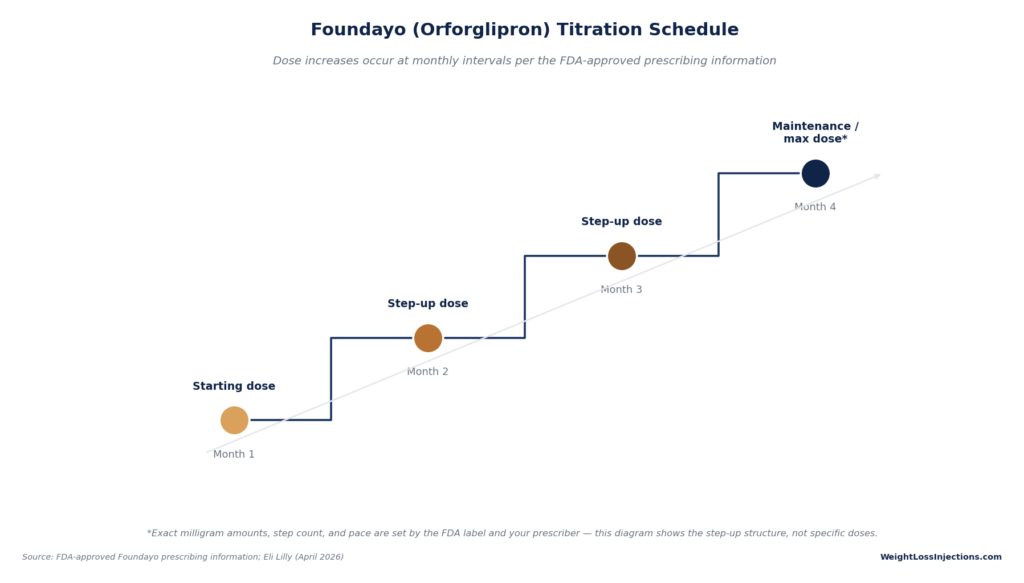
Foundayo dosing follows a structured titration schedule outlined in the FDA-approved prescribing information. Like other GLP-1 medications, treatment begins at a low starting dose that is gradually increased over time — a strategy intended to help the digestive system adjust and to minimize nausea, vomiting, and other gastrointestinal effects that tend to cluster early in treatment.
According to the approved titration schedule, patients typically begin at a low starting dose for the first month of treatment. If that dose is well tolerated, the prescriber may increase the dose at subsequent monthly intervals, moving through intermediate dose levels before reaching a maintenance dose. The specific milligram amounts and the total number of steps are detailed in Foundayo’s FDA label, and the exact schedule a person follows should come directly from their prescriber based on the official prescribing information — not from generalized guidance found online.
This step-up approach mirrors the strategy used across the GLP-1 class, including injectable options like Zepbound and Wegovy, where slower titration has been associated with better tolerability. The difference with Foundayo is what happens around the dose — not just the amount.
Why Titration Matters
The rationale behind gradual dose increases is rooted in how GLP-1 receptor agonists affect the gut. These medications slow gastric emptying and reduce appetite signals, and increasing the dose too quickly can intensify side effects like nausea and vomiting. The ATTAIN-1 trial, which supported Foundayo’s approval, evaluated multiple dose levels and found that mean weight loss ranged from approximately 14.7% to 16.9% at 52 weeks depending on the maintenance dose reached, compared with 2.3% in the placebo group. The FDA label also references an 11.2% weight loss figure over 72 weeks in certain analyses, reflecting how efficacy data can vary depending on the population and time point studied. These findings underscore why reaching and staying on an appropriate maintenance dose — as determined by a prescriber — matters for long-term results.
No Food or Water Restrictions: Why That’s Unique
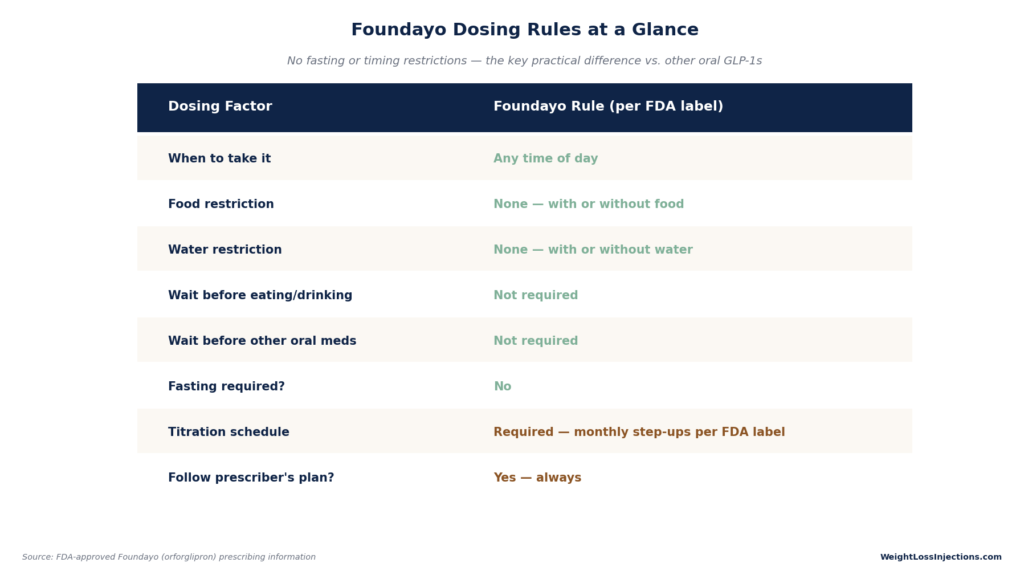
Perhaps the most practically important feature of Foundayo dosing is what it does not require. Per the FDA-approved label, Foundayo can be taken at any time of day, with or without food, and with or without water. There is no requirement to take it on an empty stomach, no minimum wait time before eating, and no restriction on how much water can be taken with it.
This is a meaningful departure from Rybelsus and the Wegovy pill, both of which must be taken first thing in the morning on an empty stomach with no more than 4 ounces of water, followed by a 30-minute wait before eating, drinking anything else, or taking other oral medications. Those strict rules exist because Rybelsus and the Wegovy pill are peptide drugs that rely on an absorption enhancer (SNAC) to survive the stomach environment long enough to be absorbed — a process easily disrupted by food, other liquids, or a full stomach.
Foundayo’s small-molecule structure doesn’t face that same vulnerability. It’s stable enough to survive digestion without special conditions, which is why the FDA label does not include timing or fasting restrictions. For a side-by-side look at how this affects real-world use, see oral GLP-1 pill timing: when to take each one for best absorption.
This flexibility doesn’t mean the dosing schedule itself is optional — the monthly titration steps and the approved maximum dose still need to be followed under a prescriber’s direction. It simply means the moment of taking the pill fits into a person’s day far more easily than a strict-fasting medication does.
Our Top 3 · September 2026
The best GLP-1 providers right now
Independently reviewed. Ranked by price, medication access, provider quality, and patient outcomes.
Renew GLP
Personalized GLP-1, GIP plans: Semaglutide & Tirzepatide.
Medvi
No membership or hidden fees. Everything you need is included.
Trimi
US-licensed clinicians and shipped to your door, from $99/mo.
Reaching the Maximum Dose
The approved titration schedule progresses toward a maximum maintenance dose, which is defined in Foundayo’s prescribing information. Not every patient needs to reach the highest available dose — a prescriber may keep a patient at a lower maintenance dose if it’s producing adequate results with good tolerability, or may continue titrating if further increases are appropriate and well tolerated.
Because individual response to GLP-1 medications varies, the “right” dose for one person may differ meaningfully from another’s. This is one of the central reasons dosing decisions should always be made in partnership with a healthcare provider who can monitor progress, side effects, and any interacting medications or health conditions.
GI Tolerability Considerations During Titration
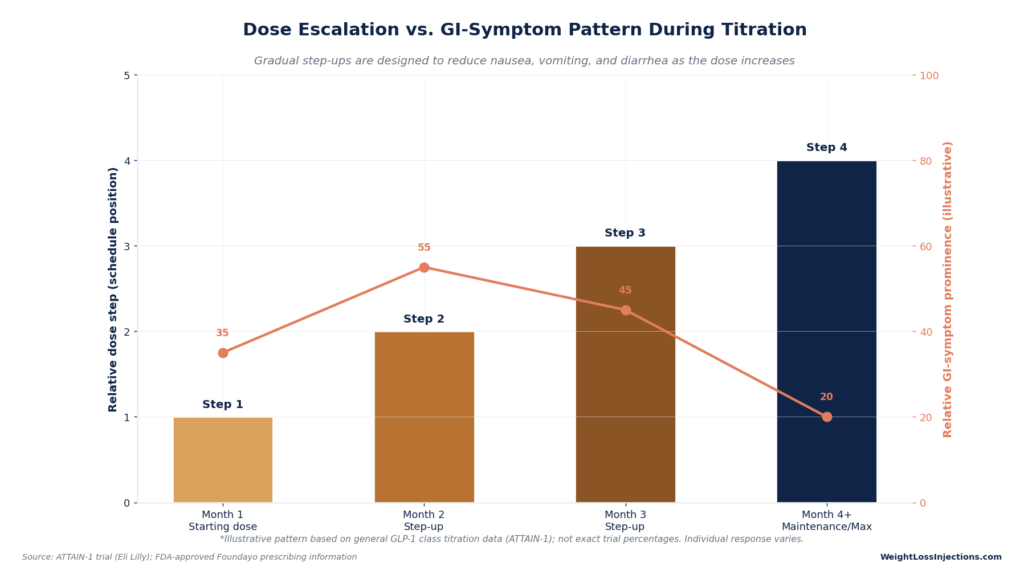
Gastrointestinal side effects — nausea, diarrhea, vomiting, constipation, and decreased appetite — are the most commonly reported side effects across all GLP-1 medications, including Foundayo. These effects tend to be most noticeable during the titration phase, when the dose is actively increasing, and often ease as the body adjusts to a given dose level.
Some general strategies patients report finding helpful during titration include eating smaller, more frequent meals, avoiding very fatty or greasy foods, and staying hydrated. However, none of these should be treated as a substitute for medical guidance — if GI side effects are severe, persistent, or interfere with daily functioning, a prescriber may recommend staying at the current dose longer before increasing, or in some cases adjusting the schedule. Never increase your own dose ahead of the approved schedule, and never adjust it downward without checking in, since abrupt changes can affect both tolerability and treatment continuity.
What If Side Effects Are a Problem?
If side effects become difficult to manage at any point during titration, the appropriate step is to contact the prescribing clinician rather than to stop or adjust the medication independently. A prescriber has several options depending on the situation, which may include extending the time spent at a given dose before stepping up further, or in some cases adjusting the plan altogether. Because Foundayo is still a relatively new medication — approved in April 2026 — prescribers are continuing to build real-world experience with how patients tolerate titration, which makes ongoing communication between patient and provider especially valuable.
Discontinuation Guidance
If a person needs to stop taking Foundayo — whether due to side effects, achieving a treatment goal, or any other reason — this should be done in consultation with the prescribing provider rather than abruptly on one’s own. GLP-1 medications, including oral options like Foundayo, are associated with some degree of weight regain after discontinuation, a pattern documented in longer-term studies of injectable GLP-1s such as the STEP-4 trial. A prescriber can help think through whether a gradual step-down, a switch to a different maintenance strategy, or ongoing lifestyle support makes the most sense for a given individual’s goals.
FAQ
What is the starting dose of Foundayo?
The starting dose is defined in Foundayo’s FDA-approved prescribing information as part of a structured titration schedule. Because the exact starting dose and step-up intervals should be confirmed with a prescriber, patients should not rely on generalized dosing charts found online and should instead follow the specific plan provided by their healthcare provider.
Do I need to take Foundayo on an empty stomach?
No. Per the FDA label, Foundayo can be taken with or without food and with or without water, at any time of day. This is different from Rybelsus and the Wegovy pill, which do require fasting conditions.
How long does it take to reach the maximum Foundayo dose?
Foundayo’s titration schedule progresses at monthly intervals, per the approved label, meaning it can take several months to reach a maintenance or maximum dose depending on how a patient tolerates each step. The specific pace is determined by the prescriber based on tolerability and response.
Can I speed up my own titration if I’m tolerating Foundayo well?
No. Dose increases should only occur according to the schedule set by a prescriber, based on the FDA-approved titration schedule. Adjusting doses independently — in either direction — is not recommended.
What happens if Foundayo causes bad nausea during titration?
Nausea and other GI side effects tend to peak during dose increases and often improve over time. If side effects are significant, contact the prescribing provider, who can evaluate whether to extend time at the current dose or make other adjustments. Do not change the dosing schedule without medical guidance.
Medical Disclaimer
Medical disclaimer: This article is for informational purposes only and does not constitute medical advice, diagnosis, or treatment recommendations. Foundayo (orforglipron), Wegovy pill (oral semaglutide 25 mg), and Rybelsus (oral semaglutide 3/7/14 mg) are prescription medications with important safety information and contraindications. Discuss any medication decision with a qualified healthcare provider. Content published by WeightLossInjections.com, your complete resource for GLP-1 medications — injections and pills alike.
Sources: FDA Drugs@FDA — Foundayo approval, April 1, 2026; Eli Lilly press releases on Foundayo approval and ATTAIN-1 data; ATTAIN-1 FDA prescribing information (April 2026); ClinicalTrials.gov NCT05674877 (ATTAIN-1).