![Unbranded [pillar-drug-class] injection pen on a neutral background — WeightLossInjections.com editorial hero](https://weightlossinjections.com/wp-content/uploads/2026/07/hero_mounjaro_c4_compare-1200x675.png)
Hero — side-by-side product illustration of Mounjaro KwikPen (blue) and Wegovy auto-injector (purple) on a clean white background with the headline “Mounjaro vs
Medical Disclaimer: Mounjaro is FDA-approved for type 2 diabetes, not weight loss. Wegovy is FDA-approved for chronic weight management in adults with obesity or overweight with at least one weight-related condition. Both require a prescription and clinical evaluation. Information on this page is educational and based on published clinical trials. WeightLossInjections.com does not provide medical advice. Consult a licensed provider before starting or switching medications.
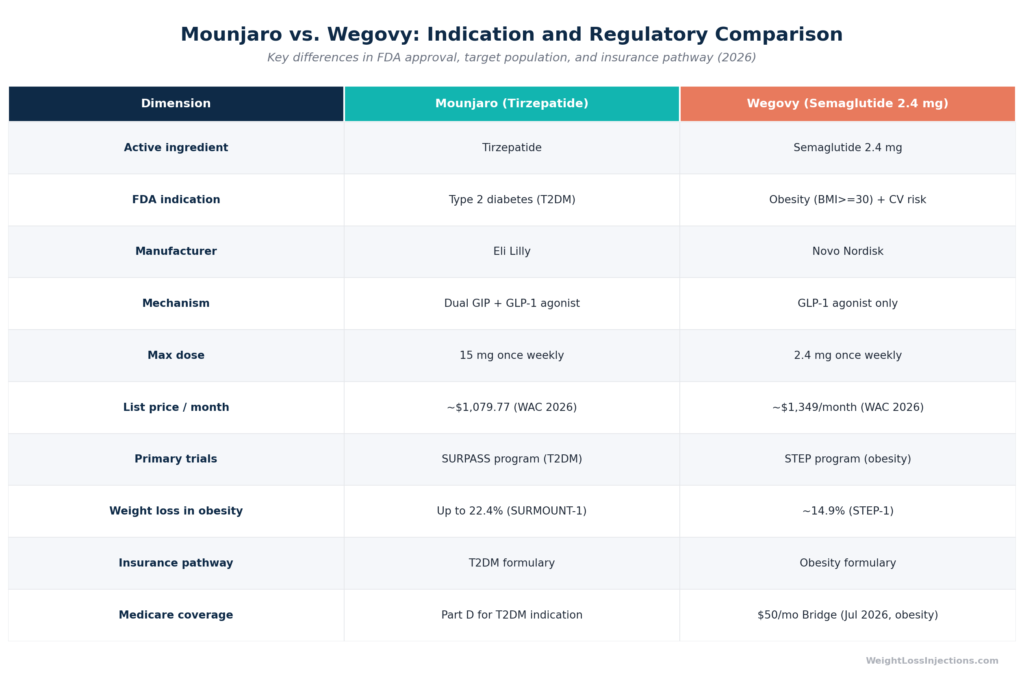
- Mounjaro (tirzepatide, Eli Lilly) is FDA-approved for type 2 diabetes — using it for weight loss is off-label. Its sister drug Zepbound (same molecule, different FDA label) is the on-label tirzepatide weight-loss option.
- Wegovy (semaglutide 2.4 mg, Novo Nordisk) is FDA-approved for chronic weight management in adults with obesity or overweight with a comorbidity.
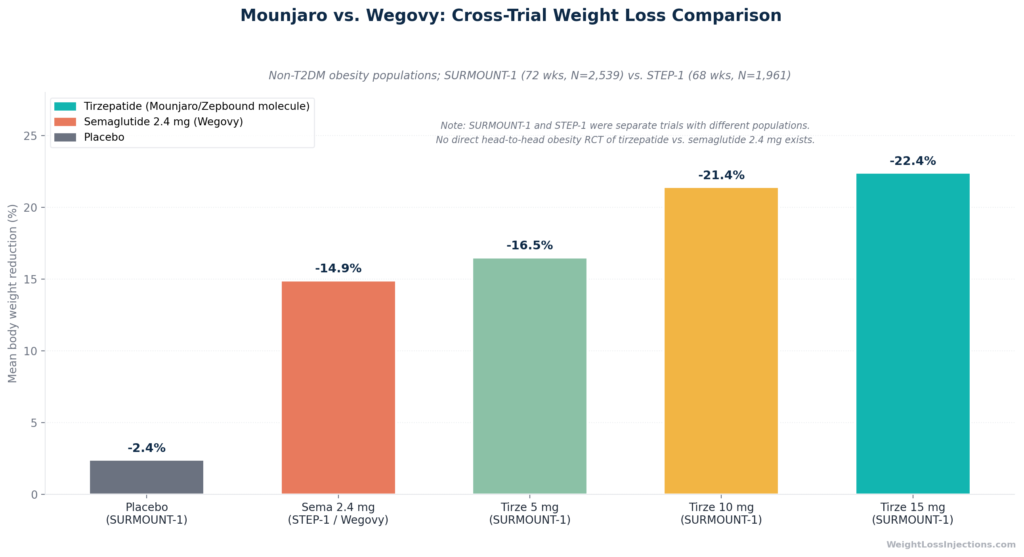
- In separate clinical trials, tirzepatide produced mean weight loss of up to 22.4% at 72 weeks (SURMOUNT-1) versus roughly 14.9% for Wegovy at 68 weeks (STEP-1). No direct head-to-head obesity trial of the two drugs exists yet.
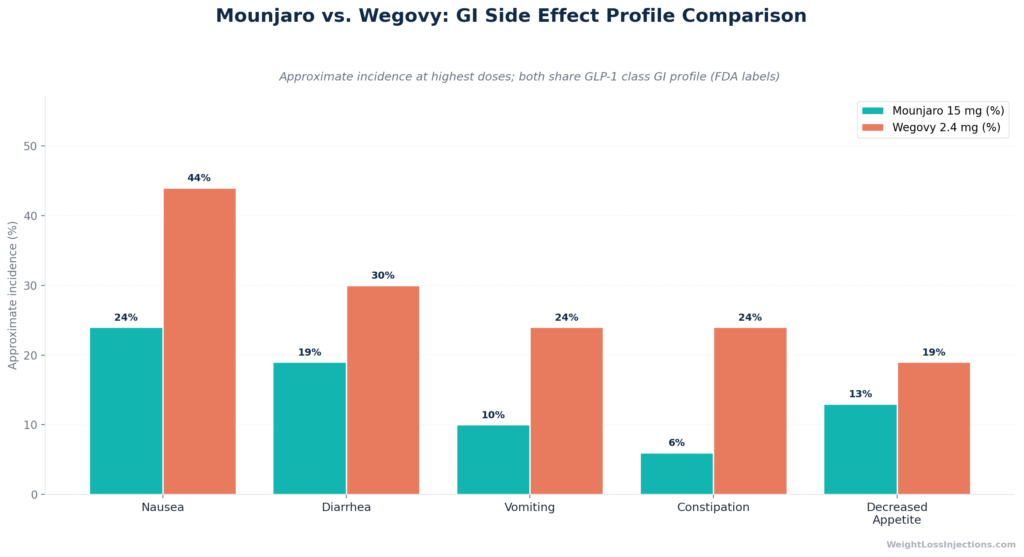
- Both are once-weekly subcutaneous injections with similar GI side-effect profiles; neither has a clearly superior tolerability record.
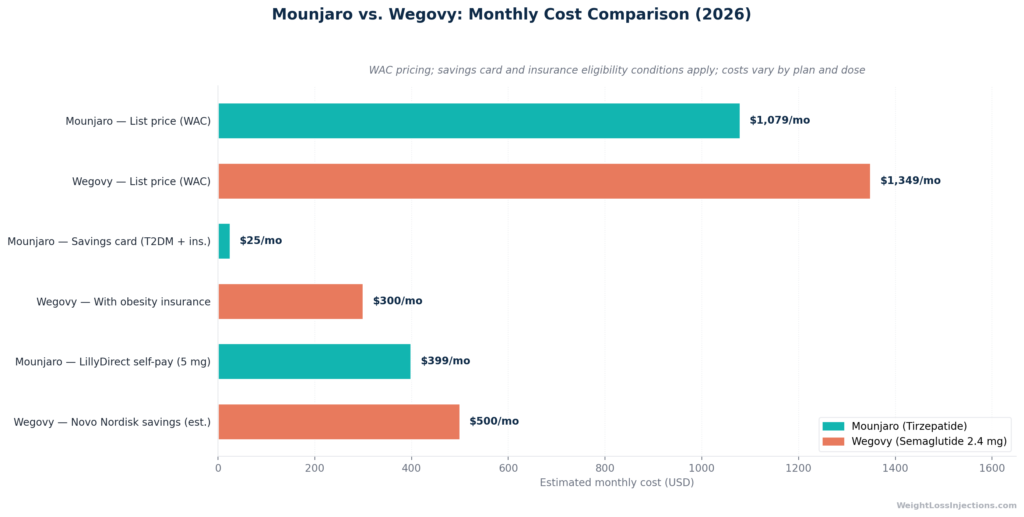
- At list price, Mounjaro is roughly $270/month cheaper than Wegovy (~$1,079.77 vs. ~$1,349).
- Patients with T2DM typically find Mounjaro easier to get covered by insurance than Wegovy; patients with obesity but no T2DM face a different calculus.
- A licensed provider should determine which drug fits your health history, comorbidities, and insurance plan — not a side-by-side article alone.
Mounjaro and Wegovy — Understanding the Basics
Before comparing data points, it is worth being precise about what each drug actually is — because “Mounjaro vs. Wegovy” is not a clean apples-to-apples comparison from a regulatory standpoint.
Mounjaro is the brand name for tirzepatide manufactured by Eli Lilly and Company. It was FDA-approved on May 13, 2022, as an adjunct to diet and exercise to improve glycemic control in adults with type 2 diabetes mellitus. That is its only FDA-approved indication. Physicians who prescribe Mounjaro to patients whose primary goal is weight loss — and who do not have T2DM — are doing so off-label. Off-label prescribing is legal in the United States; it is common practice in GLP-1 therapy; but it has downstream consequences for insurance coverage and savings card eligibility that patients need to understand.
The on-label tirzepatide weight-loss product is Zepbound, which Eli Lilly launched in November 2023 under a separate FDA approval for chronic weight management. Mounjaro and Zepbound are the same active molecule (tirzepatide) at the same doses (2.5–15 mg once weekly), but they carry different FDA labels and therefore different insurance coverage pathways, per WebMD’s GLP-1 comparison. When patients search “Mounjaro vs. Wegovy,” they are typically asking about the tirzepatide molecule broadly — whether accessed as Mounjaro or Zepbound — compared to semaglutide 2.4 mg. That is how this article frames the comparison.
Wegovy is the brand name for semaglutide 2.4 mg manufactured by Novo Nordisk. It is FDA-approved for chronic weight management in adults with BMI ≥30, or BMI ≥27 with at least one weight-related comorbidity (such as hypertension, type 2 diabetes, or dyslipidemia). In 2024, it received a second FDA indication — cardiovascular risk reduction in adults with established cardiovascular disease and obesity or overweight — based on the landmark SELECT trial.
Both drugs share several core features: once-weekly subcutaneous injection, prescription-only, suitable for adults who meet clinical criteria, and both requiring an initial dose titration period to minimize gastrointestinal side effects. Both target the GLP-1 receptor — but tirzepatide goes further, as explained in the next section, per the Innerbody Wegovy vs. Mounjaro comparison.
For T2DM patients who also have obesity: your provider may discuss Mounjaro under the diabetes indication (with better coverage odds) rather than pursuing Zepbound or Wegovy under an obesity indication. The regulatory distinction matters practically.
Mechanism — Why Tirzepatide May Have an Edge
Both drugs suppress appetite and reduce body weight through the incretin hormone system — but they do not work identically, and the pharmacological difference is the most plausible explanation for tirzepatide’s greater average weight loss in clinical data.
Wegovy (semaglutide 2.4 mg) is a selective GLP-1 (glucagon-like peptide-1) receptor agonist. It works by mimicking the natural GLP-1 hormone released after eating: it slows gastric emptying, stimulates insulin secretion in a glucose-dependent manner, suppresses glucagon, and — critically for weight management — signals the hypothalamus to reduce appetite. Wegovy is essentially the same molecule as Ozempic (semaglutide for T2DM) but at a higher dose: 2.4 mg versus the 2.0 mg maximum for Ozempic. The higher dose was selected specifically to maximize the appetite-suppression effect, per the diaTribe tirzepatide and weight summary.
Mounjaro (tirzepatide) is a dual GIP (glucose-dependent insulinotropic polypeptide) receptor and GLP-1 receptor agonist — the first of its class. Per the FDA Mounjaro prescribing information, §12.1, tirzepatide selectively binds to and activates both the GIP receptor and the GLP-1 receptor. The GLP-1 component does everything semaglutide does. The GIP component adds a second pathway: GIP receptor agonism enhances first- and second-phase insulin secretion, reduces glucagon, and has direct effects on adipose tissue — including reducing fat accumulation and improving insulin sensitivity in fat cells.
The proposed mechanism for tirzepatide’s superior weight-loss outcomes is not simply “more GLP-1 signaling” but a qualitatively different hormonal signal: two complementary incretin pathways that together produce greater appetite suppression and metabolic effects than either receptor alone can achieve, per the diaTribe tirzepatide summary.
the WeightLossInjections.com Staff notes: “The GIP component in tirzepatide appears to synergize with GLP-1 signaling rather than simply duplicating it. We are seeing this reflected in clinical data — patients on tirzepatide consistently achieve greater percent weight loss than patients on semaglutide across virtually every comparison we have. The mechanism gives us a hypothesis for why, though the full picture of GIP’s role in adipose tissue is still being studied.”
What this means in practical terms: tirzepatide’s dual mechanism correlates with greater average weight loss in clinical trials. Whether that difference is meaningful for a specific individual depends on their starting weight, their dose reached, their tolerability, and their adherence. But at the population level, the pharmacological difference is real.
Which Causes More Weight Loss? — SURMOUNT-1 vs. STEP-1
This is the question most patients are asking. The honest answer requires first acknowledging a methodological limitation.
Trial Comparison Disclaimer: SURMOUNT-1 (tirzepatide) and STEP-1 (semaglutide 2.4 mg) were conducted in separate patient populations at different time periods. These results cannot be directly compared as if from a single head-to-head trial. A clinical determination of which drug is “better” for any individual patient requires personalized evaluation.
With that caveat clearly stated, here is what the best available evidence shows:
SURMOUNT-1 (Tirzepatide in Obesity)
SURMOUNT-1 was a 72-week, double-blind, placebo-controlled Phase 3 trial that enrolled 2,539 adults without type 2 diabetes — BMI ≥30, or ≥27 with at least one weight-related comorbidity. Because Mounjaro and Zepbound are the same molecule, these results are directly relevant to the tirzepatide molecule regardless of which brand label is on the pen, per the SURMOUNT-1 primary publication in the New England Journal of Medicine.
Mean body weight reduction at 72 weeks:
- Tirzepatide 5 mg: −16.5%
- Tirzepatide 10 mg: −21.4%
- Tirzepatide 15 mg: −22.4%
- Placebo: −2.4%
Roughly 50% of patients on 10–15 mg lost 20% or more of their body weight, per PMC analysis of SURMOUNT-1. That figure — half of patients losing at least one-fifth of their body weight — is without precedent for any approved GLP-1 treatment.
Grouped bar chart — “Mean % Body Weight Loss: SURMOUNT-1 Tirzepatide vs
STEP-1 (Semaglutide 2.4 mg / Wegovy in Obesity)
STEP-1 was a 68-week, double-blind, placebo-controlled Phase 3 trial enrolling 1,961 adults without type 2 diabetes — similar BMI inclusion criteria to SURMOUNT-1. Results, per the Innerbody Wegovy vs. Mounjaro comparison and WeightFAQ GLP-1 comparison (May 2026):
Mean body weight reduction at 68 weeks:
- Semaglutide 2.4 mg (Wegovy): ~14.9%
- Placebo: ~2.4%
Approximately 32% of patients on Wegovy lost 20% or more of their body weight.
Why You Cannot Simply Subtract 14.9% from 22.4%
The temptation to say “tirzepatide beats semaglutide by ~7.5 percentage points” is understandable. The real picture is more nuanced. SURMOUNT-1 and STEP-1 differ in:
- Duration: 72 weeks vs. 68 weeks — four extra weeks can produce measurable additional weight loss at maintenance doses
- Trial period: Different calendar years, different standard-of-care contexts
- Baseline characteristics: Population demographics, baseline weight, comorbidity prevalence, and placebo-response rates all differed
- No randomization between arms: Patients were not randomized across drugs; the populations are simply not comparable in the rigorous statistical sense
No direct randomized controlled trial has compared tirzepatide against semaglutide 2.4 mg in an obesity population. The closest head-to-head data — SURPASS-2 — pitted tirzepatide against semaglutide 1 mg in a T2DM population (not an obesity population), and tirzepatide was superior at all three doses, per the NEJM SURPASS-2 publication. But 1 mg semaglutide is a diabetes dose, not the weight-management dose. That trial does not close the gap either, per the diaTribe tirzepatide summary.
The most defensible conclusion from available evidence: Tirzepatide trials consistently show greater average percent weight loss than semaglutide 2.4 mg trials. The magnitude in those separate trials is roughly 7–8 percentage points in favor of tirzepatide at maximum doses. Head-to-head data in an obesity population — the kind that would settle the question definitively — does not yet exist. For the Zepbound-specific head-to-head with Wegovy (SURMOUNT-5), that data was published in May 2025 using tirzepatide under its Zepbound label, confirming the direction: tirzepatide 20.2% vs. semaglutide 13.7% mean weight loss.
To put the difference in practical terms: A patient starting at 250 lbs on tirzepatide 15 mg (SURMOUNT-1 average) would lose approximately 56 lbs. The same patient on Wegovy (STEP-1 average) would lose approximately 37 lbs. That is a gap of roughly 19 lbs at average results — clinically meaningful for patients who are trying to reach a BMI threshold, resolve a comorbidity, or achieve a specific weight goal.
SURMOUNT-2: Tirzepatide in Obesity + T2DM
For patients who have both obesity and type 2 diabetes — a common profile for people asking “Mounjaro vs. Wegovy” — SURMOUNT-2 provides relevant data. In the Lancet 2023 SURMOUNT-2 publication, tirzepatide (5, 10, and 15 mg) in adults with both obesity and T2DM produced mean weight loss of approximately 12–15% at higher doses over 72 weeks — lower than in non-T2DM patients, but substantially greater than what Wegovy achieves in diabetes populations.
Stacked bar chart — “Proportion of Patients Achieving Weight Loss Thresholds: Tirzepatide 15 mg (SURMOUNT-1) vs
Side Effects — How Do Mounjaro and Wegovy Compare?
Both Mounjaro and Wegovy produce the same class of side effects. Because tirzepatide activates the GLP-1 receptor alongside GIP, the GI side-effect profile it generates overlaps substantially with semaglutide — gastric emptying slows, appetite drops, and the GI tract adapts over weeks.
Shared GLP-1 Class Side Effects
The most common adverse reactions for both drugs, drawn from their respective FDA label data, per the FDA Mounjaro prescribing information §6:
| Side Effect | Character |
|---|---|
| Nausea | Most common; dose-dependent; peaks during titration |
| Diarrhea | Frequency decreases after reaching maintenance dose |
| Decreased appetite | Related to mechanism; expected |
| Vomiting | Especially pronounced during escalation |
| Constipation | Less common than nausea/diarrhea |
| Dyspepsia / abdominal pain | Reported with both agents |
Both drugs carry a boxed warning for thyroid C-cell tumors. Tirzepatide causes thyroid C-cell tumors in rats and mice at clinically relevant exposures; whether this translates to humans is unknown, per the FDA Mounjaro PI. Both are contraindicated in patients with a personal or family history of medullary thyroid carcinoma (MTC) or Multiple Endocrine Neoplasia syndrome type 2 (MEN 2).
Additional serious warnings shared by both agents include pancreatitis (both should be discontinued if suspected; neither has been studied in patients with prior pancreatitis history), gallbladder disease (cholelithiasis and cholecystitis), acute kidney injury from dehydration secondary to nausea and vomiting, and hypoglycemia when combined with insulin or sulfonylureas.
Discontinuation Rates — Are They Different?
Looking at discontinuation due to adverse events gives an indirect measure of how well patients tolerate each drug. In SURMOUNT-1, tirzepatide discontinuation due to adverse events was approximately 6.2% versus 2.6% for placebo. In STEP-1, Wegovy discontinuation was approximately 7% versus 3.1% for placebo, per WeightFAQ’s GLP-1 comparison (May 2026). These figures are broadly similar — neither drug has a clearly superior tolerability advantage in the available data.
The GIP Difference: A Different GI Character, Not Necessarily a Worse One
Some patients who switch from Wegovy (semaglutide) to Mounjaro (tirzepatide) report a different pattern of GI side effects — not always more severe, but qualitatively different, likely related to the added GIP receptor component. The practical implication: a patient who had difficulty tolerating Wegovy may or may not have the same experience on tirzepatide. There is no reliable way to predict individual tolerability differences between the two drugs in advance; starting at 2.5 mg and titrating slowly remains the best approach regardless of prior semaglutide experience, per the FDA Mounjaro PI.
Hair Loss
Hair loss is reported anecdotally by patients on both Mounjaro and Wegovy. It does not appear on either drug’s FDA label because the mechanism is caloric restriction — rapid weight loss triggers a temporary shedding phase (telogen effluvium) rather than a direct drug effect. It is typically temporary and resolves as weight stabilizes.
Oral Contraceptive Interaction
Both tirzepatide and semaglutide delay gastric emptying, which can reduce the absorption of oral medications. For patients on oral contraceptives, the Mounjaro label specifically instructs use of backup contraception for four weeks after initiation and four weeks after each dose escalation, per FDA Mounjaro PI §7. This applies to Wegovy as well — confirm with your prescriber.
Our Top 3 · October 2026
The best GLP-1 providers right now
Independently reviewed. Ranked by price, medication access, provider quality, and patient outcomes.
Renew GLP
Personalized GLP-1, GIP plans: Semaglutide & Tirzepatide.
Medvi
No membership or hidden fees. Everything you need is included.
Trimi
US-licensed clinicians and shipped to your door, from $99/mo.
Cost Comparison in 2026 — With and Without Insurance
Cost is one of the top three reasons patients choose between Mounjaro and Wegovy. The pricing landscape has become more accessible in 2026, but the numbers still require careful attention.
List Prices (Wholesale Acquisition Cost)
- Mounjaro: $1,079.77 per 28-day supply (four pens), uniform across all six dose strengths (2.5–15 mg), per the official Lilly WAC disclosure sheet
- Wegovy: approximately $1,349/month, per the Innerbody Wegovy vs. Mounjaro comparison
At list price, Mounjaro is approximately $270/month cheaper than Wegovy — a gap of roughly $3,240/year, which is meaningful for patients paying out of pocket.
Mounjaro Savings Programs (2026)
The Eli Lilly Mounjaro Savings Card, valid through December 31, 2026, has two tiers depending on insurance status, per NiceRx’s savings card overview (March 2026):
| Patient situation | Cost with card |
|---|---|
| Commercial insurance covers Mounjaro (T2DM indication) | As low as $25/month |
| Commercial insurance does NOT cover Mounjaro | As low as $499/month |
| Medicare / Medicaid / government plans | NOT eligible |
The $25/month rate is for eligible T2DM patients with commercial coverage. Off-label weight-loss prescriptions of Mounjaro do not qualify for the $25 rate — the savings card is tied to the FDA-approved indication, per NiceRx.
LillyDirect self-pay vials provide a separate, significant cost reduction for cash-pay patients with a valid prescription:
- 2.5 mg: $299/month
- 5 mg: $399/month
- 7.5–15 mg: $449/month
These are branded Mounjaro vials — not compounded tirzepatide — at well below the pharmacy list price.
Wegovy Savings Programs (2026)
Novo Nordisk offers savings programs for Wegovy; current terms and eligibility are at wegovy.com. For patients with commercial insurance that covers Wegovy, copays can be reduced substantially. Check current program terms directly with Novo Nordisk.
Medicare
- Mounjaro: Medicare Part D may cover Mounjaro when prescribed for T2DM (ICD-10: E11.x). Standard Medicare does not cover it for weight loss, per the understoodcare.com Medicare GLP-1 overview (2026).
- Zepbound (not Mounjaro): Starting July 1, 2026, a Medicare GLP-1 Bridge Program covers Zepbound — the on-label weight-management tirzepatide product — at $50/month for eligible Part D enrollees with obesity, per the understoodcare.com bridge program guide. This program covers Zepbound, not Mounjaro, because the obesity indication is on the Zepbound label.
- Wegovy: May be covered under Medicare Part D for patients prescribed it specifically for cardiovascular risk reduction (Wegovy’s second FDA indication). Medicare coverage for the weight management indication alone remains subject to statutory exclusions.
Horizontal bar chart — “Mounjaro vs
Insurance Coverage — Which Is Easier to Get Covered?
Insurance coverage is the single most consequential variable for many patients comparing these two drugs. The coverage calculus differs dramatically depending on whether you have a T2DM diagnosis.
For Patients With Type 2 Diabetes
Mounjaro’s advantage here is substantial. Most major commercial plans cover Mounjaro for T2DM because the diabetes indication is well-established and appears consistently on formularies. Insurance approval rates for on-label Mounjaro (T2DM) are estimated at approximately 60–70% for commercial plans, per FormBlends’ coverage guide (April 2026). With approval comes access to the $25/month savings card.
Typical prior authorization requirements for Mounjaro under the T2DM indication include:
- Documented T2DM diagnosis (ICD-10: E11.x)
- Recent A1C ≥7.0% (within ~3 months)
- Documentation of metformin trial at maximally tolerated dose for ≥3 months, or documented allergy/intolerance
- Confirmation the drug is not being prescribed solely for weight management
- No concurrent use of another GLP-1 agonist or DPP-4 inhibitor (plan-dependent)
Per Noom’s 2026 insurance guide, the savings card stacks on top of commercial coverage, reducing out-of-pocket costs to as low as $25/month for patients who clear prior authorization.
For Patients Seeking Weight Loss Without T2DM
This is where coverage becomes more difficult for both drugs. Off-label Mounjaro (for weight loss without T2DM) is approved by commercial insurance in only roughly 15–25% of cases, per FormBlends (April 2026). Most plans require the on-label obesity product (Zepbound) if they cover tirzepatide for weight management at all.
Wegovy coverage for the obesity indication has been improving as employer health plans gradually adopt weight management benefits — but many still exclude it. Coverage rates vary widely. Some plans implement step therapy requiring a prior trial of a lower-cost obesity drug (such as phentermine/topiramate) before approving Wegovy, per FormBlends.
Step Therapy Reality
For Mounjaro under the T2DM indication, some commercial plans (notably certain BCBS plans) place Mounjaro at step 2 or later in a diabetes drug therapy sequence, requiring a prior trial of Ozempic, Trulicity, or another GLP-1/DPP-4 agent before approving Mounjaro. The typical sequence runs: metformin → generic oral agent → initial GLP-1 (e.g., Ozempic) → Mounjaro, per Noom’s insurance guide. Not all plans require this; many auto-adjudicate Mounjaro at starter doses when a diabetes diagnosis appears in the claims record.
Practical Guidance
- If you have T2DM + obesity: Mounjaro is likely your most coverage-accessible tirzepatide option and is substantially less expensive than Wegovy at list price.
- If you have obesity only (no T2DM): Neither drug is easy to cover; Wegovy’s obesity indication may be the cleaner path if your employer plan includes weight management, but Zepbound is the on-label tirzepatide alternative — not Mounjaro.
- Verify your specific plan’s formulary and benefits before starting either drug. Coverage determinations vary by payer, plan year, and state.
Switching From Wegovy to Mounjaro — What Patients Need to Know
Switching between these drugs is medically feasible and increasingly common as patients seek better weight-loss results, face insurance coverage changes, or experience tolerability issues. Here is the clinical framework.
Why Patients Switch
The most common reasons for switching from Wegovy to Mounjaro (or to Zepbound):
- Inadequate weight-loss response to semaglutide
- Coverage changes that make Mounjaro more accessible (e.g., patient acquires T2DM diagnosis or employer plan changes)
- Cost — Mounjaro’s list price is substantially lower
- Curiosity about tirzepatide’s dual mechanism after reading trial data
Washout Period
Semaglutide has a half-life of approximately one week, with full clearance taking roughly five weeks. The practical washout recommendation is 1–2 weeks minimum after the last Wegovy injection before starting Mounjaro, with some clinicians preferring 4–5 weeks for patients on the maximum Wegovy dose (2.4 mg), per switching guidance cited in the SHARED_SPEC switching protocol §13.
Starting Dose After Switching
Per the 2025 ADA Standards of Care, regardless of your prior Wegovy dose, you should start tirzepatide at 2.5 mg and titrate according to the standard schedule, per ADA 2025 guidance referenced in the SHARED_SPEC. Some clinicians managing patients who tolerated high-dose Wegovy very well may consider starting at 5 mg, but 2.5 mg is the safest default. Expect a GI re-adjustment period because the added GIP component creates a different receptor engagement profile.
Insurance Implications of Switching
Switching drugs requires a new prior authorization for the new drug. A Wegovy prior auth does not carry over to Mounjaro. Begin the insurance process before your last Wegovy dose if possible to minimize treatment gaps.
Which Drug Is Right for You? Key Questions to Ask Your Doctor
The data above provides a framework. Your prescriber applies it to your individual situation. Here are the key questions that should guide the conversation:
Do you have a documented T2DM diagnosis?
If yes, Mounjaro is FDA-approved and on-label for your condition. Coverage, cost, and access are all typically more favorable. This is likely your most efficient path to tirzepatide if weight loss is also a goal.
Is weight loss your only goal, and you do not have T2DM?
Ask your provider to compare Zepbound (on-label tirzepatide for obesity) and Wegovy (on-label semaglutide for obesity). Off-label Mounjaro is possible but faces coverage barriers. If you want the tirzepatide molecule and do not have T2DM, Zepbound is the cleaner regulatory path, per FormBlends’ prescription access guide (April 2026).
Do you have established cardiovascular disease?
Wegovy holds an FDA indication for cardiovascular risk reduction in adults with obesity and established CVD — a label Mounjaro does not have. If cardiovascular protection is part of your treatment goal, Wegovy’s evidence base in this population is more established.
What is your budget?
At list price, Mounjaro is approximately $270/month cheaper than Wegovy. LillyDirect tirzepatide vials start at [$299/month] for self-pay patients. If cost is a major factor and you have T2DM, the Mounjaro savings card can bring costs to as low as $25/month with commercial coverage.
Have you had GI side effects on GLP-1 medications before?
Neither Mounjaro nor Wegovy has a clearly better tolerability profile. If you struggled with Wegovy, switching to Mounjaro is possible — but expect a re-adjustment period, not a guaranteed improvement.
Do you have a history of pancreatitis, medullary thyroid carcinoma, or MEN 2?
Both drugs are contraindicated. Neither is appropriate.
Are you on oral contraceptives?
Both drugs can reduce oral contraceptive absorption. Plan for backup contraception during initiation and dose escalations, per FDA Mounjaro PI §7.
WeightLossInjections.com connects patients with licensed providers who can evaluate your full health history, comorbidities, and insurance situation and recommend the most appropriate medication and access pathway — [service detail]. Consultations start at [$X/month].
Our Take at WeightLossInjections.com
The question “Mounjaro vs. Wegovy” is asked by two distinct groups of patients, and the honest answer differs for each.
For patients with type 2 diabetes and obesity, Mounjaro is the most practical tirzepatide choice in 2026. It is on-label, covered by most commercial plans at favorable rates, supported by a robust savings card, and the clinical data — both SURPASS T2DM trials and SURMOUNT obesity trials using the same molecule — consistently shows greater HbA1c reduction and greater weight loss than semaglutide at any equivalent dose. There is no compelling reason to choose Wegovy over Mounjaro if you have T2DM and are trying to manage both conditions with a single weekly injection.
For patients with obesity but no T2DM, the comparison is genuinely more nuanced. The clinical data favors tirzepatide — the molecule in Mounjaro — on average weight loss. But “Mounjaro for weight loss” means off-label prescribing, which limits your coverage options and bars you from the $25/month savings card. Zepbound is the on-label tirzepatide product for this group — compare that against Wegovy, not Mounjaro off-label, unless your provider has a specific clinical rationale for the Mounjaro route. If Wegovy’s cardiovascular indication is relevant to your profile, that evidence base is real and should be weighed.
On cost: Mounjaro is the cheaper list-price option by a meaningful margin ($270/month), and LillyDirect vials make tirzepatide genuinely accessible to self-pay patients who cannot get insurance coverage. For patients paying out of pocket with no T2DM, the Zepbound/LillyDirect pathway (same prices: $299–$449/month) deserves comparison against Wegovy’s own self-pay options.
On side effects: neither drug is clearly better tolerated. Both carry the same serious contraindications, the same class-wide boxed warning, and broadly similar GI discontinuation rates across their pivotal trials. Patients switching from one to the other should expect a re-adjustment period — not assume they will immediately feel better.
The bottom line: if you have T2DM, Mounjaro is likely the better choice on all practical dimensions. If you do not, work with a licensed clinician to compare Zepbound and Wegovy as your on-label options — and factor in your cardiovascular history, insurance coverage, and tolerance of injections. The right medication is the one you can access, afford, and stay on long enough to see meaningful results.
Physician Review Block: This article was reviewed for medical accuracy by the WeightLossInjections.com Staff. Reviewed June 2026.
FAQ
Clinical trial data consistently shows greater average weight loss with tirzepatide (the active ingredient in Mounjaro) than with semaglutide 2.4 mg (Wegovy). In SURMOUNT-1, tirzepatide 15 mg produced mean body weight reduction of 22.4% at 72 weeks versus approximately 14.9% for Wegovy in STEP-1 at 68 weeks, per the SURMOUNT-1 NEJM publication and Innerbody’s comparison. However, these are separate trials with different populations, durations, and baseline characteristics — a direct head-to-head obesity trial does not yet exist comparing these specific doses. Consistent with the separate trial data, the Zepbound vs. Wegovy head-to-head (SURMOUNT-5) found tirzepatide produced 20.2% versus 13.7% mean weight loss at 72 weeks — confirming tirzepatide’s advantage directionally. Individual results vary.
No. Mounjaro is FDA-approved for type 2 diabetes only. Wegovy is FDA-approved for chronic weight management in adults with BMI ≥30, or BMI ≥27 with at least one weight-related comorbidity, and for cardiovascular risk reduction in adults with established CVD and obesity or overweight, per the FDA Mounjaro prescribing information and WebMD’s GLP-1 comparison. Physicians may prescribe Mounjaro off-label for weight loss, but patients should understand the insurance and cost implications. The on-label tirzepatide weight-loss product is Zepbound, not Mounjaro.
Yes, at list price. Mounjaro’s wholesale acquisition cost is approximately $1,079.77/month, uniform across all doses, per the Lilly WAC disclosure sheet. Wegovy lists at approximately $1,349/month — a difference of roughly $270/month, or over $3,200/year. Mounjaro also has a more accessible savings card structure for T2DM patients with commercial insurance: as low as $25/month via the NiceRx-documented Lilly savings program. LillyDirect self-pay vials start at $299/month for the lowest tirzepatide dose.
Yes — switching is common, particularly when a patient has T2DM, wants greater weight-loss results, or faces Wegovy coverage issues. The standard approach is to wait approximately 1–2 weeks after the last Wegovy injection before starting Mounjaro, then begin at the 2.5 mg starting dose regardless of your prior Wegovy dose and re-titrate per the standard schedule, per ADA 2025 guidance and SHARED_SPEC §13. Never take both drugs simultaneously. Your prescriber should guide the transition, and you will likely need a new prior authorization for Mounjaro.
Both share the GLP-1 receptor agonist class profile: nausea, diarrhea, vomiting, constipation, and boxed warnings for thyroid C-cell tumors, per the FDA Mounjaro PI §6. Serious risks including pancreatitis, gallbladder disease, and acute kidney injury are shared by both. Discontinuation due to adverse events was approximately 6.2% for tirzepatide (SURMOUNT-1) versus approximately 7% for Wegovy (STEP-1) — broadly similar. Some patients who switch from Wegovy to tirzepatide report a qualitatively different GI pattern related to the added GIP component, per WeightFAQ’s GLP-1 comparison. Neither drug is clearly better tolerated on the population-level data available.
It depends heavily on your diagnosis. For patients with T2DM, Mounjaro tends to be easier to cover — commercial approval rates are roughly 60–70% for the on-label diabetes indication, per FormBlends (April 2026). For weight loss without T2DM, off-label Mounjaro approval rates fall to 15–25% on commercial plans — similar difficulty to Wegovy, which depends on whether your employer plan includes weight management benefits. Patients with obesity and no T2DM should compare Zepbound (on-label tirzepatide for obesity) against Wegovy as their two primary covered options, per Noom’s 2026 insurance guide.