Mounjaro vs Ozempic Cost in 2026: Real Prices With and Without Insurance
Medically reviewed by WeightLossInjections.com Staff•Updated July 23, 2026•11 min readMedically reviewed
⤢
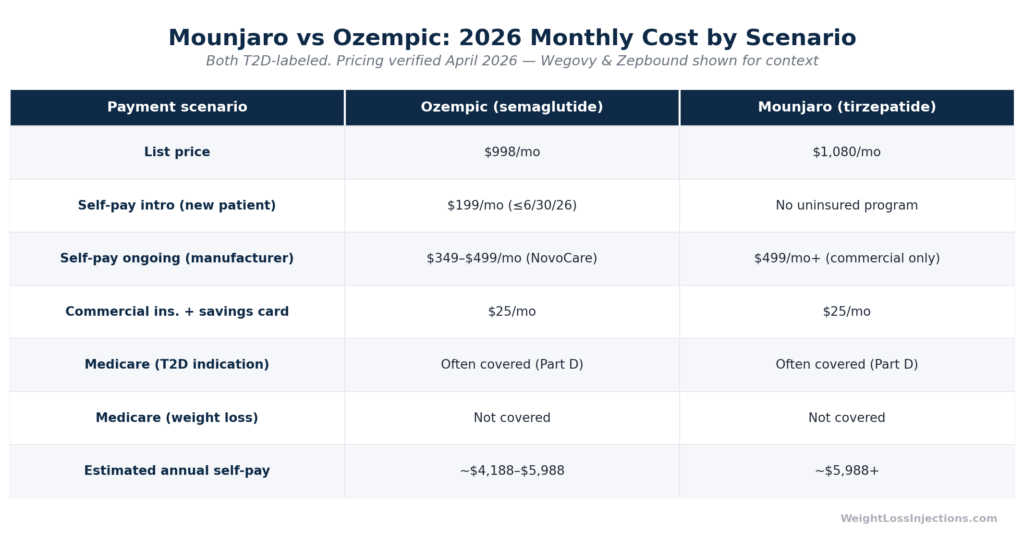
At list price, Mounjaro (~$1,080/month) runs slightly more than Ozempic (~$998/month). With commercial insurance and a savings card, both can drop to $25/month for T2D. Self-pay is where they diverge: Ozempic’s NovoCare program starts at $199/month (introductory, through June 30, 2026), while uninsured patients using the Mounjaro savings card pay a minimum of $499/month.
For weight loss specifically, the cheaper option depends on your indication, insurance status, and whether you consider Zepbound, tirzepatide’s FDA-approved weight-loss brand, via LillyDirect at $299–$449/month. Neither Mounjaro nor Ozempic is FDA-approved for weight loss; their weight-management counterparts are Zepbound and Wegovy. That distinction drives everything from insurance coverage to savings program eligibility.
Side-by-side cost comparison table
Mounjaro vs. Ozempic: What You’re Actually Comparing
Before getting into numbers, the drug names matter. Mounjaro and Ozempic are both FDA-approved for type 2 diabetes (T2D), not for weight loss. Their weight-loss counterparts are different branded products from the same manufacturers:
This distinction matters enormously for cost. Insurance plans that cover GLP-1s “for weight loss” look at the label, not the molecule. A plan that covers Zepbound for obesity will not automatically cover Mounjaro prescribed off-label for the same purpose — and vice versa. Medicare Part D currently covers GLP-1s for T2D, sleep apnea, and cardiovascular risk reduction, but not for weight loss as a standalone indication. That policy is expected to remain in place through most of 2026, with a Medicare GLP-1 Bridge program for Wegovy and Zepbound (weight-management indications only) beginning July 1, 2026, at a $50/month copay for eligible beneficiaries, according to KFF analysis of the CMS BALANCE Model.
If you are comparing costs specifically for weight loss and you have no T2D diagnosis, the comparison is more accurately Zepbound vs. Wegovy, not Mounjaro vs. Ozempic. That said, off-label use is legal and clinicians do prescribe both for weight management. The pricing and savings information below reflects real costs in both scenarios.
List Prices Without Insurance or Discounts (April 2026)
Neither manufacturer publicly posts a simple “list price” on their homepage, but WAC (wholesale acquisition cost) data reported by GoodRx and drug information resources establishes the following:
Ozempic: approximately $998/month at list price, per Noom’s 2026 Ozempic cost analysis. GoodRx reports a retail price of approximately $1,474/pen for single-pen cartons without any discount applied, which is consistent with an approximately $1,000–$1,200/month retail price depending on dose and pharmacy.
Mounjaro: approximately $1,069–$1,080/month at list price. GoodRx data places the list price at approximately $1,080 per fill (4 prefilled pens), and TrimRx’s 2026 breakdown reports a manufacturer list price of $1,069.08.
Neither price is what most patients pay. Both drugs are almost universally accessed through savings programs, insurance, or both.
Our take at WeightLossInjections.com: List prices exist mainly so pharmacies can calculate their markup. They have essentially no bearing on what patients pay. If someone quotes you the list price as your actual out-of-pocket, that’s a red flag, it means nobody has walked you through the savings programs you almost certainly qualify for.
2026 Self-Pay and Cash Prices: Where Ozempic Has a Real Edge
This is the most practically important section for uninsured patients or those whose insurance doesn’t cover weight-loss GLP-1s.
Ozempic Self-Pay (NovoCare Program)
Novo Nordisk’s NovoCare savings program offers the following tiers for patients paying without commercial insurance, as detailed on Ozempic.com’s savings page:
New patients: $199/month for the first 2 monthly fills of Ozempic 0.25 mg or 0.5 mg (introductory offer valid through June 30, 2026)
Existing patients (0.25 mg, 0.5 mg, or 1 mg): $349/month
Existing patients (2 mg): $499/month
These prices are processed outside of insurance and do not count toward deductibles or out-of-pocket maximums. Government beneficiaries (Medicare, Medicaid, TRICARE, VA) are excluded.
Mounjaro Self-Pay: The $499 Floor for Some, Nothing for Others
Mounjaro’s savings program has a structural limitation that is worth understanding clearly:
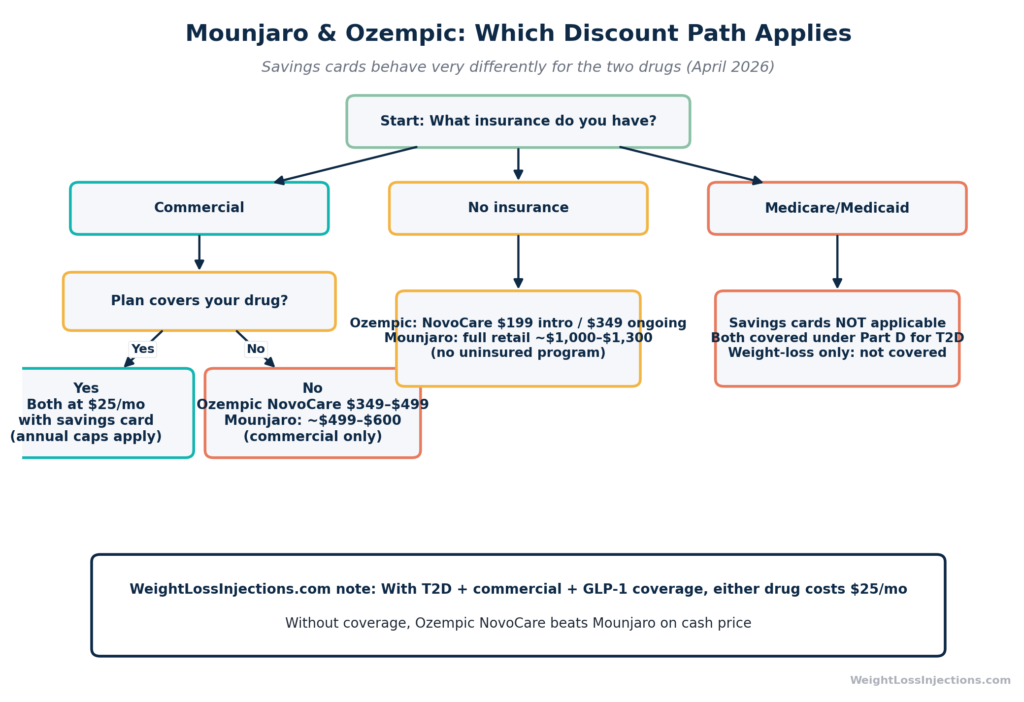
If you have commercial insurance that covers Mounjaro: you pay as little as $25/month (savings card covers up to $150/month for a 1-month fill, max $1,950/year, valid through December 31, 2026).
If you have commercial insurance that does not cover Mounjaro: you can still use the savings card and pay approximately $499–$600/month after the maximum $463 savings applied to the retail price, per Noom’s Mounjaro cost guide and August AI’s savings card analysis.
If you have no commercial insurance at all (truly uninsured): the Mounjaro savings card is not available to you. You would pay full retail: $1,000–$1,300/month.
This is a meaningful gap. Ozempic’s NovoCare program is accessible to genuinely uninsured patients; Mounjaro’s savings card requires at least some form of commercial insurance.
Zepbound via LillyDirect: The Tirzepatide Self-Pay Alternative
For patients seeking tirzepatide for weight loss without insurance, Zepbound single-dose vials through LillyDirect are the most affordable Lilly option. Following a December 2025 price reduction, current pricing is:
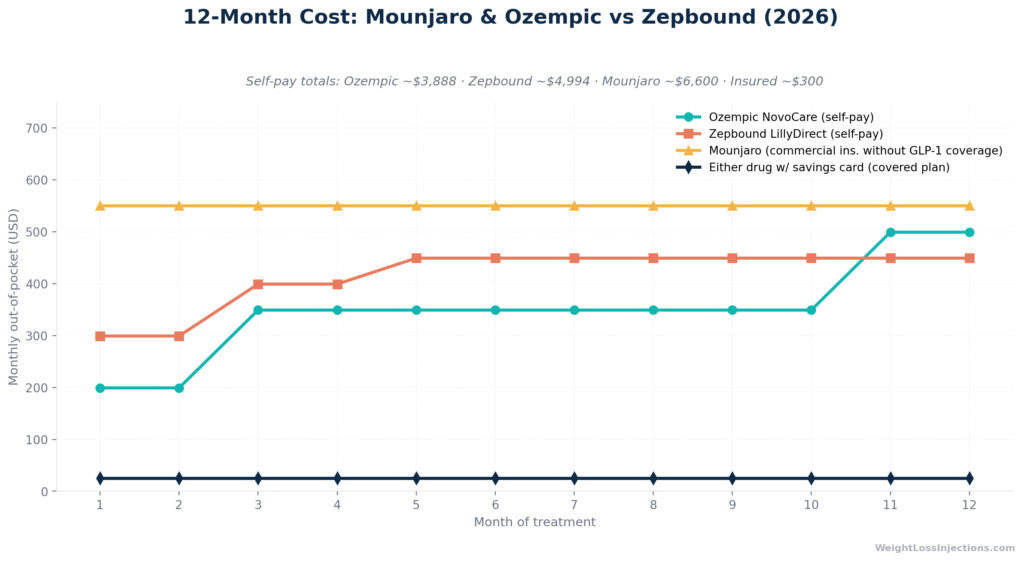
2.5 mg: $299/month
5 mg: $399/month
7.5 mg, 10 mg, 12.5 mg, 15 mg: $449/month
A valid Zepbound prescription (on-label, weight-management indication) is required. For doses above 5 mg, patients must meet Lilly’s Self Pay Journey Program requirements, per Eden Health’s 2026 Zepbound breakdown. Eli Lilly also launched a multi-dose KwikPen at the same price range via LillyDirect in February 2026, per Noom’s Zepbound cost analysis. These prices are distinct from Mounjaro — a Mounjaro prescription cannot be filled at Zepbound vial prices.
Dose escalation cost-over-time chart
Insurance Copays and Coverage Patterns
Commercial Insurance (T2D Indication)
Both drugs are commonly covered for T2D under commercial plans, with prior authorization nearly universal. Savings cards reduce copays to $25/month for both; without the card, specialty-tier copays typically run $50–$300/month. Annual card limits apply: Ozempic caps at $100/month for up to 48 months; Mounjaro caps at $1,950/year.
Commercial Insurance (Weight Loss / Off-Label)
Off-label weight-loss coverage is inconsistent and often denied. Insurers look at the label, not the molecule — some plans covering Zepbound or Wegovy will still decline Mounjaro or Ozempic for the same purpose. Prior authorization and step-therapy requirements are nearly universal.
Medicare
Medicare Part D covers both drugs for T2D, but the 2026 Final Rule confirmed that anti-obesity drugs will not receive general weight-loss coverage. The Medicare GLP-1 Bridge (July–December 2026) provides $50/month access to Wegovy and Zepbound only, not Mounjaro or Ozempic, for qualifying beneficiaries, per KFF’s March 2026 analysis.
Medicaid
Coverage varies by state. Neither drug is reliably covered across all Medicaid programs, and Medicaid patients cannot use manufacturer savings cards.
Manufacturer Savings Programs: Full Details
Eli Lilly Mounjaro Savings Card (Valid through December 31, 2026)
Key eligibility requirements: must have a valid prescription for an FDA-approved use (type 2 diabetes), commercial drug insurance, be 18+ years old, U.S. or Puerto Rico resident. Up to 13 fills per calendar year.
Novo Nordisk Ozempic Savings Card (Self-Pay, through June 30, 2026 for introductory tier)
Patient Scenario
Monthly Cost
Details
Commercial ins. with Ozempic coverage
As low as $25
Max savings $100/mo, up to 48 months
Uninsured / self-pay, new patient, 0.25 or 0.5 mg
$199/month
First 2 monthly fills only; offer through 6/30/2026
WeightLossInjections.com editorial note: The Ozempic self-pay $199 introductory tier is a limited-time offer expiring June 30, 2026. If you’re starting Ozempic on self-pay now, you have a narrow window to benefit from the entry-level pricing. The $349 tier for the 1 mg therapeutic dose is what most ongoing self-pay patients will realistically pay.
Savings card eligibility flowchart
Our Top 3 · September 2026
The best GLP-1 providers right now
Independently reviewed. Ranked by price, medication access, provider quality, and patient outcomes.
For patients who don’t qualify for manufacturer programs or want to compare pharmacy pricing, GoodRx reports the following discounted prices as of April 2026:
Ozempic via GoodRx:
0.25/0.5 mg (2 mg/3 mL pen): ~$199 with coupon (86% off average retail of $1,388)
1 mg (4 mg/3 mL pen): ~$349 with coupon
2 mg (8 mg/3 mL pen): ~$499 with coupon
These GoodRx prices for Ozempic mirror the NovoCare self-pay tiers, which is not a coincidence, Novo Nordisk has structured the programs in parallel.
Mounjaro via GoodRx: Retail prices start at approximately $1,089 per GoodRx’s Mounjaro page, with GoodRx coupons typically saving 9–27% off the cash price, according to Ro’s Mounjaro coupon guide. That yields a GoodRx-assisted price of roughly $995–$1,062 depending on pharmacy, meaningfully more expensive than Ozempic for self-pay patients.
Compounded Tirzepatide: No Longer a Legal Low-Cost Option
Prior to 2025, many telehealth platforms offered compounded tirzepatide at significantly reduced prices ($199–$349/month) citing FDA shortage status. That option has effectively closed.
The FDA declared the tirzepatide shortage resolved on October 2, 2024, reaffirmed that determination on December 19, 2024, and a federal court upheld the resolution in May 2025, per the FDA’s clarification on GLP-1 compounder policies. Enforcement deadlines passed in February–March 2025: 503A pharmacies by February 18, 2025; 503B outsourcing facilities by March 19, 2025.
As of April 2026, compounded tirzepatide is only permissible when a patient has a documented medical need that cannot be met by an FDA-approved formulation (e.g., a verified allergy to an inactive ingredient). Compounding for cost or convenience is not a qualifying reason under Section 503A, per Healthon’s legal analysis. Compounded semaglutide remains subject to separate, ongoing shortage-status determinations.
Our take at WeightLossInjections.com: The LillyDirect Zepbound vial program at $299–$449/month was developed in part as a legal alternative to compounded tirzepatide for cost-sensitive patients. It’s the closest thing to the compounding price point that still uses an FDA-approved product. If your clinic is still offering compounded tirzepatide at scale without individualized medical justification, ask hard questions.
Total Cost of Weight Loss Treatment: Beyond the Prescription Price
The medication cost is one component. A realistic monthly total includes:
Item
Estimated Monthly Cost
Mounjaro (self-pay, savings card)
~$499–$600
Ozempic (self-pay, NovoCare ongoing)
~$349–$499
Zepbound via LillyDirect (self-pay vial)
$299–$449
Injection supplies (needles/syringes for vials)
$20–$40
Labs (quarterly HbA1c, metabolic panel)
$25–$75 (amortized monthly)
Provider consultation (telehealth)
$40–$150
Provider consultation (in-person)
$150–$400
Telehealth programs that bundle medication, provider access, and labs can reduce the total cost meaningfully. At WeightLossInjections.com, a typical patient pays [$X/month] all-in, including the medication, unlimited provider messaging, dose adjustments, and [service detail]. That transparency matters: the per-pen price comparison is nearly meaningless without knowing what support and services are included.
Which Is Cheaper for Weight Loss in 2026? A Scenario-Based Guide
There is no universal answer. The cheapest option depends on your clinical situation.
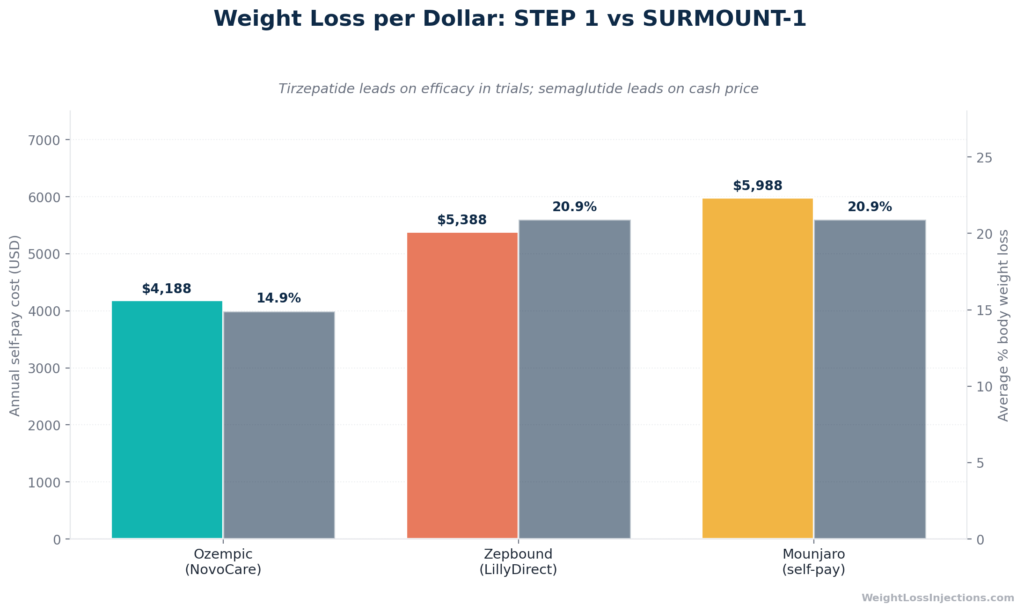
Weight-loss-per-dollar comparison
Scenario
Recommended path
Estimated monthly cost
T2D + commercial insurance with GLP-1 coverage
Mounjaro or Ozempic with savings card
$25
T2D + commercial insurance, no coverage
Ozempic via NovoCare
$349–$499
Weight loss + commercial insurance (Zepbound/Wegovy covered)
Zepbound or Wegovy (labeled products)
$25 + plan copay
Weight loss + no T2D + self-pay
Zepbound via LillyDirect
$299–$449
No insurance + want semaglutide
Ozempic NovoCare ($199 intro, then $349)
$199–$499
Medicare + T2D
Ozempic or Mounjaro (Part D covered)
Plan-dependent
Medicare + weight loss only
Wegovy or Zepbound (July 2026 Bridge, $50/mo)
$50 (Bridge program)
On efficacy, tirzepatide has the edge in trial data. SURMOUNT-1 (NEJM, 2022) showed average weight reductions of 15.0–20.9% at 72 weeks for tirzepatide 5–15 mg. STEP 1 showed a 14.9% average weight reduction at 68 weeks for semaglutide 2.4 mg (Wegovy dose), per Eli Lilly’s SURMOUNT-1 press release. Comparing them dollar-for-dollar requires assumptions about individual response that the population-level trials can’t resolve.
Our take at WeightLossInjections.com: For self-pay patients choosing between these two molecules, Zepbound via LillyDirect currently offers the best combination: the labeled weight-loss indication, an FDA-approved product, and tirzepatide’s stronger average trial efficacy, at $299–$449/month versus $349–$499/month for Ozempic’s ongoing self-pay tiers. Ozempic’s $199 introductory NovoCare offer remains the cheapest entry point for a new self-pay patient in 2026. After the first two months, the gap narrows considerably.
FAQ
Truly uninsured patients pay full retail: approximately $1,000–$1,300/month. The Mounjaro savings card requires commercial drug insurance; no-insurance patients do not qualify. With commercial insurance that doesn’t cover Mounjaro, the card reduces cost to approximately $499–$600/month, per Noom’s Mounjaro cost guide. For the tirzepatide molecule at a lower self-pay price, Zepbound vials via LillyDirect are available at $299–$449/month with a valid Zepbound prescription.
Yes, if you have commercial insurance that covers Ozempic for type 2 diabetes and you activate the Novo Nordisk savings card. The $25 rate is not available to Medicare or Medicaid patients, uninsured patients, or those using Ozempic off-label without coverage. Full terms are on Ozempic.com’s savings page. Maximum savings: $100/month for up to 48 months.
Neither drug is FDA-approved for weight loss, so most insurers cover them for T2D but not for off-label weight management. The labeled weight-loss products, Zepbound (tirzepatide) and Wegovy (semaglutide), have better coverage prospects for obesity indications, though prior authorization is nearly universal. Medicare Part D excludes weight-loss drugs in 2026; a Bridge program launching July 1, 2026 provides Wegovy and Zepbound access at $50/month for qualifying enrollees, per KFF.
Ozempic. NovoCare starts at $199/month for new patients (through June 30, 2026), then $349/month for 1 mg — vs. a minimum of $499–$600/month for Mounjaro (which also requires commercial insurance to access any savings at all). For tirzepatide at a competitive self-pay price, Zepbound vials via LillyDirect at $299–$449/month are the legal alternative, per Eden Health’s Zepbound cost breakdown.
Not for tirzepatide. The FDA declared the tirzepatide shortage resolved in October 2024; enforcement deadlines for compounders passed in February–March 2025. Compounded tirzepatide is only permissible under narrow medical-necessity exemptions as of April 2026, per FDA’s GLP-1 compounder guidance. For semaglutide, shortage-status determinations continue separately. The practical legal alternative for tirzepatide is now the Zepbound LillyDirect vial program at $299–$449/month.
This article is for informational purposes only and is not a substitute for medical advice. Pricing, savings program terms, and insurance coverage rules are subject to change. Always verify current terms directly with the manufacturer and your insurance plan. WeightLossInjections.com’s editorial team reviews content quarterly; last medical review: April 2026.

![Unbranded [pillar-drug-class] injection pen on a neutral background — WeightLossInjections.com editorial hero](https://weightlossinjections.com/wp-content/uploads/2026/04/hero_ozempic_c4_compare-1200x675.png)