![Unbranded [pillar-drug-class] injection pen on a neutral background — WeightLossInjections.com editorial hero](https://weightlossinjections.com/wp-content/uploads/2026/07/hero_mounjaro_c1_cost-1200x675.png)
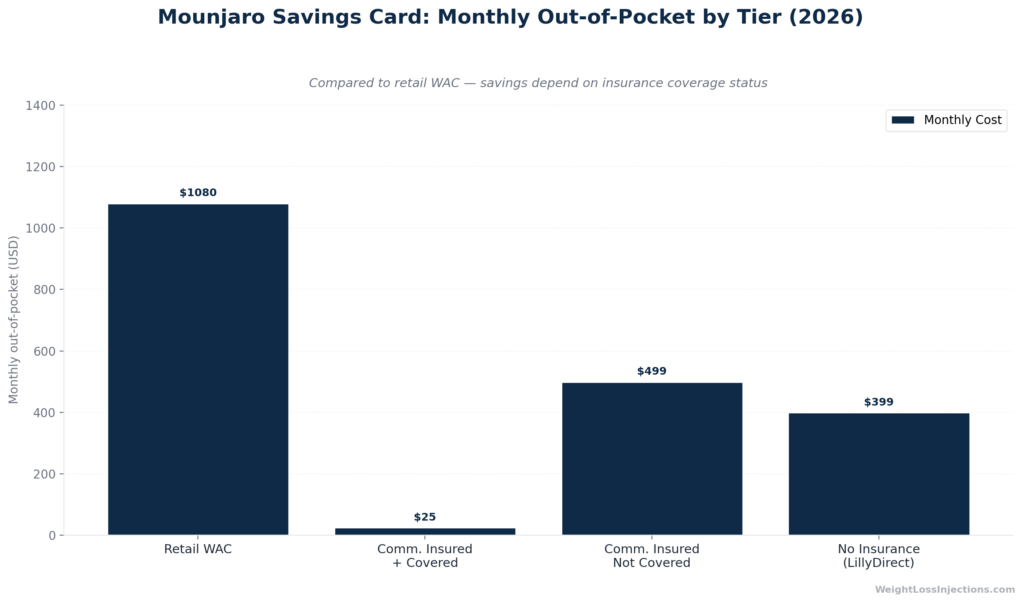
Hero eligibility comparison grid — 2×2 layout showing the four Mounjaro patient scenarios: (1) Commercially insured, T2DM covered → as low as $25/month; (2) Commercially insured, not covered → as low…
- The Mounjaro savings card is a manufacturer copay-assistance program from Eli Lilly — not insurance — valid through December 31, 2026 for commercially insured patients only.
- Track 1 (commercial insurance covers Mounjaro for T2DM): as low as $25/month; annual savings cap of $1,950/year ($150/month maximum).
- Track 2 (commercial insurance does NOT cover Mounjaro): as low as $499/month; annual savings cap of $8,411/year ($647/month maximum).
- Not eligible: Medicare, Medicaid, VA, TRICARE, CHIP, DoD, and all other government-funded plans — barred by the federal Anti-Kickback Statute.
- Not eligible: Uninsured patients. Best alternative: LillyDirect self-pay tirzepatide vials at $299–$449/month.
- Not eligible: Off-label weight-loss-only prescriptions. The savings card requires the FDA-approved type 2 diabetes (T2DM) indication.
- The card does not apply during your insurance deductible phase — high-deductible plan enrollees pay full cost until the deductible clears.
- Card payments typically do not count toward your deductible or out-of-pocket maximum.
- Enroll at mounjaro.lilly.com/savings-resources or text “MJ” to 85099.
WeightLossInjections.com editorial note: Eli Lilly can amend Mounjaro savings card terms without notice. All dollar figures in this article are verified against program materials as of mid-2026. Confirm current terms directly at mounjaro.lilly.com/savings-resources before filling your prescription. The Mounjaro savings card and the Zepbound savings card are separate programs with different eligibility rules and different caps — do not assume terms overlap.
What Is the Mounjaro Savings Card and Who Offers It?
The Mounjaro savings card is a manufacturer copay-assistance program operated by Eli Lilly and Company, the maker of Mounjaro (tirzepatide). It is not a prescription drug plan, not a patient assistance program, and not a government benefit. It is a commercial copay-offset card that functions as a secondary payor: your health insurance processes the claim first, and the savings card then covers a portion of your remaining patient cost-share — up to the monthly cap.
Mounjaro was FDA-approved on May 13, 2022, as an adjunct to diet and exercise to improve glycemic control in adults with type 2 diabetes mellitus. That FDA-approved indication — T2DM — is central to how the savings card works, who qualifies, and which dollar figure you’ll pay. Patients whose prescriptions are written for off-label weight-loss use enter a completely different (and far less generous) eligibility lane, or may be ineligible entirely.
The 2026 card is valid through December 31, 2026, and patients must re-enroll annually. According to NiceRx’s March 2026 overview of the Mounjaro savings card, the card applies to 1-month, 2-month, and 3-month prescription fills, with a maximum of 13 fills per calendar year. Enrollment is available online at mounjaro.lilly.com/savings-resources or by texting “MJ” to 85099. HIPAA authorization is required during enrollment; you’ll receive a card number, BIN, PCN, and Group code to present at the pharmacy.
The card is accepted at most major retail pharmacy chains — CVS, Walgreens, Walmart, Kroger, Costco, and most mail-order pharmacies that process commercial insurance — according to FormBlends’ Mounjaro savings card explainer. It cannot be used at compounding pharmacies, and it does not apply to LillyDirect’s self-pay tirzepatide vials, which have their own separate pricing structure.
At its most generous, the card can bring a commercially insured T2DM patient’s monthly cost down to $25 — one of the lowest patient copays available for any brand-name GLP-1 medication at its list price of approximately $1,079.77 per 28-day supply, per Lilly’s official WAC disclosure. Understanding exactly when and how the card hits that $25 floor — and when it doesn’t — is what this article is designed to answer.
Eligibility: The Four Patient Scenarios Explained
The Mounjaro savings card is not a universal discount available to everyone with a prescription. Eligibility depends entirely on your insurance type and your prescription’s indication. There are four distinct patient scenarios, and they produce four very different outcomes.
Scenario 1: Commercial Insurance That Covers Mounjaro (T2DM Indication) — $25/Month
This is the scenario most people searching for the “Mounjaro savings card” are hoping to land in.
Requirements: You must hold active commercial (private) insurance — such as an employer-sponsored plan, an ACA marketplace plan, or an individual commercial plan — and your plan must cover Mounjaro for its FDA-approved T2DM indication. Your prescription must be written under the T2DM diagnosis code (ICD-10: E11.x). Most major commercial plans do cover Mounjaro for type 2 diabetes, per Noom’s 2026 insurance coverage guide.
Cost with the card: As low as $25/month for 1-, 2-, or 3-month fills. For a 3-month supply, you pay as low as $75 total.
Annual savings cap: $1,950/year, structured as a $150/month maximum in card savings, per NiceRx’s March 2026 program summary. This means the card covers up to $150 of your copay each month. If your insurance copay is $80, the card covers $80 and you pay $25 (the minimum floor). If your copay is $175, the card covers $150 and you pay $25. If your copay is $300, the card covers $150 and you pay $150 — the $25 floor does not hold once your copay exceeds $175.
Fill limit: Up to 13 prescription fills per calendar year.
Deductible phase caveat — critical: The card does not apply during your insurance deductible phase, per FormBlends’ savings card explainer. If you are enrolled in a high-deductible health plan (HDHP), you will pay full or near-full cost for Mounjaro until your annual deductible is satisfied — potentially $1,000–$3,000 or more — even if you’re already enrolled in the savings card. This is one of the most common and expensive surprises Mounjaro patients encounter.
Scenario 2: Commercial Insurance That Does NOT Cover Mounjaro — $499/Month
Not all commercial plans cover Mounjaro, even for T2DM. And patients whose insurance explicitly excludes the drug — or whose plan doesn’t list it on formulary — fall into a separate savings card track with much higher out-of-pocket cost.
Requirements: Active commercial insurance that does not cover Mounjaro, or that classifies your claim as a non-covered benefit. This also typically applies to patients prescribed Mounjaro off-label for weight loss without a T2DM diagnosis, though such cases may be ineligible entirely — see Scenario 4.
Cost with the card: As low as $499/month for the same 1-, 2-, or 3-month fills.
Annual savings cap: $8,411/year ($647/month maximum in card savings). Given Mounjaro’s WAC of approximately $1,079.77/month per Lilly’s official pricing disclosure, the card covers roughly $581 of the full retail price, with the patient responsible for the remaining $499.
Fill limit: Up to 13 fills per calendar year.
Note on off-label weight-loss prescriptions: If Mounjaro is prescribed for weight loss only — without a T2DM diagnosis — the prescription typically falls into non-covered territory or may be categorically ineligible for the savings card. Per meetaugust.ai’s 2026 Mounjaro savings card analysis, the savings card program requires the FDA-approved T2DM indication for the standard covered-benefit track. Patients with both obesity and T2DM who are prescribed Mounjaro under the diabetes indication may qualify for Track 1 — the critical variable is which indication appears on the prescription.
Scenario 3: Medicare, Medicaid, or Government Insurance — NOT Eligible
This is the most consequential eligibility rule, and it is not a Lilly policy choice. Federal law prohibits manufacturer copay cards from being used by beneficiaries of Medicare, Medicaid, TRICARE, the VA, the Department of Defense, CHIP, or any other government-funded healthcare program. The legal basis is the federal Anti-Kickback Statute, which restricts manufacturers from providing financial incentives that could influence prescribing or dispensing decisions in federally funded healthcare programs. Per HealthRX’s patient assistance FAQ, this exclusion is absolute and applies equally to Medicare Advantage plans administered by private insurers — because Medicare Advantage is still a Medicare program.
If a pharmacist attempts to run a manufacturer savings card for a Medicare patient, the claim will reject. There is no workaround or exception. If you are on any form of government-sponsored health coverage, the savings card is not available to you. See the section below on Medicare and Medicaid alternatives.
Scenario 4: Uninsured — NOT Eligible
The Mounjaro savings card requires an active commercial insurance claim to process — the card acts as a secondary payor after insurance. Patients without any insurance coverage cannot use the savings card, per program terms. The appropriate pathway for uninsured patients is LillyDirect self-pay tirzepatide vials (discussed in the alternatives section below).
Savings Card Limits: Annual Caps and Fill Limits for 2026
Understanding the dollar math behind the annual caps is essential to avoid unexpected costs mid-year.
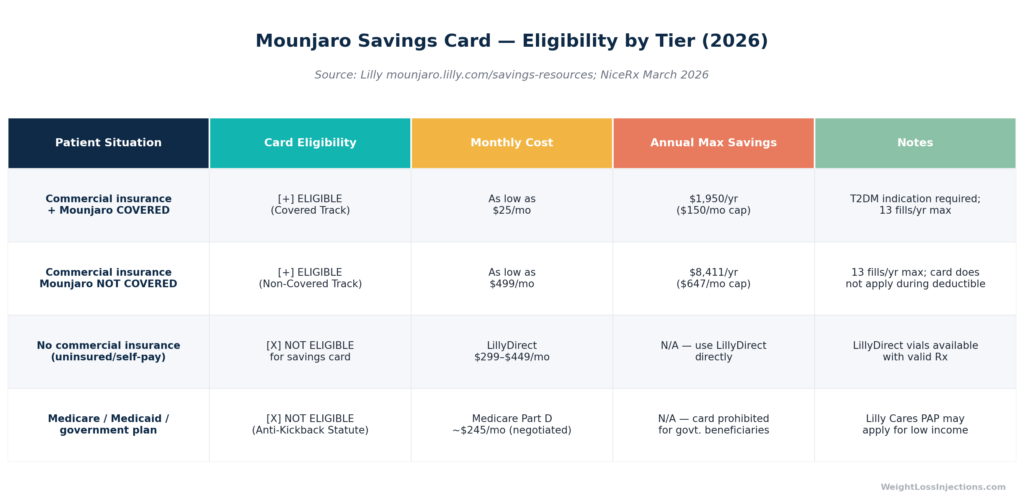
Savings scenario table — four labeled scenarios showing starting copay or WAC, card savings applied, and patient net cost
| Patient Situation | Cost with Card | Monthly Savings Cap | Annual Max Savings | Max Fills/Year |
|---|---|---|---|---|
| Commercial insurance covers Mounjaro (T2DM) | As low as $25/month | $150/month | $1,950/year | 13 |
| Commercial insurance does NOT cover Mounjaro | As low as $499/month | $647/month | $8,411/year | Up to 13 |
| Medicare / Medicaid / government plans | NOT eligible | — | — | — |
| No insurance | NOT eligible | — | — | — |
Sources: NiceRx Mounjaro Savings Card (March 2026); Mounjaro Savings Resources — Lilly.com
What the $1,950/year cap means in practice: At $150/month in maximum savings across 13 fills, the card caps out at $1,950 per calendar year. If you exhaust this cap before December 31, your remaining 2026 fills will be charged at your full insurance copay rate — without any card assistance — until the cap resets on January 1, 2027. For patients who take Mounjaro continuously throughout the year, this is not hypothetical: at 13 fills across 12 months, you will use the card for every fill, and the cap will dictate whether the $25 floor holds or breaks based on your copay level.
What the $8,411/year cap means for non-covered patients: For patients on the non-covered track, the card’s annual maximum of $8,411 in savings (at $647/month) positions a $499/month out-of-pocket cost against a full WAC of approximately $1,079.77/month. The math works to the card’s benefit for most of the year, but as with the covered track, fills beyond the annual cap limit will revert to the full non-covered price.
Deductible phase — the most common source of sticker shock: Per FormBlends’ savings card explainer, the savings card does not apply when a patient is in their insurance deductible phase. During this period — typically January through March or April for calendar-year plans — patients pay the full cost of Mounjaro as determined by their plan’s pricing, which often approaches or equals the full WAC. The card activates only after the insurance claim processes past the deductible threshold.
Copay accumulator programs: In addition to the deductible issue, many commercial plans now operate “copay accumulator” or “copay maximizer” programs that explicitly prevent manufacturer card payments from counting toward the patient’s deductible or out-of-pocket maximum, per FormBlends’ explainer. This means using the savings card all year will not move you closer to your annual out-of-pocket cap — a counterintuitive outcome that trips up many patients. Always call your insurer and confirm how manufacturer savings card payments are treated under your specific plan.
How to Activate and Use the Mounjaro Savings Card: Step by Step
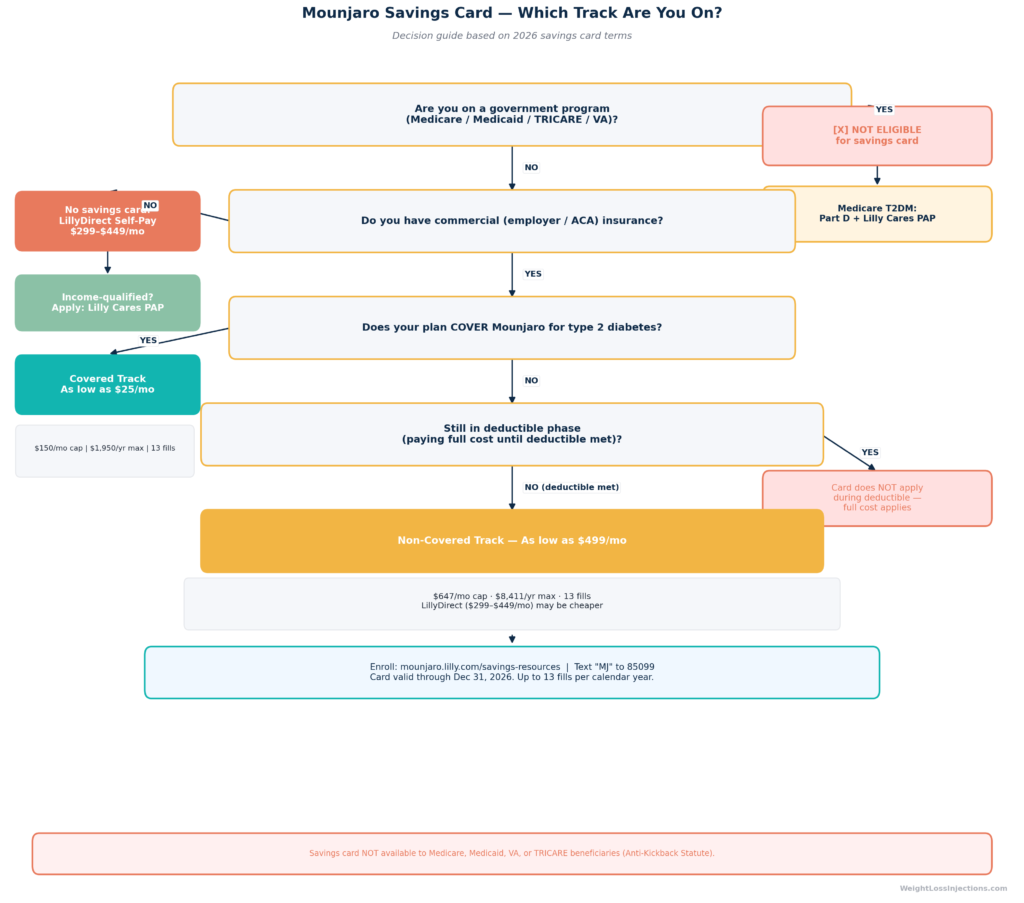
Decision and activation flowchart — “Can You Use the Mounjaro Savings Card?” Start: Do you have commercial (private) insurance? No → LillyDirect or compounded tirzepatide alternatives
Our take at WeightLossInjections.com: The activation process takes under 10 minutes online if you have your insurance card handy. The most common reason patients are rejected at the pharmacy is a mismatch between their insurance type — specifically Medicare or Medicare Advantage — and the card’s commercial-only eligibility. If your pharmacy declines the card, ask them to confirm your insurance type first, then verify your plan is truly commercial before assuming you’re ineligible for any savings.
Step 1: Confirm Your Eligibility Before Enrolling
Before creating an account or entering any information, verify the following:
- You hold active commercial (private) insurance — not Medicare, Medicaid, VA, TRICARE, CHIP, or any government-funded plan. If you’re unsure whether your Medicare Advantage plan counts as “commercial,” it does not — Medicare Advantage is still Medicare and is excluded.
- Your Mounjaro prescription is written under the T2DM indication (ICD-10: E11.x). If your doctor prescribed Mounjaro for weight loss without a diabetes diagnosis, confirm with your prescriber which indication is on the script — this determines your eligibility track.
- You are a resident of the United States or Puerto Rico.
Step 2: Enroll in the Program
Enrollment is available through three channels, per mounjaro.lilly.com/savings-resources:
- Online: Visit mounjaro.lilly.com/savings-resources directly. This is the fastest method and walks you through HIPAA authorization.
- Text: Send “MJ” to 85099. Lilly will respond with enrollment instructions.
- Phone: Call Lilly’s patient assistance line — check the current number at the official Lilly website, as phone lines can change.
During enrollment, you will provide your insurance information, date of birth, and complete HIPAA authorization. At the end of the process, you receive a card number along with a BIN, PCN, and Group code. Write these down or screenshot them — the pharmacist needs all four to process the claim correctly.
Step 3: Present the Card at the Pharmacy
When you pick up your Mounjaro prescription — whether in person or via mail order — tell the pharmacist: “I have a Mounjaro manufacturer savings card to apply after insurance.” This exact phrasing matters. Some pharmacy staff process the card as a primary payment rather than a secondary one; applying it after insurance is the correct sequence and ensures the card calculates your copay offset accurately.
The pharmacy workflow is:
- Run your commercial insurance as the primary payer.
- Apply the Mounjaro savings card to your remaining patient cost-share (copay or coinsurance).
- You pay the final net amount — ideally $25 if you’re on the covered track with a copay at or below $175.
The card works at most major retail chains including CVS, Walgreens, Walmart, Kroger, and Costco, as well as mail-order pharmacies that process commercial insurance claims, per FormBlends’ savings card explainer. It does not work at compounding pharmacies and does not apply to LillyDirect’s self-pay tirzepatide vials.
Step 4: Track Your Annual Limits and Plan Ahead
Two limits govern your card throughout the year:
- Annual savings cap: $1,950 (covered track) or $8,411 (non-covered track). Once you reach the cap, the card provides no further benefit for that calendar year.
- Fill limit: Maximum 13 prescription fills per calendar year. A 3-month fill counts as one fill toward this limit.
Monitor your remaining annual savings. If you’re on the covered track with a copay above $150, your card savings are capped at $150/month and you will reach the $1,950 annual cap at 13 fills regardless of copay size. If your copay is lower — say $80/month — you’ll reach the $1,950 cap only if your average monthly savings exceed $150, which won’t occur at that copay level. The practical takeaway: patients with very high copays are more likely to exhaust the annual cap before year-end.
The card resets January 1 each year. Re-enrollment is typically required annually, and Lilly may update program terms at each renewal cycle — always verify current terms at mounjaro.lilly.com/savings-resources before your first fill of the new year.
The Deductible Problem: Why January Is the Most Expensive Month
This section addresses what is arguably the most practically impactful limitation of the Mounjaro savings card — and the one that produces the most patient frustration.
For patients enrolled in calendar-year insurance plans, January 1 resets both the savings card annual cap and the insurance deductible simultaneously. If you’re on a high-deductible health plan (HDHP) — and a large proportion of employer-sponsored plans are HDHPs — your deductible (often $1,400–$3,000 for individual coverage) must be satisfied before your insurance begins cost-sharing. Until then, you are paying a negotiated rate that can approach the full WAC of approximately $1,079.77/month, per Lilly’s WAC disclosure. The savings card does not reduce this amount during the deductible phase.
Most patients on HDHPs satisfy their deductible somewhere between February and April. After that, the savings card activates normally, and your cost typically drops to $25/month. But the first few months of the year can involve $800–$1,100+ monthly expenses — a shock many patients aren’t prepared for.
Three strategies to manage the deductible phase:
- Use a 3-month fill in Q4. Fill a 90-day supply in December while your prior-year card is still active and your deductible is already met. A 3-month fill counts as one card fill, and you pay as little as $75 total. This effectively extends your affordable coverage into January and possibly February.
- Compare LillyDirect self-pay during deductible phase. LillyDirect’s self-pay tirzepatide vials — $299/month (2.5 mg), $399/month (5 mg), $449/month (7.5–15 mg), per BestMedsHub’s May 2026 pricing guide — may cost less than your HDHP’s negotiated rate during deductible phase for lower doses. Run the comparison before filling in January.
- Ask your prescriber about a deductible-phase strategy. Some prescribers will coordinate timing of dose titrations with the patient’s deductible status, particularly when a dose increase would otherwise require a fill during the deductible window.
Our Top 3 · October 2026
The best GLP-1 providers right now
Independently reviewed. Ranked by price, medication access, provider quality, and patient outcomes.
Renew GLP
Personalized GLP-1, GIP plans: Semaglutide & Tirzepatide.
Medvi
No membership or hidden fees. Everything you need is included.
Trimi
US-licensed clinicians and shipped to your door, from $99/mo.
What to Do If You Don’t Qualify for the Savings Card
Not qualifying for the savings card does not mean Mounjaro is unaffordable — it means you need a different access pathway. Here are five substantive alternatives, in order of typical patient priority.
Option 1: LillyDirect Self-Pay Tirzepatide Vials
For patients without commercial insurance coverage — including uninsured patients and those on government programs — LillyDirect offers branded Mounjaro tirzepatide in single-dose vials at self-pay cash prices. Per BestMedsHub’s May 2026 pricing update, current pricing is:
| Dose | LillyDirect Monthly Price |
|---|---|
| 2.5 mg | $299/month |
| 5 mg | $399/month |
| 7.5–15 mg | $449/month |
Note: The $449/month pricing at 7.5–15 mg requires adherence to a 45-day refill window. Filling outside this window may price differently. LillyDirect vials are the branded Mounjaro product — not compounded tirzepatide — and require a valid prescription. The vial format requires a separate syringe and needle, which are not included.
Option 2: Lilly Cares Foundation Patient Assistance Program (PAP)
For patients who cannot afford their medication and do not qualify for the savings card, Eli Lilly offers income-based assistance through the Lilly Cares Foundation, per HealthRX’s patient assistance FAQ. Eligibility is based on income and insurance status. T2DM patients without coverage or with government insurance who meet income criteria may receive Mounjaro at reduced or no cost through this program. Check current eligibility thresholds directly with Lilly, as PAP terms are updated periodically.
Option 3: Medicare Part D Coverage for T2DM Patients
Medicare patients prescribed Mounjaro for type 2 diabetes — not for weight loss — may have coverage through their Part D plan if the drug appears on the plan’s formulary at the diabetes indication (ICD-10: E11.x), per HealthRX’s Medicare Part D guide and Healthgrades Medicare overview. Reported negotiated prices for Medicare T2DM patients are approximately $245/month under White House pricing agreements rolling out in 2026, per Noom’s May 2026 cost guide.
Additionally, the 2026 Medicare Part D out-of-pocket cap is $2,100/year under the Inflation Reduction Act, per meetaugust.ai’s Medicare coverage guide. For Medicare patients on Mounjaro for T2DM with high-cost Part D plans, the annual OOP cap provides a meaningful financial backstop.
Important distinction: The Medicare GLP-1 Bridge Program announced for 2026 applies to Zepbound (tirzepatide under the obesity indication) at $50/month — it does not apply to Mounjaro under the diabetes indication. These are separate programs covering distinct indications.
Option 4: Compounded Tirzepatide via Licensed Telehealth Platforms
For patients who cannot access or afford branded Mounjaro, compounded tirzepatide has been available through licensed 503A/503B compounding pharmacies via telehealth prescribers at $249–$449/month for the same active molecule, per Noom May 2026. This is not the branded Mounjaro KwikPen — formulations, inactive ingredients, and quality controls differ from the FDA-approved product. Important 2025–2026 legal status update: Mass-market compounding of tirzepatide effectively ended in early 2025 after the FDA declared the tirzepatide shortage resolved. The FDA’s April 2026 compounding guidance clarifies that only a narrow personalized exception remains: 503A pharmacies may compound tirzepatide for an individual patient when a prescriber documents a specific clinical need (such as an excipient allergy) that cannot be met by the commercially available product — this exception is limited to approximately ≤4 prescriptions per month in practice. General-population access to compounded tirzepatide is no longer broadly available as it was in 2024. Confirm current legal availability and the compounding pharmacy’s licensure status before pursuing this route.
WeightLossInjections.com offers telehealth-supervised access to FDA-approved tirzepatide starting at [$X/month], including [service detail]. Our intake process includes an insurance status screening and eligibility review for the Mounjaro savings card before your first fill, so you know your exact cost pathway before picking up.
Option 5: Prior Authorization Appeal for Insurance Coverage
If your commercial insurance denied Mounjaro coverage, a prior authorization (PA) appeal with adequate clinical documentation has approximately a 60–70% approval rate for the T2DM indication, per FormBlends’ prescription access guide (April 2026). Required documentation typically includes:
- Documented T2DM diagnosis (ICD-10: E11.x) with recent A1C (typically ≥7.0% or ≥8.0% per plan)
- Evidence of metformin trial at maximally tolerated dose (≥2,000 mg) for ≥3 months, or documented intolerance/allergy
- Clinical notes confirming obesity or weight-related comorbidities
- Prescriber’s attestation that the drug is for the FDA-approved diabetes indication, not weight loss
If your plan has step therapy requirements — commonly: metformin, then an SGLT2 inhibitor or DPP-4, then a GLP-1 agonist (e.g., Ozempic or Trulicity), then Mounjaro — your prescriber must document completion of or contraindication to each prior step, per Cigna’s PA coverage policy for Mounjaro.
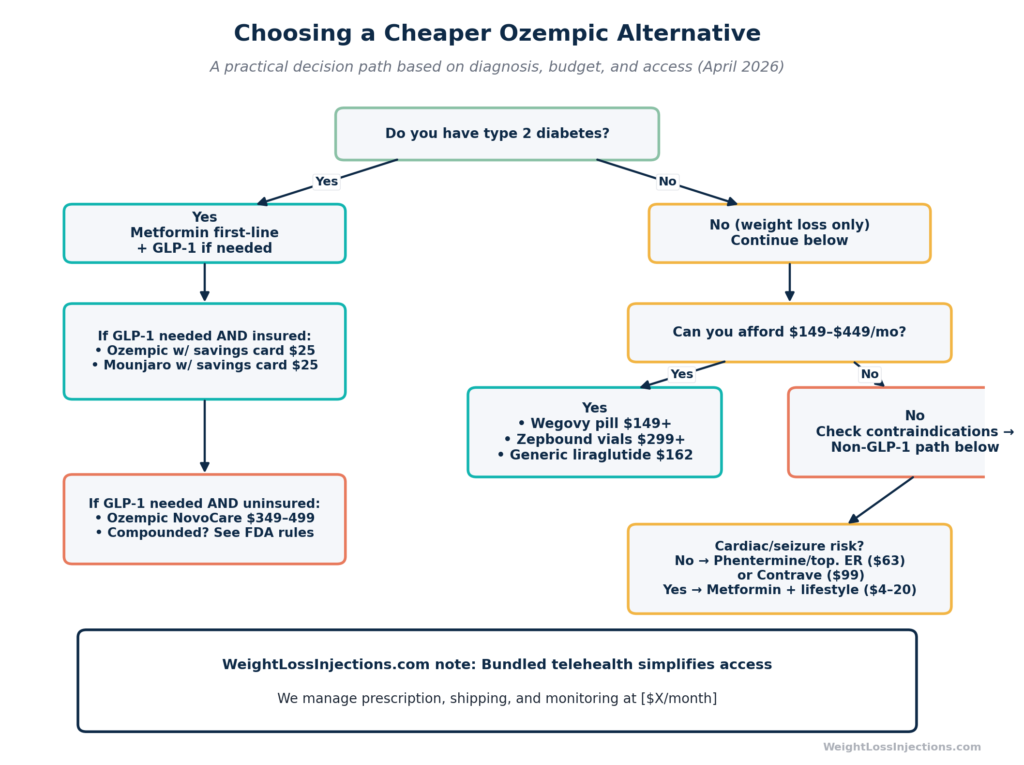
Annual cost bar chart comparing five scenarios — (1) Mounjaro at WAC with no assistance ~$12,957/year; (2) Covered savings card, $25/month × 13 fills = ~$325/year; (3) Non-covered savings card,…
The Off-Label Weight Loss Question: Does the Card Work If Mounjaro Is Prescribed for Obesity?
This is one of the most searched questions about the Mounjaro savings card — and the answer is nuanced enough to warrant its own section.
The short answer: No. The Mounjaro savings card’s covered-benefit track ($25/month) requires the FDA-approved T2DM indication. Off-label prescriptions for weight loss without a T2DM diagnosis do not qualify for this track.
The longer answer involves three distinct patient types:
Type A — Pure weight-loss prescription, no T2DM: A patient prescribed Mounjaro solely for obesity or weight management, with no diabetes diagnosis, is not eligible for the $25 covered-benefit track. They may fall into the non-covered track at $499/month if their commercial plan processes the claim — or the claim may reject entirely. Per meetaugust.ai’s 2026 savings card analysis, off-label weight-loss prescriptions do not qualify for the standard savings card. For most of these patients, the better option is Zepbound — the FDA-approved weight management indication of the same molecule (tirzepatide) — which has its own savings card.
Type B — T2DM and obesity comorbidity, prescription under T2DM indication: If a patient has both type 2 diabetes and obesity, and the prescribing physician writes the Mounjaro prescription under the T2DM indication (ICD-10: E11.x), the patient may qualify for the savings card’s covered-benefit track — assuming commercial insurance covers it. The T2DM indication is what matters for card eligibility, not whether the patient also has obesity. This is a clinically common and entirely appropriate scenario given that Mounjaro is FDA-approved for diabetes management regardless of weight status.
Type C — Off-label weight loss, commercial insurance doesn’t cover it: If a patient without T2DM tries to use Mounjaro for weight loss and their commercial insurance denies coverage (which is typical, per FormBlends’ April 2026 coverage analysis), they may fall into the non-covered savings card track at $499/month. However, this scenario is complicated by the savings card’s indication requirement — patients should confirm directly with Lilly at enrollment whether their specific prescription is eligible.
The underlying reason for this restriction is that Mounjaro is not FDA-approved for chronic weight management — that is Zepbound. The savings card is program-aligned with the drug’s approval. Patients seeking tirzepatide for weight loss without a T2DM diagnosis should explore Zepbound first, not attempt to work around Mounjaro’s savings card eligibility rules.
Mounjaro Savings Card vs. Zepbound Savings Card: Key Differences
Because Mounjaro and Zepbound contain the identical active ingredient — tirzepatide — at the same doses and the same weekly injection schedule, many patients ask whether the savings cards are interchangeable. They are not. They are separate programs with separate terms.
| Program Feature | Mounjaro Savings Card (2026) | Zepbound Savings Card (2026) |
|---|---|---|
| Drug | Mounjaro (tirzepatide) | Zepbound (tirzepatide) |
| Indication | T2DM | Obesity / OSA |
| Covered track monthly cost | $25/month | $25/month |
| Covered track monthly savings cap | $150/month | $100/month |
| Covered track annual max savings | $1,950/year | $1,300/year |
| Non-covered track monthly cost | $499/month | $499/month |
| Government plan eligibility | NOT eligible | NOT eligible |
| Uninsured eligibility | NOT eligible | NOT eligible |
| Enrollment | mounjaro.lilly.com/savings-resources | zepbound.lilly.com/savings |
The Mounjaro savings card is more generous on the covered track — offering a $150/month cap and $1,950/year in maximum annual savings versus the Zepbound card’s $100/month and $1,300/year. This reflects the different insurance coverage dynamics: Mounjaro is covered by a broader range of commercial plans for the well-established T2DM indication, while Zepbound faces more formulary resistance for the weight management indication.
For patients who have both T2DM and obesity, the savings card eligibility follows the prescription indication — if your physician prescribes Mounjaro under T2DM, you use the Mounjaro savings card; if prescribed Zepbound for obesity, you use the Zepbound savings card. They cannot be stacked or substituted.
Medicare and Medicaid Alternatives: What Government-Program Patients Can Do
Federal law categorically bars manufacturer savings cards for government-insured patients, and that prohibition has no exceptions. But there are legitimate cost-reduction pathways for Medicare and Medicaid beneficiaries.
Medicare Part D — T2DM Coverage:
Medicare Part D plans may cover Mounjaro for the T2DM indication if the drug is on the plan’s formulary, per HealthRX’s Medicare Part D guide. With Mounjaro’s reported negotiated price of approximately $245/month for Medicare T2DM patients under 2026 White House pricing agreements, per Noom’s cost analysis, and the 2026 Medicare Part D OOP cap of $2,100/year under the Inflation Reduction Act, per meetaugust.ai’s Medicare guide, Medicare coverage for T2DM patients can represent meaningful savings compared to the non-covered savings card track. Check your Part D plan’s formulary for Mounjaro coverage before assuming it’s unavailable.
Medicaid:
All 50 states plus the District of Columbia cover Mounjaro for T2DM with prior authorization, per the KFF Medicaid GLP-1 coverage tracker. Medicaid patient cost-sharing for Mounjaro under T2DM is typically minimal — most states charge nominal copays of $1–$8 for brand-name drugs under Medicaid formulary coverage. Confirm coverage and PA requirements with your state Medicaid program.
Lilly Cares Foundation:
Income-qualified patients — including those on Medicare or Medicaid who still face cost-sharing barriers — may apply to the Lilly Cares Foundation patient assistance program for additional cost support, per HealthRX’s patient assistance FAQ. This program operates independently of both the savings card and the Medicare/Medicaid exclusions.
Our Take at WeightLossInjections.com
Our take at WeightLossInjections.com: The Mounjaro savings card is one of the most generous manufacturer copay programs available for any brand-name GLP-1 medication — but it comes with eligibility architecture that filters out a substantial share of the people who want it most. The $25/month figure is real and achievable, but only for a narrowly defined population: commercially insured, T2DM-diagnosed patients whose plans cover Mounjaro and who are past their annual deductible. Everyone else faces either the $499/month non-covered track, the full WAC during deductible season, or flat-out ineligibility.
The three scenarios we see most frequently at WeightLossInjections.com that result in patients paying far more than expected:
- The deductible ambush — Patients enroll in January, have the card active, and are still charged $900+ for their first fill because they haven’t met their HDHP deductible yet. The card isn’t malfunctioning; it simply doesn’t apply until the deductible clears. A December 3-month fill can significantly blunt this problem.
- The Medicare Advantage misconception — Medicare Advantage patients assume their plan is “private” insurance because it’s administered by a private insurer. It is not. Medicare Advantage is Medicare. The Anti-Kickback Statute exclusion applies. Every year, patients on Medicare Advantage present the Mounjaro savings card at the pharmacy and are turned away.
- The weight-loss prescription trap — Patients with obesity but no T2DM diagnosis receive Mounjaro prescribed off-label, then discover the $25 savings card doesn’t apply to their prescription. If your goal is weight management and you don’t have a T2DM diagnosis, Zepbound is almost always the right drug for savings card purposes — it’s the same molecule, with an FDA-approved obesity indication and its own savings card.
WeightLossInjections.com connects patients with licensed telehealth prescribers who verify your insurance status, determine your correct savings pathway, handle prior authorization when applicable, and walk you through savings card activation or LillyDirect enrollment before your first fill. We offer telehealth-supervised access starting at [$X/month], including [service detail] — so you arrive at the pharmacy knowing your exact out-of-pocket cost, not discovering it at the counter.
FAQ
Who qualifies for the Mounjaro savings card in 2026?
Eligibility requires three conditions: (1) active commercial (private) health insurance — not Medicare, Medicaid, VA, TRICARE, or any government-funded plan; (2) a valid Mounjaro prescription for the FDA-approved T2DM indication (ICD-10: E11.x); and (3) U.S. or Puerto Rico residency. Per NiceRx’s March 2026 savings card summary, commercially insured T2DM patients whose plans cover Mounjaro pay as low as $25/month (covered track), while commercially insured patients whose plans do not cover Mounjaro pay as low as $499/month (non-covered track). Uninsured patients and government-program beneficiaries are not eligible for either track.
How do I activate the Mounjaro savings card?
Enroll at mounjaro.lilly.com/savings-resources or text “MJ” to 85099. The process takes under 10 minutes online. You’ll need your insurance information and must complete HIPAA authorization. You’ll receive a card number, BIN, PCN, and Group code. At the pharmacy, instruct the pharmacist to run your insurance first, then apply the Mounjaro savings card as a secondary payor to your remaining copay. The card cannot be applied retroactively to a prescription that has already been processed without it. Annual re-enrollment is required; card terms may change each January.
Does the Mounjaro savings card work with Medicare?
No. The Mounjaro savings card cannot be used by any Medicare beneficiary — including Medicare Advantage plans — under any circumstances. This is a requirement of the federal Anti-Kickback Statute (42 U.S.C. § 1320a-7b), which prohibits manufacturers from providing financial incentives to beneficiaries of federally funded healthcare programs, per HealthRX’s patient assistance FAQ. Medicare patients should explore Medicare Part D coverage for the T2DM indication (reported negotiated price ~$245/month) or the Lilly Cares Foundation PAP for income-based assistance. Note that the 2026 Medicare GLP-1 Bridge program applies to Zepbound for obesity — it does not apply to Mounjaro under the T2DM indication.
What is the annual savings cap on the Mounjaro savings card?
For commercially insured patients whose plans cover Mounjaro for T2DM (covered track), the annual maximum savings is $1,950/year, structured as a maximum of $150/month in card savings, with up to 13 fills per calendar year, per NiceRx’s March 2026 summary. For patients on the non-covered track (commercial insurance does not cover Mounjaro), the annual maximum savings is $8,411/year ($647/month cap, up to 13 fills). Both caps reset January 1 of each year. Once you hit the annual cap, remaining fills that calendar year are charged at your full insurance copay or drug cost without card assistance.
Can I use the savings card if Mounjaro is prescribed for weight loss, not T2DM?
Generally no, for the $25 covered-benefit track. The Mounjaro savings card’s covered track requires the FDA-approved T2DM indication. Off-label weight-loss prescriptions on Mounjaro do not qualify for the $25/month price point, per meetaugust.ai’s 2026 savings card analysis. Patients with both T2DM and obesity prescribed Mounjaro under the T2DM indication may qualify. Patients who need tirzepatide strictly for weight management without a T2DM diagnosis should explore Zepbound — the same molecule with FDA approval for chronic weight management — and its separate savings card. Using Mounjaro for pure weight loss without a diabetes diagnosis also means your prescription is less likely to be covered by insurance, and card eligibility in the non-covered track depends on individual program terms that should be confirmed directly with Lilly at enrollment.
Does the Mounjaro savings card apply during my deductible phase?
No. The card does not apply when you are in your insurance deductible phase, per FormBlends’ savings card explainer. During this period — which for calendar-year plans resets every January — you pay the negotiated rate your insurer has established for Mounjaro, which can approach the full WAC of approximately $1,079.77/month per Lilly’s WAC disclosure. The card activates after the deductible is satisfied. Strategies to minimize this impact include filling a 3-month supply in December (when your prior deductible is already met) and comparing LillyDirect self-pay pricing at $299–$449/month during the deductible window for lower doses.
This article is for informational purposes only and does not constitute medical or legal advice. Savings card terms, eligibility rules, and pricing are subject to change by Eli Lilly at any time without notice. All figures are verified against primary sources as of June 2026. WeightLossInjections.com reviews content quarterly; last verified June 2026. Always confirm current program terms at mounjaro.lilly.com/savings-resources before making coverage or access decisions.