![Unbranded [pillar-drug-class] injection pen on a neutral background — WeightLossInjections.com editorial hero](https://weightlossinjections.com/wp-content/uploads/2026/07/hero_mounjaro_c3_safety-1200x675.png)
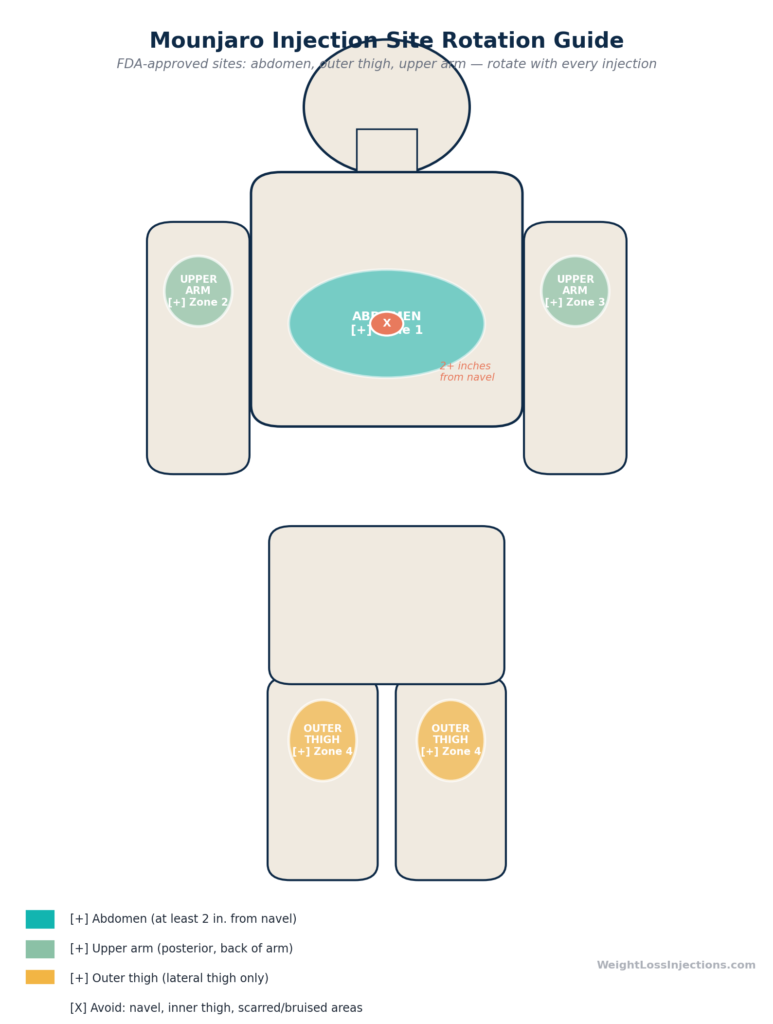
Body silhouette diagram showing the three approved Mounjaro injection zones (abdomen in green, outer thighs in green, posterior upper arms in green) with red “off-limits” shading over navel area,…
- Mounjaro (tirzepatide) is injected subcutaneously once weekly using the KwikPen into one of three FDA-approved body regions: the abdomen, outer thigh, or back of the upper arm.
- In placebo-controlled SURPASS trials, injection site reactions occurred in 3.2% of Mounjaro-treated patients vs. 0.4% on placebo — common, but rarely serious.
- The most frequently reported injection site reactions are redness (erythema) and itching (pruritus); the vast majority — 91% — are mild in severity with no serious reactions documented in clinical trials.
- Lumps at the injection site are usually either simple post-injection induration (resolves in days) or lipohypertrophy from repeating the same injection spot (resolves in weeks to months with rest).
- Site rotation is the most effective prevention: never inject the same spot within at least 4 weeks, and plan a systematic rotation across all three body regions.
- Red flags requiring emergency care: hives spreading beyond the injection site, throat tightening, facial swelling, or difficulty breathing — these may signal a serious allergic reaction and require immediate attention.
- This article explains every reaction type, the correct injection technique, the full rotation system, and how to distinguish normal from concerning signs.
Reviewed by: the WeightLossInjections.com Staff
Jump to section:
- What injection site reactions are normal with Mounjaro?
- Why do lumps form after injecting Mounjaro?
- How to rotate injection sites correctly
- Injection technique tips to reduce bruising and lumps
- Reactions that signal a problem: allergic vs. normal
- Mounjaro injection site FAQs
- Our take at WeightLossInjections.com
- Full FAQ
You pressed the button, held it for 10 seconds, removed the Mounjaro KwikPen — and now there’s a firm little bump under your skin where you injected. Or a small pink circle of redness. Or a bruise that wasn’t there yesterday. If you’re in the first few months of Mounjaro therapy, the injection site is often the first thing that catches your attention after the GI side effects settle down, and it can be alarming if you don’t know what to expect.
Here’s the reassurance: injection site reactions are among the most common questions providers receive from patients on any subcutaneous injectable medication — not just Mounjaro. They are also, in most cases, entirely normal. The FDA’s updated Mounjaro prescribing information documents injection site reactions in 3.2% of patients across placebo-controlled trials — and in that data, 91% of reactions were classified as mild in severity, 9% as moderate, and none as serious. The most common reactions were redness and itching. No patient in the clinical trial program experienced a serious injection site event.
That does not mean every reaction is ignorable. There is a meaningful difference between the normal low-grade tissue response to a subcutaneous needle and a growing, warm, tender lump that could signal infection — or between mild localized itching and hives spreading across your torso that demand a 911 call. This article covers the full spectrum: what is happening physiologically at each reaction type, how to prevent the avoidable ones, and which signs are a genuine reason to stop injecting and seek care.
What Injection Site Reactions Are Normal with Mounjaro?
Mounjaro (tirzepatide) is a once-weekly subcutaneous injection delivered via the KwikPen, a single-dose autoinjector that deposits 0.5 mL of solution into the fatty tissue just beneath the skin. Per the FDA Prescribing Information, Section 2, the three approved injection sites are the abdomen (at least 2 inches from the navel), the outer thigh, and the back of the upper arm. The needle penetrates the skin and delivers medication directly into subcutaneous fat — a tissue layer that is richly supplied with small blood vessels, immune cells, and nerve endings. Some degree of local response is simply what happens when you puncture that tissue weekly.
The FDA Prescribing Information and clinical trial data identify the following as normal, non-urgent injection site reactions:
Mild redness (erythema). A pink or flushed coloration at the injection site lasting anywhere from 30 minutes to a few hours. Caused by local vasodilation — small blood vessels dilate in response to the needle puncture and the presence of the injected solution. This is the most commonly reported injection site reaction with tirzepatide across all clinical trial populations, per the updated Mounjaro prescribing information. It typically fades on its own without any intervention. Redness that stays within roughly an inch of the injection point and resolves within a few hours is considered normal.
Small bruise (ecchymosis). A purplish or yellowish discoloration at the injection site, usually the size of a small coin, appearing within hours and fading over several days. Caused by minor capillary damage from the needle — a few small blood vessels at the injection point are disrupted, and a small amount of blood tracks into the surrounding tissue. This is more common in patients taking blood thinners (anticoagulants or antiplatelet agents such as aspirin or warfarin), where even minor capillary rupture leads to more visible bruising. A bruise that stays small, doesn’t grow, and isn’t warm or painful beyond mild tenderness is a normal finding.
Mild itching (pruritus). Brief, localized itching at the injection site in the first few hours after injection. This represents a normal immune recognition response — the skin’s mast cells and sensory nerve endings react to the foreign protein solution being deposited. Per the updated Mounjaro prescribing information, pruritus is one of the two most common signs of injection site reaction alongside erythema. Localized, brief itching that stays at the injection site and resolves within hours is not a cause for concern.
Slight swelling or induration. Minor puffiness or firmness at the injection point, resolving within hours to a day. The subcutaneous tissue swells mildly as it accommodates the injected volume and the small amount of local inflammation triggered by needle entry. This is expected with any subcutaneous injectable.
Temporary soreness. A dull ache or tenderness at the site for one to two days, especially during the first several injections. The tissue is reacting to the mechanical disruption of the needle and the chemical properties of the solution itself. This discomfort typically diminishes as patients improve their technique and the tissue adapts over the first weeks of therapy.
These reactions are not unique to tirzepatide — they are class effects of subcutaneous injections in general, seen with insulin, semaglutide, and other once-weekly injectable medications. As patients develop better injection habits (particularly letting the pen warm to room temperature before injecting and refining their rotation plan), the frequency and severity of these reactions typically decrease. Per GoodRx’s clinical summary of Mounjaro common side effects, most patients find that injection site issues are most noticeable in the first month and improve significantly with practice.
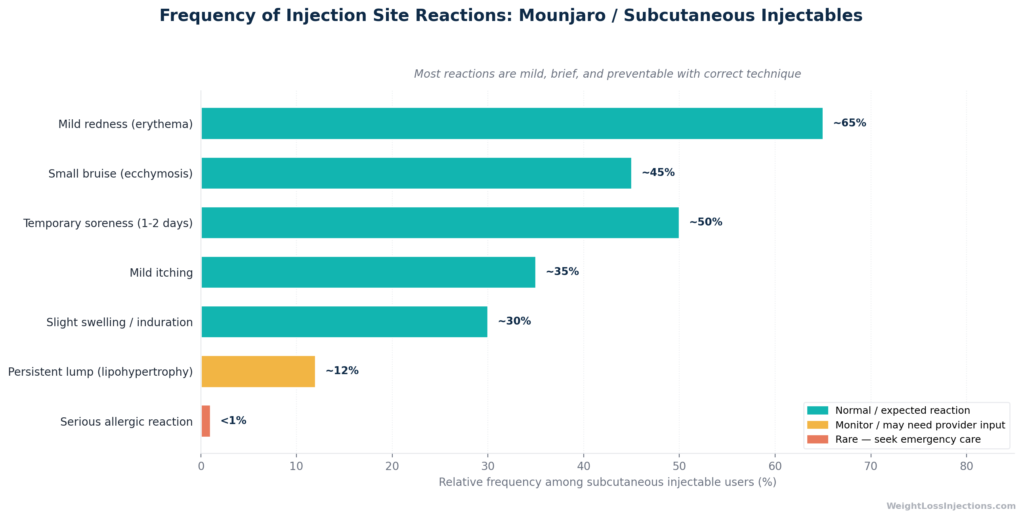
Horizontal bar chart showing relative frequency of different Mounjaro injection site reaction types: erythema/redness (most frequent), itching/pruritus, mild swelling, small bruise, soreness,…
Why Do Lumps Form After Injecting Mounjaro?
Of all the injection site reactions patients encounter, lumps are the most alarming-looking. A firm bump appearing under the skin a day after an injection looks wrong, even when it is almost always benign. Understanding the three physiologically distinct reasons lumps form — and what each one means — removes most of the anxiety.
1. Simple Induration (Post-Injection Inflammatory Response)
The most common and most benign cause of a lump after a Mounjaro injection is simple induration: mild local inflammation at the injection site in response to the needle puncture and the injected solution. The subcutaneous tissue swells and firms up slightly as immune cells and fluid accumulate at the site. This type of lump is typically small (pea-sized or smaller), appears within hours of injection, and resolves completely within a few days without treatment.
Simple induration is not a medical problem and does not affect drug absorption. It is the same tissue response that follows any subcutaneous injection and is especially noticeable in the first weeks of Mounjaro therapy before the tissue adapts.
2. Lipohypertrophy (The Clinically Important One)
Lipohypertrophy is the abnormal proliferation of subcutaneous fat tissue at an injection site in response to repeated mechanical and chemical stimulation. When the same small zone of subcutaneous fat is punctured week after week, the tissue responds by growing — the adipocytes (fat cells) in that area multiply and enlarge, producing a firm, rubbery lump that can feel significantly larger than a simple post-injection bump. According to data from insulin-injecting populations reviewed by the Cleveland Clinic, approximately 64% of people who inject into the same sites without systematic rotation develop some degree of lipohypertrophy over time.
Lipohypertrophy is clinically important for one specific reason: it disrupts drug absorption. Tirzepatide injected into lipohypertrophied tissue is absorbed more slowly and erratically than medication injected into healthy subcutaneous fat. Per Medical News Today’s clinical review of Mounjaro side effects, altered absorption from lipohypertrophy can undermine glycemic control and reduce the consistency of the drug’s weight-management effect — meaning a lump that forms from poor rotation is not just a cosmetic issue. It can silently reduce how well your medication works.
The distinguishing features of lipohypertrophy: the lump is firm and rubbery, not tender, and does not have warmth or redness on the skin above it. It may be the size of a grape or larger if neglected. It develops gradually over weeks to months of injecting the same spot. Per the Mayfair Weight Loss Clinic’s dedicated clinical guide to injection site lumps, lipohypertrophy resolves naturally when the affected site is completely rested — but full resolution can take weeks to months, and the site should not be used for injection during that period.
What to do: Stop injecting in or near the lipohypertrophied area. Map the lump’s location on your body and exclude that zone from your rotation plan for at least 2–3 months or until it resolves completely. Do not attempt to massage or manipulate the lump — this is not helpful and may cause unnecessary discomfort.
3. Rare: Seroma or Localized Fluid Collection
Occasionally, a small fluid-filled pocket (seroma) can form at the injection site when local tissue fluid collects after injection. This is uncommon with single-dose subcutaneous injections and usually self-resolves within days without intervention. A seroma feels softer and more fluid-like than lipohypertrophy — almost like a water balloon just under the skin — rather than firm and rubbery.
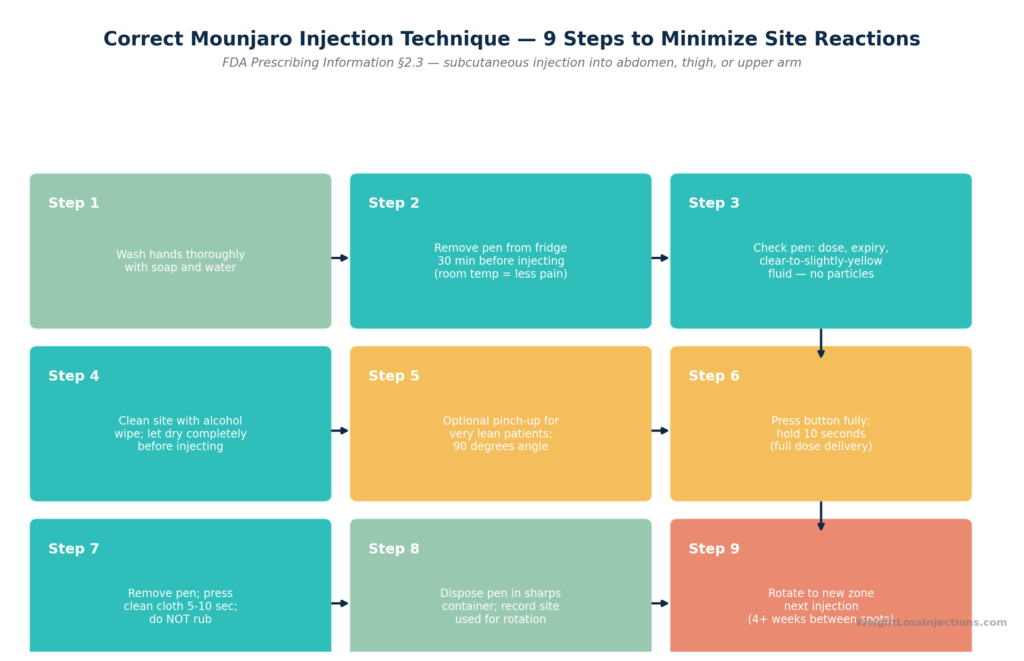
Two-column decision chart comparing normal vs
The One Lump That Should Not Be Ignored
There is a fourth type of lump that belongs in a different category: the infected abscess. An abscess is a collection of pus caused by bacterial contamination of the injection site — a rare but serious complication that requires medical attention. How to distinguish it from the benign lumps above: an abscess is tender to the touch, the skin above it becomes warm, and the lump grows over the course of days rather than staying stable or shrinking. It may develop a soft, fluctuant center as pus collects. Per the FDA Prescribing Information, serious injection site reactions are not documented in the clinical trial data — meaning true injection site infections are rare with proper sterile technique — but they can occur, particularly if injections are given through broken, irritated, or dirty skin.
A warm, growing, tender lump at an injection site that develops several days after injection should be evaluated by a provider. Do not delay.
How to Rotate Injection Sites Correctly (Abdomen, Thigh, Upper Arm)
Site rotation is the single most impactful preventive strategy for injection site lumps, lipohypertrophy, and inconsistent drug absorption. Per the FDA Prescribing Information, Section 2.3, rotating the injection site with each dose is an explicit labeled instruction — not optional guidance. The three approved injection regions each offer ample surface area for systematic rotation.
The Three Approved Injection Regions
Abdomen. The abdomen is the most commonly used and often the most accessible injection site. Per the FDA Prescribing Information, Section 2.3, injections must be placed at least 2 inches (approximately 5 cm) away from the navel in all directions. The reason: the tissue immediately around the navel has increased vascularity and a higher density of nerve endings, which produces more pain and a greater risk of intravascular injection. The entire perimeter of the abdomen — left side, right side, upper and lower quadrants — is available for rotation, giving approximately 8–12 distinct injection zones depending on body habitus.
Outer thigh. The lateral (outer) thigh — the front-outer surface of the upper leg, roughly the middle third between the hip and the knee — is the second approved site. Per the Fella Health tirzepatide injection guide, the inner thigh is not appropriate due to less subcutaneous fat and proximity to large superficial blood vessels. Each thigh provides several usable zones when divided systematically. The thigh is particularly useful for patients who find abdominal injections uncomfortable or who are injecting through clothing.
Back of the upper arm. The posterior upper arm — the soft fleshy area on the back of the arm between the shoulder and elbow — is the third approved site. Per the FDA Prescribing Information, this site is best administered with the help of a caregiver or partner, as reaching the posterior arm for a self-injection is difficult for most people. Patients who can reach this area effectively, or who have a partner to assist, find it a useful third rotation region.
Building a Rotation System That Works
The goal of site rotation is to ensure that no single injection zone is used more than once every 4 weeks at minimum — with 6–8 weeks between uses of the exact same spot being an even better target for preventing lipohypertrophy. Here are two practical rotation strategies:
The Clock System (abdomen only). Mentally divide the abdomen into 12 positions on a clock face, each corresponding to an injection zone positioned around the navel at least 2 inches from its center. Rotate clockwise each week. After 12 weeks, you’ve returned to week 1’s position — giving each zone 11 weeks of rest before it’s used again. This is one of the most reliable systems for patients who prefer the abdominal route.
The Regional Rotation System. Alternate between all three body regions on a weekly or monthly cycle. For example: abdomen this week, right thigh next week, left thigh the week after, posterior upper arm the following week, then return to the abdomen in a different quadrant. This approach maximizes the available surface area and gives each individual zone the most recovery time.
Tracking your rotation. Many patients keep a small notebook or use their phone’s calendar to log which zone was used each week, with a rough diagram. The Mounjaro patient app (if available through your provider or pharmacy) may also include a site rotation tracker. The method doesn’t matter — consistency does.
What to Avoid
Per the FDA Prescribing Information and Fella Health’s tirzepatide injection guide, do not inject into:
- Any area within 2 inches of the navel (increased vascularity, more pain, injection safety risk)
- Skin that is bruised, swollen, scarred, or already has a palpable lump from prior lipohypertrophy
- Broken, irritated, rashed, or tattooed skin
- Areas with moles, birthmarks, or prominent visible blood vessels
- The inner thigh (less subcutaneous fat, proximity to vascular structures)
- The gluteal region (not an FDA-approved site for Mounjaro — the buttocks are approved for some other injectable medications, but not tirzepatide per its labeling)
A note on absorption consistency: Some clinical literature notes slight differences in absorption rates between injection sites — abdominal injections may produce marginally faster absorption than thigh or arm. The FDA Prescribing Information does not specify an absorption-based site preference; all three sites are approved as equivalent. If your provider has given you specific guidance on site consistency for glycemic management, follow their recommendation. Otherwise, the most important thing is to rotate systematically — not which region you start with.
Our Top 3 · October 2026
The best GLP-1 providers right now
Independently reviewed. Ranked by price, medication access, provider quality, and patient outcomes.
Renew GLP
Personalized GLP-1, GIP plans: Semaglutide & Tirzepatide.
Medvi
No membership or hidden fees. Everything you need is included.
Trimi
US-licensed clinicians and shipped to your door, from $99/mo.
Injection Technique Tips to Reduce Bruising and Lumps {#technique}
Even when you’re rotating correctly, technique matters. The same injection site managed with poor technique will produce more bruising, more pain, and more localized reactions than the same site managed well. The following step-by-step protocol reflects the FDA Prescribing Information’s Instructions for Use, Section 2.3 and practical guidance from clinical injection technique literature.
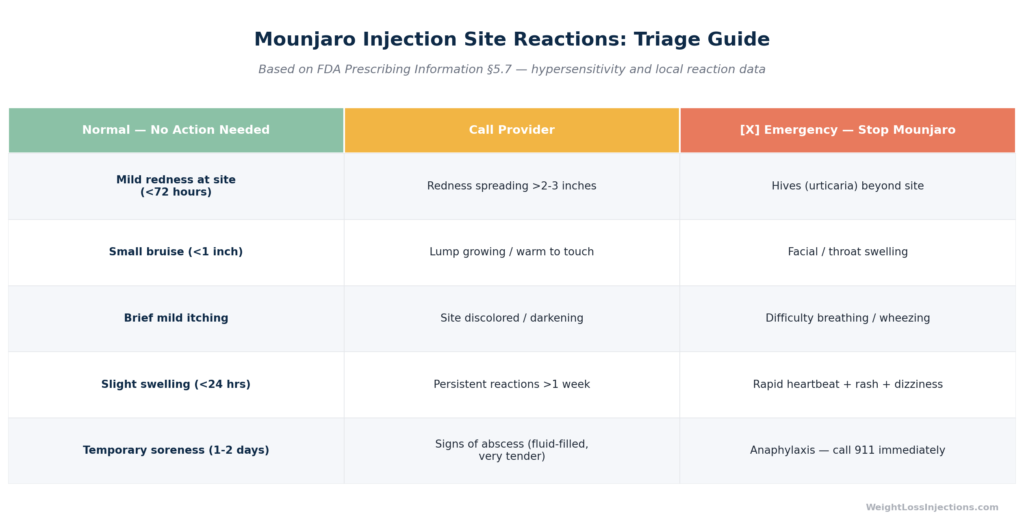
Horizontal step-by-step process diagram showing the 9 correct Mounjaro injection steps as labeled sequential bars: (1) Wash hands, (2) Remove pen from fridge 30 min before, (3) Check pen appearance,…
Step 1 — Wash your hands. Thorough hand-washing with soap and water for at least 20 seconds before handling the pen removes surface bacteria that could otherwise contaminate the injection site. This is the most straightforward infection-prevention step and should never be skipped.
Step 2 — Remove the pen from the refrigerator 30 minutes before injection. This is the single most impactful technique change for reducing injection site discomfort and local reactions. Cold medication from the fridge causes more vasoconstriction, more tissue stinging, and a greater local inflammatory response than room-temperature medication. Per FormBlends’ clinical injection guide for Mounjaro, tirzepatide is stable at room temperature for up to 21 days per FDA labeling — there is no pharmacological reason to inject it cold. Set a phone reminder 30 minutes before your planned injection time.
Step 3 — Inspect the pen. Verify the dose strength, check the expiration date, and examine the medication through the viewing window. The solution should be clear to slightly yellow and free of visible particles or cloudiness. Do not use the pen if the solution appears discolored, cloudy, or contains floating particles, or if the pen has been frozen (per FDA label, Section 16, Mounjaro must not be frozen).
Step 4 — Clean the injection site with an alcohol wipe. Use a 70% isopropyl alcohol swab and clean the skin at the planned injection location with a circular motion from the center outward.
Step 5 — Let the skin dry completely before injecting. This step is skipped by many patients and is consistently underemphasized — but injecting through wet alcohol causes immediate stinging and briefly introduces alcohol into the subcutaneous tissue, which increases local irritation. Allow 15–30 seconds for the alcohol to evaporate fully before inserting the needle.
Step 6 — Optional skin pinch for lean patients. For most patients with adequate subcutaneous fat at the injection site, no pinch is needed — the KwikPen needle length is designed to deposit medication subcutaneously without a pinch technique in typical adult body habitus. For very lean patients with minimal subcutaneous fat, pinching 1–2 inches of skin gently between thumb and forefinger before insertion ensures the needle reaches fatty tissue rather than muscle. If you are unsure whether to use a pinch technique, ask your provider or pharmacist.
Step 7 — Insert at 90°. Per the FDA Prescribing Information, Instructions for Use, the Mounjaro KwikPen is designed for 90-degree (perpendicular to skin surface) insertion. Very lean patients may benefit from a 45-degree angle, but 90 degrees is appropriate for the vast majority of adult users. Press the pen firmly against the skin until the gray safety guard retracts, then press the injection button.
Step 8 — Hold the button for a full 10 seconds. The most common technique error that leads to incomplete dosing is removing the pen too quickly after pressing the button. The full 10-second hold ensures the complete 0.5 mL dose is delivered into the subcutaneous tissue and prevents medication from leaking back through the needle track. The viewing window should confirm the dose indicator has moved before you remove the pen.
Step 9 — Apply gentle pressure — do not rub. After removing the pen, press a clean cotton ball or dry gauze against the injection site for 5–10 seconds. This gentle pressure encourages the tissue to close around the needle track and minimizes minor bleeding or bruising. Do not rub the site. Rubbing drives the injected medication into deeper tissue planes (potentially into muscle), increases the risk of bruising by spreading blood from capillaries disrupted by the needle, and intensifies local tissue irritation. Press and hold — never rub.
Disposal. Place the used pen immediately into an FDA-cleared sharps container. Do not re-cap the needle or place used pens in household trash. Many pharmacies and community programs accept used sharps — check local regulations for disposal options.
A Note on Patients Taking Blood Thinners
Patients concurrently using anticoagulants (warfarin, apixaban, rivaroxaban) or antiplatelet agents (aspirin, clopidogrel) should anticipate more frequent and more pronounced bruising at injection sites, even with flawless technique. The mechanism is simple: any capillary disruption from the needle in a patient with impaired clotting will produce a larger hematoma. Applying pressure for a longer period after injection (up to 2–3 minutes) helps minimize this. Do not discontinue or adjust anticoagulant therapy because of injection-related bruising without explicit direction from the provider managing that medication.
Reactions That Signal a Problem: Allergic vs. Normal {#warning-signs}
The most important clinical skill a Mounjaro patient can develop is the ability to distinguish between reactions that are expected and self-limiting versus those that require a phone call — or, in the most serious cases, an immediate 911 call. The spectrum runs from “completely normal, do nothing” to “medical emergency, stop injecting now.”
Local Reactions That Are Expected and Non-Urgent
The following findings at the injection site are well within the expected range and do not require any action beyond observation:
- Mild redness or pink discoloration at the injection site, resolving within a few hours
- Small bruise appearing within 24 hours, staying contained to a small area and fading over 3–7 days
- Mild itching at the site, resolving within hours without spreading
- Slight firmness or puffiness at the injection point, resolving within a day
- A small, non-tender lump appearing within 24–48 hours after injection (likely simple induration, resolves within days)
Local Reactions Requiring Provider Notification
Contact your prescribing provider if you notice any of the following:
- Redness expanding beyond 2–3 inches from the injection point. Spreading redness in an expanding circle, particularly if accompanied by warmth and tenderness, may indicate cellulitis — a bacterial skin infection. Cellulitis requires antibiotics and should be evaluated promptly. Per Medical News Today’s review of Mounjaro side effects, this pattern is distinct from the minor flush of normal post-injection erythema.
- A lump that grows over days, becomes warm to touch, develops a fluid-filled center, or becomes increasingly tender. This describes a possible abscess — rare with proper technique, but requiring medical drainage and antibiotic treatment.
- Skin that becomes significantly discolored (darkened or purplish patches that extend well beyond a typical bruise pattern and do not resolve within a week).
- Persistent site reactions not resolving within a week — any redness, swelling, or lump that is not improving or is worsening at 7 days should be reviewed by your provider.
Systemic Reactions Requiring Immediate Emergency Care
Stop using Mounjaro and call 911 or go to the emergency room immediately if you experience any of the following after an injection:
- Hives (urticaria) appearing at or spreading beyond the injection site — raised, itchy welts that can appear anywhere on the body
- Difficulty breathing, throat tightening, or shortness of breath
- Swelling of the face, lips, tongue, or throat (angioedema)
- Rapid heartbeat, dizziness, and rash occurring together — this constellation is the classic presentation of anaphylaxis
These signs represent a serious hypersensitivity reaction. Per the FDA Prescribing Information, Section 5.4, serious hypersensitivity reactions including anaphylaxis and angioedema have been reported with Mounjaro. The rate of hypersensitivity reactions across placebo-controlled trials was 3.2% for Mounjaro-treated patients versus 1.7% for placebo, with most being mild (urticaria, eczema) — but anaphylaxis, though rare, can be life-threatening and requires immediate epinephrine administration and emergency care.
Important distinction: Abdominal pain that develops after a Mounjaro injection and is severe, radiating to the back, and constant is not an injection site reaction. This pattern may indicate pancreatitis — a recognized warning in the FDA Prescribing Information, Section 5.2 — and requires emergency evaluation regardless of when in your injection cycle it occurs.
If you have experienced a persistent, unusual, or worrying reaction to your Mounjaro injection and want a clinical evaluation, WeightLossInjections.com can connect you with a provider for a follow-up consultation — at [$X/month] for [service detail].
Our Take at WeightLossInjections.com {#our-take}
Injection site reactions are one of the most searchable topics in the Mounjaro patient experience, and for good reason: finding a lump or a bruise after an injection is alarming if no one told you it was coming. Our view after working with patients across many months of GLP-1 therapy is that almost all injection site anxiety is preventable with two things: expectation-setting before the first injection, and a written rotation plan that becomes habit before lipohypertrophy has any chance to develop.
The data from the FDA clinical trial program are genuinely reassuring: 91% of injection site reactions in Mounjaro patients were mild, 9% were moderate, and zero were classified as serious. The most common reactions — redness and itching — are self-limiting and require nothing more than observation. The one reaction type that has real clinical stakes is lipohypertrophy from inadequate rotation, because it quietly degrades drug absorption without obvious symptoms. A patient who never notices lumps forming and never rests any site may find their Mounjaro becomes less consistent in its glycemic or weight effects over time — not because the drug stopped working, but because it’s being absorbed erratically from tissue that has been overused.
The fix is straightforward: rotate every week without exception, map your zones before you start, and inspect your injection sites with your fingertips (not just visually) at least once a month. Lumps that can’t be seen can often be felt. Catch them early, rest the site, and the tissue heals. The patients who run into genuine problems are almost always the ones who used the abdomen exclusively, kept injecting the same 2-square-inch area, and only noticed the lump after it had been growing for months.
At WeightLossInjections.com, provider support is available for technique questions, injection-related concerns, or any aspect of your Mounjaro therapy — including a telehealth consultation when a site reaction raises questions that need clinical eyes. Access is available at [$X/month] for [service detail].
Mounjaro Injection Site FAQ — Quick Reference {#faq-quick-reference}
Does it matter which of the three injection sites I use?
All three FDA-approved sites — abdomen, outer thigh, and posterior upper arm — are considered equivalent for Mounjaro delivery, per the FDA Prescribing Information. Consistency within your rotation plan matters more than which region you choose first. Some patients prefer the abdomen for convenience; others find the thigh easier to visualize and access. Any systematic rotation using all three regions is appropriate.
Can I inject Mounjaro in my buttocks?
No. The gluteal region is not an FDA-approved injection site for Mounjaro. Approved sites are limited to the abdomen, outer thigh, and posterior upper arm. Injecting outside approved sites may result in intramuscular delivery or inconsistent absorption. Per the FDA Prescribing Information, Section 2, only the three listed regions are validated.
What should I do with used Mounjaro pens?
Place used pens immediately in an FDA-cleared sharps disposal container. Do not place them in household trash or recycling. Many pharmacies, hospitals, and community health programs offer sharps disposal collection. Some states have mail-back programs. Check SafeNeedleDisposal.org for local options. Never re-cap the needle or attempt to remove it from the pen.
Can I see a lump through my clothes after a Mounjaro injection?
Simple post-injection swelling (induration) typically resolves within a day and would not be visible through clothing. If you have a lump that is persistently visible or palpable through clothing — large enough to push against fabric — this is beyond normal and should be evaluated by your provider. It may represent significant lipohypertrophy that needs to be mapped and rested, or, in rare cases, a fluid collection requiring assessment.
Does injection pain mean I injected wrong?
Brief, sharp pain at the moment of needle entry is normal. Mild soreness for 1–2 days afterward is also normal. Severe or prolonged pain — particularly if it intensifies over hours rather than resolving — suggests one of two possibilities: you may have accidentally delivered the medication intramuscularly (the needle penetrated beyond the subcutaneous fat into muscle, which is significantly more painful), or you injected into an area of existing lipohypertrophy or prior tissue trauma. Per the Fella Health tirzepatide injection guide, intramuscular injection causes more rapid absorption and localized pain but is not dangerous; if it happens occasionally, refine your technique and consider the pinch-up approach for leaner tissue areas.
Medical Disclaimer: This article is for informational purposes only and does not constitute medical advice. Mounjaro (tirzepatide) is an FDA-approved prescription medication for type 2 diabetes mellitus. All treatment decisions and concerns about injection site reactions should be discussed with a licensed healthcare provider. Signs of a serious allergic reaction — including hives, swelling of the face or throat, or difficulty breathing — require immediate emergency medical attention. WeightLossInjections.com does not prescribe medications directly.
Reviewed by: the WeightLossInjections.com Staff
Last reviewed: June 2026
FAQ {#faq}
Is it normal to have a lump after a Mounjaro injection?
In most cases, yes. A small, firm lump at the injection site is a common and typically harmless reaction. It usually results from mild tissue inflammation (simple induration, resolving within days) or from repeated use of the same injection spot causing fat tissue buildup — a condition called lipohypertrophy. Per the Mayfair Weight Loss Clinic’s clinical guide, lipohypertrophy lumps resolve naturally if the site is completely rested, though full resolution can take weeks to months. The exception requiring medical attention is a lump that grows, becomes warm and tender, and develops a fluid-filled center — this could indicate an abscess.
How do I prevent lumps from Mounjaro injections?
The most effective prevention strategy is consistent site rotation — never injecting the same spot within at least 4 weeks, and ideally 6–8 weeks. Let the pen reach room temperature before injecting, hold the injection button for the full 10 seconds, and apply gentle pressure (no rubbing) after needle removal, per the FDA Prescribing Information, Section 2.3. Inspect injection sites monthly with your fingertips — early lumps are often felt before they’re seen.
Where are the approved injection sites for Mounjaro?
Mounjaro can be injected subcutaneously into the abdomen (at least 2 inches from the navel), the outer thigh (lateral surface, middle third between hip and knee), or the back of the upper arm (posterior; best administered with caregiver assistance). Per the FDA Prescribing Information, all three regions are approved and equivalent. Rotate among all three to maximize available injection surface area and minimize site-specific tissue stress.
What does an allergic reaction to Mounjaro look like?
Localized redness and mild itching at the injection site are normal reactions — not signs of allergy. A true allergic reaction involves systemic signs: hives spreading beyond the injection site, swelling of the face, lips, tongue, or throat, difficulty breathing, or a combined pattern of rash, rapid heartbeat, and dizziness (anaphylaxis). Per the FDA Prescribing Information, Section 5.4, serious hypersensitivity reactions including anaphylaxis and angioedema have been reported with Mounjaro. These require immediate emergency care — call 911, stop the medication, and do not re-administer Mounjaro until a provider has evaluated and cleared you.
My injection site is red and warm two days later — should I be concerned?
Mild redness lasting up to 72 hours is generally within the normal range of post-injection response. However, if the redness is spreading outward from the injection point, the skin above or around the site is distinctly warm to touch compared to surrounding skin, and a lump is growing in size rather than shrinking — this triad describes a possible localized infection. Contact your provider. Early cellulitis responds well to oral antibiotics; an abscess may require drainage. Do not delay evaluation if all three signs are present, per GoodRx’s Mounjaro adverse event guidance.
Can I inject Mounjaro in my stomach even if I have belly fat?
Yes — the abdomen is one of the preferred and most widely used Mounjaro injection sites, and it works well for patients with abdominal fat. Subcutaneous fat in the abdomen provides an ideal depot for the medication. The only requirement is that you stay at least 2 inches from the navel in all directions, per the FDA Prescribing Information, Section 2. Rotating through different abdominal zones — left side, right side, upper and lower quadrants — gives you a large available surface area that easily supports years of weekly injections without overusing any single spot.