![Unbranded [pillar-drug-class] injection pen on a neutral background — WeightLossInjections.com editorial hero](https://weightlossinjections.com/wp-content/uploads/2026/07/hero_mounjaro_c5_lifestyle-1200x675.png)
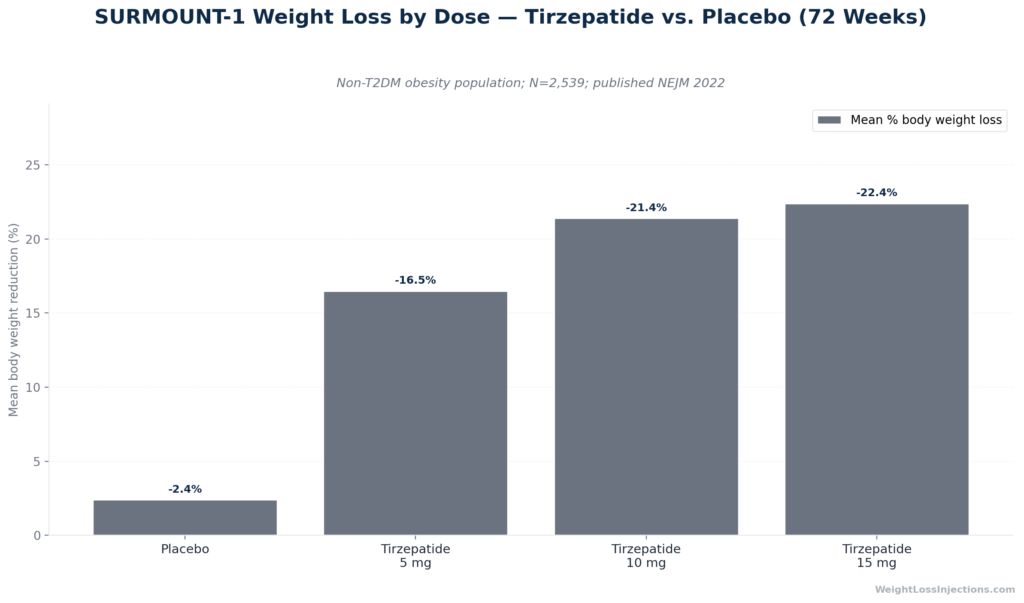
Hero — grouped bar chart showing SURMOUNT-1 mean body weight percentage lost at tirzepatide 5 mg (−22.4%), 10 mg (−21.4%), 15 mg (−22.4%), vs placebo (−2.4%) at 72 weeks; clean…
- In the SURMOUNT-1 clinical trial, tirzepatide — the active ingredient in Mounjaro — produced an average weight loss of 22.4% of body weight at the maximum 15 mg dose over 72 weeks, versus 2.4% on placebo. For a 250-pound person, that is more than 55 pounds.
- Mounjaro is NOT FDA-approved for weight loss. It is FDA-approved only for type 2 diabetes (T2DM). The weight-loss brand of the same molecule is Zepbound, approved November 2023.
- Off-label prescribing of Mounjaro for weight loss is legal and common in the United States — physicians can prescribe any approved drug for any indication at their clinical discretion.
- Mounjaro and Zepbound are pharmacologically identical. The differences are entirely in FDA labeling and insurance coverage pathways.
- Most patients begin losing meaningful weight after 4–8 weeks at the 5 mg therapeutic dose; maximum results accumulate over 12–18 months.
- Tirzepatide consistently outperforms semaglutide (Wegovy, Ozempic) in weight loss data from head-to-head and independent clinical trials.
- WeightLossInjections.com can connect you with a licensed provider to evaluate whether Mounjaro is right for your goals — starting at [$X/month] for [service detail].
Jump to a section:
- Is Mounjaro FDA-Approved for Weight Loss?
- How Tirzepatide Causes Weight Loss
- Clinical Trial Results: How Much Weight Can You Lose?
- Who Qualifies for Off-Label Mounjaro?
- Mounjaro vs. Zepbound: Is There a Difference?
- What to Expect Week by Week
- Mounjaro vs. Wegovy and Ozempic
- Our Take
- FAQ
In the summer of 2022, a clinical trial result landed that reshaped the weight-loss drug landscape. In SURMOUNT-1, adults with obesity on the highest dose of tirzepatide lost an average of 22.4% of their body weight over 72 weeks — more than double what any previously approved weight-loss medication had achieved. For someone starting at 250 pounds, that is a 55-pound loss. For someone at 300 pounds, it is 67 pounds. These were not cherry-picked outliers; they were the mean result from a rigorously conducted trial involving 2,539 participants published in the New England Journal of Medicine.
The molecule responsible for those results is tirzepatide. If you have heard about Mounjaro for weight loss, this is why.
There is, however, a regulatory complexity that most coverage of this topic glosses over — and getting it right matters for your insurance coverage, your prescription access, and your out-of-pocket costs. Mounjaro is not FDA-approved for weight loss. Mounjaro (tirzepatide) received FDA approval on May 13, 2022, as an adjunct to diet and exercise to improve glycemic control in adults with type 2 diabetes mellitus. The weight-loss brand of the identical molecule is Zepbound, which received FDA approval for chronic weight management in November 2023.
Millions of Americans use Mounjaro off-label for weight loss. This is legal. Physicians in the United States may prescribe any FDA-approved drug for any indication based on their clinical judgment, and off-label prescribing is a well-established practice that accounts for roughly 20% of all prescription drug use. But the distinction matters in real terms: it determines which insurance formulary applies, whether the Lilly Savings Card is usable, and how a telehealth provider will document your prescription.
This article explains exactly how Mounjaro works for weight loss, what the evidence actually shows, who qualifies, how it compares to Zepbound and other GLP-1 medications, and what a realistic timeline looks like. This guide was reviewed by the WeightLossInjections.com Staff.
Is Mounjaro FDA-Approved for Weight Loss?
The direct answer is no.
Mounjaro’s FDA-approved indication, as written on the label since May 13, 2022, is: “an adjunct to diet and exercise to improve glycemic control in adults with type 2 diabetes mellitus.” The label does not include obesity, overweight, or chronic weight management.
The weight-loss version of the same molecule is Zepbound (also tirzepatide, also made by Eli Lilly). Zepbound received FDA approval on November 8, 2023, specifically for chronic weight management in adults with obesity (BMI ≥30) or overweight (BMI ≥27) with at least one weight-related comorbidity. Starting in 2024, Eli Lilly also obtained approval for Zepbound in adults with moderate-to-severe obstructive sleep apnea and obesity. Zepbound and Mounjaro are the same active ingredient at the same doses — the regulatory difference is in labeling, not in the drug itself. As WebMD explains in its comparison, tirzepatide under both brands performs identically.
Why does this matter to patients?
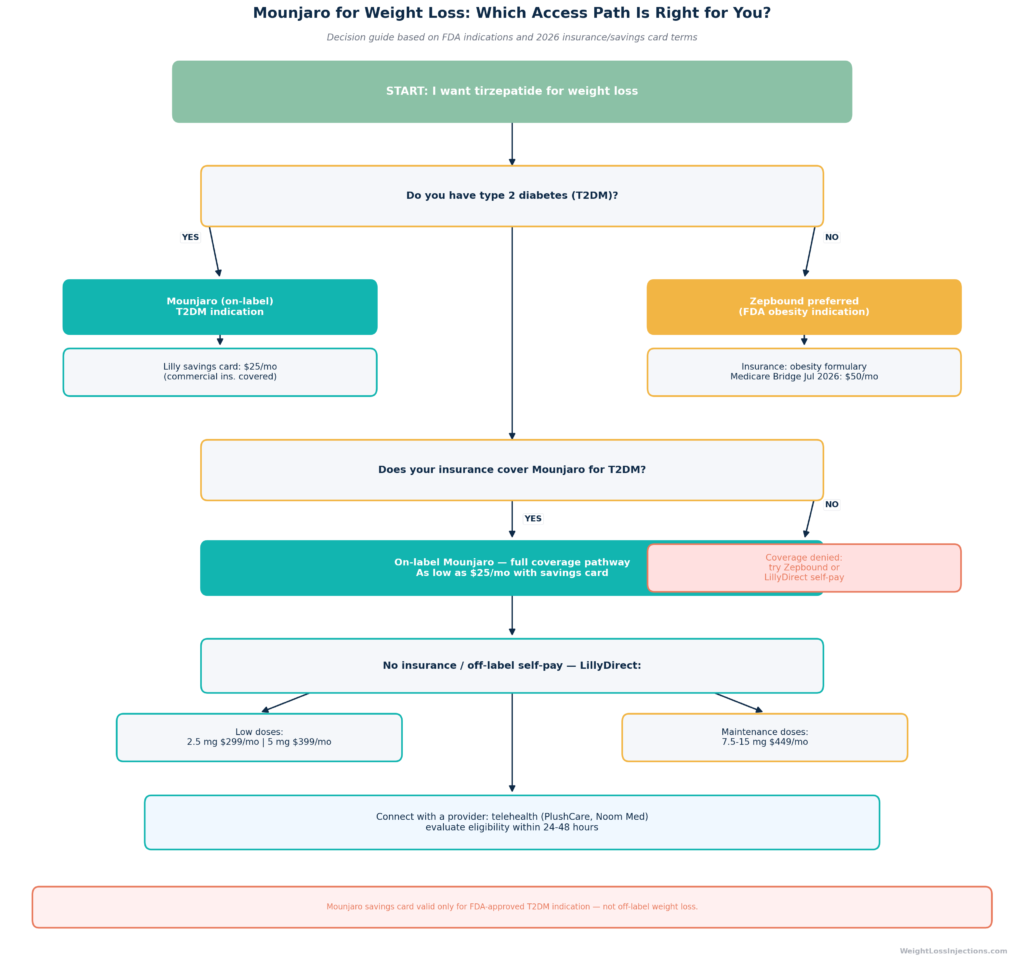
Insurance coverage follows the indication, not the molecule. When Mounjaro is prescribed for T2DM, most commercial insurance plans cover it under their diabetes formulary. When it is prescribed off-label for weight loss, those same plans typically will not cover it — they require the Zepbound label to cover tirzepatide under an obesity formulary. The Mounjaro Lilly Savings Card — which can reduce out-of-pocket cost to $25/month for commercially insured T2DM patients — explicitly does not apply to off-label prescriptions for weight loss.
Why do physicians prescribe Mounjaro off-label for weight loss?
Several legitimate clinical reasons drive this practice:
- The patient has both T2DM and obesity. A patient who qualifies for Mounjaro under the diabetes indication receives its weight-loss benefits as a secondary outcome — the FDA-approved pathway covers the prescription, and the weight-loss effect follows.
- Insurance covers Mounjaro but not Zepbound. Many employer-sponsored plans include Mounjaro on their T2DM formulary but have excluded anti-obesity drugs from coverage — a common exclusion in employer benefit plans. When patients have both conditions, Mounjaro is the practical path to affordable access.
- Zepbound supply or formulary gaps. Pharmacy availability and formulary placement vary. When Zepbound is not available or not on a patient’s plan, a prescriber may substitute Mounjaro under off-label provisions.
- Clinical judgment. Off-label prescribing for weight loss alone is also supported by the clinical evidence base — the SURMOUNT data for tirzepatide is robust enough that many weight-management specialists consider it scientifically appropriate, as Medical News Today describes in its overview of online Mounjaro prescribing.
The practical upshot: if you are specifically pursuing weight loss without a T2DM diagnosis, Zepbound is typically the better path — it is FDA-approved for your indication and increasingly covered by insurers and, as of July 1, 2026, Medicare. If you have T2DM, Mounjaro is the labeled option and often the more insurable one. And if cost is the primary driver, the access pathway — whether Mounjaro off-label or Zepbound on-label — should be evaluated with your provider based on your individual insurance and situation.
How Tirzepatide Causes Weight Loss (Dual GIP/GLP-1 Mechanism)
Understanding why Mounjaro works for weight loss is not merely academic — it explains why it works better than older GLP-1 medications, why it is not just “a drug that makes you eat less,” and what the mechanism is actually correcting in the body.
Tirzepatide is the world’s first dual agonist of two distinct incretin hormone receptors: the glucose-dependent insulinotropic polypeptide receptor (GIPR) and the glucagon-like peptide-1 receptor (GLP-1R). Per Section 12.1 of the FDA Mounjaro Prescribing Information, tirzepatide “selectively binds to and activates both the GIP and GLP-1 receptors.” No single medication had ever combined these two mechanisms before Mounjaro’s approval.
The GLP-1 pathway: what most weight-loss injections do
GLP-1 receptor agonism is the shared mechanism of Ozempic, Wegovy, Victoza, Trulicity, and most GLP-1 medications. When a GLP-1 receptor agonist is active in the body, it produces several coordinated effects relevant to weight:
- Slows gastric emptying. Food moves through the stomach more slowly, extending satiety signals from the gut to the brain. Patients feel full sooner and stay full longer after meals.
- Acts directly on appetite centers in the brain. GLP-1 receptors in the hypothalamus and brainstem receive agonist signaling, which reduces hunger and lowers the biological drive to eat. This is not willpower — it is hormonal reprogramming of appetite signals.
- Reduces glucagon secretion. Lower glucagon levels reduce glucose production by the liver, contributing to glycemic control.
The net result is a significant, sustained reduction in daily caloric intake — typically 30–40% — that most patients experience as simply not feeling as hungry rather than as effortful restriction.
The added GIP layer: tirzepatide’s differentiator
GIP receptor agonism is what distinguishes tirzepatide from every other weight-loss medication currently available. GIP receptors are present not just in the pancreas but also in the brain, adipose tissue, and throughout the gut — and the effects of GIP agonism synergize with GLP-1 agonism in clinically meaningful ways:
- GIP receptors in the hypothalamus appear to amplify satiety signals beyond what GLP-1 alone achieves, deepening appetite suppression.
- GIP agonism improves insulin sensitivity in peripheral tissues and may enhance fat metabolism directly in adipocytes.
- The dual signaling mechanism is the most likely explanation for why tirzepatide consistently outperforms semaglutide (a GLP-1-only agent) in head-to-head data — the SURPASS-2 trial published in NEJM demonstrated that all three doses of tirzepatide produced superior HbA1c and body weight reductions compared to semaglutide 1 mg.
As diaTribe’s tirzepatide clinical summary describes, the combination of these two mechanisms produces compounding effects on caloric restriction, insulin sensitivity, and fat storage signaling that explain the magnitude of weight loss seen in the SURMOUNT trials.
What this means practically
The critical reframe is that Mounjaro does not work by forcing you to diet harder. It corrects dysregulated hormonal signaling — the kind of dysregulation that makes weight loss physiologically difficult for people living with obesity, regardless of effort. Hunger that previously felt overwhelming diminishes. The biological set point — the weight the body attempts to defend — gradually shifts downward. The drug does not provide willpower; it reduces the metabolic need for it.
This is also why weight tends to return when tirzepatide is discontinued, as the SURMOUNT-4 withdrawal data demonstrated. The medication is not a temporary fix; it is an ongoing intervention in a chronic biological process — no different in principle from blood pressure or cholesterol medication, which also require continuation to maintain their effect.
Clinical Trial Results: How Much Weight Can You Lose on Mounjaro?
Because Mounjaro and Zepbound are the same molecule, two sets of clinical trial data apply to patients using tirzepatide for weight loss. The SURPASS trials (conducted in T2DM patients) provide weight-loss data as a secondary outcome. The SURMOUNT trials (conducted in obesity patients without T2DM) provide weight loss as the primary endpoint — and produce larger reductions.
SURMOUNT-1: The benchmark weight-loss trial
SURMOUNT-1 is the most directly relevant trial for patients seeking Mounjaro for weight loss. Published in the New England Journal of Medicine in 2022, the trial enrolled 2,539 adults with obesity (BMI ≥30) or overweight (BMI ≥27 plus at least one weight-related comorbidity) without type 2 diabetes. Participants were randomized to tirzepatide 5 mg, 10 mg, or 15 mg weekly versus placebo over 72 weeks.
Weight loss results at 72 weeks (SURMOUNT-1 NEJM; PMC review):
| Tirzepatide Dose | Mean Body Weight Reduction | vs. Placebo |
|---|---|---|
| 5 mg | −16.5% | −14.1 percentage points |
| 10 mg | −21.4% | −19.0 percentage points |
| 15 mg | −22.4% | −20.0 percentage points |
| Placebo | −2.4% | — |
In absolute terms, a patient starting at 230 pounds on the 15 mg dose lost an average of approximately 52 pounds over the trial period.
The responder data at 15 mg is equally striking: 89% of patients on 15 mg lost ≥5% of body weight; 57% lost ≥20% of body weight — a threshold historically associated with bariatric surgery outcomes. For context, prior to tirzepatide and semaglutide, no FDA-approved weight-loss medication had consistently produced ≥15% mean body weight reduction in a major clinical trial.
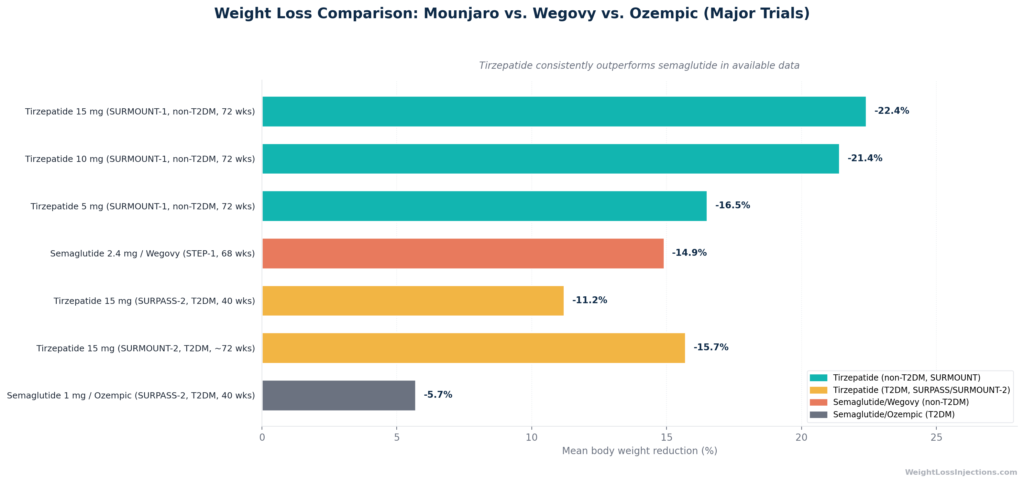
Horizontal comparison bar chart showing average body weight reduction: Tirzepatide 15 mg SURMOUNT-1 (−22.4%), Tirzepatide 10 mg SURMOUNT-1 (−21.4%), Semaglutide 2.4 mg STEP-1 (−14.9%), Tirzepatide 15…
SURMOUNT-2: When obesity and T2DM overlap
SURMOUNT-2 enrolled 938 adults with obesity plus established type 2 diabetes (HbA1c 7–10%) and found somewhat lower but still clinically significant weight reductions: approximately −15% at 15 mg and −12.8% at 10 mg, versus −3.2% for placebo, at 72 weeks (The Lancet, 2023). The approximately 6-percentage-point gap between SURMOUNT-1 and SURMOUNT-2 is consistent across GLP-1 class drugs — T2DM metabolic factors, including greater insulin resistance and co-occurring medications, reduce the magnitude of weight loss but do not eliminate it. Patients with T2DM should calibrate expectations to SURMOUNT-2 figures, not SURMOUNT-1.
SURPASS trials: weight loss in the T2DM population
The SURPASS program (SURPASS-1 through -5 and SURPASS-CVOT) studied tirzepatide in T2DM patients with glycemic control as the primary endpoint; body weight was a secondary endpoint. Key figures:
- SURPASS-3 (vs. insulin degludec, 52 weeks): Tirzepatide 15 mg produced −12.9 kg body weight vs. +2.3 kg for insulin degludec (The Lancet, 2021)
- SURPASS-2 (vs. semaglutide 1 mg, 40 weeks): Tirzepatide 15 mg produced −11.2 kg vs. −5.7 kg for semaglutide 1 mg — a near-doubling of weight-loss outcomes (NEJM, 2021)
- SURPASS-CVOT (~4 years vs. dulaglutide 1.5 mg): −11.6% body weight (tirzepatide) vs. −4.5% (dulaglutide) over a median of approximately four years in a high cardiovascular risk T2DM population (NEJM, December 2025)
The SURPASS weight reductions are lower than SURMOUNT because the population has T2DM. This is the same pattern seen between SURMOUNT-1 and SURMOUNT-2 — diabetes status reduces the magnitude of weight loss by approximately 6–8 percentage points at equivalent doses.
SURMOUNT-1 vs. STEP-1 (Wegovy): the headline comparison
The comparison that most readers want to see:
| Trial | Drug | Dose | Population | Weight Loss | Duration |
|---|---|---|---|---|---|
| SURMOUNT-1 (NEJM 2022) | Tirzepatide (Mounjaro/Zepbound) | 15 mg | Obesity, no T2DM | −22.4% | 72 weeks |
| STEP-1 | Semaglutide (Wegovy) | 2.4 mg | Obesity, no T2DM | −14.9% | 68 weeks |
Tirzepatide 15 mg outperformed semaglutide 2.4 mg by approximately 7.5 percentage points in separate pivotal obesity trials. These were not directly head-to-head at the obesity-indicated doses, but the magnitude of difference is consistent across every dataset where the two molecules appear together or in parallel comparisons — including SURPASS-2, where tirzepatide significantly outperformed semaglutide 1 mg at all three doses (NEJM SURPASS-2).
Who Qualifies for Off-Label Mounjaro for Weight Loss?
Line chart showing tirzepatide weight loss trajectory over 72 weeks for three dose arms (5 mg, 10 mg, 15 mg) plus placebo reference; slow early phase (weeks 0–8), accelerating phase (weeks 8–36),…
There is no single national standard for off-label Mounjaro prescribing — individual physicians and telehealth platforms set their own clinical criteria. In practice, most follow criteria closely modeled on the FDA’s obesity pharmacotherapy guidelines and the Zepbound label, since the clinical justification for off-label tirzepatide use rests on the SURMOUNT trial data, which used those same eligibility thresholds.
Criteria most platforms and physicians apply
Who typically qualifies:
- BMI ≥30 (Class I obesity or above), OR
- BMI ≥27 with at least one weight-related comorbidity — including hypertension, type 2 diabetes, dyslipidemia, obstructive sleep apnea, or cardiovascular disease
These thresholds match the criteria used in SURMOUNT-1 and the Zepbound FDA-approved indication, and they represent the evidence base on which off-label prescribing is justified.
Required documentation typically includes:
- Current weight and height (BMI calculation)
- Description of prior weight-loss efforts
- Medical history, current medications, and comorbidities
- No personal or family history of medullary thyroid carcinoma (MTC) or Multiple Endocrine Neoplasia syndrome type 2 (MEN 2) — these are boxed contraindications in the FDA label
- No history of pancreatitis
Who should not use Mounjaro for weight loss:
- Patients with type 1 diabetes (not indicated, not studied)
- Patients with severe gastroparesis (contraindicated per FDA label)
- Patients currently on another GLP-1 receptor agonist (no added benefit; increased GI risk)
- Pregnant patients or those planning pregnancy
- Medicare or Medicaid beneficiaries seeking weight-loss use — Mounjaro’s savings card and Medicare off-label coverage do not apply; the path for those patients typically runs through Zepbound
For patients on insulin or sulfonylureas, Mounjaro can still be appropriate, but dose coordination with the prescriber is essential to avoid hypoglycemia — the FDA label explicitly addresses this risk (FDA Prescribing Information).
Telehealth access and typical process
Multiple telehealth platforms evaluate patients for off-label Mounjaro based on clinical criteria — a T2DM diagnosis is not required for off-label evaluation. Platforms including PlushCare, Noom Med, and others conduct online intake, medical history review, and provider consultation (typically within 24–48 hours), following which a prescription is issued if clinically appropriate, per FormBlends’ off-label prescribing guide and Medical News Today’s overview.
Cost reality for weight-loss patients
Without insurance coverage, cost is the primary barrier. The wholesale acquisition cost (WAC) of Mounjaro is $1,079.77 per 28-day supply across all dose strengths — but most cash-pay weight-loss patients never pay WAC. Through LillyDirect, Mounjaro vials are available for self-pay patients with a valid prescription at $299/month for 2.5 mg, $399/month for 5 mg, and $449/month for 7.5–15 mg — making the therapeutic weight-loss dose range meaningfully more accessible than the pharmacy list price.
Important caveat: the Lilly Savings Card ($25/month) applies only to commercially insured patients with a T2DM diagnosis. Off-label weight-loss prescriptions on Mounjaro do not qualify. If you have T2DM and insurance that covers Mounjaro, the savings card is the most powerful access tool available. If you do not have T2DM and are paying out of pocket, Zepbound may offer comparable or better pricing depending on your specific situation — and is the FDA-approved weight-loss option.
WeightLossInjections.com can connect you with a licensed provider who evaluates your individual situation — [$X/month] for [service detail].
Our Top 3 · October 2026
The best GLP-1 providers right now
Independently reviewed. Ranked by price, medication access, provider quality, and patient outcomes.
Renew GLP
Personalized GLP-1, GIP plans: Semaglutide & Tirzepatide.
Medvi
No membership or hidden fees. Everything you need is included.
Trimi
US-licensed clinicians and shipped to your door, from $99/mo.
Mounjaro vs. Zepbound for Weight Loss: Is There a Difference?
This question deserves a direct, unsatisfying answer: no, there is no clinically meaningful difference. The active ingredient is identical. The doses are identical. The injection schedule is identical. The weight-loss data is identical — because all tirzepatide weight-loss evidence comes from the same molecule, regardless of which brand name appears on the pen.
WebMD’s 2024 brand comparison states this plainly: tirzepatide under both brands performs the same. A patient switching from Mounjaro to Zepbound mid-treatment would experience no pharmacological change.
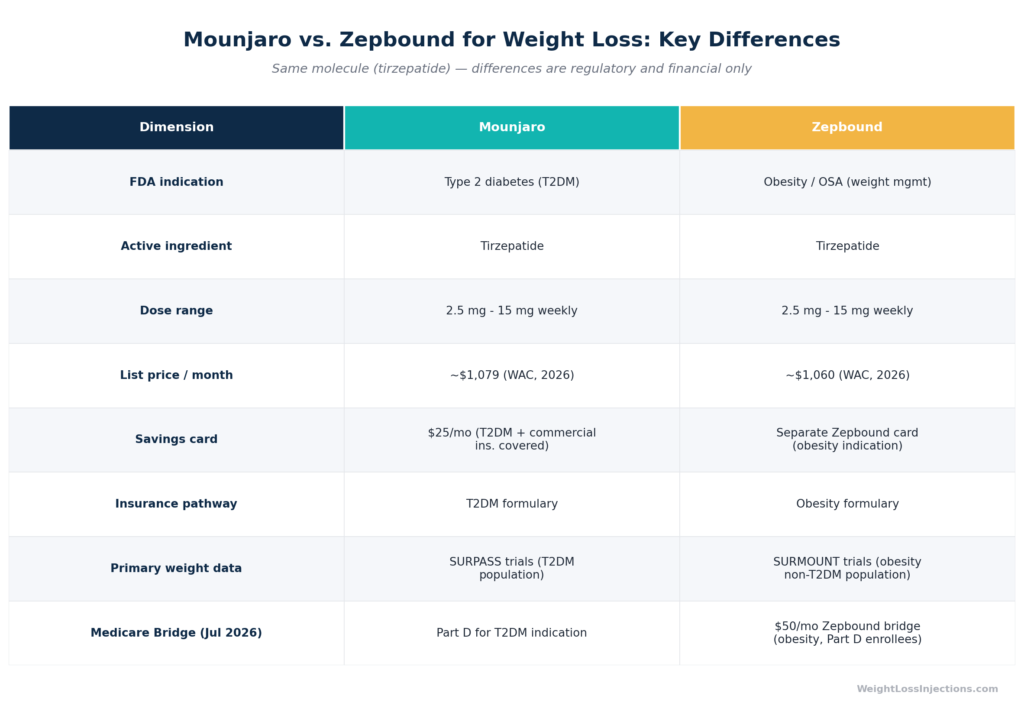
Clean two-column comparison matrix chart: Mounjaro vs Zepbound across eight dimensions — FDA indication, active ingredient, dosing range, list price, savings card, insurance pathway, weight loss data…
The differences are entirely regulatory and financial:
| Dimension | Mounjaro | Zepbound |
|---|---|---|
| FDA indication | Type 2 diabetes | Obesity / obstructive sleep apnea |
| Active ingredient | Tirzepatide | Tirzepatide |
| Available doses | 2.5–15 mg once weekly | 2.5–15 mg once weekly |
| List price (WAC) | ~$1,079/month | ~$1,060/month |
| Lilly Savings Card | $25/month (T2DM, commercial insurance) | Separate Zepbound savings card |
| Insurance coverage | T2DM formulary | Obesity formulary |
| Primary weight-loss data | SURPASS trials (T2DM population) | SURMOUNT trials (obesity population) |
| Medicare weight-loss coverage (July 2026) | Not covered for weight loss | $50/month via GLP-1 Bridge Program |
Sources: FDA Prescribing Information; WebMD comparison; understoodcare.com Medicare GLP-1 Bridge Program
When would a patient be prescribed Mounjaro instead of Zepbound for weight loss?
- They have T2DM + obesity. The diabetes indication covers Mounjaro; most commercial plans cover it under their T2DM formulary; and the weight-loss benefit is real regardless of label.
- Their insurance covers Mounjaro but not Zepbound. This is common in employer plans that include anti-diabetic GLP-1s on formulary while excluding anti-obesity drugs. Patients with a T2DM diagnosis can access Mounjaro affordably while Zepbound remains uncovered.
- Zepbound is not on their formulary or has supply issues. Formulary placement varies by plan and by pharmacy.
- Their prescriber recommends Mounjaro based on clinical judgment. Some physicians prefer to prescribe on-label for the diabetes indication when the patient qualifies, with weight loss as a documented co-benefit.
The Medicare distinction (2026)
Starting July 1, 2026, Medicare’s GLP-1 Bridge Program covers Zepbound — not Mounjaro — at $50/month for eligible Part D enrollees with obesity, per understoodcare.com’s 2026 Medicare GLP-1 coverage guide. Medicare Part D plans may separately cover Mounjaro for T2DM when prescribed under the diabetes indication; the weight-loss coverage distinction matters primarily for patients without a T2DM diagnosis seeking Medicare-covered obesity treatment.
What to Expect When Using Mounjaro for Weight Loss
Weight loss on Mounjaro does not happen uniformly. The drug’s titration schedule — starting at 2.5 mg and stepping up every four weeks — means your experience at month one looks dramatically different from your experience at month nine. Understanding the curve in advance is the most effective antidote to premature discouragement.
The full picture emerges from SURMOUNT-1 data in NEJM combined with the titration schedule embedded in the FDA Prescribing Information. Individual results vary; these are trial-derived benchmarks, not personal guarantees.
Weeks 1–4 at 2.5 mg: the tolerance phase
The 2.5 mg starting dose is explicitly a tolerability step per the FDA label — not a weight-loss dose, and not a maintenance dose. Its purpose is to allow your body to acclimate to the drug’s GI effects before escalating to therapeutic levels. Nausea, mild GI discomfort, and decreased appetite are most prominent during weeks 1–3 as the system adapts. Weight loss at 2.5 mg is typically modest: perhaps 1–3% of body weight, primarily reflecting reduced food intake and early appetite suppression beginning to take hold. Patients who evaluate their results during these first four weeks and conclude “it isn’t working” are assessing the tolerance phase, not the treatment.
Weeks 5–16 at 5–7.5 mg: therapeutic weight loss begins
After four weeks at 2.5 mg, the titration protocol advances to 5 mg. This is the first maintenance-range dose — the level where clinically meaningful appetite suppression and caloric restriction begin. Most patients at this phase report noticeably smaller portion sizes, reduced interest in snacking, and loss of roughly 1–2 pounds per week. Cumulative loss by the end of month three (around week 12–16, when many patients are approaching 7.5–10 mg) typically reaches 7–10% of starting body weight for patients advancing on schedule, per SURMOUNT-1 trajectory data.
Months 4–9 at 10–15 mg: the peak loss phase
The 10–15 mg range represents the maximum therapeutic doses, and this is where the most dramatic weight loss occurs. SURMOUNT-1 data shows weight loss curves steepest between approximately weeks 8–36; patients moving through 10 mg and 12.5 mg toward 15 mg during months 4–9 are in the fastest loss window. By month 6, patients at or approaching 15 mg have often achieved 12–16% cumulative weight loss, per the PMC tirzepatide efficacy review. By month 9, those at 15 mg are typically approaching 18–20%.
Months 9–18: the plateau and maintenance phase
Weight loss slows markedly after month 9–12 as the body approaches a new metabolic equilibrium at a lower weight. In SURMOUNT-1, the weight loss curve largely flattened from approximately week 52 to week 72 — from about 19% loss to 22% at 15 mg. This plateau is not treatment failure; it is the expected physiological endpoint as the body settles at a new defended weight. The drug is now maintaining that lower weight, not actively driving further loss.
Long-term reality: Mounjaro does not cure obesity. Just as blood pressure medications must be taken continuously to maintain their effect, tirzepatide must be continued to maintain weight-loss outcomes. The SURMOUNT-4 withdrawal study confirmed that patients who stopped tirzepatide after achieving significant loss regained substantially — a clinical reality to discuss with your provider before starting, not after reaching your goal. This does not diminish the drug’s value; it correctly frames it as chronic-disease management, not a course of treatment with a defined endpoint.
Lifestyle integration still matters
The FDA label specifies Mounjaro as “an adjunct to diet and exercise” — and the evidence backs that framing. SURMOUNT-3, which added a 12-week structured lifestyle intervention before randomization, produced total weight loss of −24.3% from study entry in the tirzepatide arm, compared to −20.9% in SURMOUNT-1 without the lifestyle lead-in. The drug does the heavy lifting, but dietary quality, adequate protein intake (approximately 1.2–1.6 g/kg/day to preserve lean mass), and consistent physical activity compound the results and support long-term maintenance.
Mounjaro Weight Loss vs. Wegovy and Ozempic: How Does It Compare?
For patients evaluating tirzepatide against semaglutide-based medications, the clinical data provides a reasonably clear picture — though direct head-to-head obesity-dose comparisons at the doses used in pivotal weight-loss trials are still limited.
| Medication | Mechanism | FDA Indication | Mean Weight Loss | List Price/Month |
|---|---|---|---|---|
| Mounjaro (tirzepatide) | Dual GIP + GLP-1 | T2DM (off-label for wt. loss) | ~16–22% (SURMOUNT-1, non-T2DM) | ~$1,079 |
| Zepbound (tirzepatide) | Dual GIP + GLP-1 | Obesity / OSA | ~16–22% (SURMOUNT-1) | ~$1,060 |
| Wegovy (semaglutide 2.4 mg) | GLP-1 only | Obesity / CV risk | ~15% (STEP 1, 68 weeks) | ~$1,349 |
| Ozempic (semaglutide 2.0 mg) | GLP-1 only | T2DM | ~6–10% (diabetes doses) | ~$935 |
Sources: WeightFAQ GLP-1 comparison; Innerbody Wegovy vs. Mounjaro; SURPASS-CVOT NEJM Dec 2025
Mounjaro vs. Wegovy: the key comparison
Tirzepatide (Mounjaro/Zepbound) and semaglutide 2.4 mg (Wegovy) are the most commonly compared weight-loss medications because both are approved or widely used for weight management and both are weekly injections from the GLP-1 class (with tirzepatide also adding GIP agonism).
The weight-loss advantage for tirzepatide is consistent and substantial:
- SURMOUNT-1 (tirzepatide): −22.4% at 15 mg over 72 weeks
- STEP-1 (semaglutide 2.4 mg): −14.9% at 2.4 mg over 68 weeks
- Difference: approximately 7.5 percentage points favoring tirzepatide
This 7.5-point advantage was achieved in separate trials with somewhat different populations, so direct head-to-head comparison must be made cautiously. The SURPASS-2 NEJM trial did directly compare tirzepatide to semaglutide 1 mg (not the higher Wegovy dose) in T2DM patients, and tirzepatide was statistically superior at all three doses. The emerging indirect body of evidence consistently favors tirzepatide for weight loss magnitude.
Cost comparison: Wegovy carries a higher list price (~$1,349/month) than Mounjaro (~$1,079/month WAC), making tirzepatide both more effective and less expensive at list price. Insurance coverage varies significantly by plan.
Side effect comparison: Both medications share a GI-dominant adverse event profile — nausea, diarrhea, constipation, and decreased appetite predominate, particularly during dose escalation. In SURPASS-CVOT, tirzepatide had a slightly higher rate of GI-related drug discontinuation (13.2%) versus dulaglutide (10.1%) at approximately four years (NEJM SURPASS-CVOT) — though dulaglutide is a lower-efficacy comparator. Most patients who complete the titration phase find GI side effects substantially improve at their maintenance dose.
Mounjaro vs. Ozempic: different purposes, different comparisons
Ozempic (semaglutide up to 2.0 mg) is FDA-approved for T2DM and cardiovascular risk reduction — not for weight management as a primary indication. Comparing Mounjaro directly to Ozempic for weight loss is somewhat like comparing Zepbound to Mounjaro: one brand is on-label for the indication, one is not.
That said, SURPASS-2 provides a direct 40-week comparison in T2DM patients: tirzepatide 15 mg produced −11.2 kg body weight vs. −5.7 kg for semaglutide 1 mg — approximately double the weight loss. The maximum approved Ozempic dose (2.0 mg) was not the comparator in SURPASS-2 (semaglutide 1 mg was), which means the head-to-head advantage for tirzepatide over maximum-dose Ozempic is directionally supported but not precisely quantified.
For patients with T2DM who want the most weight loss alongside glycemic control, tirzepatide’s combined data across SURPASS and SURMOUNT makes a compelling case as the higher-efficacy option — even accepting that Ozempic has more established MACE superiority data from SUSTAIN-6 (tirzepatide’s cardiovascular outcomes trial, SURPASS-CVOT, demonstrated noninferiority but not superiority).
Our Take at WeightLossInjections.com
The case for tirzepatide as the most effective pharmacological weight-loss option currently available is well-supported. SURMOUNT-1’s 22.4% mean weight reduction at 72 weeks at the 15 mg dose is not a marketing claim — it is a primary endpoint in a Phase 3 trial published in one of the most rigorous peer-reviewed journals in medicine. When more than half of participants on the maximum dose lose at least 20% of their body weight, that is a clinically meaningful, population-level result.
What those numbers do not tell you is that reaching 15 mg takes five dose escalations over at least 20 weeks — and that the most common reason patients underperform the trial data is not pharmacological non-response but premature conclusions drawn during the titration phase. Month 1 at 2.5 mg is not an audition for the drug’s efficacy; it is a tolerance ramp. The patients who achieve SURMOUNT-1-level results are the ones who escalate systematically, stay consistent with weekly dosing, support the drug’s appetite suppression with adequate protein and activity, and frame this as long-term chronic-disease management rather than a fixed course of treatment.
The Mounjaro/Zepbound distinction is genuinely important and worth understanding before you start. If you have T2DM, Mounjaro is the on-label option and frequently the more insurable one. If you do not have T2DM and are using tirzepatide off-label for weight loss, you are using a drug whose clinical evidence base for your goal is excellent — but you should go in with clear eyes about the insurance realities and out-of-pocket costs, and ideally pursue Zepbound on-label if your plan covers it.
The bottom line: tirzepatide is the highest-efficacy weight-loss medication currently available with robust Phase 3 evidence. Whether your prescription says Mounjaro or Zepbound, the molecule doing the work is the same.
WeightLossInjections.com can evaluate your eligibility and connect you with a licensed provider — [$X/month] for [service detail].
Medical Disclaimer: This article is for informational purposes only and does not constitute medical advice. Mounjaro (tirzepatide) is an FDA-approved prescription medication for type 2 diabetes mellitus. Off-label use for weight loss requires evaluation and prescription by a licensed healthcare provider. Zepbound (tirzepatide) is FDA-approved for chronic weight management. WeightLossInjections.com does not prescribe medications directly. Individual results vary; clinical trial averages may not reflect your personal outcome.
Reviewed by: the WeightLossInjections.com Staff
Last reviewed: June 2026
FAQ
Yes, off-label. Mounjaro is FDA-approved only for type 2 diabetes, but physicians in the United States can legally prescribe any approved medication for any indication based on their clinical judgment — and off-label prescribing accounts for a significant portion of all prescription activity. Many telehealth platforms and weight-management physicians evaluate patients for Mounjaro using BMI criteria (≥30, or ≥27 with a weight-related comorbidity) without requiring a pre-existing T2DM diagnosis. The identical molecule is also marketed as Zepbound, which is FDA-approved specifically for chronic weight management — patients without T2DM may find Zepbound a cleaner path for insurance and documentation purposes, per FormBlends’ prescribing access guide.
In the SURMOUNT-1 trial published in NEJM, adults without type 2 diabetes lost a mean of 22.4% of body weight at the 15 mg dose over 72 weeks — approximately 52 pounds for a 230-pound person. At 10 mg the mean was 21.4%; at 5 mg it was 16.5%. Patients with type 2 diabetes achieved somewhat lower but still clinically significant results (approximately 15% at 15 mg) in the separate SURMOUNT-2 trial. Results vary based on dose reached and maintained, adherence, diabetes status, dietary choices, and individual metabolism. For a deeper dive, see our guide on how much weight can you lose on Mounjaro.
Both are highly effective, but tirzepatide (Mounjaro/Zepbound) consistently outperforms semaglutide (Wegovy) in available data. SURMOUNT-1 showed −22.4% weight loss for tirzepatide 15 mg at 72 weeks versus approximately −14.9% for Wegovy (semaglutide 2.4 mg) in its separate STEP 1 trial — a difference of approximately 7.5 percentage points. The dual GIP/GLP-1 mechanism of tirzepatide is the most likely explanation for the superiority over GLP-1-only semaglutide. Wegovy also carries a higher list price (~$1,349/month vs. ~$1,079/month for Mounjaro). For a full head-to-head breakdown, see our Mounjaro vs. Wegovy comparison.
No clinically meaningful difference exists — both contain tirzepatide at identical 2.5–15 mg doses on the same weekly injection schedule. The only differences are the FDA-approved indication (type 2 diabetes for Mounjaro; obesity and OSA for Zepbound) and the resulting insurance coverage pathways. A patient whose prescription switches from Mounjaro to Zepbound — or vice versa — would experience no change in pharmacological effect. The insurance and out-of-pocket cost implications can be significant, however, depending on your plan and whether you have T2DM. See our detailed Mounjaro vs. Zepbound comparison for a full breakdown.
Most patients begin experiencing meaningful appetite suppression within the first few weeks at the 5 mg dose (weeks 5–8). Visible weight loss of 5–10% typically occurs by months 3–4 as the dose escalates toward 7.5–10 mg. The steepest rate of loss — often 1–2 pounds per week — occurs between months 4–9 as patients reach 10–15 mg. Weight loss substantially slows after months 9–12 as the body approaches a new equilibrium, with most of the total loss accumulated by the 12–15 month mark. Significant weight loss of ≥10% typically occurs by months 6–9 for patients reaching therapeutic doses, per SURMOUNT-1 trajectory data and PMC review.
Yes, weight regain after stopping tirzepatide is consistent and well-documented. While SURMOUNT-4 specifically studied Zepbound, the pharmacology is identical for Mounjaro — the SURMOUNT-4 withdrawal arm showed that patients who stopped tirzepatide after achieving significant loss regained a mean of 14% of body weight over the following 52 weeks, retaining less than half their original loss. Only 16.6% of patients who stopped maintained ≥80% of their lost weight. This is not behavioral failure — it is the biology of obesity reasserting itself when the drug’s appetite-suppression effect is removed, the same mechanism that makes blood pressure medication require continuation. Discuss a long-term treatment plan with your provider before starting — including what the off-ramp, if any, looks like. See also our guide on Mounjaro side effects.