![Unbranded [pillar-drug-class] injection pen on a neutral background — WeightLossInjections.com editorial hero](https://weightlossinjections.com/wp-content/uploads/2026/07/hero_mounjaro_c1_cost-1200x675.png)
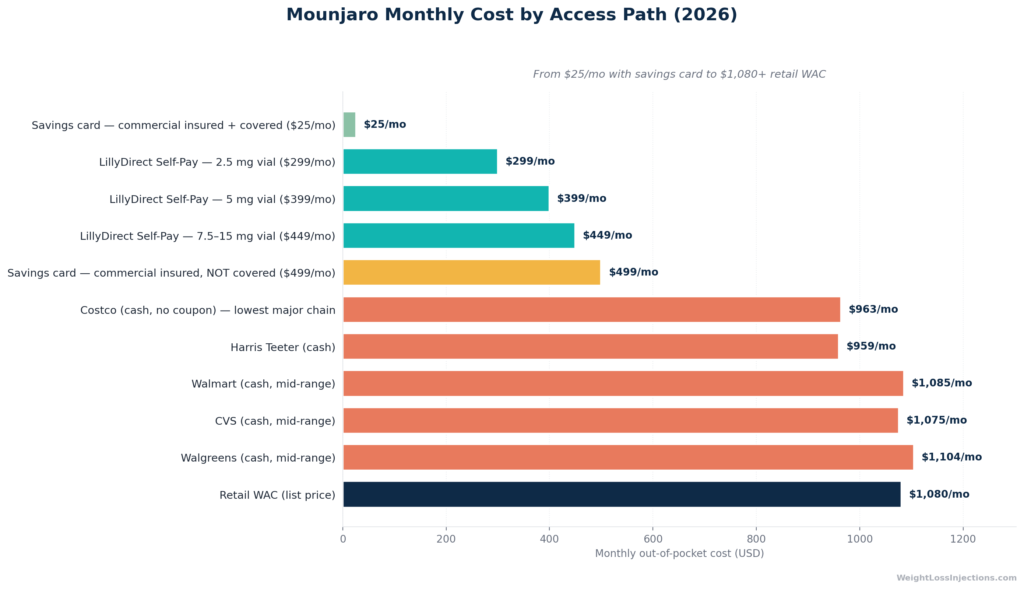
Horizontal bar chart comparing Mounjaro monthly costs across eight access paths in 2026 — Retail WAC $1,080, CVS ~$1,075, Walgreens ~$1,104, Walmart ~$1,085, GoodRx ~$937, LillyDirect 2.5 mg $299,…
- Mounjaro’s official list price (WAC) is $1,079.77/month for all six dose strengths, per the Lilly official WAC disclosure — but fewer than 10% of patients actually pay that number.
- The cheapest path for uninsured patients is LillyDirect self-pay vials: $299/mo (2.5 mg), $399/mo (5 mg), $449/mo (7.5–15 mg), per BestMedsHub May 2026.
- The Mounjaro savings card brings costs to $25/month — but it requires both commercial insurance AND an FDA-approved T2DM diagnosis; off-label weight-loss prescriptions do not qualify, per meetaugust.ai 2026.
- GoodRx coupons reduce retail prices to roughly $875–$1,000/month — meaningful savings, but still far above LillyDirect.
- Compounded tirzepatide runs $249–$449/month via telehealth platforms, per Noom May 2026, though mass-market compounding ended in early 2025 and only a narrow personalized exception remains — FDA quality concerns and current legal status should be understood before choosing this route.
- Medicare beneficiaries with T2DM may see a negotiated price near $245/month under the White House pricing agreement rollout, per Noom May 2026.
- Annual cost without any assistance runs $12,957–$13,440/year, per Noom May 2026 cost analysis — but with LillyDirect, annual costs drop to $3,588–$5,388.
WeightLossInjections.com editorial note: All prices in this article reflect verified Q1–Q2 2026 figures. Lilly WAC and savings card terms can change without notice — always confirm current pricing at mounjaro.lilly.com/savings-resources before filling your prescription.
What Is the List Price of Mounjaro in 2026?
When a patient or a prescriber looks up Mounjaro at a retail pharmacy counter without insurance or assistance, the number they encounter is built on a single foundation: the Wholesale Acquisition Cost, or WAC. Understanding what that number is — and what it is not — is the first piece of groundwork that makes every other pricing comparison in this article meaningful.
The WAC: $1,079.77 per 28-day supply
According to the Lilly official Colorado WAC Disclosure Sheet, Mounjaro’s Wholesale Acquisition Cost is $1,079.77 per 28-day supply (four single-dose KwikPens) as of January 1, 2026. That figure is uniform across all six dose strengths — 2.5 mg, 5 mg, 7.5 mg, 10 mg, 12.5 mg, and 15 mg. Whether you are in your first month of treatment at the lowest starting dose or at the maximum maintenance dose of 15 mg, the published list price is identical.
It’s worth noting that some aggregator sources and pricing databases cite $1,112.16 for Mounjaro, which may reflect a subsequent Lilly price adjustment not yet captured in the primary Colorado disclosure sheet. For the most current verified figure, the Lilly WAC disclosure PDF is the primary source; the $1,079.77 number is the verified Q1 2026 benchmark throughout this article.
One structural nuance worth understanding: WAC is the manufacturer’s published price before any rebates, channel discounts, or pharmacy markups. It is the price at which Lilly sells to wholesalers — not the price at which retail pharmacies sell to patients. In practice, retail pharmacies add dispensing fees and margin on top of WAC, which is why the cash price at your local pharmacy is typically higher than the WAC figure itself. This means the $1,079.77 WAC is actually the floor, not the ceiling, of what an unassisted retail cash-pay patient might encounter.
What the Uniform WAC Means in Practice
The dose-agnostic pricing structure has an important planning implication. Most patients begin Mounjaro at 2.5 mg for tolerability, titrate to 5 mg after four weeks, and then continue escalating in 2.5 mg increments at minimum four-week intervals, per the FDA Mounjaro Prescribing Information. A patient who ultimately stabilizes at 10 mg or 15 mg will be paying the same list price as someone on the 2.5 mg starting dose — a structural difference from many other chronic medications where cost scales with dose strength.
At WAC pricing, the annual cost without any assistance runs approximately $12,957–$13,440 per year, per Noom’s May 2026 cost analysis. That number is what makes Mounjaro feel inaccessible to many uninsured patients at first glance — and it is the starting point that the rest of this article dismantles.
Quick-reference: Mounjaro 2026 price by access path
| Access Path | Monthly Cost |
|---|---|
| Retail WAC (all doses) | $1,079.77 |
| Major pharmacy cash price (range) | ~$980–$1,193 |
| GoodRx coupon | ~$875–$1,000 |
| SingleCare coupon | ~$872–$987 |
| LillyDirect self-pay — 2.5 mg | $299 |
| LillyDirect self-pay — 5 mg | $399 |
| LillyDirect self-pay — 7.5–15 mg | $449 |
| Savings card (commercial insurance, T2DM covered) | $25 |
| Savings card (commercial insurance, not covered) | $499 |
| Compounded tirzepatide (telehealth) | $249–$449 |
| Medicare (White House negotiated, T2DM) | ~$245 |
Sources: Lilly WAC disclosure; BestMedsHub May 2026; NiceRx March 2026; SingleCare; GoodRx Mounjaro; Noom May 2026
Why Retail Cash Prices Are Higher Than the WAC
The WAC is the manufacturer’s starting point, but the price a patient actually sees at the pharmacy counter is shaped by several additional factors: the pharmacy chain’s own markup, dispensing fees, and regional variation. This is why comparing pharmacies — before defaulting to the one nearest your house — can save hundreds of dollars per month at retail cash prices.
Cash Prices at Major Pharmacy Chains (Q1–Q2 2026, No Coupon)
Based on verified Q1–Q2 2026 data from FormBlends, Buy Canadian Insulin, and GoodRx Mounjaro, here are the cash prices at major chains before any coupon or assistance program:
| Pharmacy | Cash Price Range (28-day supply) |
|---|---|
| CVS | ~$1,025–$1,125/month |
| Walgreens | ~$1,015–$1,193/month |
| Walmart | ~$980–$1,189/month |
| Costco | ~$850–$1,075/month (lowest major chain) |
| Harris Teeter | ~$959/month |
A few observations from this table:
Costco is meaningfully cheaper. The warehouse club’s pharmacy model — lower markup, no per-prescription dispensing fee premium — tends to produce lower cash prices for specialty drugs. The ~$850–$1,075 range at Costco can represent $150–$300 in monthly savings compared to CVS or Walgreens at the high end of their ranges. A Costco membership is not required to use the pharmacy in most states.
The range is wide within each chain. Walgreens’ spread of roughly $178 between their low and high observed cash prices reflects regional and store-level variation. Calling your specific pharmacy location directly to get a current cash price quote is the reliable approach — online tools aggregate historical data and may not reflect the exact current price at your local branch.
The dose-agnostic rule holds here too. Like WAC, retail cash prices at major pharmacies apply uniformly across all six dose strengths. A 15 mg fill costs the same as a 2.5 mg fill.
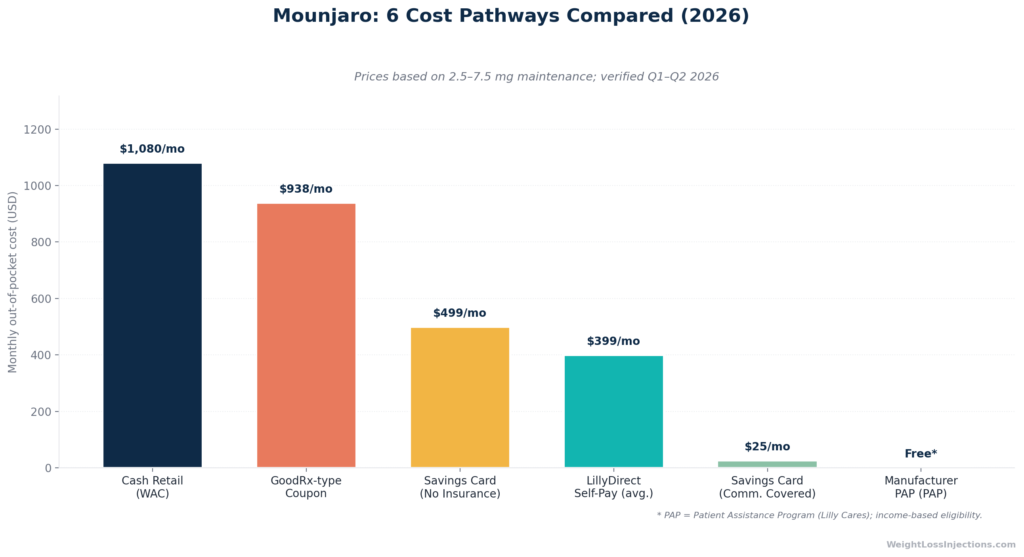
Full pricing matrix table — rows showing all six dose strengths (2.5 mg through 15 mg), columns showing Retail WAC, CVS, Walgreens, Walmart, Costco, GoodRx, SingleCare, and LillyDirect self-pay…
GoodRx and Prescription Discount Coupons
Prescription discount cards don’t use your insurance — they negotiate pre-set rates with participating pharmacies and pass that reduction to you directly at the counter. For Mounjaro:
- GoodRx: Approximately $875–$1,000/month depending on pharmacy, per FormBlends Q1 2026. This represents a roughly 10–15% reduction from retail cash prices — real savings, but a long way from LillyDirect.
- SingleCare: Approximately $872–$987/month at participating pharmacies, per SingleCare’s Mounjaro pricing page.
Both GoodRx and SingleCare are free to use — you download the coupon or app, present it at the pharmacy, and pay the negotiated rate. The practical ceiling on their savings potential is built into the model: they negotiate within the existing retail pharmacy framework, not outside it. For a specialty drug where LillyDirect offers $299–$449/month for branded product, discount cards at $875–$1,000/month represent a second-best option for patients who cannot access LillyDirect for logistical or prescribing reasons.
One important technical note: prescription discount cards cannot be combined with insurance. You use one or the other for any given fill.
Mounjaro Cost With Insurance vs. Without: The Critical Differences
The pricing conversation for Mounjaro is fundamentally shaped by two variables: whether you have insurance, and whether your prescription is written for the FDA-approved type 2 diabetes indication or off-label weight loss. Getting these two questions answered correctly before filling a prescription determines whether you pay $25/month or $449/month — a difference of $5,000+ per year.
Commercial Insurance: Coverage Rates and What to Expect
Most major commercial plans — employer-sponsored, ACA marketplace — cover Mounjaro when prescribed for its FDA-approved indication of type 2 diabetes mellitus (T2DM). Insurance approval rates in 2026 run approximately 60–70% for the T2DM indication, per FormBlends’ April 2026 prescription access guide. For off-label weight-loss prescriptions, that rate drops sharply to roughly 15–25% — insurers generally expect obesity-indication prescriptions to use the Zepbound label (tirzepatide’s weight-management approval), not Mounjaro’s T2DM label.
Prior authorization is required by most commercial plans for the T2DM indication. Common PA criteria include:
- Documented T2DM diagnosis (ICD-10: E11.x)
- Recent A1C measurement within the past three months, typically ≥7.0% or ≥8.0% depending on the plan
- Documentation of metformin trial at maximally tolerated dose (≥2,000 mg/day) for at least three months, or documented allergy/intolerance
- Confirmation that the prescription is not for chronic weight management
- No concurrent use of another GLP-1 agonist or DPP-4 inhibitor (some plans)
Sources: Kaiser Permanente PA form; Cigna coverage policy
Some plans, including certain BCBS plans in multiple states, place Mounjaro at Step 2 of their diabetes formulary, requiring a documented prior trial of a Step 1 agent — typically a GLP-1 like Ozempic or Trulicity — before authorizing Mounjaro, per Sprypt’s step therapy guide. This step therapy requirement adds weeks to the access timeline for new patients.
With qualifying commercial coverage and an approved PA, the Mounjaro savings card can reduce your copay to as low as $25/month — transforming a four-figure list-price drug into one of the more affordable diabetes treatments on the market.
Medicare Coverage: The 2026 Landscape
Medicare’s Mounjaro coverage in 2026 has nuances that matter depending on your diagnosis:
For T2DM: Medicare Part D plans may cover Mounjaro when prescribed for the FDA-approved T2DM indication (ICD-10: E11.x) if the drug appears on the plan’s formulary, per Healthgrades Medicare overview and HealthRX Medicare Part D guide. Starting in 2026, the IRA’s annual out-of-pocket cap of $2,100 applies to Medicare Part D enrollees. Additionally, a White House pricing agreement rollout has produced a reported negotiated Medicare price of approximately $245/month for T2DM patients, per Noom May 2026 — though the full rollout timeline should be confirmed with your specific plan.
For weight loss only: Medicare does not cover Mounjaro prescribed solely for weight management. The Social Security Act historically excluded anti-obesity drugs from Part D, and that exclusion remains in effect for the Mounjaro label specifically. The Medicare GLP-1 Bridge Program that launched July 1, 2026 applies to Zepbound — tirzepatide’s weight-management brand — not to Mounjaro.
Savings card exclusion: The Mounjaro savings card is not available to Medicare or Medicaid beneficiaries. This is a hard exclusion under federal anti-kickback statute, per HealthRX patient assistance FAQ.
Medicaid Coverage
All 50 states and DC cover Mounjaro for T2DM with prior authorization, per KFF Medicaid GLP-1 coverage tracker. Coverage for obesity-only prescriptions is narrow: approximately four states (Vermont, Rhode Island, Connecticut, Minnesota) extend coverage to obesity with BMI ≥35 plus comorbidities; the remaining 43 states plus DC limit coverage to the diabetes indication, per FormBlends Medicaid coverage guide. Several states have restricted GLP-1 obesity coverage in 2025–2026 due to budget pressures.
The Savings Card T2DM Requirement: The Most Important Distinction in This Article
This point is worth a dedicated callout because it is the most frequently misunderstood aspect of Mounjaro pricing:
The Mounjaro savings card is not available to patients without commercial insurance, regardless of income or circumstances. The $25/month track requires a qualifying commercial insurance plan AND an FDA-approved T2DM diagnosis. Patients who use Mounjaro off-label for weight loss — even if they have commercial insurance — do not qualify for the $25 covered-benefit track, per meetaugust.ai’s savings card analysis.
This single distinction often determines whether someone will pursue Mounjaro or pivot to Zepbound (which has its own savings structure and LillyDirect program). If your prescription is T2DM-indicated and you have commercial insurance, the savings card changes your economics entirely. If your prescription is weight-loss-only, the relevant benchmark is LillyDirect pricing, not the savings card.
The Cheapest Ways to Get Mounjaro Without Insurance
For patients who are uninsured, underinsured, or whose insurance does not cover Mounjaro, several distinct pricing paths exist. They are not equally accessible, and they are not all appropriate for every patient. This section walks through each one with concrete numbers and the practical requirements to access it.
LillyDirect Self-Pay Vials: The Lowest-Cost Branded Option
LillyDirect is Eli Lilly’s direct-to-consumer pharmacy platform, and for uninsured patients with a valid Mounjaro prescription, it is the most significant pricing program available in 2026. LillyDirect offers Mounjaro as single-dose tirzepatide vials — branded Mounjaro product, not compounded tirzepatide — at substantially below-retail self-pay prices, per BestMedsHub May 2026:
| Dose | LillyDirect Self-Pay Monthly Price |
|---|---|
| 2.5 mg | $299/month |
| 5 mg | $399/month |
| 7.5 mg | $449/month |
| 10 mg | $449/month |
| 12.5 mg | $449/month (45-day refill window) |
| 15 mg | $449/month (45-day refill window) |
For 12.5 mg and 15 mg doses outside the 45-day refill window, prices rise to the $849–$1,049 range. Adherence to the refill cadence is not optional if you want to maintain program pricing at maintenance doses.
Key operational points about LillyDirect vials:
- These are the branded Mounjaro product — same formulation, same Lilly quality controls as the pen. The difference from the retail pen is the delivery format: vials require a separate syringe and needle for each injection, purchased independently. Patients transitioning from insulin administration will find the syringe draw process familiar.
- No insurance is required to enroll. A valid Mounjaro prescription from a licensed provider is required.
- LillyDirect is a mail-order pharmacy platform — vials are shipped directly to your home. They are not available at traditional retail pharmacy locations.
- Storage follows standard Mounjaro temperature guidelines: refrigeration at 2°C–8°C (36°F–46°F), or up to 21 days at temperatures not exceeding 30°C (86°F), per the FDA Prescribing Information §16.
The annual cost implications of LillyDirect pricing are significant. At $449/month (the maintenance dose tier), annual cost runs approximately $5,388/year — compared to $12,957–$13,440/year at retail WAC. Over a multi-year course of treatment, that difference compounds substantially. For patients who will be on Mounjaro long-term for T2DM management, the LillyDirect pricing path is the single most impactful decision in the cost equation.
To enroll, navigate to startlilly.com, complete the enrollment process, and have your prescription ready. LillyDirect connects T2DM patients with certified physicians via telehealth if needed and served over one million patients monthly in 2025, per Yahoo Finance’s Eli Lilly JPM26 reporting.
Mounjaro Savings Card: For Commercially Insured Patients
The Mounjaro savings card, available at mounjaro.lilly.com/savings-resources or by texting “MJ” to 85099, operates as a separate program from LillyDirect and is available exclusively to commercially insured patients, per NiceRx March 2026. The 2026 card terms are:
| Patient Situation | Cost with Card | Annual Max Savings |
|---|---|---|
| Commercial insurance covers Mounjaro (T2DM) | As low as $25/month | $1,950/year ($150/month cap) |
| Commercial insurance does NOT cover Mounjaro | As low as $499/month | $8,411/year ($647/month cap) |
| Medicare / Medicaid / government plans | NOT eligible | — |
The card allows up to 13 prescription fills per calendar year. A 3-month supply under the covered-benefit track costs as little as $75 total. The card is valid through December 31, 2026.
One important caveat: the card does not apply during your plan’s deductible phase. Patients who haven’t met their annual deductible will pay much more until it is met — even with the savings card enrolled, per FormBlends’ savings card explainer. Plan your first fills accordingly if you are in a high-deductible health plan early in the calendar year.
For commercially insured patients whose plan does not cover Mounjaro, the $499/month non-covered track is available — but in most cases, comparing this to LillyDirect’s $449/month maintenance-dose pricing reveals that LillyDirect will be cheaper for patients on 7.5 mg and higher, with no annual fill cap.
GoodRx, SingleCare, and Other Drug Discount Coupons
For patients who cannot access LillyDirect (logistical constraints, specific pharmacy requirements, or prescribing platform limitations) and need to fill at a retail pharmacy, discount coupons provide a meaningful but partial reduction:
- GoodRx: Approximately $875–$1,000/month depending on pharmacy location, per FormBlends Q1 2026. A useful tool, but nearly twice the LillyDirect price at maintenance doses.
- SingleCare: Approximately $872–$987/month at participating pharmacies, per SingleCare. Comparable to GoodRx; worth comparing both before filling.
Both are free to use, require no enrollment, and work at most major retail pharmacies. Neither can be combined with insurance. For a patient who absolutely cannot use LillyDirect and has no insurance, these coupons represent the practical floor of retail pharmacy pricing.
Compounded Tirzepatide: Lower Cost, Higher Complexity
Compounded tirzepatide — the same active molecule as Mounjaro, prepared by licensed 503A or 503B pharmacies and typically accessed through telehealth platforms — costs approximately $249–$449/month, per Noom May 2026. At the lower end of that range, it undercuts even LillyDirect pricing significantly.
However, the compounded tirzepatide landscape in 2026 is more complex than it was in 2024–2025, and patients should understand several important distinctions before choosing this path:
It is not Mounjaro. Compounded tirzepatide is not the branded Mounjaro KwikPen or LillyDirect vial. It is the same active molecule formulated by a compounding pharmacy — formulations, inactive ingredients, concentrations, and quality controls vary by pharmacy. The FDA has raised quality and safety concerns about compounded GLP-1 products and has taken enforcement actions against some compounding operations.
Legal status has shifted. When FDA declared the tirzepatide shortage resolved in late 2024, enforcement timelines were set for 503A pharmacies (February 2025) and 503B outsourcing facilities (March 2025). As of mid-2026, the availability of compounded tirzepatide at general scale is more restricted than it was in the 2024 peak of availability. Specific exceptions remain for documented patient-specific needs (e.g., excipient allergies), but general-population access has narrowed. The situation differs from the Zepbound compounding landscape in that Mounjaro-targeted compounding involves the same molecule but different regulatory context.
If you pursue compounded tirzepatide, use a licensed provider. Platforms that offer compounded tirzepatide should be using a verified 503A or 503B licensed pharmacy and must provide appropriate prescriber oversight. Avoid providers who do not require clinical evaluation or who cannot identify their compounding pharmacy’s licensure status.
WeightLossInjections.com’s bundled telehealth consult — starting at [$X/month] — includes [service detail] and connects you with a licensed provider who can evaluate your eligibility, review which pricing paths are appropriate for your situation, and provide ongoing clinical management. [service detail]

Decision flowchart titled “Which Mounjaro Pricing Path Is Right for You?” — branching tree starting with insurance status: commercial insurance? → plan covers Mounjaro T2DM? → savings card $25/mo OR…
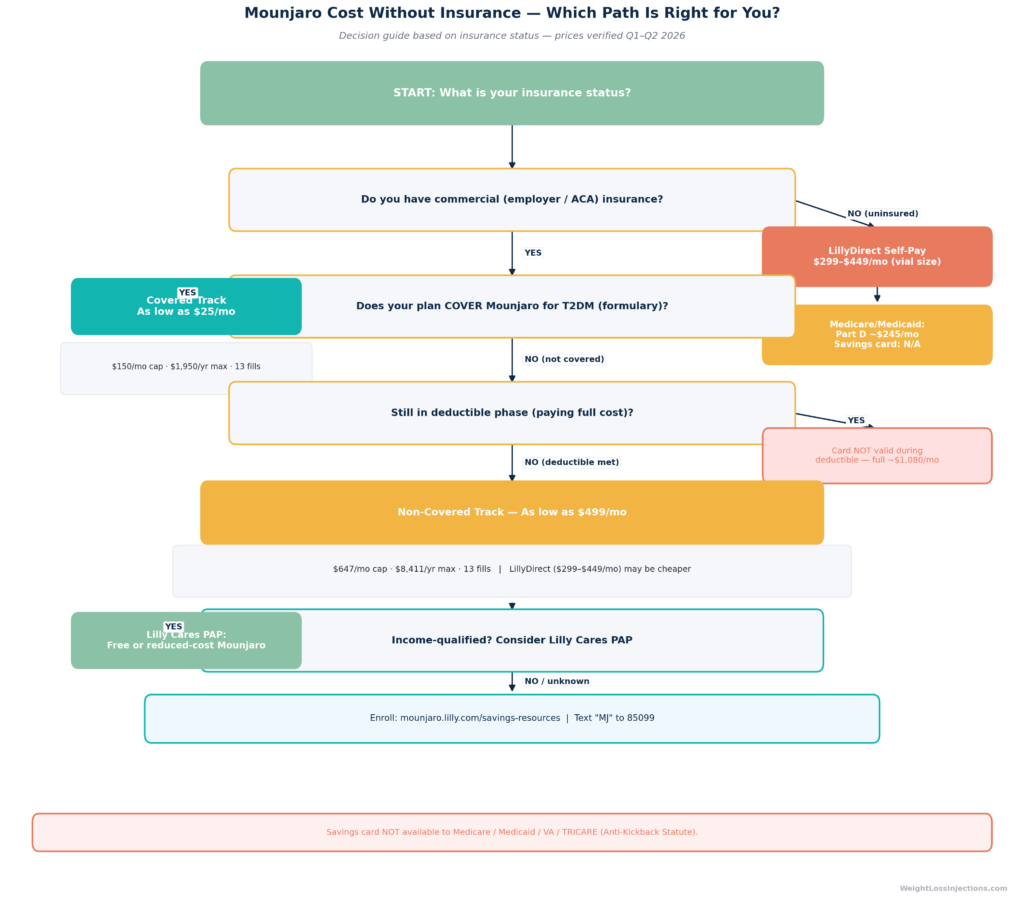
Decision flowchart titled “Which Mounjaro Pricing Path Is Right for You?” — branching tree starting with insurance status: commercial insurance? → plan covers Mounjaro T2DM? → savings card $25/mo OR…
Our Top 3 · September 2026
The best GLP-1 providers right now
Independently reviewed. Ranked by price, medication access, provider quality, and patient outcomes.
Renew GLP
Personalized GLP-1, GIP plans: Semaglutide & Tirzepatide.
Medvi
No membership or hidden fees. Everything you need is included.
Trimi
US-licensed clinicians and shipped to your door, from $99/mo.
Step-by-Step: How to Get Mounjaro at the Lowest Price
Understanding the pricing landscape intellectually is one thing; navigating the actual enrollment steps is where many patients either save thousands of dollars or inadvertently pay list price. Here is the practical sequence for the most common patient situations.
If You Have No Insurance: The LillyDirect Path
Step 1: Confirm eligibility and obtain a valid prescription. LillyDirect is a pharmacy, not a prescriber — it fills prescriptions, not clinical evaluations. You need a licensed provider to evaluate your T2DM diagnosis, current medications, and clinical status before issuing a Mounjaro prescription. For the FDA-approved indication, this requires a documented T2DM diagnosis, recent A1C ≥7.0%, and appropriate clinical workup. Telehealth platforms including PlushCare, Noom Med, and others offer same-day or next-day appointments, per FormBlends’ prescription access guide and Medical News Today 2026. Typical turnaround from telehealth consult to prescription: 24–48 hours.
Step 2: Enroll on LillyDirect. Navigate to startlilly.com, complete the enrollment, and upload or transfer your prescription. Select your starting dose (2.5 mg, per the FDA-recommended titration schedule), provide your delivery address, and complete payment setup. Pricing is confirmed at checkout: $299/month for 2.5 mg.
Step 3: Manage your refill window carefully. At maintenance doses (7.5–15 mg), the 45-day refill window is the most common source of pricing disruptions. Set a recurring reminder at 38–40 days post-delivery for each fill. Missing the window at higher doses can push a single fill from $449 to $849–$1,049 — a $400–$600 increase for one month.
Step 4: Establish clinical oversight. A LillyDirect prescription and a vial do not by themselves constitute a supervised treatment program. The SURPASS trial data was generated in structured clinical settings with regular follow-up. At minimum, establish follow-up with a prescriber for periodic A1C and metabolic labs, dose titration review, and management of any GI adverse effects during titration.
If You Have Commercial Insurance With T2DM Coverage
Step 1: Confirm formulary status and PA requirements. Ask your plan or pharmacist whether Mounjaro is on your plan’s formulary for the T2DM indication and what PA documentation your prescriber needs to submit. Compile your recent A1C result (within 3 months), documentation of metformin trial, and your T2DM diagnosis code.
Step 2: Enroll in the savings card immediately. Do not wait until the PA is approved — enroll at mounjaro.lilly.com/savings-resources or by texting “MJ” to 85099 as soon as your prescriber submits the PA. The card reduces your T2DM-covered copay to as low as $25/month, per NiceRx March 2026.
Step 3: Understand the deductible phase. If you have not met your annual deductible, the savings card will not reduce your cost to $25 until the deductible is satisfied. Plan your first fill timing accordingly or discuss with your prescriber whether to delay the first fill until after your deductible resets.
If You Have Medicare With T2DM
Step 1: Check your Part D plan’s formulary. Medicare coverage for Mounjaro for T2DM is plan-specific — not all Part D plans include it, per HealthRX Medicare Part D guide. Contact your plan directly to confirm formulary placement and negotiated pricing. With the White House pricing agreement rollout, negotiated prices in the range of approximately $245/month have been reported for Medicare T2DM patients, per Noom May 2026.
Step 2: Note the savings card exclusion. The Mounjaro savings card is not available to Medicare beneficiaries under any circumstances, per HealthRX patient assistance FAQ. Your IRA-established $2,100 annual out-of-pocket cap provides protection against catastrophic costs, per meetaugust.ai 2026.
Annual Cost of Mounjaro: Putting Monthly Numbers in Context
Monthly prices make intuitive sense, but a chronic medication for type 2 diabetes is a long-term commitment — and the annual cost comparison makes the savings from different pricing paths more concrete.
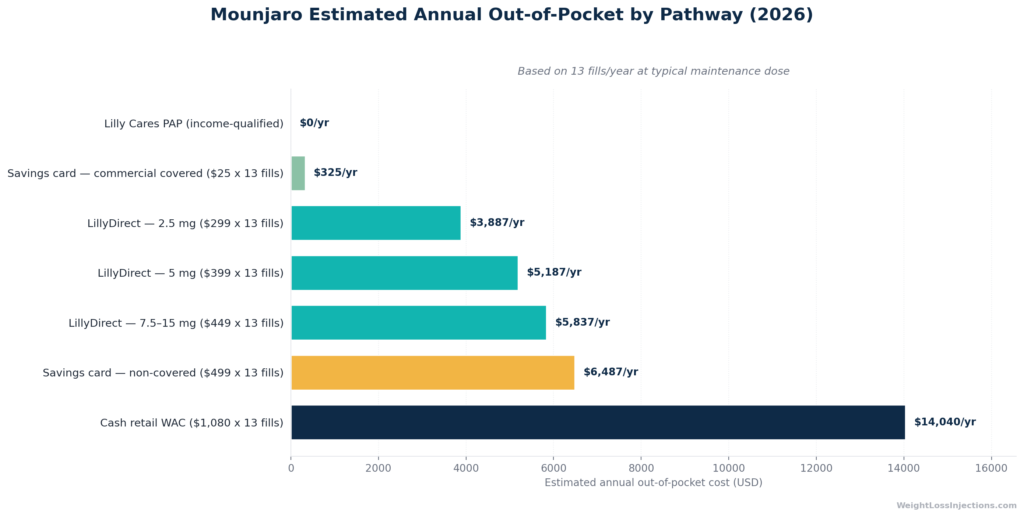
Grouped bar chart showing estimated annual Mounjaro costs across five access paths in 2026 — Retail WAC ~$12,957, LillyDirect 2.5 mg ~$3,588, LillyDirect 5 mg ~$4,788, LillyDirect 7.5–15 mg ~$5,388,…
Estimated annual costs (13 fills/year at 28-day supply):
| Access Path | Monthly Cost | Estimated Annual Cost |
|---|---|---|
| Retail WAC (no program) | $1,079.77 | ~$12,957–$13,440 |
| LillyDirect self-pay — 2.5 mg | $299 | ~$3,588 |
| LillyDirect self-pay — 5 mg | $399 | ~$4,788 |
| LillyDirect self-pay — 7.5–15 mg | $449 | ~$5,388 |
| Savings card — covered commercial T2DM | $25 | ~$300–$325 |
| Savings card — non-covered commercial | $499 | ~$5,988 |
| Compounded tirzepatide (telehealth) | $249–$449 | ~$2,988–$5,388 |
Sources: Lilly WAC disclosure; Noom May 2026; BestMedsHub May 2026; NiceRx March 2026
The comparison between retail WAC (~$13,000/year) and LillyDirect at maintenance dose (~$5,388/year) represents approximately $7,600 in annual savings for an uninsured patient who accesses LillyDirect rather than filling at a retail pharmacy without assistance. Over a three-year treatment course, that gap exceeds $22,000.
For a patient with commercial insurance who qualifies for the covered-benefit savings card at $25/month, annual cost drops to approximately $300 — roughly 2.3% of the retail WAC annual cost. The difference in outcome between someone who knows how to use the savings card correctly and someone who pays retail out-of-pocket is more than $12,000 per year.
Is Mounjaro Worth the Cost? The Clinical Case for the Price
The cost question cannot be fully answered without engaging the clinical evidence — because the economic calculation for Mounjaro is fundamentally different depending on what you are treating.
The T2DM Evidence: What the SURPASS Program Shows
Mounjaro’s approval is built on the SURPASS clinical trial program, one of the most comprehensive T2DM drug development datasets in recent history. The headline results relevant to the cost conversation:
SURPASS-2 (vs. Semaglutide 1 mg): In this 40-week, 1,879-patient head-to-head trial published in the New England Journal of Medicine (Frías et al., 2021), tirzepatide 15 mg reduced HbA1c by 2.30% and body weight by 11.2 kg — significantly greater than semaglutide 1 mg’s −1.86% HbA1c and −5.7 kg weight reduction. All three tirzepatide doses achieved both noninferiority and superiority over semaglutide for the primary endpoint.
SURPASS-CVOT (2025 cardiovascular outcomes): Published in the NEJM, December 2025 (Nicholls et al.), this landmark 13,299-patient trial over approximately four years compared tirzepatide to dulaglutide in T2DM patients with established cardiovascular disease. Tirzepatide met the primary noninferiority endpoint for MACE (HR 0.92; 95.3% CI 0.83–1.01). Key secondary outcomes included a 16% reduction in all-cause mortality (HR 0.84; 95% CI 0.75–0.94), driven primarily by non-cardiovascular deaths, and an 11.6% reduction in body weight vs. 4.5% with dulaglutide.
For weight loss (same molecule): Because Mounjaro and Zepbound contain identical tirzepatide, the SURMOUNT-1 trial data is clinically relevant context. At 72 weeks, tirzepatide 15 mg produced −22.4% mean body weight reduction vs. −2.4% placebo in adults without T2DM, per PMC SURMOUNT-1 summary. In T2DM populations (SURPASS trials), weight reductions ranged from −11.0% to −12.9% at 15 mg.
The Real Cost-of-Illness Calculation
For T2DM patients, the economic argument for effective glycemic management goes well beyond the drug’s sticker price. Uncontrolled T2DM generates downstream costs through hospitalizations, emergency department visits, dialysis for end-stage renal disease, cardiovascular interventions, and management of diabetic retinopathy and neuropathy. The annual direct medical cost of poorly controlled T2DM substantially exceeds the annual LillyDirect price of $5,388 for Mounjaro.
When the comparison is framed correctly — not “Mounjaro vs. nothing,” but “Mounjaro at $449/month vs. the cost of uncontrolled T2DM complications” — the economic argument becomes considerably more favorable. The SURPASS-CVOT 16% reduction in all-cause mortality adds a clinical dimension to this calculation that few diabetes medications can claim.
Our take at WeightLossInjections.com
Our take at WeightLossInjections.com: At LillyDirect prices of $299–$449/month, Mounjaro is significantly more accessible than the $1,079 sticker price implies — and that accessibility gap is the story of Mounjaro pricing in 2026 that most patients haven’t heard. The WAC is what you’d pay if you walked into CVS without a plan, but no thoughtful approach to Mounjaro access should start there.
For T2DM patients with qualifying commercial insurance who activate the savings card correctly, $25/month is a real, repeatable number that holds through December 31, 2026. The main traps: the deductible phase (savings card doesn’t help until deductible is met), and the T2DM indication requirement (off-label weight-loss prescriptions are categorically ineligible for the $25 track).
For uninsured patients, LillyDirect is the right answer in almost every scenario where a valid Mounjaro prescription exists. The $449/month maintenance-dose pricing is approximately 41% of the retail WAC — and it is branded Lilly product with the same formulation as the pharmacy pen. The 45-day refill window is the one operational detail that demands attention; missing it at higher doses can add $400–$600 to a single fill.
For patients whose insurance denied Mounjaro coverage and who are not eligible for LillyDirect for any reason, GoodRx and SingleCare at $875–$1,000/month are the practical fallback — real savings, but a secondary option.
Compounded tirzepatide at $249–$449/month occupies a legitimate space for patients who cannot access branded product and who are working with a responsible licensed telehealth provider with a verified compounding pharmacy. It is not equivalent to branded Mounjaro, and the FDA quality and legal concerns around GLP-1 compounding warrant careful vetting of any platform offering it.
At WeightLossInjections.com, our telehealth team helps patients work through exactly these eligibility questions as part of our bundled consult. Understanding which pricing path you qualify for before your first fill — not after — is the decision that determines whether you pay $300 or $13,000 per year for the same medication. Our program starts at [$X/month] and includes [service detail], with licensed providers who can guide you through prescription access, savings card enrollment, LillyDirect enrollment, and ongoing clinical management.
FAQ
Without insurance, the cost depends significantly on which access path you use. The official list price (WAC) is $1,079.77/month for all dose strengths, per the Lilly WAC disclosure. At retail pharmacies without any coupon, cash prices run approximately $850–$1,193/month depending on chain and location. With a GoodRx or SingleCare discount coupon, prices drop to $872–$1,000/month. The significantly lower option for uninsured patients is LillyDirect: $299/month for 2.5 mg, $399/month for 5 mg, and $449/month for all doses from 7.5 mg through 15 mg, per BestMedsHub May 2026. A valid Mounjaro prescription is required but no insurance is needed for LillyDirect enrollment.
For patients without any insurance, LillyDirect self-pay vials are the lowest-cost path to branded Mounjaro: $299/month at 2.5 mg, $399/month at 5 mg, and $449/month for 7.5 mg through 15 mg. Enrollment at startlilly.com requires a valid Mounjaro prescription; no insurance is needed. Adherence to the 45-day refill window is required to maintain these prices at maintenance doses. Compounded tirzepatide from a licensed 503A/503B pharmacy through a telehealth platform may run as low as $249/month but involves regulatory and quality considerations that differ from branded product, per FDA compounding guidance April 2026.
No. The Mounjaro savings card requires active commercial drug insurance enrollment — it is designed to reduce cost-sharing for insured patients, not to replace insurance. Uninsured patients are not eligible for either the $25/month covered-benefit track or the $499/month non-covered track, per meetaugust.ai 2026. Additionally, the $25/month covered-benefit track requires not just commercial insurance but also an FDA-approved T2DM indication — off-label weight-loss prescriptions do not qualify for the lowest-cost tier even if commercial insurance is present. If you have no insurance, LillyDirect’s $299–$449/month self-pay pricing is the manufacturer-supported cash-pay path.
Medicare does not cover Mounjaro prescribed solely for weight loss. The Social Security Act historically excluded anti-obesity drugs from Medicare Part D coverage, and Mounjaro’s FDA-approved indication is T2DM — not weight management. The Medicare GLP-1 Bridge Program launched July 1, 2026 covers Zepbound (tirzepatide’s weight-management brand) at $50/month for eligible beneficiaries — it does not apply to Mounjaro, per understoodcare.com 2026. For Medicare beneficiaries with T2DM, Part D plans may cover Mounjaro under the diabetes indication if it is on the plan’s formulary, with a reported negotiated price near $245/month under White House pricing agreement terms, per Noom May 2026.
Compounded tirzepatide uses the same active molecule — tirzepatide — as Mounjaro, but it is not the same product. Branded Mounjaro is manufactured by Eli Lilly under controlled pharmaceutical conditions with FDA-monitored quality standards. Compounded tirzepatide is prepared by a 503A or 503B licensed compounding pharmacy; formulations, inactive ingredients, and quality controls vary between pharmacies. The FDA has raised concerns about quality and safety issues in compounded GLP-1 products, and the legal landscape for compounding has evolved significantly since 2025. If you pursue compounded tirzepatide, use a licensed telehealth provider who can verify the compounding pharmacy’s licensure status. For patients who want branded product at reduced cost, LillyDirect is the appropriate path.
LillyDirect self-pay pricing is dramatically lower than retail cash prices. At the 7.5–15 mg maintenance dose tier, LillyDirect charges $449/month — compared to $850–$1,193/month at major retail pharmacy chains without a coupon, and $872–$1,000/month with GoodRx or SingleCare, per FormBlends Q1 2026 and SingleCare. The LillyDirect savings versus retail range from approximately $400–$750/month depending on the pharmacy — equivalent to $4,800–$9,000/year in annual savings for a patient on maintenance dosing. The trade-off: LillyDirect vials require a syringe for each injection (versus the self-contained KwikPen format sold at retail pharmacies) and are only available through the LillyDirect mail-order platform, not at local pharmacies.
This article is for informational purposes only and does not constitute medical advice. All pricing reflects verified sources as of Q1–Q2 2026; prices, program availability, and savings card terms are subject to change without notice. WeightLossInjections.com editorial team reviews content quarterly; last verified June 27, 2026. Consult a licensed provider before starting or changing any medication.