LGBTQ+ and GLP-1 Medications: What You Should Know
Medically reviewed by WeightLossInjections.com Staff•Updated July 24, 2026•10 min readMedically reviewed
Medical disclaimer: This article is for general educational purposes only and does not constitute medical advice, diagnosis, or treatment. GLP-1 and GIP/GLP-1 medications (semaglutide, tirzepatide, and related drugs) carry risks and are not appropriate for everyone. Always consult a licensed healthcare provider, ideally one familiar with your full medical, sexual, and gender history, before starting, stopping, or changing any medication.
Health decisions around GLP-1 medications look different depending on sexual orientation, gender identity, and existing health conditions.
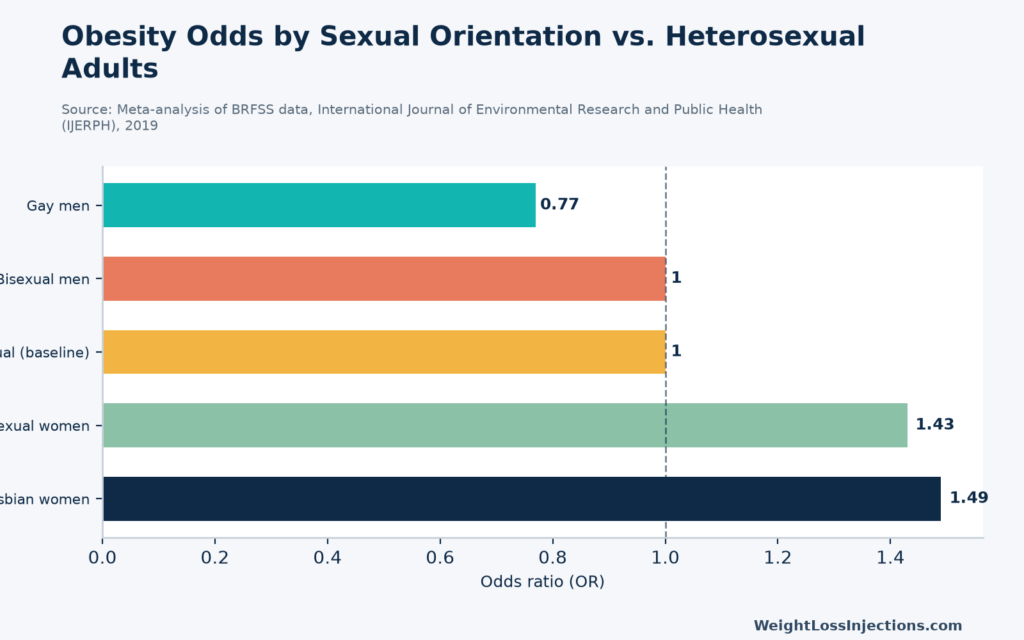
Lesbian and bisexual women have higher odds of obesity than heterosexual women — 49% and 43% higher, respectively — while gay men show consistently lower odds (GWU STOP Obesity Alliance; IJERPH).
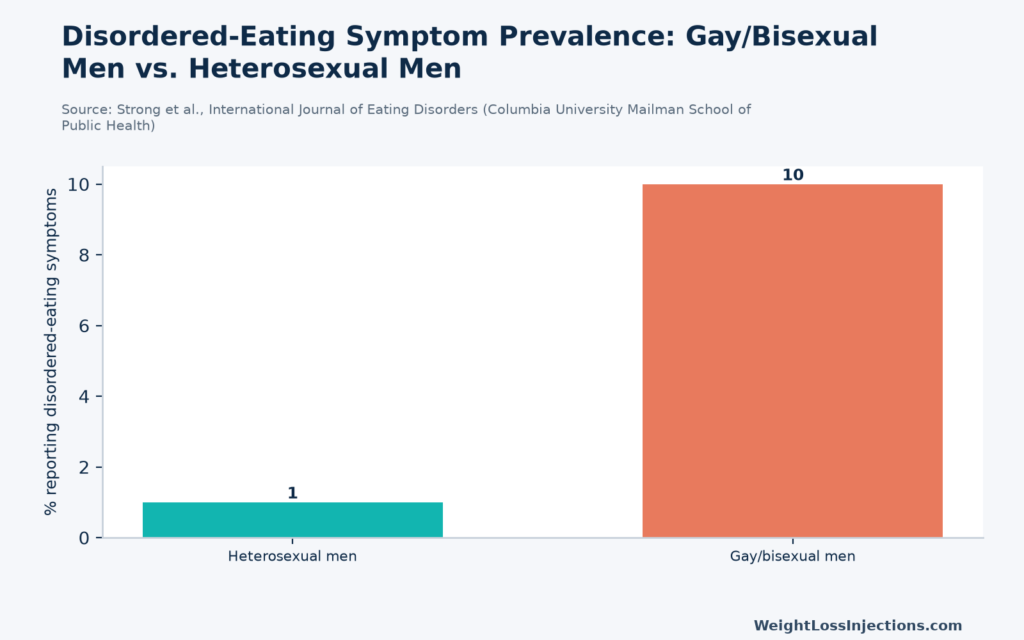
Gay/bisexual men have markedly elevated eating-disorder rates — disordered-eating symptoms are roughly 10x more common than in heterosexual men (International Journal of Eating Disorders).
Transgender individuals show elevated eating-disorder prevalence — ~17.7% lifetime versus ~1% generally — making pre-treatment screening important (European Eating Disorders Review).
Tirzepatide, unlike semaglutide, carries an FDA warning that delayed gastric emptying can reduce oral contraceptive/estradiol absorption (FDA Zepbound label).
GLP-1s have no meaningful interaction with antiretroviral therapy and appear effective for HIV-associated lipohypertrophy (IAS-USA).
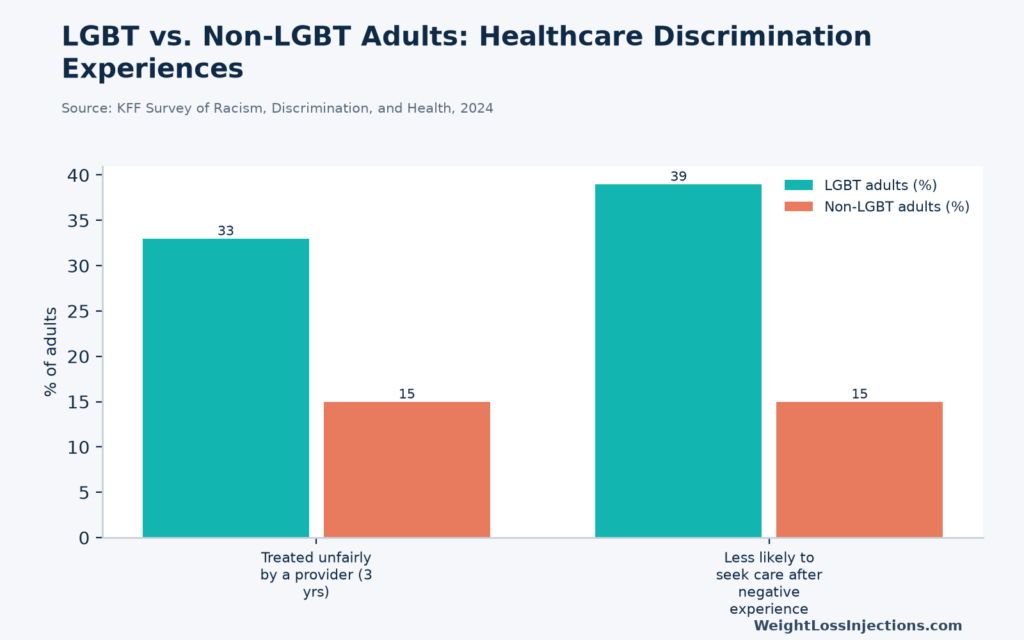
LGBT adults are over twice as likely to report unfair provider treatment (33% vs. 15%), shaping willingness to seek care (KFF).
Insurance coverage for GLP-1s is inconsistent for everyone, with ~62% of obesity-related prescriptions denied on first pass in 2024 (The Atlantic; IntuitionLabs).
Journalism is documenting GLP-1 uptake inside gay body-image culture, warning rapid weight loss can intensify existing appearance pressure (Out Magazine).
Introduction: Do GLP-1 medications work differently for LGBTQ+ people?
GLP-1 receptor agonists like semaglutide (Ozempic, Wegovy) and the dual GIP/GLP-1 agonist tirzepatide (Mounjaro, Zepbound) work the same way regardless of who takes them. But the population-level context around obesity, body image, hormone therapy, and healthcare access is measurably different for lesbian, gay, bisexual, and transgender people — context that matters for how these medications should be discussed, screened for, and monitored.
This isn’t about stereotyping individuals. It’s population-level epidemiology: CDC surveillance data and peer-reviewed research show sexual orientation and gender identity correlate with different average rates of obesity, eating disorders, and access to non-discriminatory care (CDC/NCHS). Any individual may fall anywhere on these spectrums — but clinicians and patients benefit from knowing where the documented disparities lie.
Obesity and Weight-Related Health Disparities in LGBTQ+ Populations
The relationship between sexual orientation and body weight isn’t uniform. CDC data show mean body weight was lower in gay men than heterosexual men, but higher in lesbian and bisexual women than heterosexual women, with the latter also showing higher average BMI and waist circumference on exams (CDC/NCHS).
A 2019 meta-analysis using Behavioral Risk Factor Surveillance System (BRFSS) data quantified this: lesbian women had 49% higher odds of obesity (OR 1.49) and gay men had 23% lower odds (OR 0.77) versus straight counterparts; bisexual women had 43% higher odds (OR 1.43) while bisexual men showed no significant difference (IJERPH). A separate meta-analysis found nearly identical patterns (lesbian OR 1.41, bisexual women OR 1.24, gay men OR 0.72) (Oxford Academic).
Race intersects with these patterns: Black bisexual women had the highest obesity rates in BRFSS data, while Black lesbians had lower rates than straight counterparts — opposite the pattern among white and Hispanic women (GWU STOP Obesity Alliance).
These disparities carry downstream consequences: lesbian and bisexual women in NHIS data reported higher lifetime rates of diabetes, heart disease, and hypertension (CDC/NCHS).
WeightLossInjections.com editorial note: Population averages describe groups, not individuals. Use this data to understand why intake forms increasingly ask about sexual orientation — not to assume anything about a specific patient.
Screening for Eating Disorders Before Starting a GLP-1
This is arguably the most important consideration for LGBTQ+ patients starting a GLP-1 — and the one most likely skipped in a rushed telehealth visit.
Gay and bisexual men show dramatically elevated rates of eating disorders. A widely cited Columbia University Mailman School of Public Health study found disordered-eating symptoms roughly 10 times more common among gay/bisexual men (10%) than heterosexual men (1%) (International Journal of Eating Disorders; ScienceDaily). A more recent study found sexual minority adults had 2–4 times greater odds of a DSM-5 eating-disorder diagnosis (Current Opinion in Psychiatry).
Transgender and gender-diverse people show some of the highest rates in the literature: a systematic review estimated eating-disorder prevalence at 17.7% versus about 1% generally (European Eating Disorders Review), while a large claims-data study found 2.43% of people receiving gender-affirming care had a diagnosed eating disorder, rising to 5.60% among patients aged 12–15 (International Journal of Eating Disorders). Other reviews estimate 20–50% of transgender and gender-diverse adults report disordered-eating behaviors (Journal of Eating Disorders; PubMed), and one Danish study found 80.6% of transgender respondents with disordered eating used food and diet to modify sex characteristics — a motivation clinicians should ask about directly (Rasmussen et al.).
Body dysmorphic concerns compound this picture: a 2020 survey found body dysmorphic disorder symptoms in more than 49% of gay and bisexual participants, with muscle dysmorphia documented as a distinct, common pattern among gay men (EverydayHealth.com; OutCare Health).
Our take at WeightLossInjections.com: If you’re LGBTQ+ and considering a GLP-1 for weight management, ask your prescriber directly whether they screen for eating-disorder history and disordered-eating behaviors as a standard part of intake — not as an afterthought. Given the prevalence data above, this isn’t an optional step; it’s foundational to prescribing safely.
Eating-disorder and body-image screening should be a standard part of GLP-1 intake, especially for gay/bisexual men and transgender patients.
Transgender-Specific Considerations: Hormones, Absorption, and Fertility
Transgender patients on gender-affirming hormone therapy (GAHT) face GLP-1 pharmacology questions cisgender patients don’t.
Oral estradiol and delayed gastric emptying. GLP-1 and GIP/GLP-1 medications work partly by slowing gastric emptying. The FDA label for Zepbound (tirzepatide) states the drug “delays gastric emptying and has the potential to impact the absorption of concomitantly administered oral medications,” and instructs patients using oral hormonal contraceptives to switch to a non-oral method or add a barrier method for four weeks after initiation and each dose escalation (FDA Zepbound label). A pharmacokinetic study found tirzepatide reduced oral contraceptive exposure by roughly 20% after a single dose, with analyses citing reductions up to 60% at peak effect (Washington State Health Care Authority; Celerion). A systematic review confirmed tirzepatide significantly reduced oral contraceptive plasma concentration, while five other GLP-1 receptor agonist studies showed no significant effect — tirzepatide’s absorption effect appears more pronounced than semaglutide’s (PubMed). Because oral estradiol shares the same absorption pathway, transfeminine people using it alongside tirzepatide should discuss timing with their prescriber; transdermal estradiol bypasses this mechanism entirely (Medscape).
Testosterone and injectable hormones. Injectable testosterone shares no metabolic pathway with semaglutide or tirzepatide, and no significant interaction has been identified, since injectable/transdermal routes don’t depend on gastric transit time (PMC/NIH).
Body composition and fertility. GLP-1-driven weight loss involves some lean-mass reduction alongside fat loss — estimates range from 15% to 60% of total weight lost, though newer MRI research suggests much of this is proportionate to expected age-related muscle change rather than disproportionate wasting (PubMed). FDA labeling recommends discontinuing semaglutide at least two months before a planned pregnancy and tirzepatide at least four weeks before, given insufficient human safety data; this applies to anyone with reproductive capacity, including transgender men and non-binary people, regardless of hormone therapy status.
WeightLossInjections.com editorial note: None of this means GLP-1s are unsafe for transgender patients on hormone therapy — no major medical society has flagged a fundamental contraindication. It means timing and hormone delivery route deserve a specific conversation, not a generic one.
GLP-1 Medications and People Living With HIV
People living with HIV (PWH) face their own weight-related profile, driven substantially by antiretroviral therapy (ART) itself. Modern integrase strand transfer inhibitor (InSTI)- and tenofovir alafenamide (TAF)-based regimens cause significantly more weight gain than older regimens, with disproportionately greater increases in Black women specifically (IAS-USA).
The encouraging news: GLP-1 receptor agonists have no clinically meaningful pharmacokinetic interactions with antiretroviral drugs and can be safely coadministered, per a clinical review from IAS–USA. A US cohort of 222 people with HIV starting semaglutide showed mean weight loss of 6.47 kg at one year, and a Greek study found median weight loss of 14.6 kg at 24 months in patients with baseline BMI over 35 — alongside improved inflammatory markers and a CD4+/CD8+ ratio increase from 0.54 to 0.83 (IAS-USA).
For HIV-associated lipohypertrophy — abnormal fat redistribution some people with HIV experience — a randomized, placebo-controlled phase 2b trial of once-weekly semaglutide 1.0 mg found significant reductions in visceral and subcutaneous adipose tissue, with improved glucose metabolism and lipid profiles (IAS-USA).
Evidence is still maturing: IDSA recommends reserving GLP-1s for select situations in PWH pending more trial data (IAS-USA); clinicians typically monitor lean mass and nutrition closely given some PWH already have sarcopenia or lipoatrophy from earlier ART.
Access, Equity, and Finding Competent Care
Even when clinically appropriate, LGBTQ+ patients face compounding barriers to getting a GLP-1 prescribed.
Discrimination shapes whether people seek care at all. A 2024 KFF survey found 33% of LGBT adults reported being treated unfairly by a provider in the past three years, versus 15% of non-LGBT adults; 39% said a negative experience made them less likely to seek care again (KFF). These numbers worsen for lower-income LGBT adults (70% vs. 51% for higher-income LGBT adults).
Coverage barriers hit everyone but compound for populations already facing cost friction. Only about 1% of ACA marketplace plans covered Wegovy in 2024, versus 82% covering Ozempic for diabetes (IntuitionLabs). Only 28% of new obesity-focused GLP-1 prescriptions were filled via insurance in 2024, with roughly 62% denied on first pass (The Atlantic; IntuitionLabs). Medicaid coverage remains optional, with only 13 states covering GLP-1s for obesity as of January 2026 (KFF).
Telehealth has expanded access but isn’t a substitute for LGBTQ-competent evaluation. Telehealth platforms can prescribe FDA-approved GLP-1s after remote history review, lowering geographic barriers (Doctronic), but rapid intake is exactly where eating-disorder and hormone-interaction screening gets skipped. Directories like the LGBTQ+ Healthcare Directory and OutCare Health’s OutList help patients find documented LGBTQ-competent providers.
Access barrier
Data point
Source
Provider mistreatment
33% of LGBT adults treated unfairly by a provider in 3 years (vs. 15% non-LGBT)
The Cultural Angle: GLP-1s and Body Image in Gay Community Spaces
Beyond clinical data, journalists have documented how GLP-1s are landing inside gay community culture. Out Magazine’s reporting notes that gay and bisexual men already navigate “toxic gym culture,” image-focused circuit-party spaces, and body-shaming dating-app shorthand — and that GLP-1s are entering this environment as both a genuine health tool and a new pressure point (Out Magazine).
Dr. Kevin R. Gendreau, a gay physician board-certified in obesity medicine with a personal history of binge-eating disorder, told Out Magazine there is “a real risk that these meds get co-opted to fuel restrictive eating or perfectionism rather than health improvements” in a community already facing high rates of body-image pressure (Out Magazine). Dr. Anne Marie O’Melia, an eating-disorder-recovery psychiatrist, cautioned that cosmetic-purpose prescribing “refuels the cultural and medical mythology that weight is a choice and size is a disorder that needs correcting” (Out Magazine). Clinicians also flagged that side effects like constipation and bloating can affect comfort during sex — worth raising proactively with a provider (Out Magazine).
Our take at WeightLossInjections.com: GLP-1 medications are legitimate treatments for obesity and its associated conditions — not tools for chasing an aesthetic ideal. If you notice a GLP-1 conversation shifting from “managing a diagnosed health condition” to “fixing how I look to be desirable,” that’s worth naming out loud with your prescriber or a therapist, ideally one with LGBTQ-specific training.
Clinicians increasingly recommend pairing GLP-1 treatment with body-image-aware mental health support in LGBTQ+ community contexts.
Frequently Asked Questions
Yes, on a population level. Meta-analyses using national survey data (including BRFSS) consistently find gay men have 23–34% lower odds of obesity than heterosexual men — a population average, not a statement about any individual (IJERPH; Oxford Academic).
Research hasn’t settled on a single cause; studied factors include minority stress and disparities in preventive-care access — but the pattern itself is consistent across independent surveys (American Journal of Public Health; CDC/NCHS).
There’s no outright contraindication, but the labels warn that delayed gastric emptying can reduce absorption of oral hormonal medications, especially during early weeks and after each dose increase. Discuss timing with your prescriber; transdermal estradiol (patch/gel) avoids this mechanism entirely (FDA Zepbound label).
The interaction appears less pronounced with semaglutide. A systematic review found tirzepatide significantly reduced oral contraceptive absorption while five studies of other GLP-1 receptor agonists did not (PubMed).
If you’re LGBTQ+, yes — given documented elevated rates in gay/bisexual men (2–4x general-population odds) and transgender people (~17.7% lifetime prevalence) (Current Opinion in Psychiatry; European Eating Disorders Review). Ask your prescriber if screening is part of intake.
Current evidence suggests no clinically meaningful pharmacokinetic interaction with antiretrovirals, with promising results for HIV-associated lipohypertrophy. IDSA currently recommends reserving GLP-1s for select situations pending further trial data (IAS-USA).
Directories such as the LGBTQ+ Healthcare Directory and OutCare Health’s OutList list LGBTQ-affirming providers — worth using given that 33% of LGBT adults report unfair treatment by providers (KFF).