![Unbranded [pillar-drug-class] injection pen on a neutral background — WeightLossInjections.com editorial hero](https://weightlossinjections.com/wp-content/uploads/2026/07/hero_mounjaro_c5_lifestyle-1200x675.png)
Grouped bar chart comparing Mounjaro tirzepatide weight loss results by dose (5 mg, 10 mg, 15 mg) across SURMOUNT-1 (non-T2DM) and SURMOUNT-2 (obesity + T2DM) clinical trials, dual-color grouping,…
- The pivotal SURMOUNT-1 trial published in the New England Journal of Medicine showed tirzepatide 15 mg produced a mean body-weight reduction of −22.4% over 72 weeks in adults with obesity who did not have type 2 diabetes — the largest weight-loss result ever recorded for a once-weekly injection in a large clinical trial.
- At 10 mg, participants lost an average of −21.4%; at 5 mg, −16.5% — all versus −2.4% on placebo.
- People with type 2 diabetes lose meaningfully less: SURMOUNT-2 showed ~15.7% at 15 mg in the obesity + T2DM population.
- Weight loss begins slowly during the 2.5 mg tolerability phase, accelerates through weeks 8–36, then plateaus toward week 72.
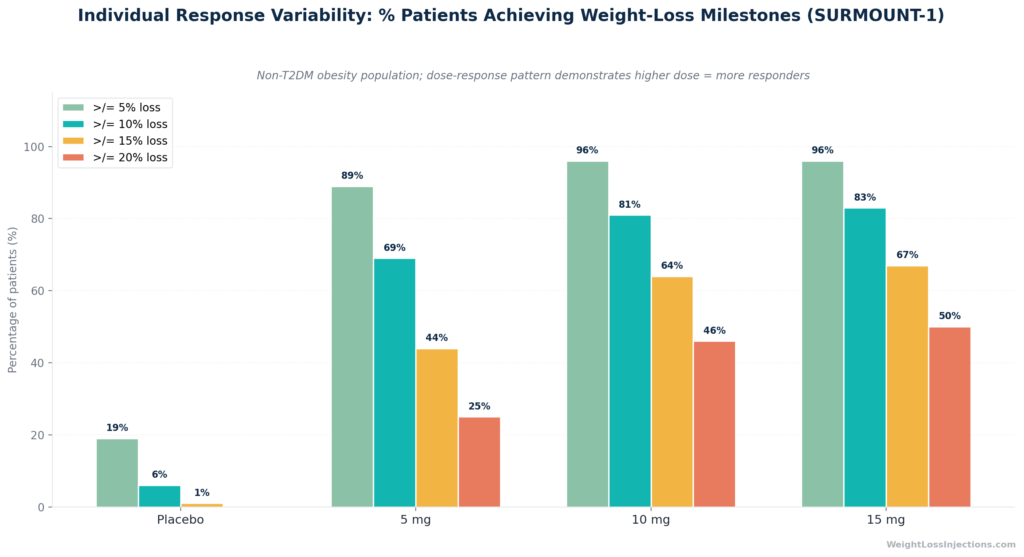
- More than half of 15 mg patients (57%) lost ≥20% of their body weight — a threshold historically associated with bariatric surgery.
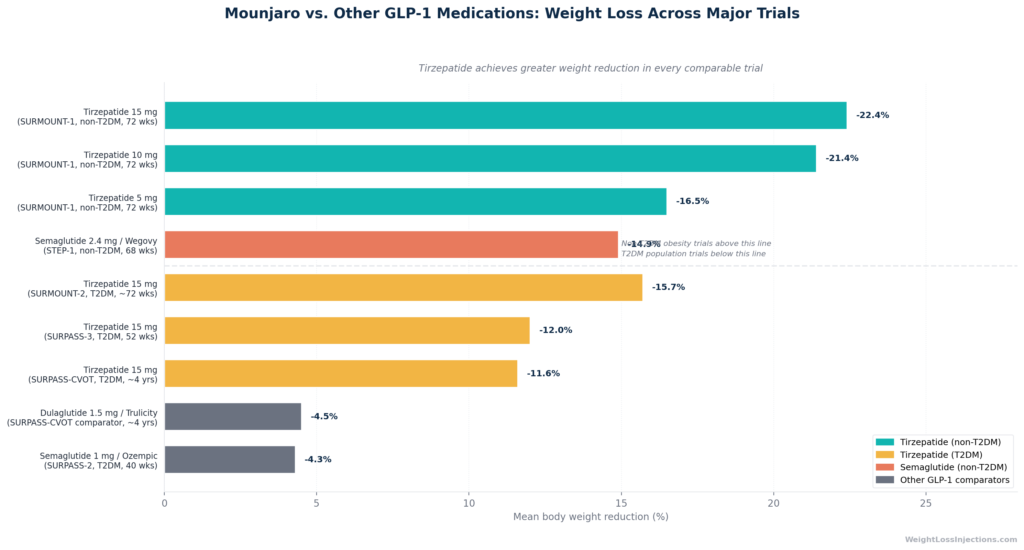
- Mounjaro outperforms Wegovy (semaglutide 2.4 mg) in available data: ~22.4% vs. ~14.9% in separate large obesity trials.
- Weight tends to return after stopping — plan for long-term, chronic use.
Jump to:
Mounjaro vs. Wegovy · After Stopping
The best-available clinical evidence shows that at the highest dose (15 mg), tirzepatide — the active molecule in Mounjaro — produced an average body-weight reduction of 22.4% over 72 weeks in the SURMOUNT-1 trial. For someone starting at 230 pounds, that translates to approximately 52 pounds lost. No once-weekly injectable has produced a larger mean weight-loss result in a Phase 3 trial of this size.
Before you reach for that number as your personal benchmark, one distinction matters critically: Mounjaro is FDA-approved for type 2 diabetes (T2DM), and the 22.4% figure comes from SURMOUNT-1, which enrolled adults with obesity who did not have T2DM. The closely related drug Zepbound — identical active ingredient, different FDA label — carries the obesity indication. When the same molecule is studied in people who have both obesity and T2DM (SURMOUNT-2), weight loss falls to approximately 15.7% at 15 mg. If you have T2DM, that is your more relevant benchmark. If you are using Mounjaro off-label for weight loss without diabetes, SURMOUNT-1 is the most applicable data.
This article presents dose-by-dose tables, a week-by-week weight loss timeline, a comparison to Wegovy, and the individual factors that determine whether your outcome lands closer to 10% or 22%. Every figure traces back to a primary clinical source. The editorial team at WeightLossInjections.com has reviewed this article for accuracy as of June 2026.
Average Weight Loss on Mounjaro by Dose (2.5 mg through 15 mg)
Tirzepatide is dispensed in six dose strengths — 2.5 mg, 5 mg, 7.5 mg, 10 mg, 12.5 mg, and 15 mg — but not all of these doses are equivalent from a weight-loss standpoint. The FDA Prescribing Information states explicitly that 2.5 mg is an initiation dose for tolerability and is not intended for glycemic control at that strength. The same principle applies to weight loss: 2.5 mg is the price of admission, not the treatment destination.
The three therapeutic weight-loss doses studied in SURMOUNT-1 were 5 mg, 10 mg, and 15 mg. The results, published in the New England Journal of Medicine and verified by a 2023 PMC systematic review, are as follows:
SURMOUNT-1 Weight Loss by Dose (Non-T2DM Obesity Population, 72 Weeks)
| Tirzepatide Dose | Mean % Body Weight Loss | Approx. lbs Lost (starting 230 lbs) | Patients Losing ≥20% |
|---|---|---|---|
| 5 mg | −16.5% | ~38 lbs | 35% |
| 10 mg | −21.4% | ~49 lbs | 55% |
| 15 mg | −22.4% | ~52 lbs | 57% |
| Placebo | −2.4% | ~6 lbs | 3% |
Source: SURMOUNT-1, NEJM 2022; PMC tirzepatide efficacy review, 2023.
Several things stand out in this table. First, even the lowest therapeutic dose (5 mg) produced more than six times the weight loss of placebo. Second, the jump from 10 mg to 15 mg is relatively modest — about 1 percentage point of additional loss — while the jump from 5 mg to 10 mg is nearly 5 percentage points. Third, and perhaps most striking: 57% of patients on 15 mg lost ≥20% of their body weight, a threshold historically reserved for bariatric surgery outcomes.
SURMOUNT-2 Weight Loss by Dose (Obesity + Type 2 Diabetes, ~72 Weeks)
For patients who have both obesity and type 2 diabetes, SURMOUNT-2, published in The Lancet in 2023, provides the relevant benchmark:
| Tirzepatide Dose | Mean % Body Weight Loss |
|---|---|
| 10 mg | ~13.4% |
| 15 mg | ~15.7% |
| Placebo | ~3.3% |
Source: The Lancet SURMOUNT-2, 2023.
The T2DM population caveat is important and consistent across all GLP-1 and dual GIP/GLP-1 medications: insulin resistance in T2DM blunts the weight-reduction response. A person with obesity and T2DM who achieves 15% weight loss is experiencing a clinically significant, meaningful outcome — but the ceiling is lower than in non-diabetic peers. This is a biological reality of the disease, not a failure of the drug or the patient.
SURPASS Trial Results: What Clinical Studies Show
The SURMOUNT data above focuses on weight loss as a primary goal. For patients with T2DM, the SURPASS program — a five-trial Phase 3 program evaluating tirzepatide specifically in T2DM populations — provides the foundational efficacy dataset, with weight loss measured as a secondary endpoint.
The American Diabetes Association summarized the SURPASS program as the most comprehensive Phase 3 evaluation of a T2DM agent in recent history. Across all five trials, tirzepatide produced substantial and consistent weight reduction in every head-to-head comparison.
SURPASS-1: Monotherapy vs. Placebo
SURPASS-1, published in The Lancet in June 2021, enrolled 478 treatment-naïve T2DM patients in a 40-week, placebo-controlled trial. The weight results by dose:
| Arm | Body Weight Reduction |
|---|---|
| Tirzepatide 5 mg | −7.0 kg (−7.9%) |
| Tirzepatide 10 mg | −8.5 kg (~9.7%) |
| Tirzepatide 15 mg | −9.5 kg (−11.0%) |
| Placebo | ~−0.7 kg |
Source: Lilly Investor — SURPASS-1 Lancet publication.
SURPASS-2: The Landmark Head-to-Head vs. Semaglutide
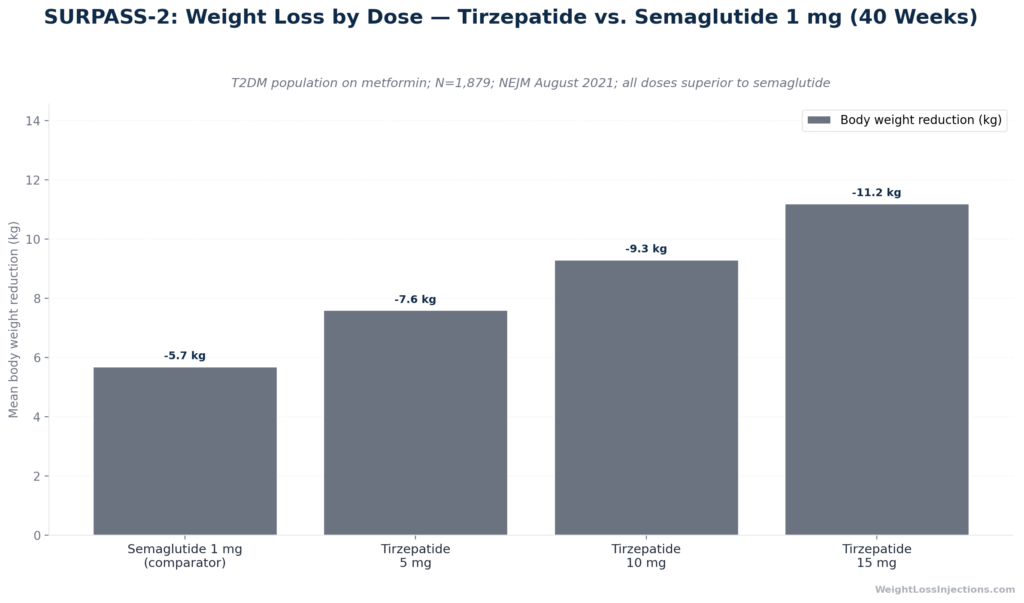
The most clinically significant SURPASS result for weight loss comparisons is SURPASS-2, published in the New England Journal of Medicine in August 2021. This 40-week trial (N=1,879) pitted tirzepatide directly against semaglutide 1 mg (the standard Ozempic dose) in T2DM patients on metformin:
| Arm | Body Weight Change |
|---|---|
| Tirzepatide 5 mg | −7.6 kg |
| Tirzepatide 10 mg | −9.3 kg |
| Tirzepatide 15 mg | −11.2 kg |
| Semaglutide 1 mg | −5.7 kg |
Source: SURPASS-2, NEJM 2021.
All three tirzepatide doses significantly outperformed semaglutide 1 mg for weight loss. An important caveat: semaglutide 1 mg is not the maximum approved dose — Ozempic goes up to 2 mg and Wegovy reaches 2.4 mg. This comparison does not pit tirzepatide’s peak against semaglutide’s peak.
SURPASS-3: Reversing the Weight Gain of Insulin Therapy
A persistent clinical problem with insulin therapy in T2DM is weight gain. SURPASS-3, published in The Lancet in August 2021, enrolled 1,444 T2DM patients on metformin ± SGLT2 inhibitor over 52 weeks and compared tirzepatide to insulin degludec. The weight results were dramatic: tirzepatide 15 mg produced −12.9 kg of weight reduction while insulin degludec produced +2.3 kg of weight gain — a 15.2 kg differential in a single year. Source: SURPASS-3, The Lancet 2021.
For T2DM patients currently on insulin who are considering Mounjaro, this comparison is directly relevant: tirzepatide not only avoids the weight gain associated with insulin therapy but actively reverses it.
SURPASS-CVOT: Sustained Weight Loss Over Four Years
The most recent and longest-duration SURPASS data comes from SURPASS-CVOT, published in the New England Journal of Medicine in December 2025. This landmark cardiovascular outcomes trial (N=13,299; median ~4-year follow-up) compared tirzepatide up to 15 mg against dulaglutide 1.5 mg in T2DM patients with established cardiovascular disease.
| Parameter | Tirzepatide | Dulaglutide |
|---|---|---|
| Body weight reduction | −11.6% | −4.5% |
| Duration | ~4 years | ~4 years |
Source: SURPASS-CVOT, NEJM December 2025.
The key clinical insight from SURPASS-CVOT: tirzepatide’s weight-reduction effect is sustained over four years, not a temporary early phenomenon. The drug continues to maintain substantially lower body weight compared to comparator long after the titration phase ends.
Summary: SURPASS Program Weight Data (T2DM Population)
| Trial | Tirzepatide 15 mg | Comparator | Differential |
|---|---|---|---|
| SURPASS-1 | −9.5 kg (−11.0%) | −0.7 kg (placebo) | −8.8 kg advantage |
| SURPASS-2 | −11.2 kg | −5.7 kg (semaglutide 1 mg) | −5.5 kg advantage |
| SURPASS-3 | −12.9 kg | +2.3 kg (insulin degludec) | −15.2 kg advantage |
| SURPASS-CVOT | −11.6% | −4.5% (dulaglutide) | −7.1 pp advantage |
Sources: Pooled SURPASS analysis, PubMed; diaTribe tirzepatide summary.
If you have T2DM, use the SURPASS data as your weight-loss reference point — not SURMOUNT-1. If you do not have T2DM and are using Mounjaro off-label for weight loss, SURMOUNT-1 is your baseline.
Week-by-Week Weight Loss Timeline on Mounjaro
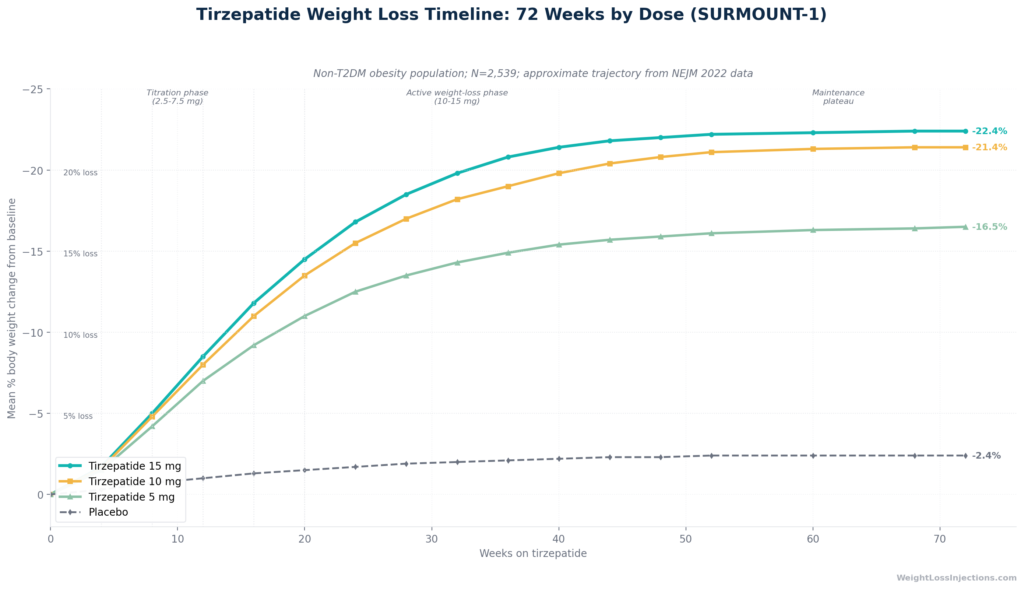
Multi-line chart showing tirzepatide weight loss percentage over 72 weeks for 5 mg, 10 mg, 15 mg, and placebo arms from SURMOUNT-1 trial data, x-axis weeks 0–72, y-axis mean percent body weight…
One of the most common questions from people starting Mounjaro is not “how much will I lose?” but “how fast will I lose it?” The answer requires understanding the mandatory titration structure built into the FDA dosing protocol.
Per the FDA Prescribing Information, tirzepatide begins at 2.5 mg and escalates in 2.5 mg increments every 4 weeks minimum. Reaching the maximum 15 mg dose takes a minimum of 20 weeks. The weight loss curve is therefore not linear — it follows the dose ladder, accelerating with each step up and eventually plateauing near weeks 52–72.
Here is what the clinical data from SURMOUNT-1 and the PMC tirzepatide efficacy review shows by phase:
Weeks 1–4 (2.5 mg Initiation Dose)
This is the tolerance phase, not the treatment phase. The 2.5 mg starting dose is explicitly below the therapeutic threshold for meaningful weight reduction — it exists to allow the GI system to adapt to tirzepatide’s effects. Expect little to no weight loss on the scale. Appetite suppression begins but is mild. Most patients experience the most prominent GI side effects (nausea, constipation, early satiety) during weeks 1–3 as the body adjusts. This is also the period with the highest dropout rate in clinical studies.
What to watch for: early satiety at meals and reduced cravings. These are signs the mechanism is activating, even if the scale hasn’t moved dramatically.
Weeks 5–8 (First Escalation to 5 mg)
Moving from 2.5 mg to 5 mg is the first meaningful dose step. Most patients report their first significant appetite reduction during this window. Average cumulative loss in the 5 mg arm at this phase: 1–3% body weight. GI side effects may briefly intensify at dose escalation before settling. The caloric restriction that drives weight loss becomes more pronounced as the drug approaches steady-state plasma concentration (~4 weeks at each dose level).
Weeks 9–20 (5 mg to 7.5 mg Escalation)
Weight loss accelerates. Patients on 7.5 mg are moving through the first truly therapeutic dose range. Typical rate: 0.5–1.5 lbs per week during active loss windows at each escalating dose. Cumulative loss by week 20 for patients tracking toward 7.5–10 mg: approximately 5–8% of starting body weight. Most patients notice this phase in their clothing — sizes begin to change, and the loss becomes visually apparent to others.
Weeks 21–36 (7.5 mg to 10 mg)
This is often the fastest phase of active loss for patients approaching 10 mg maintenance. SURMOUNT-1 data shows the 10 mg arm had achieved approximately 12–15% cumulative loss by week 36. GI side effects typically improve after dose stabilization, allowing more consistent caloric restriction. Many patients describe this period as the most motivating — the drug’s appetite-suppression effect is strongest at 10 mg, food noise quiets substantially, and the clinical results are clearly tracking.
Weeks 37–52 (10 mg to 15 mg)
Patients escalating to 15 mg enter what SURMOUNT-1 shows as the approach to maximum efficacy. Cumulative loss for the 15 mg arm at week 52: approximately 20–22% of starting body weight. Highest responders cross the 20% threshold in this phase. Not all patients reach 15 mg — some achieve excellent clinical benefit and maintain at 5 mg or 10 mg; dosing is individualized based on tolerability and clinical response, per the FDA label.
Weeks 53–72 (Maintenance Phase)
Weight loss slows considerably as the body reaches a new homeostatic equilibrium. The plateau is normal and expected — it represents the body defending its new lower weight with the drug’s support. The rate of change drops from 1–2 lbs per week at peak to fractions of a pound per week. SURMOUNT-1 participants at week 72 on 15 mg had reached a mean of −22.4% from baseline, the study’s primary efficacy endpoint.
Weight Loss Timeline at a Glance (15 mg Trajectory, SURMOUNT-1)
| Timeframe | Approximate Cumulative Weight Loss |
|---|---|
| Week 4 | ~1–2% |
| Week 12 | ~7–8% |
| Week 24 | ~13–15% |
| Week 36 | ~17–19% |
| Week 52 | ~20–22% |
| Week 72 | ~22–24% (peak efficacy group) |
Sources: SURMOUNT-1, NEJM 2022; PMC tirzepatide efficacy review, 2023.
The most common mistake patients make is judging Mounjaro’s effectiveness during weeks 1–4 at 2.5 mg, which is the tolerance phase — not the treatment phase. The dose isn’t there yet.
Our Top 3 · October 2026
The best GLP-1 providers right now
Independently reviewed. Ranked by price, medication access, provider quality, and patient outcomes.
Renew GLP
Personalized GLP-1, GIP plans: Semaglutide & Tirzepatide.
Medvi
No membership or hidden fees. Everything you need is included.
Trimi
US-licensed clinicians and shipped to your door, from $99/mo.
Factors That Affect How Much Weight You Lose
Clinical averages are population means. The SURMOUNT-1 mean of 22.4% at 15 mg represents the center of a wide distribution — some patients lost 30%+ while others on the same dose lost 12%. Understanding what drives that variation is essential for setting realistic expectations and optimizing your own outcomes.
1. Whether You Have Type 2 Diabetes
This is the single largest non-modifiable predictor of weight-loss magnitude. SURMOUNT-2 showed ~15.7% loss at 15 mg in obesity + T2DM patients vs. 22.4% in SURMOUNT-1’s non-T2DM population — a roughly 7 percentage-point gap at the maximum dose. The underlying mechanism: insulin resistance in T2DM impairs lipolysis, and the co-occurring medications, altered metabolic signaling, and hormonal disruption that characterize T2DM all reduce the drug’s maximum weight effect. Sources: SURMOUNT-1, NEJM; SURMOUNT-2, The Lancet.
T2DM patients still achieve clinically meaningful, substantial weight loss — 15% is not a minor result. But the ceiling is lower, and expectations calibrated to SURMOUNT-1 will lead to disappointment in a T2DM context.
2. Dose Achieved and Maintained
Dose is the strongest modifiable predictor of outcome. The SURMOUNT-1 dose-response data is clear: 5 mg produces −16.5%, 10 mg produces −21.4%, and 15 mg produces −22.4%. Patients who cannot tolerate escalation beyond 5 mg due to GI side effects will see meaningfully lower results than those who reach the maximum dose. GI tolerability determines the dose ceiling for many patients — which makes managing early-phase side effects (through slower titration, dietary adjustments, anti-nausea strategies) an important clinical goal in its own right. Source: SURMOUNT-1, NEJM.
3. Baseline Body Weight and BMI
Higher starting BMI generally correlates with higher absolute pounds lost, while percentage weight loss remains broadly consistent across BMI groups. A person starting at 350 lbs losing 20% sheds 70 lbs; a person starting at 200 lbs losing 20% sheds 40 lbs. Percentage is the more clinically meaningful comparator because it reflects metabolic burden. Both outcomes are substantial.
4. Diet and Lifestyle Co-Interventions
Mounjaro is FDA-labeled as “adjunct to diet and exercise” for a reason — it works synergistically with behavioral change, not as a replacement for it. Patients who make structured dietary changes alongside tirzepatide consistently outperform those who rely on the drug alone. The key inputs:
- Adequate protein intake: Approximately 1.2–1.6 g per kilogram of body weight per day helps preserve lean mass during rapid weight loss, sustaining metabolic rate
- Caloric deficit: The drug suppresses appetite; pairing this signal with whole-food dietary choices amplifies outcomes
- Resistance exercise: Compound strength training 2–3 times per week preserves metabolically active muscle during rapid fat loss
Source: Pooled SURPASS analysis, PubMed.
5. Adherence and Dosing Consistency
Tirzepatide reaches steady-state plasma concentration after approximately 4 weeks of once-weekly dosing at each level, per the FDA Prescribing Information. Missing doses breaks that steady state, reducing drug levels and blunting appetite suppression. The SURMOUNT-1 mean of 22.4% assumes consistent dosing per protocol. Inconsistent adherence is one of the most common reasons individual results fall below trial averages.
6. Concurrent Medications and Comorbidities
Several medication classes work against tirzepatide’s weight-loss mechanism:
- Antidepressants (particularly mirtazapine and some SSRIs/SNRIs) promote weight gain and can partially offset drug effects
- Antipsychotics (olanzapine, clozapine, quetiapine) have significant weight-promoting effects
- Corticosteroids increase gluconeogenesis, appetite, and fat deposition
- Insulin can oppose the net caloric deficit if doses are not appropriately reduced during tirzepatide initiation
Hypothyroidism, if undertreated, independently limits weight loss on any intervention and should be evaluated before attributing poor response to tirzepatide alone. TSH at baseline is a reasonable screening step.
7. Sex and Hormonal Factors
Some evidence suggests modest differences in weight-loss rate between male and female patients at equivalent doses, consistent with patterns seen across GLP-1 and GIP/GLP-1 agents. This effect is smaller in magnitude than the dose or T2DM-status effect. Peri- and post-menopausal hormonal changes can affect rate and distribution of fat loss, though both sexes achieve clinically significant outcomes at all therapeutic doses.
8. Gut Microbiome and Emerging Biological Variability
Emerging research suggests that individual variation in gut microbiome composition affects GLP-1 drug response — a mechanistically plausible explanation for why two patients on identical doses, with identical demographics, can have substantially different results. This remains an active research area without actionable clinical guidance as of June 2026.
Working with a provider who understands tirzepatide pharmacology and can optimize these modifiable factors meaningfully improves outcomes. WeightLossInjections.com connects patients with telehealth providers experienced in GLP-1 and dual GIP/GLP-1 therapy — starting at [$X/month] for [service detail]. Source: SURMOUNT-2, The Lancet; Pooled SURPASS analysis.
How Does Mounjaro Weight Loss Compare to Wegovy?
Horizontal bar chart comparing weight loss results for Mounjaro/tirzepatide 15 mg SURMOUNT-1 (−22.4%), Wegovy/semaglutide 2.4 mg STEP-1 (−14.9%), tirzepatide 15 mg SURPASS-3 (−12.9 kg), and…
This is the question most people researching Mounjaro eventually ask, and the short answer is: in every available comparison, tirzepatide produces greater weight loss than semaglutide.
Direct Head-to-Head Data (SURPASS-2)
The closest thing to a direct comparison is SURPASS-2, which pitted tirzepatide against semaglutide 1 mg in T2DM patients. All three tirzepatide doses significantly outperformed semaglutide for weight loss — tirzepatide 15 mg (−11.2 kg) vs. semaglutide 1 mg (−5.7 kg). Every dose of tirzepatide was statistically superior to semaglutide 1 mg.
Critical caveat: Semaglutide 1 mg is below the maximum approved dose for weight management. Ozempic goes up to 2 mg; Wegovy is semaglutide at 2.4 mg/week. SURPASS-2 was not a peak-vs.-peak comparison.
Indirect Comparison: Obesity Trials (Different Studies)
For the obesity population, the relevant comparison is between separate large trials:
| Drug | Trial | Population | Duration | Mean Weight Loss |
|---|---|---|---|---|
| Tirzepatide 15 mg (Mounjaro/Zepbound) | SURMOUNT-1 | Non-T2DM obesity | 72 weeks | −22.4% |
| Semaglutide 2.4 mg (Wegovy) | STEP-1 | Non-T2DM obesity | 68 weeks | ~−14.9% |
| Tirzepatide 15 mg (T2DM) | SURPASS-2 | T2DM on metformin | 40 weeks | −11.2 kg |
| Semaglutide 1 mg (Ozempic) | SURPASS-2 | T2DM on metformin | 40 weeks | −5.7 kg |
Sources: SURPASS-2, NEJM; Innerbody Wegovy vs. Mounjaro comparison; WeightFAQ GLP-1 comparison, May 2026; SURPASS-CVOT, NEJM December 2025.
The indirect comparison shows approximately 7.5 percentage points in tirzepatide’s favor at peak doses in comparable obesity populations. This is not a head-to-head figure — different trials have different designs, populations, dropout rates, and timeframes — but the consistency of tirzepatide’s superiority across multiple study contexts is notable.
Why Does Tirzepatide Outperform Semaglutide?
The mechanistic answer lies in tirzepatide’s dual GIP + GLP-1 receptor agonism versus semaglutide’s GLP-1-only mechanism. GIP receptor agonism in adipose tissue appears to amplify fat metabolism and augment satiety signaling beyond what GLP-1 alone achieves. The combination of two incretin pathways drives deeper appetite suppression and more complete metabolic reprogramming — which the weight-loss data reflects. Source: diaTribe tirzepatide mechanism summary.
Cost Comparison
Mounjaro’s WAC (Wholesale Acquisition Cost) as of January 1, 2026 is $1,079.77 per 28-day supply, uniform across all dose strengths, per the Lilly official WAC disclosure. Wegovy lists at approximately $1,349/month. This makes tirzepatide roughly 20% cheaper per month at list price while delivering greater efficacy in available comparisons — a combination that drives strong patient interest.
Will the Weight Stay Off After Stopping Mounjaro?
This is one of the most important questions for anyone considering long-term Mounjaro therapy, and the evidence gives a clear, if sobering, answer: no — most weight returns after stopping.
The mechanism is not mysterious. Tirzepatide works by continuously suppressing appetite, slowing gastric emptying, and altering satiety signaling through GIP and GLP-1 receptors. These effects are active only while the drug is present in the system. With a half-life of approximately 5 days per the FDA Prescribing Information, meaningful drug effects begin dissipating within weeks of stopping. As plasma concentrations fall, hunger signals return, caloric intake rises, and the body’s biological drive to defend its prior higher weight reasserts itself.
What the Withdrawal Data Shows
Extension data from SURMOUNT-1 and SURMOUNT-4 (which enrolled participants following the same tirzepatide molecule) documents this effect rigorously. Participants who discontinued tirzepatide after achieving significant weight loss regained approximately two-thirds of lost weight within one year — a well-documented GLP-1 class effect consistent across semaglutide, liraglutide, and tirzepatide studies. Source: SURMOUNT-1, NEJM; PMC tirzepatide efficacy review.
This does not mean Mounjaro “doesn’t work.” It means obesity has a chronic disease model that requires long-term treatment, analogous to hypertension requiring continuous antihypertensive medication or hypercholesterolemia requiring ongoing statin therapy. Stopping the medication because you’ve reached a goal weight is similar to stopping blood pressure medication because your blood pressure is now controlled — the control was dependent on the treatment.
The FDA Prescribing Information frames Mounjaro as a chronic-use medication for T2DM management, consistent with this understanding. Providers prescribing it off-label for weight loss typically have the same long-term continuity framework in mind.
What a Responsible Long-Term Plan Looks Like
Working with a qualified provider to plan for long-term tirzepatide use involves:
- Establishing an ongoing monitoring rhythm — regular A1C, lipid panel, and weight check-ins to assess continued benefit and metabolic progress
- Determining optimal maintenance dose — not all patients need to remain at 15 mg indefinitely; some achieve durable maintenance at 10 mg or even 5 mg once the initial loss phase stabilizes
- Building sustainable dietary and behavioral habits during the active treatment phase — patients who use the drug’s appetite-suppression signal to establish new food patterns, protein-adequate eating, and regular movement tend to retain more weight loss if doses are eventually reduced
- Understanding the withdrawal curve — knowing the regain trajectory helps patients make informed decisions before discontinuing
Patients who make substantial dietary and behavioral changes during active Mounjaro use retain more weight loss than those who rely solely on the drug’s pharmacological effect. Starting with a clear long-term plan increases both weight outcomes and metabolic benefit. WeightLossInjections.com can connect you with a provider experienced in tirzepatide therapy — [$X/month] for [service detail].
Tornado (butterfly) bar chart showing factors that increase or decrease Mounjaro weight loss results — bars extending right for favorable factors (15 mg dose, no T2DM, diet + exercise integration,…
Our Take at WeightLossInjections.com
The SURMOUNT-1 figure of 22.4% body weight reduction at 15 mg deserves to be read carefully — not as a personal guarantee, but as what’s possible when the drug is used consistently at its highest dose in people without type 2 diabetes. In a clinical trial setting, that result made tirzepatide the most effective once-weekly injectable ever studied for weight loss. In the real world, that ceiling is achievable for a meaningful proportion of patients who reach and maintain 15 mg.
What separates the patients who get there from those who plateau well below the trial averages? In our experience reviewing the clinical data and the literature on adherence outcomes, it almost always comes down to the same set of factors: dose escalation to the maximum tolerated level, week-over-week injection consistency, protein-adequate eating during the active loss phase, realistic phase-appropriate expectations at 2.5 mg and 5 mg when results are modest, and a provider relationship that actively troubleshoots plateaus rather than accepting them.
The T2DM distinction also cannot be overstated enough. If you have type 2 diabetes, SURMOUNT-2 is your reference, not SURMOUNT-1. A 15% result in an obesity + T2DM population is not underperformance — it is a clinically meaningful outcome for a metabolically complex situation. The SURPASS CVOT data further confirms that weight reduction in T2DM patients on tirzepatide persists for years, not just weeks.
The weight-after-stopping question is perhaps the most practically important one for people considering starting Mounjaro. The honest answer is that most of the lost weight returns within a year of discontinuation. This is not a reason to not start — it is a reason to plan for long-term use, discuss a maintenance strategy before starting, and understand that you are treating a chronic condition, not completing a course of antibiotics.
WeightLossInjections.com evaluates and connects patients with licensed telehealth providers experienced in GLP-1 and dual GIP/GLP-1 therapy, including tirzepatide. Mounjaro is a prescription medication requiring evaluation by a licensed clinician. If you are exploring whether tirzepatide is appropriate for your situation, [service detail].
Medical Disclaimer: This article is for informational purposes only and does not constitute medical advice. Weight-loss results from clinical trials represent population averages; individual results will vary. Mounjaro (tirzepatide) is an FDA-approved prescription medication for type 2 diabetes mellitus. Off-label use for weight loss requires evaluation and prescription by a licensed healthcare provider. WeightLossInjections.com does not prescribe medications directly.
Reviewed by: the WeightLossInjections.com Staff
Last reviewed: June 2026
FAQ
Based on SURMOUNT-1 trajectory data, patients on tirzepatide 10–15 mg typically lose approximately 10–13% of body weight within the first 12–16 weeks. For someone starting at 230 pounds, that is roughly 23–30 pounds at the 3-month mark at higher doses. Patients still in early titration at 5 mg may be closer to 5–8%. The exact figure depends heavily on where you are in the dose escalation schedule at week 12 — the drug’s weight-loss effect scales with dose, and 2.5 mg and 5 mg initiation doses produce more modest early results.
During the active loss phase (approximately weeks 8–36), most patients lose roughly 0.5–1.5 lbs per week. The rate is faster at higher doses and during active dose escalations, and slower during the maintenance plateau phase that typically begins around weeks 40–52. Individual variation is substantial — some patients lose 2+ lbs per week during peak phases; others lose less than 0.5 lbs per week at the same dose. Track weekly averages rather than daily fluctuations to see the true trend. Source: SURMOUNT-1, NEJM 2022.
Yes, but the increment is modest. SURMOUNT-1 showed 10 mg produced −21.4% and 15 mg produced −22.4% — approximately 1 percentage point of additional loss at the highest dose. Both doses substantially outperformed placebo and both produced the ≥20% responder threshold in more than half of patients (55% at 10 mg, 57% at 15 mg). The larger marginal gain in SURMOUNT-1 came from the 5 mg → 10 mg step (~5 percentage points), not the 10 mg → 15 mg step. This does not mean stopping at 10 mg is wrong — many patients achieve excellent outcomes there — but patients who can tolerate 15 mg have a modest additional weight-loss benefit.
In available data, tirzepatide (Mounjaro/Zepbound) produces greater weight loss. SURMOUNT-1 showed −22.4% at tirzepatide 15 mg vs. the STEP-1 trial’s ~−14.9% for semaglutide 2.4 mg (Wegovy) — a roughly 7.5 percentage-point difference at peak doses in comparable non-T2DM obesity populations. These are separate trials, not a direct head-to-head, so treat the comparison as directionally meaningful rather than definitively precise. The mechanistic reason for tirzepatide’s advantage is its dual GIP + GLP-1 agonism vs. semaglutide’s GLP-1-only mechanism. On cost, Mounjaro lists at ~$1,079/month versus Wegovy’s ~$1,349/month — tirzepatide delivers more weight loss at lower list price. Sources: Innerbody comparison; WeightFAQ GLP-1 comparison.
Yes — most patients regain significant weight after stopping. Withdrawal data from SURMOUNT-1 and related tirzepatide extension studies showed approximately two-thirds of lost weight was regained within 1 year of discontinuation, consistent with the withdrawal pattern documented across GLP-1 class medications. Mounjaro works best as a long-term chronic treatment strategy for the same reason antihypertensives require ongoing use: the disease being treated (obesity, or T2DM) doesn’t resolve because a goal is reached. Sources: SURMOUNT-1, NEJM; PMC tirzepatide efficacy review.
Yes — significantly. Patients with T2DM lose less weight on average. SURMOUNT-2 (obesity + T2DM) showed ~15.7% loss at 15 mg versus 22.4% in SURMOUNT-1’s non-T2DM population — about a 7 percentage-point gap at peak dose. The insulin resistance underlying T2DM blunts the maximum weight-reduction effect. Both outcomes represent clinically meaningful results — T2DM patients who achieve 15% weight loss are still reducing cardiovascular risk substantially, improving glycemic control, and seeing significant metabolic benefit. But T2DM patients should calibrate expectations to SURMOUNT-2 figures, not SURMOUNT-1, to avoid disappointment.