![Unbranded [pillar-drug-class] injection pen on a neutral background — WeightLossInjections.com editorial hero](https://weightlossinjections.com/wp-content/uploads/2026/05/hero_zepbound_c1_cost-1200x675.png)
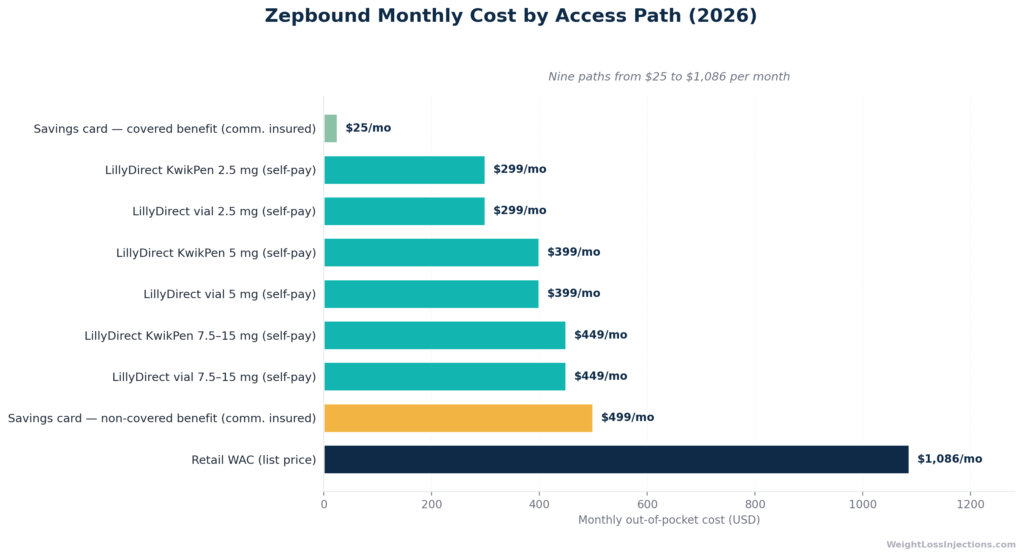
Zepbound Monthly Cost by Access Path (2026)
Zepbound’s official list price (WAC) is $1,086/mo for all six dose strengths, but very few patients pay that number. The cheapest uninsured path is Eli Lilly’s LillyDirect Self Pay Journey Program: $299/mo for 2.5 mg, $399/mo for 5 mg, and $449/mo for all higher doses, available in both single-dose vials and the new KwikPen launched February 23, 2026.
Commercially insured patients with coverage can use the Zepbound savings card for as little as $25/mo. Medicare beneficiaries gain a new $50/mo bridge program running July 1 – December 31, 2026. Compounded tirzepatide is no longer legally available to most patients; both the 503A and 503B compounding windows closed in early 2025.
What Zepbound Actually Costs Without Insurance in 2026
The $1,086 list price is the number that appears on pharmacy invoices and the one that makes headlines. It is almost never what uninsured patients actually pay, but you have to know which program you qualify for and enroll correctly. Three distinct price tiers exist depending on whether you have commercial insurance, government coverage, or no insurance at all.
The List Price (WAC): $1,086/mo
Eli Lilly’s pricing page for Colorado lists Zepbound’s Wholesale Acquisition Cost (WAC) at $1,086/mo for a 28-day supply, four single-dose injections at any of the six available strengths (2.5 mg through 15 mg). WAC is the manufacturer’s published price before rebates, discounts, or channel adjustments. It is the price floor from which all negotiations start, not an approximation of what you’ll pay at the pharmacy counter.
Retail pharmacy cash prices at major chains typically land at or modestly above WAC, anywhere from $1,086 to roughly $1,284/mo, depending on the pharmacy’s dispensing fee and regional markup. If you walk into a pharmacy without insurance, without a manufacturer program, and without a coupon, this is your exposure. It is an expensive starting point, but it is rarely your only option.
One structural fact worth understanding: Lilly’s WAC applies uniformly across all six dose strengths. Whether you are in your first month at 2.5 mg (a tolerability-only starting dose, per the Zepbound prescribing information) or at the 15 mg maintenance dose after titrating for five months, the list price is identical. This differs from how some medications are priced by dose and matters when you are calculating annual cost across the full titration sequence.
LillyDirect Self-Pay Vials: $299–$449/mo
As of December 1, 2025, Eli Lilly significantly reduced Zepbound self-pay prices on its LillyDirect platform, per CNBC’s reporting on the price cut. For patients who enroll in the Self Pay Journey Program on LillyDirect, the dose-by-dose pricing for single-dose vials is:
| Dose Strength | LillyDirect Vial Price (Self Pay Journey Program) |
|---|---|
| 2.5 mg | $299/mo |
| 5 mg | $399/mo |
| 7.5 mg | $449/mo |
| 10 mg | $449/mo |
| 12.5 mg | $449/mo |
| 15 mg | $449/mo |
Source: CNBC Dec 1, 2025 — LillyDirect price cut; Eli Lilly LillyDirect pricing page
The Self Pay Journey Program is not automatic — you must actively enroll on the LillyDirect platform. Outside the Journey Program, regular LillyDirect prices are substantially higher: $599 for 7.5 mg, $699 for 10 mg, $849 for 12.5 mg, and $1,049 for 15 mg. Enrollment in the program and adherence to a 45-day refill cadence are both required to sustain the discounted pricing. Miss your refill window and you may lose program pricing on that fill.
Vial logistics. Vials are single-dose (one vial = one weekly injection = 0.5 mL), but they do not come with a built-in injector. You need a separate syringe and needle, which must be purchased independently. They are not available at traditional retail pharmacies, only through LillyDirect directly. For patients comfortable with syringe-based injection (a technique familiar from insulin administration), the vial format works well and is slightly more familiar to patients transitioning from insulin regimens.
No insurance is required to access LillyDirect. You do need a valid prescription for Zepbound, which means a licensed prescriber must evaluate and approve you before you can order.
LillyDirect KwikPen: $299–$449/mo
On February 23, 2026, Eli Lilly launched a multi-dose KwikPen for Zepbound, a single-patient-use pen containing four weekly doses (one full month of treatment) per device, per CNBC’s coverage of the launch. The KwikPen requires priming before each use and represents a more convenient self-injection experience than drawing from a vial.
KwikPen pricing under the Self Pay Journey Program mirrors the vial structure exactly:
| Dose Strength | LillyDirect KwikPen Price (Self Pay Journey Program) |
|---|---|
| 2.5 mg | $299/mo |
| 5 mg | $399/mo |
| 7.5 mg | $449/mo |
| 10 mg | $449/mo |
| 12.5 mg | $449/mo |
| 15 mg | $449/mo |
Source: CNBC Feb 23, 2026 — KwikPen launch
As of April 2026, the KwikPen is available through LillyDirect for self-pay patients and through Walmart Pharmacy as a LillyDirect partner location — the first retail pick-up option at LillyDirect pricing, per Walmart’s announcement of the LillyDirect partnership. It is not yet available through traditional pharmacy channels for commercially insured patients; insured patients accessing Zepbound through their plan must currently use the original single-dose auto-injector pens.
The KwikPen format is already familiar to patients who have used Mounjaro — Lilly’s tirzepatide formulation for type 2 diabetes — and it eliminates the need for a separate syringe entirely. Cost is identical to vials; choice between them is primarily a matter of preference and injection technique comfort.
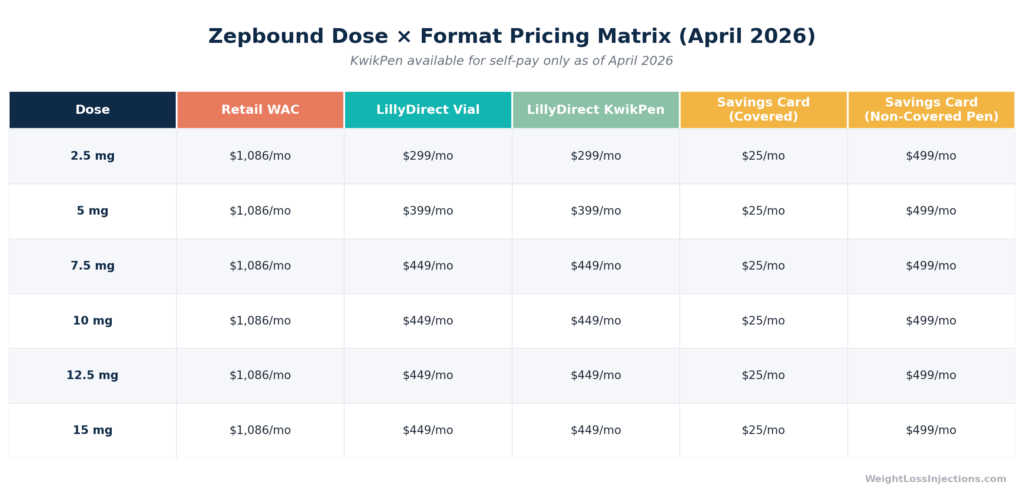
Zepbound Dose × Format Pricing Matrix (April 2026)
The Master Pricing Matrix: All Doses, All Access Paths
The matrix above consolidates every verified pricing path for April 2026 across all six Zepbound dose strengths. A few observations worth highlighting:
The WAC uniformity is unusual. Most medications are priced at higher doses proportionally higher. Zepbound’s flat $1,086/mo WAC means the per-mg cost drops dramatically as you titrate, but since all patients start at 2.5 mg and most stabilize at 10–15 mg, the practical implication is that the retail cash price stays fixed even as your clinical dose more than quadruples across titration.
LillyDirect pricing tiers are not flat. The gap between 2.5 mg ($299/mo) and 7.5 mg+ ($449/mo) is $150/mo, meaningful over a year. Patients who start the Journey Program at 2.5 mg and titrate to maintenance doses should budget for the step up at 7.5 mg, not assume the introductory tier price persists.
The refill window is non-negotiable. The 45-day refill requirement under the Self Pay Journey Program is a compliance condition, not a suggestion. Setting a calendar reminder for the 40-day mark from each delivery is practical risk management for maintaining program pricing.
The Zepbound Savings Card: Who It Helps (and Who It Doesn’t)
The savings card is a separate mechanism from LillyDirect and operates within a different patient population. Understanding which program applies to your situation is the single most important clarification this article can provide — and it is the point that competitors most frequently conflate.
Covered Benefit Track: Commercial Insurance With Zepbound Coverage
If you have commercial health insurance and your plan covers Zepbound for weight management, the Zepbound savings card brings your out-of-pocket cost to as little as $25/mo for a 1-, 2-, or 3-month fill. The 2026 card terms cap maximum savings at approximately $1,300 per calendar year, down from the 2025 cap of $1,950, with a maximum of 13 fills per year and a monthly savings maximum of $100.
This is unambiguously the cheapest monthly cost available: $25/mo against a $1,086 WAC. But it requires that your commercial plan has added Zepbound to its formulary, which approximately 43–45% of commercial plans have done for weight management as of March 2026, per Pandameds insurance coverage analysis. Employer-sponsored plans show roughly 55% approval rates after prior authorization. If your plan covers Zepbound, use the savings card, $25/mo is the number to anchor on.
Savings card payments do not count toward your deductible or out-of-pocket maximum in most states. There are state-specific exceptions; confirm with your plan before assuming card payments contribute to your annual OOP accumulator.
The savings card applies to single-dose pens only, not to vials obtained through LillyDirect.
Non-Covered Benefit Track: Commercial Insurance Without Zepbound Coverage
If you have commercial insurance but your plan does not cover Zepbound (roughly 55–57% of commercial plans as of April 2026), a different track of the savings card may still reduce your cost. Under the non-covered benefit card, eligible patients pay as little as $499/mo for single-dose pens, with up to $469 in savings per fill, per PrescriberPoint’s Zepbound savings card summary. Annual maximum benefit is approximately $3,283, covering up to 7 fills per year.
Alternatively, patients with commercial insurance but no Zepbound coverage can also access LillyDirect self-pay pricing ($299–$449/mo) — which in most cases is cheaper than the $499 non-covered card rate for pens. For these patients, a side-by-side comparison:
| Access Path | Monthly Cost | Format | Annual Fills Covered |
|---|---|---|---|
| Non-covered savings card (pen) | $499/mo | Single-dose pen | Up to 7 fills |
| LillyDirect Journey Program (7.5 mg+) | $449/mo | Vial or KwikPen | No cap (45-day refill cadence) |
| LillyDirect Journey Program (5 mg) | $399/mo | Vial or KwikPen | No cap |
| LillyDirect Journey Program (2.5 mg) | $299/mo | Vial or KwikPen | No cap |
For most doses, LillyDirect is the better deal if your insurance doesn’t cover Zepbound.
Who Does NOT Qualify for the Savings Card
The Zepbound savings card is explicitly unavailable to:
- Medicare Part A or B enrollees
- Medicaid beneficiaries
- Veterans Administration (VA) and TRICARE beneficiaries
- Any government-funded health program participants
- Patients with no commercial insurance (uninsured patients — use LillyDirect instead)
This exclusion list is standard across manufacturer savings programs in the United States. The IRS rules governing these programs prohibit their use with government-funded plans to avoid violating anti-kickback statutes. If you are on Medicare and you see a Zepbound coupon advertised, you cannot use it — the Medicare GLP-1 Bridge program (see below) is your relevant 2026 option.
Our Top 3 · October 2026
The best GLP-1 providers right now
Independently reviewed. Ranked by price, medication access, provider quality, and patient outcomes.
Renew GLP
Personalized GLP-1, GIP plans: Semaglutide & Tirzepatide.
Medvi
No membership or hidden fees. Everything you need is included.
Trimi
US-licensed clinicians and shipped to your door, from $99/mo.
Medicare and Government Program Options for 2026
Medicare coverage for Zepbound is not straightforward in 2026, but it is more accessible than it was in 2025. Three distinct scenarios apply depending on your indication and enrollment.
The Medicare GLP-1 Bridge Program (July 1 – December 31, 2026)
In a significant policy shift, CMS announced a temporary Medicare GLP-1 Bridge program that provides Zepbound coverage to eligible Part D enrollees at a $50 copayment for the obesity indication, per KFF’s March 2026 analysis of the Medicare GLP-1 Bridge program. Key program details:
- Eligible period: July 1, 2026 through December 31, 2026
- Copayment: $50/mo
- Eligibility criteria: BMI ≥35, or BMI ≥27 with at least one qualifying clinical condition
- Cost structure: Operates outside the Part D benefit — payments do not count toward the $2,100 annual OOP cap established by the Inflation Reduction Act, per Wellcare’s Medicare guidance on GLP-1 drugs
- What it bridges to: The BALANCE Model demonstration starting January 1, 2027, which is designed to make long-term GLP-1 access for Medicare beneficiaries more permanent
The $50 copay for a drug with an $1,086 WAC is the most dramatic pricing differential in the entire 2026 Zepbound landscape. If you are a Medicare beneficiary who qualifies, the bridge program is your first call from July 1 onward.
Medicare Part D — OSA Indication
Zepbound received FDA approval as the first medication indicated for moderate-to-severe obstructive sleep apnea (OSA) in adults with obesity on December 20, 2024, per the Eli Lilly OSA approval press release. Because the OSA indication is not a “weight loss drug” per se, individual Medicare Part D plans may cover Zepbound for this indication at standard formulary terms — subject to their specific formulary and tier placement. Per Wellcare Medicare guidance, Medicare plans can exercise discretion in covering medications with non-obesity primary indications. If Zepbound has been prescribed specifically for your OSA diagnosis, check your Part D plan’s formulary directly — coverage is plan-dependent and not guaranteed.
Medicare Part D — Weight Management: Still Excluded
Medicare remains statutorily prohibited from covering drugs prescribed solely for weight management under Part D. As of April 2026, the American College of Gastroenterology’s April 2025 analysis confirms that anti-obesity drugs are not covered under Medicare or Medicaid for the weight management indication. The Medicare GLP-1 Bridge program (above) is a temporary administrative program that works outside the Part D benefit framework — it does not change the statutory exclusion. Congress has not passed legislation lifting this prohibition as of April 2026.
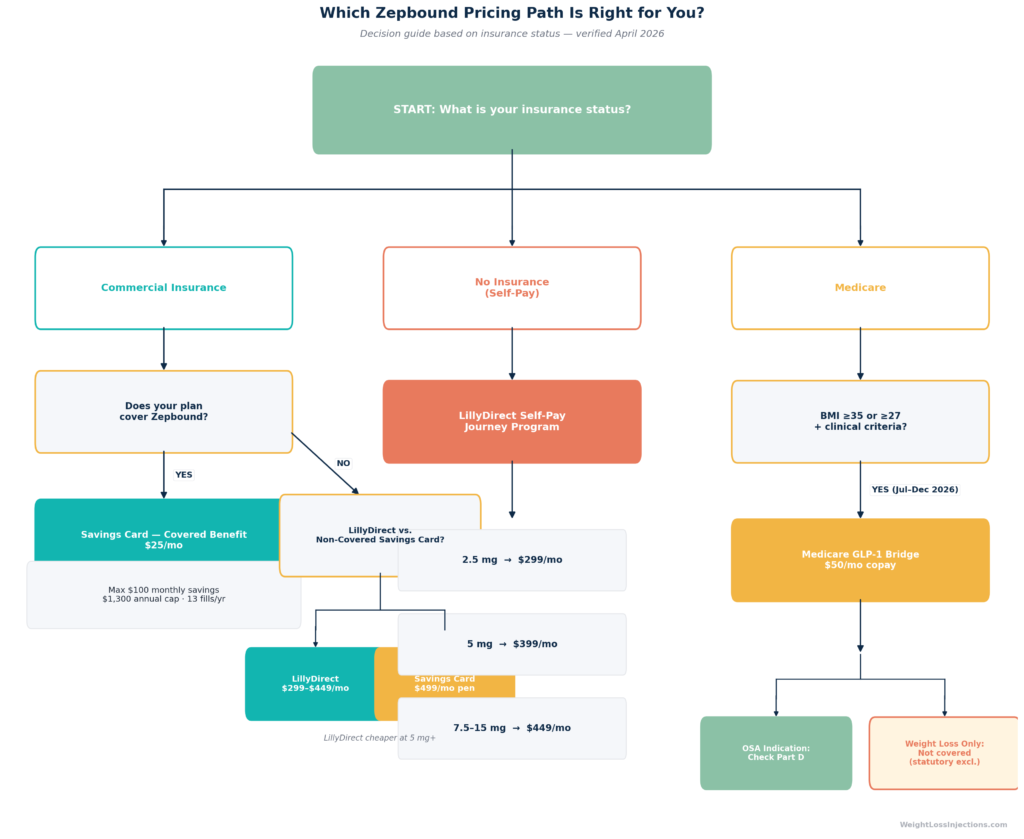
Which Zepbound Pricing Path Is Right for You?
How to Get Zepbound Without Insurance: Step by Step
If you have no commercial insurance coverage for Zepbound and you are not a Medicare beneficiary, LillyDirect is your primary access path. The process is straightforward but has several steps where missteps can delay or increase cost.
Step 1: Obtain a Valid Zepbound Prescription
LillyDirect does not provide prescriptions, it fills them. You need a licensed prescriber to evaluate you and issue a Zepbound prescription before placing your first order. Eligibility for Zepbound requires meeting the FDA-approved indications: either BMI ≥30, or BMI ≥27 with at least one weight-related comorbidity (hypertension, type 2 diabetes, or dyslipidemia), per the FDA press release approving Zepbound on November 8, 2023.
Telehealth services can bridge this step for patients without a primary care provider who prescribes GLP-1s. At WeightLossInjections.com, our bundled telehealth consult starts at [$X/month] and includes [service detail], connecting you with a licensed provider who can evaluate your eligibility, issue the prescription, and provide ongoing clinical management.
Step 2: Enroll in the LillyDirect Self Pay Journey Program
Navigate to LillyDirect’s website and complete enrollment in the Self Pay Journey Program. Have your Zepbound prescription ready. You will select your dose (starting at 2.5 mg per the standard titration schedule), set up payment, and establish your delivery address. Shipping from LillyDirect is typically handled through a mail-order pharmacy network.
At enrollment, confirm your refill cadence. The Journey Program requires refill within the 45-day window from each delivery to maintain program pricing. Missing that window does not automatically remove you from the program, but it may affect pricing on that specific fill. Setting automatic refill reminders at 38–40 days post-delivery is the practical approach.
Step 3: Choose Vial or KwikPen Format
Both formats cost the same under the Journey Program; the decision is one of convenience and technique:
- Single-dose vial: Requires a separate syringe and needle (purchased separately, not included). Draw 0.5 mL from the vial and inject subcutaneously. More familiar for patients with prior syringe experience (e.g., insulin users). Vials may be stored at room temperature up to 30°C (86°F) for up to 21 days, per the Zepbound prescribing information.
- KwikPen: Multi-dose, single-patient-use pen containing four weekly doses. No separate syringe needed. Requires priming before each use. Same per-dose cost, more convenient administration. Available for pickup at Walmart Pharmacy (LillyDirect partner) in addition to mail delivery.
Step 4: Set Up Clinical Oversight
A LillyDirect prescription and a pen do not by themselves constitute a supervised treatment program. The SURMOUNT-1 trial data published in NEJM, which showed 20.9% average weight loss at 15 mg over 72 weeks, was generated in a structured clinical setting with regular follow-up. Patients self-managing without clinical oversight are not replicating those conditions. At minimum, establish follow-up with a prescriber for periodic metabolic labs and dose titration review.
Total Annual Cost Comparison
The sticker-shock of $1,086/mo WAC takes on a different character when you extend it across a year and compare it to the real alternatives.
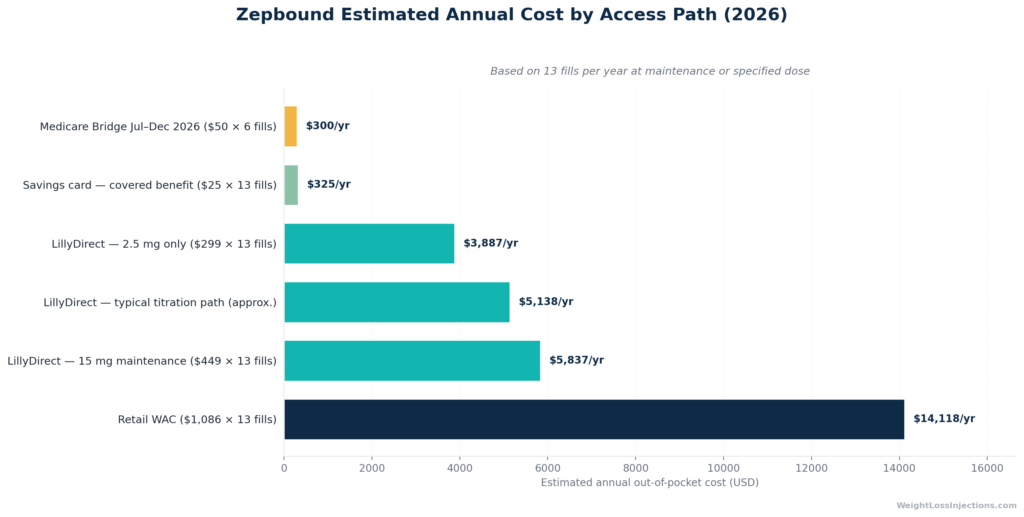
Zepbound Annual Cost by Access Path (2026)
Annual cost estimates at a glance:
| Access Path | Monthly Cost | Estimated Annual Cost (13 fills) |
|---|---|---|
| Retail WAC (no program) | $1,086/mo | ~$14,118/yr |
| LillyDirect Journey 2.5 mg | $299/mo | ~$3,887/yr |
| LillyDirect Journey 5 mg | $399/mo | ~$5,187/yr |
| LillyDirect Journey 7.5–15 mg | $449/mo | ~$5,837/yr |
| Savings card — covered benefit | $25/mo | ~$325/yr |
| Medicare Bridge (Jul–Dec 2026) | $50/mo | ~$300/yr (6 months) |
For context, the annual cost of the LillyDirect program at $449/mo (~$5,837/yr) is approximately 41% of the retail WAC annual cost. Over a three-year treatment course, the SURMOUNT-4 data makes clear that stopping tirzepatide leads to meaningful weight regain, per JAMA 2023, the cumulative savings from LillyDirect vs. retail reach tens of thousands of dollars.
Alternatives to Consider if Zepbound Is Still Out of Budget
For patients where even $299–$449/mo is financially prohibitive, the relevant alternatives are limited but worth understanding clearly.
Wegovy (Semaglutide for Weight Management)
Wegovy (semaglutide 2.4 mg weekly, Novo Nordisk) is the primary branded competitor. At the equivalent self-pay tier through NovoCare, Novo Nordisk’s direct pharmacy program, pricing runs $199/mo for the first two fills as an introductory offer (0.25–0.5 mg starting doses), then $349/mo ongoing for most maintenance doses. Clinical efficacy compares favorably: SURMOUNT-1 demonstrated 20.9% average weight loss at 72 weeks with tirzepatide 15 mg versus 14.9% average weight loss in STEP 1 (NEJM, 2021) with semaglutide 2.4 mg (Wegovy). Both are meaningful efficacy numbers; tirzepatide’s dual GIP/GLP-1 mechanism appears to produce incrementally greater weight loss in trials.
For patients for whom cost is the primary constraint and $349/mo (Wegovy/NovoCare ongoing) is more accessible than $449/mo (Zepbound at higher doses), Wegovy’s self-pay program provides a real alternative with strong clinical evidence.
A Note on Compounded Tirzepatide
Compounded tirzepatide, the category of lower-cost alternatives that proliferated through 2024 — is no longer legally available to most patients. The FDA declared the tirzepatide shortage resolved on December 19, 2024, per the FDA memorandum confirming resolution. This triggered enforcement deadlines for 503A compounding pharmacies (February 18, 2025) and 503B outsourcing facilities (March 19, 2025), per the FDA’s clarification of compounding policies.
As of April 2026, compounding “essentially identical” tirzepatide is not permitted. The limited exceptions remaining — documented patient-specific needs such as allergies to branded excipients, or 503A pharmacies filling up to 4 prescriptions/month for individual clinical needs per FDA’s April 1, 2026 guidance — do not apply to general self-pay patients seeking a cheaper alternative to Zepbound.
Any telehealth platform or pharmacy currently marketing “compounded tirzepatide” as a broadly available lower-cost option is not operating within FDA’s current enforcement framework. The legitimate uninsured path is LillyDirect. There is no legal workaround at general scale.
Our take at WeightLossInjections.com: The real pricing landscape for Zepbound in 2026 is genuinely more navigable than the $1,086 WAC implies, but navigating it requires enrollment steps that are easy to miss. The 45-day refill window under the Self Pay Journey Program is the most common error: patients who miss it may lose Journey Program pricing for that fill and pay substantially more. The savings card confusion (many uninsured patients think they qualify, but they don’t, it requires commercial insurance) is the second most common issue. And the KwikPen, launched in February 2026, offers meaningful convenience without any cost premium over vials. Our recommendation: if you’re uninsured and cost is your primary variable, LillyDirect with Journey Program enrollment is your answer. If you have commercial insurance, the first question is formulary coverage, because the difference between $25/mo and $449/mo is entirely determined by whether your plan covers Zepbound. WeightLossInjections.com’s telehealth team helps patients work through exactly these eligibility questions as part of the bundled consult. Our program starts at [$X/month] and includes [service detail], with licensed providers who can guide you through prescription access, program enrollment, and ongoing clinical management.
Frequently Asked Questions
Without insurance, the lowest legally available price in April 2026 is $299/mo for the 2.5 mg starting dose through Eli Lilly’s LillyDirect Self Pay Journey Program, per CNBC’s reporting on the December 2025 price cut. The 5 mg dose is $399/mo and all doses from 7.5 mg through 15 mg are $449/mo under the same program. These prices apply to both single-dose vials and the KwikPen format. The official retail list price (WAC) without any program is $1,086/mo for all dose strengths, per the Eli Lilly pricing page. Enrollment in the Self Pay Journey Program and adherence to a 45-day refill window are required to maintain these rates.
For patients without any insurance, Eli Lilly’s LillyDirect Self Pay Journey Program is the cheapest available path: $299/mo for 2.5 mg, $399/mo for 5 mg, and $449/mo for all maintenance doses. This is available in both single-dose vials (requiring a separate syringe) and the multi-dose KwikPen (no syringe needed) launched February 23, 2026. A valid Zepbound prescription is required but no insurance is needed. Patients who have commercial insurance but whose plan does not cover Zepbound can also access LillyDirect pricing, which is typically cheaper than the non-covered savings card rate of $499/mo for pens, per PrescriberPoint’s savings card analysis.
No. The Zepbound savings card requires enrollment in a commercial drug insurance plan — it is designed to reduce cost-sharing for insured patients, not to replace insurance. Uninsured patients are not eligible for either the covered-benefit ($25/mo) or non-covered-benefit ($499/mo) savings card tracks, per Eli Lilly’s savings page terms. If you have no insurance, LillyDirect’s Self Pay Journey Program at $299–$449/mo is the manufacturer-supported self-pay path. Additionally, patients on government programs — Medicare, Medicaid, VA, TRICARE — are explicitly excluded from the savings card regardless of their out-of-pocket cost burden.
Not through standard Medicare Part D, which remains statutorily prohibited from covering drugs prescribed solely for weight loss, as confirmed by the American College of Gastroenterology’s April 2025 analysis. However, two pathways exist in 2026: First, the Medicare GLP-1 Bridge program (July 1 – December 31, 2026) covers Zepbound for eligible Part D enrollees at a $50 copay for the obesity indication, eligibility requires BMI ≥35 or ≥27 with clinical criteria, and payments operate outside the $2,100 annual OOP cap, per KFF’s March 2026 analysis. Second, Medicare Part D plans may cover Zepbound at standard formulary terms when prescribed specifically for moderate-to-severe OSA — its second FDA-approved indication, though coverage is plan-dependent. The bridge program is set to transition to the permanent BALANCE Model starting January 2027.
No. LillyDirect operates as a direct-to-consumer pharmacy platform, not a prescriber. You must have a valid Zepbound prescription from a licensed provider before placing an order. LillyDirect does not offer telemedicine consultations itself — it fills prescriptions at self-pay pricing. Patients without a prescriber can obtain a prescription through telehealth services, including WeightLossInjections.com, which provides a bundled consult and [service detail] as part of its program. Once you have a prescription in hand, the LillyDirect enrollment and ordering process is conducted online.
Under the LillyDirect Self Pay Journey Program, vials and KwikPens are identically priced: $299/mo at 2.5 mg, $399/mo at 5 mg, and $449/mo for 7.5 mg through 15 mg. The difference is entirely in the administration experience. Single-dose vials require a separate syringe and needle (not included, purchased separately) and a manual draw; they are the original LillyDirect format and are slightly more familiar to patients with prior injectable medication experience. The KwikPen, launched February 23, 2026, is a multi-dose device containing four weekly injections per pen — no separate syringe is needed, it requires priming before each use, and it is available for pickup at Walmart Pharmacy locations in addition to mail delivery from LillyDirect. Per CNBC’s KwikPen launch coverage, the KwikPen is the same device platform Lilly uses for Mounjaro (tirzepatide for T2D), making it familiar to patients transitioning from that medication. For most new patients without prior syringe experience, the KwikPen is the more accessible choice.
This article is for informational purposes only and does not constitute medical advice. All pricing reflects verified sources as of April 2026; prices and program availability are subject to change. WeightLossInjections.com editorial team reviews content quarterly; last verified April 2026. Consult a licensed provider before starting or changing any medication.