![Unbranded [pillar-drug-class] injection pen on a neutral background — WeightLossInjections.com editorial hero](https://weightlossinjections.com/wp-content/uploads/2026/07/hero_tirzepatide_c4_compare-1200x675.png)
This content is for informational purposes only and does not constitute medical advice. Consult a licensed healthcare provider before starting, stopping, or changing any treatment.
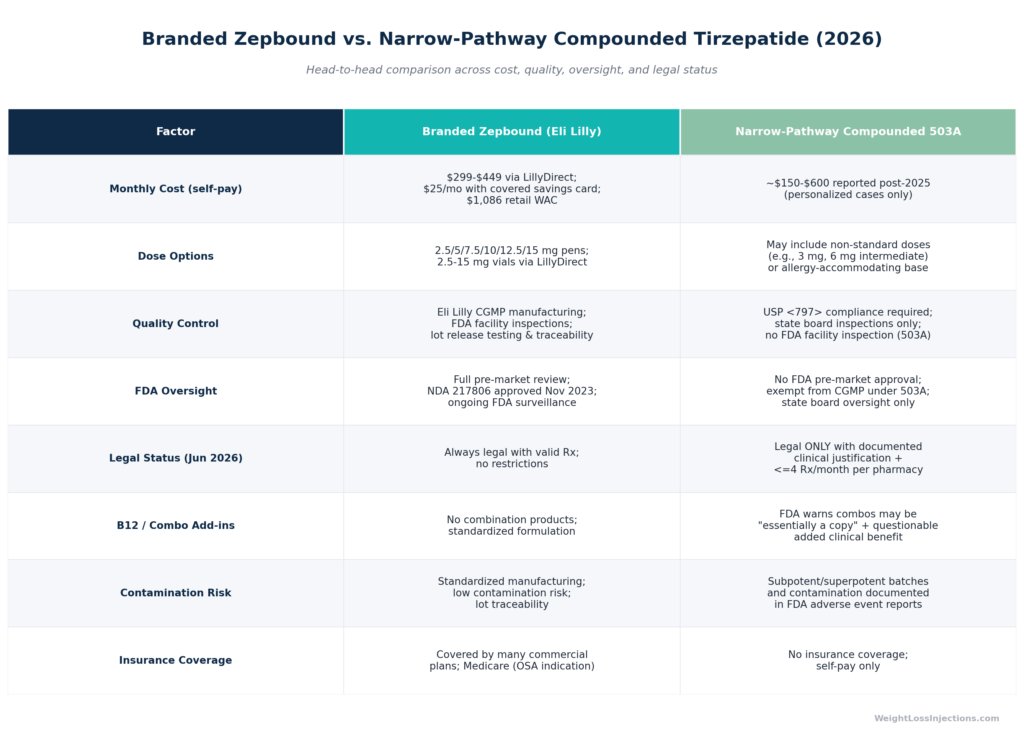
Master comparison table rendered as a high-resolution infographic — all key comparison factors (molecule, FDA status, quality control, cost, delivery, legality, dose flexibility) as rows; Compounded…
- Compounded tirzepatide and Zepbound contain the same active molecule — tirzepatide, a dual GIP + GLP-1 receptor agonist (“twincretin”). If a compounded product is accurately dosed, expected weight-loss outcomes mirror Zepbound.
- The comparison is not a tie: Zepbound is FDA-approved, CGMP-manufactured, and quality-verified at every lot. Compounded tirzepatide is not.
- The legal landscape changed permanently in March 2025. Mass-market compounded tirzepatide is no longer lawful. In 2026, the only legal pathway for compounded tirzepatide is a narrow 503A personalized-medicine exception: documented allergy to an inactive ingredient or a clinically necessary non-standard dose, with no more than four prescriptions per month from the compounding pharmacy.
- Cost is not a qualifying justification. The FDA explicitly confirmed this in April 2026 guidance.
- Zepbound via LillyDirect vials starts at $299/month — the low end of what compounded tirzepatide ever cost, closing the gap that once drove patients to compounders.
- With commercial insurance and Lilly’s savings card, Zepbound can run as little as $25 per fill.
- For most patients in 2026, Zepbound is the appropriate default. WeightLossInjections.com helps patients navigate both pathways — including the narrow exception for those who genuinely qualify.
The Molecule Is Identical: What Zepbound and Compounded Tirzepatide Share
Here is the fact that drives this search query, and it is true: the molecule in Zepbound and in legitimately compounded tirzepatide is the same. Both contain tirzepatide — a synthetic 39-amino-acid peptide that is the active pharmaceutical ingredient (API) in Eli Lilly’s branded products Zepbound (weight management) and Mounjaro (type 2 diabetes). There is no proprietary modification to the molecule in the branded version; Lilly did not create a different chemical compound that compounders cannot access. Per StatPearls on NCBI Bookshelf, tirzepatide is a first-in-class dual GIP and GLP-1 receptor agonist — sometimes called a “twincretin” — meaning it activates both the glucose-dependent insulinotropic polypeptide (GIP) receptor and the glucagon-like peptide-1 (GLP-1) receptor simultaneously. No other FDA-approved drug in this exact class existed as of June 2026.
The mechanism of action is identical regardless of source. Both Zepbound and properly made compounded tirzepatide stimulate GIP and GLP-1 receptors, which together suppress appetite through central hypothalamic signaling, slow gastric emptying to blunt post-meal glucose spikes, stimulate glucose-dependent insulin secretion from pancreatic beta cells (meaning low hypoglycemia risk as monotherapy), suppress glucagon from alpha cells, improve insulin sensitivity independent of weight loss, and increase adiponectin, per StatPearls. The “dual” nature of the mechanism — activating GIP receptors that GLP-1-only drugs like semaglutide do not — is believed to explain tirzepatide’s superior weight-loss outcomes compared to GLP-1 monotherapy.
The route and frequency are also identical. Both are administered as subcutaneous (under-the-skin) injections, once weekly. The standard titration schedule — starting at 2.5 mg once weekly for four weeks, then escalating in 2.5 mg increments every four weeks to a maximum of 15 mg — applies to both options, per the FDA Zepbound NDA 217806 Medical Review. Compounded pharmacies have historically also offered non-standard intermediate doses (for example, 3 mg or 6 mg) that Lilly does not supply — a point we will return to in the decision section.
If the compounded product contains accurate tirzepatide at the labeled potency, the clinical outcomes should mirror the SURMOUNT program data. The gold-standard efficacy evidence for this molecule comes from SURMOUNT-1, published in the New England Journal of Medicine in 2022, which enrolled 2,539 adults with obesity or overweight without type 2 diabetes for 72 weeks. At the three therapeutic doses, mean body weight change was −15.0% at 5 mg, −19.5% at 10 mg, and −20.9% at 15 mg — compared to −3.1% for placebo. Clinically meaningful weight loss of at least 5% was achieved by 85%, 89%, and 91% of participants at the three doses, versus 35% on placebo.
The operative phrase is “if properly dosed.” That conditional is doing significant work, and it is where the comparison between compounded tirzepatide and Zepbound diverges sharply — beginning with quality control and ending with legal status. A patient using compounded tirzepatide and a patient using Zepbound may be targeting the same clinical outcomes via the same molecule, but the degree of certainty that the product in the vial matches the label is fundamentally different for each option.
What Zepbound Has That Compounded Tirzepatide Doesn’t
FDA Approval and Pre-Market Review
Zepbound received FDA approval for chronic weight management on November 8, 2023. That approval means Eli Lilly submitted a full NDA (New Drug Application) — the NDA 217806 dossier included the complete SURMOUNT clinical trial program, detailed safety data from thousands of patients, chemistry and manufacturing data for every strength and formulation, and a full labeling proposal — and the FDA reviewed all of it before a single pen reached a patient. Zepbound is approved for adults with a body mass index (BMI) of 30 or higher, or 27 or higher with at least one weight-related comorbidity (hypertension, type 2 diabetes, dyslipidemia, obstructive sleep apnea, or cardiovascular disease), as an adjunct to reduced-calorie diet and increased physical activity, per the Zepbound HCP prescribing information.
Compounded tirzepatide has never undergone pre-market FDA review. No compounding pharmacy has submitted clinical trial data. The molecule is the same, but the manufacturer and its product have not been reviewed.
CGMP Manufacturing and Lot-Release Testing
Eli Lilly manufactures Zepbound under FDA’s Current Good Manufacturing Practice (CGMP) regulations — the federal standards that govern pharmaceutical manufacturing quality. CGMP compliance means: validated manufacturing processes, rigorous sterility testing, potency verification on every production lot before it ships, full supply chain traceability from API synthesis to patient delivery, and regular FDA facility inspections. The FDA Mounjaro Label NDA 215866 and its associated chemistry reviews document the extent of this quality infrastructure.
In practical terms: every Zepbound pen or vial that leaves the Lilly plant has been verified — by the manufacturer and by lot-release testing — for identity, purity, sterility, and potency. The dose labeled on the pen is what is in the pen, with documented tolerance ranges. This is not a claim any compounding pharmacy can make.
Standardized Delivery Device: The KwikPen
Zepbound’s KwikPen autoinjector is a prefilled, pre-set, color-coded device. There is no reconstitution, no syringe drawing, no dose calculation, and no risk of math errors. You dial to the labeled dose, inject subcutaneously, and you are done. For patients who are anxious about self-injection, unfamiliar with drawing syringes, or prone to calculation errors, this is a meaningful clinical advantage. Lilly also now offers single-dose vials through LillyDirect for patients and practitioners who prefer drawing their own doses — so the format flexibility once offered by compounders is available through the branded program, per the Zepbound HCP site.
Cost Access — LillyDirect and the Savings Card
The economics of this comparison shifted dramatically when Lilly introduced its self-pay programs. According to Healthy Meals Incentives’ April 2026 tirzepatide cost analysis:
- LillyDirect vials (Self Pay Journey Program): $299/month at 2.5 mg, $399/month at 5 mg, and $449/month for 7.5 mg through 15 mg
- Zepbound savings card (commercial insurance): As low as $25 per fill for commercially insured patients
The LillyDirect starting price of $299/month sits at the low end of what legitimate compounded tirzepatide cost even before the legal changes. For commercially insured patients using the savings card, Zepbound is dramatically cheaper than any compounded source.
Regulatory Clarity and Ongoing Pharmacovigilance
When a patient asks their doctor “Is this legal?” — Zepbound, prescribed by a licensed U.S. physician, is unambiguously legal in all 50 states. There is no compliance uncertainty, no risk of product seizure, and no gray area. Post-market pharmacovigilance for Zepbound also continues: adverse event reporting, FDA label updates, and real-world safety monitoring are active and ongoing, improving the safety profile over time as real-world data accumulates.
What Compounded Tirzepatide Had — and the Narrowed Case for It in 2026
The Historical Advantages (2023–2024)
Before March 2025, compounded tirzepatide offered two genuine advantages over retail Zepbound: cost and dose flexibility.
On cost: retail Zepbound at the time ran approximately $1,000–$1,100 per month at list price, while compounded tirzepatide was available for $400–$700 per month — a meaningful differential for self-pay patients. This cost gap was the single largest driver of the compounding market that emerged after tirzepatide’s FDA approval.
On dose flexibility: compounded pharmacies could offer intermediate doses (3 mg, 6 mg, and others) not available in Lilly’s dose schedule. Some patients with severe gastrointestinal side effects during titration reported benefit from a slower escalation through non-standard dose steps. Compounders also offered the drug in multi-dose vials, which some practitioners preferred for office-use flexibility.
Additionally, compounders offered tirzepatide in combination with vitamin B12, lipotropic mixes, and other additives. It is important to note that the FDA has specifically warned that these combination formulations are generally considered “essentially copies” of the commercially available product and do not meet the 503A clinical exception standard without specific, documented clinical justification — per the FDA GLP-1 Compounding Clarification Page. Furthermore, there is no clinical evidence from controlled trials that adding B12 to tirzepatide improves weight-loss outcomes.
How the Landscape Shifted in 2025–2026
The cost advantage has substantially eroded. LillyDirect vials at $299/month represent the self-pay floor that few compounders could match even at peak competition. For patients with commercial insurance and the Lilly savings card, Zepbound at $25 per fill is unbeatable.
The dose-flexibility advantage has also narrowed. Lilly’s single-dose vials now cover the vial-format need. The specific clinical use case for intermediate doses — a patient who genuinely cannot tolerate standard titration increments — remains a narrow but legitimate reason a physician might document a compounded need. But this is a clinical determination for an individual patient, not a market-wide offering.
The bottom line is that the advantages of compounded tirzepatide that existed in 2023–2024 — primarily cost and dose flexibility — have largely been addressed by Lilly’s own market evolution. The remaining case for compounded tirzepatide is narrow: documented clinical need for a dose or formulation not available commercially, evaluated by a physician and documented in the prescription.
Our take at WeightLossInjections.com: The original cost argument for compounding has been significantly undercut by LillyDirect pricing and the savings card program. If a patient had been seeking compounded tirzepatide purely because it was cheaper, that logic no longer holds in most situations. The legitimate case in 2026 is specific and documented — not a general preference or convenience decision.
Safety and Quality Control — Where the Comparison Gets Serious
What the FDA Adverse Event Data Shows
The FDA compiled over 320 adverse event reports related to compounded tirzepatide through February 2025, per FDA’s compounding clarification guidance. These reports encompassed three categories of concern that are qualitatively different from the known side effects of the molecule itself:
Subpotent batches: Patients reported no weight loss, no appetite suppression, and feeling no effect after weeks of injections — consistent with receiving a product containing little or no active tirzepatide. Some patients injected for months with no clinical response before discovering the product was understrength.
Superpotent batches: Other patients reported severe nausea, vomiting, and hypoglycemic episodes consistent with receiving several times the intended dose. Some required hospitalization. Per the FDA Mounjaro label, tirzepatide’s therapeutic dose range is 2.5–15 mg weekly; dosing errors from improperly reconstituted lyophilized (freeze-dried) powder can deliver five to ten times the intended dose in a single injection.
Contamination from non-sterile compounding: Bacterial contamination in any injectable product is a life-threatening risk. Sterile injectable compounding requires rigorous clean-room environments and validated processes — standards that, as discussed below, are not uniformly met by all 503A pharmacies.
The Salt Form Controversy
Legitimate tirzepatide API is tirzepatide base — the same chemical form in Zepbound. Some compounders have used salt forms of tirzepatide (hydrochloride salt, acetate salt) not equivalent to the approved API. The pharmacological activity of these salt forms relative to tirzepatide base has not been proven equivalent. The FDA has specifically flagged the use of non-base salt forms as a quality and regulatory concern — a product containing tirzepatide acetate is not simply “tirzepatide” in the same sense as what Lilly manufactures, per FDA’s compounding clarification page.
The 503A vs. CGMP Quality Gap
Understanding why these quality failures happen requires understanding the regulatory difference between 503A pharmacies and CGMP manufacturers:
- Eli Lilly (CGMP): FDA-inspected facilities, lot release testing before product ships, validated sterile manufacturing processes, full analytical chemistry on every batch, traceable supply chain from raw API to finished product.
- 503A pharmacy: Inspected by state pharmacy boards only — typically less frequent and less technically rigorous for sterile injectables than FDA inspections. USP \<797> sterile-compounding standards are required, but compliance is verified by state inspectors of varying technical backgrounds, not FDA chemists. Not all state boards have equivalent rigor.
Even among 503A pharmacies, quality varies significantly. A PCAB (Pharmacy Compounding Accreditation Board)-accredited pharmacy that provides a Certificate of Analysis (CoA) from an accredited third-party laboratory — confirming API identity, potency, and sterility — represents meaningfully lower risk than an unaccredited pharmacy providing no CoA. But even the best 503A pharmacy does not operate at the CGMP standard that Lilly’s manufacturing achieves.
![Cost comparison grouped vertical bar chart. Monthly cost for each option]](https://weightlossinjections.com/wp-content/uploads/2026/07/tirz_art04_img2_cost_savings_chart-1024x549.png)
Cost comparison grouped vertical bar chart
Bottom Line on Safety
The compounded product may contain the right molecule at the right dose — or it may not. With Zepbound, you know what you are getting because Lilly’s CGMP process and FDA lot-release requirements guarantee it. With compounded tirzepatide, even from a licensed pharmacy, there is inherent additional uncertainty. The risk level is not fixed; it depends heavily on the specific pharmacy’s quality practices, accreditation, third-party testing, and compliance culture. That variability is the risk — and it is categorically absent when using Zepbound.
For patients considering a compounded option under the narrow legal exception, StatPearls on NCBI Bookshelf and the FDA’s own guidance recommend working only with a pharmacy that meets all of the following criteria:
- Active, clean state license: Verify the dispensing pharmacy’s license on the state board website; confirm no disciplinary history, no suspensions, and no pending actions.
- USP \<797> compliance: Sterile injectable compounding requires compliance with USP \<797> standards — ask the pharmacy for its most recent state inspection report confirming compliance.
- Certificate of Analysis (CoA): Reputable 503A pharmacies should provide a CoA from an accredited third-party laboratory confirming API identity (tirzepatide base, not a salt form), potency (within labeled tolerance), and sterility. If a pharmacy cannot or will not provide this, stop the conversation.
- PCAB accreditation: While not legally required, Pharmacy Compounding Accreditation Board (PCAB) accreditation signals a higher voluntary quality standard. Prefer PCAB-accredited pharmacies when available.
- No red flags: Walk away immediately if a pharmacy dispenses without a valid individualized prescription, markets tirzepatide as a “peptide” or “research chemical,” ships internationally from overseas sources, or offers “any dose, any quantity” subscription models without documented individualized prescriber assessment — these models likely violate current FDA guidance, per the FDA GLP-1 Compounding Clarification Page.
- Pricing is not suspiciously low: If compounded tirzepatide is being offered at dramatically below-market prices, it may originate from overseas peptide suppliers or non-licensed sources. Legitimate 503A pharmacy costs are not dramatically lower than LillyDirect in the current environment.
Quality control spectrum horizontal bar chart — from lowest to highest quality assurance: illegal overseas source → non-accredited 503A → PCAB-accredited 503A with CoA → LillyDirect vials → branded…
Our Top 3 · October 2026
The best GLP-1 providers right now
Independently reviewed. Ranked by price, medication access, provider quality, and patient outcomes.
Renew GLP
Personalized GLP-1, GIP plans: Semaglutide & Tirzepatide.
Medvi
No membership or hidden fees. Everything you need is included.
Trimi
US-licensed clinicians and shipped to your door, from $99/mo.
Legal Status Post-March 2025 — The Non-Negotiable Difference
Understanding the 503A and 503B Framework
To evaluate what is and is not legal in 2026, it helps to understand the two compounding regulatory frameworks:
503A traditional compounding pharmacies are state-licensed pharmacies that compound patient-specific prescriptions under state pharmacy board oversight. They are exempt from FDA’s CGMP requirements and drug approval requirements — provided they compound for an identified individual patient under a valid prescription and do not regularly compound drugs that are essentially copies of commercially available products, per FDA’s compounding guidance. They are inspected by state boards, not the FDA, for routine oversight.
503B outsourcing facilities are FDA-registered facilities that may compound without a patient-specific prescription for “office stock” distribution to prescribers. They are FDA-inspected and must comply with CGMP requirements. They may compound using bulk API only if the substance appears on FDA’s 503B Bulks List or if the drug is on the active FDA shortage list. As of the FDA April 30, 2026 press announcement, FDA has proposed to formally exclude tirzepatide from the 503B Bulks List, confirming no remaining legal pathway for outsourcing facilities.
How We Got Here: The Shortage Timeline
To understand the current legal status, you need to understand the regulatory history. Tirzepatide was added to the FDA Drug Shortage List on December 15, 2022, following explosive demand after Mounjaro’s approval for type 2 diabetes. That shortage status created a legal window for compounders: under the Federal Food, Drug, and Cosmetic Act, 503A pharmacies and 503B outsourcing facilities may compound drugs that are on the FDA shortage list. The compounding market that emerged from 2022 through 2024 was operating, broadly speaking, under that legal window.
That window closed. Per the FDA GLP-1 Compounding Clarification Page:
- February 18, 2025: Enforcement discretion ended for 503A (state-licensed) compounding pharmacies
- March 10, 2025: Federal court denied the pharmacist trade association’s preliminary injunction; the 503A grace period effectively closed
- March 19, 2025: Enforcement discretion ended for 503B outsourcing facilities
Per Harris Beach Murtha’s June 2026 analysis, and Frier Levitt’s tirzepatide legal update, tirzepatide is not on the FDA shortage list, has no market shortage, and therefore the shortage-based compounding authorization that sustained the 2022–2024 market does not exist.
On April 30, 2026, the FDA proposed to formally exclude tirzepatide from the 503B Bulks List — confirming no clinical need for outsourcing-facility bulk compounding, per the FDA press announcement.
What Is Still Legal: The 503A Narrow Exception
One pathway survives — but it is genuinely narrow and requires active physician involvement. Under 21 U.S.C. § 503A, a traditional compounding pharmacy may compound an “essentially a copy” product if the prescriber makes a documented determination that a compounded version is clinically necessary for the individual patient — meaning the compounded product provides a clinically significant difference from the commercially available product for that specific patient. Per FDA’s April 2026 updated guidance, valid clinical justifications include:
- A documented allergy or hypersensitivity to an inactive ingredient in the branded product — for example, cresol, which is used as a preservative in the Zepbound autoinjector pens
- A documented clinical need for a dose strength not commercially available — for example, an intermediate titration dose that the prescriber has determined is medically necessary to manage intolerable side effects
- A route of administration not commercially available
The FDA also imposes a ≤4 prescriptions per calendar month safe harbor limit for 503A pharmacies compounding essentially-a-copy products under this exception, per the FDA GLP-1 Compounding Clarification Page. This means the 503A model that existed in 2023–2024 — filling unlimited prescriptions from a telehealth platform for any patient who wanted a cheaper alternative — is definitively no longer legal.
The four-per-month cap is per pharmacy. A 503A pharmacy that fills five tirzepatide prescriptions in a calendar month under the essentially-a-copy exception — even with valid individualized prescriptions — is exceeding the safe harbor. This is not a technicality; it reflects FDA’s intent that the 503A personalized-medicine exception be genuinely individualized, not a bulk supply mechanism.
For the prescriber’s documentation to be valid, it must specify the particular clinical reason the compounded product is necessary for this specific patient. Generic language such as “patient prefers compounded” or “patient cannot afford branded” does not meet the standard. The prescriber’s documented determination is part of the prescription, not a verbal understanding. Per Frier Levitt’s tirzepatide compounding legal update, both the prescriber and the pharmacy bear legal exposure when this documentation is absent or inadequate.
Cost alone is not a qualifying clinical justification. The FDA’s April 2026 guidance explicitly confirms this. A prescription that documents “patient requests compounded version due to cost” does not satisfy the 503A exception.
Enforcement Actions in 2025–2026
The FDA has followed through with enforcement. Multiple warning letters were issued to 503A and 503B facilities continuing to bulk-compound tirzepatide after the grace periods, per FDA’s warning letters database. The FTC issued warning letters to telehealth platforms for misleading marketing of compounded GLP-1 drugs without adequate disclosure that they were not FDA-approved. State pharmacy boards in Texas, Florida, and California issued cease-and-desist orders to pharmacies continuing to bulk-dispense tirzepatide after March 2025, per Harris Beach Murtha’s June 2026 enforcement summary.
What This Means for Patients
Patients who proceed with non-compliant compounded sources in 2026 face real consequences: the product may be seized by FDA during enforcement action, the prescribing physician faces potential regulatory action, and the patient has no legal recourse if the product is subpotent, contaminated, or causes harm. These are not hypothetical risks — they are outcomes that occurred for some patients in 2024–2025.
Compounded Tirzepatide vs. Zepbound: A Full Comparison Table
| Factor | Compounded Tirzepatide (503A, 2026) | Zepbound (Branded, FDA-Approved) |
|---|---|---|
| Active molecule | Tirzepatide (same API) | Tirzepatide (same API) |
| FDA approval | None — not FDA-reviewed | FDA-approved (NDA 217806, Nov 2023) |
| Manufacturing standard | USP \<797>; state board oversight only | CGMP; FDA facility inspections; lot-release testing |
| Quality verification | Variable; CoA from accredited lab if pharmacy provides one | Every lot verified for identity, purity, sterility, potency |
| Salt form | May use non-base salt forms (hydrochloride, acetate) — not proven equivalent | Tirzepatide base only |
| Delivery format | Typically multi-dose vials; requires syringe | KwikPen autoinjector; single-dose vials (LillyDirect) |
| Monthly cost (self-pay) | ~$150–$600 for qualifying patients | $299–$449/mo (LillyDirect); $25/fill (savings card + insurance) |
| Legality (June 2026) | Legal ONLY with documented clinical justification + ≤4 Rx/month/pharmacy | Legal in all 50 states with valid Rx |
| Dose flexibility | Non-standard doses possible if clinically documented | 2.5/5/7.5/10/12.5/15 mg; single-dose vials available |
| Known safety database | 320+ FDA adverse event reports; no post-market surveillance | Continuous pharmacovigilance; ongoing label updates |
| Adverse event recourse | None — not FDA-regulated product | FDA MedWatch reporting; Lilly pharmacovigilance |
Sources: StatPearls / NCBI Bookshelf; FDA GLP-1 Compounding Clarification Page; Healthy Meals Incentives — Tirzepatide cost 2026; FDA Zepbound NDA 217806 Medical Review
Decision Framework — Who Should Choose Which Option
The following framework reflects current legal status, FDA guidance, and clinical evidence as of June 2026.
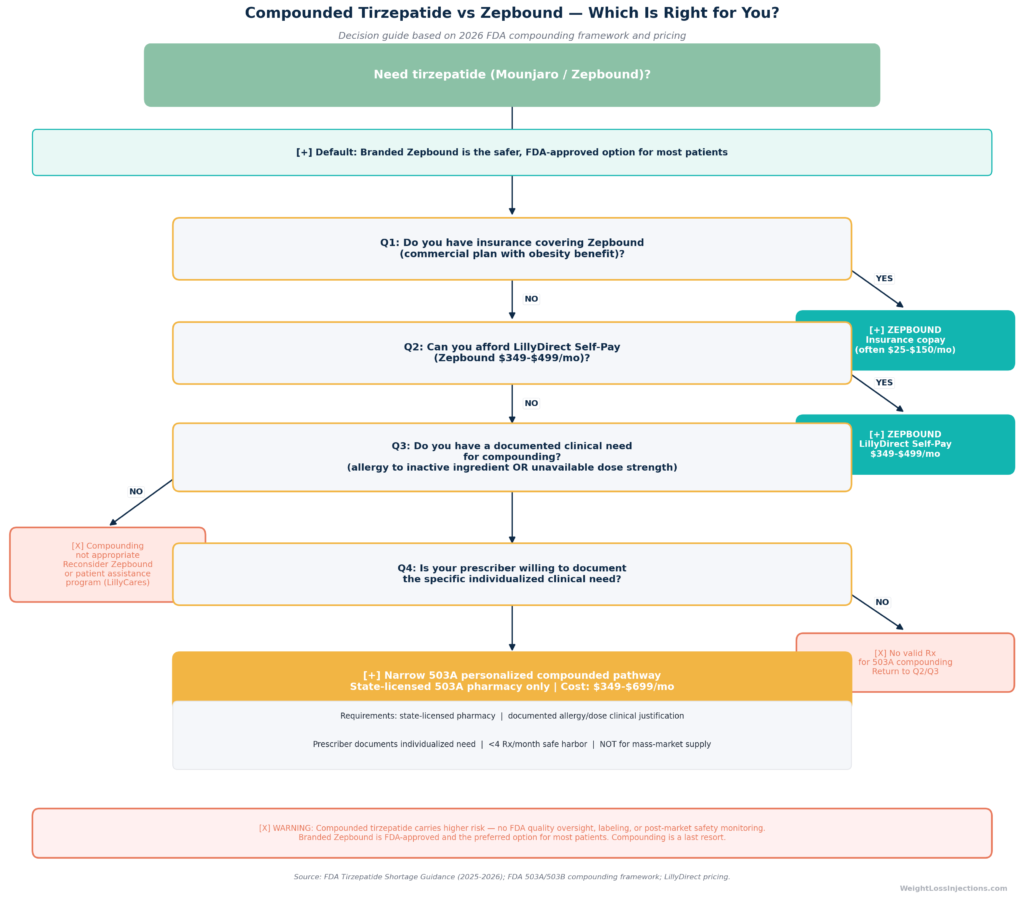
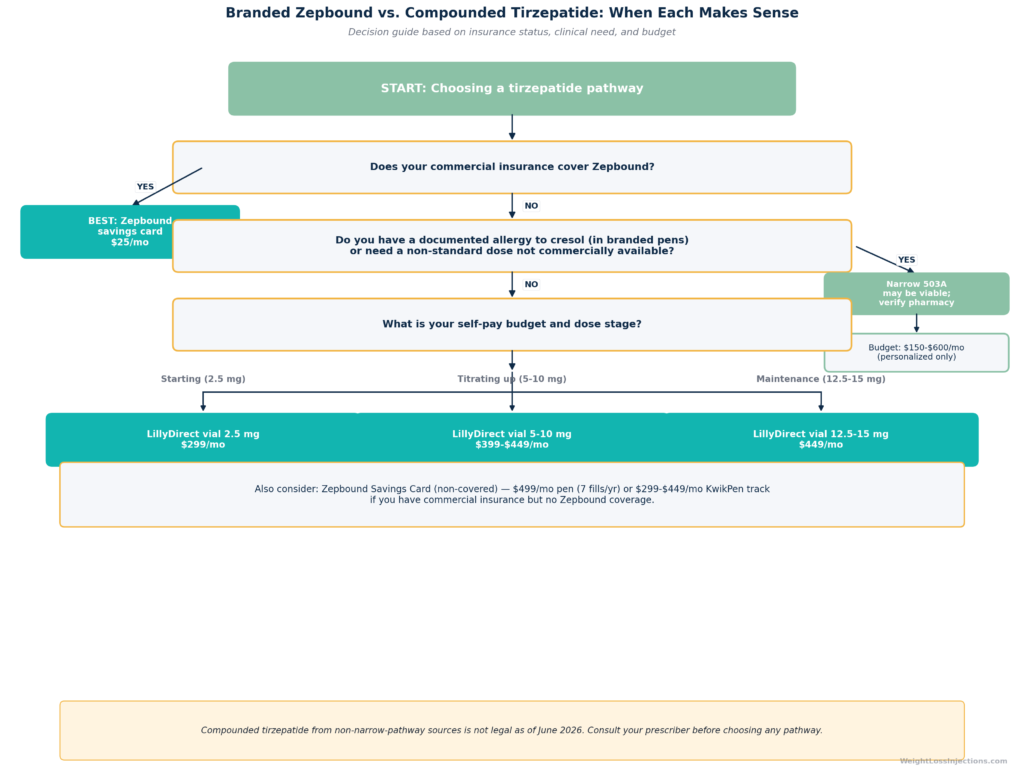
Decision tree / flowchart — Patient starts → “Do you have commercial insurance?” → savings card pathway → OR → “Do you have a documented allergy/clinical need?” → 503A exception → OR → LillyDirect…
Choose Zepbound When:
You are the majority of patients. If you do not have a documented allergy to a branded product inactive ingredient and do not have a physician-documented clinical need for a dose not commercially available, you do not qualify for the 503A exception — full stop.
You have commercial insurance, particularly with access to the Lilly savings card. At $25 per fill, Zepbound is dramatically cheaper than any legitimate compounded option. Work with your prescriber and insurance to pursue prior authorization. Per Healthy Meals Incentives, commercial plans cover Zepbound for weight management at varying rates; prior authorization is commonly required but is achievable with documented BMI criteria.
You want the most quality-verified option. If peace of mind about potency and sterility matters to you, Zepbound’s CGMP manufacturing and FDA lot-release testing are categorically superior to any 503A compounded product.
You prefer the KwikPen autoinjector. If self-injection anxiety or dose calculation concerns are real factors, the prefilled, pre-set KwikPen eliminates those variables entirely.
You are a self-pay patient without a 503A-qualifying clinical need. LillyDirect vials at $299–$449/month are the practical and legal default. This is Lilly’s own answer to the access problem compounders were filling. WeightLossInjections.com can assist you with the LillyDirect enrollment process — [service detail].
The Narrow Case for Compounded 503A Tirzepatide (Consult Your Physician):
This pathway is not for everyone. It is for specific patients with specific, documented clinical needs:
- You have a documented allergy to cresol or another inactive ingredient in the Zepbound pen formulation, and your prescriber has confirmed this in writing
- Your physician has documented a specific clinical need for a non-standard titration dose not offered commercially (for example, a 3 mg or 6 mg intermediate step) because you have experienced medically significant GI side effects at standard escalation rates
- You are being treated by a physician who has independently verified that the compounding pharmacy is 503A-licensed in good standing, compliant with USP \<797>, PCAB-accredited if possible, and can provide a third-party Certificate of Analysis
- You understand and accept that the quality assurance for compounded tirzepatide is inherently lower than for CGMP-manufactured Zepbound, and you and your physician have discussed this risk
If you meet these criteria and your physician agrees, WeightLossInjections.com can help evaluate whether a compliant 503A pharmacy pathway exists for you — [$X/month] for [service detail].
Patients for Whom Neither Standard Pathway Applies:
Patients without insurance coverage, without a 503A-qualifying clinical need, and with cost constraints should consider LillyDirect vials at $299/month (2.5 mg start) as their entry point. If tirzepatide remains financially out of reach, discuss semaglutide alternatives — Wegovy via NovoCare starts at $349/month for injection maintenance, with an oral pill option at $149–$299/month — with your provider.
Our take at WeightLossInjections.com: The honest answer for most patients in 2026 is this: Zepbound, via LillyDirect or your insurance, is your best path. The cost gap that once justified the compounding market has effectively closed for most patients. WeightLossInjections.com serves patients across both pathways — we help with LillyDirect enrollment, insurance prior authorization support, and the narrow 503A compounding exception for patients who genuinely qualify with documented clinical need. If you are unsure which pathway applies to you, a consultation with one of our licensed clinicians can clarify your options. [service detail]
Our Take at WeightLossInjections.com
Our overall assessment: This is not a close call for most patients, and we want to be direct about that rather than manufacture a false balance.
The molecule in both products is identical, and that fact matters — but it is not the whole story. Zepbound’s CGMP manufacturing process, FDA lot-release testing, and ongoing pharmacovigilance deliver something compounded tirzepatide cannot: reliable certainty that the product in your pen matches the label. The 320+ adverse event reports the FDA collected by early 2025 are not evidence that compounded tirzepatide is always dangerous — they are evidence that quality failures occur at a rate that the compounding system cannot inherently prevent, and that Lilly’s manufacturing system is specifically designed to prevent.
The cost argument for compounding has also largely been resolved by the market. LillyDirect vials at $299/month starting price, and the $25/fill savings card for commercially insured patients, mean that Zepbound is now competitive on price for most patients. The days when a patient could look at a $1,000 branded list price and find a compelling economic rationale for a compounded alternative are not fully over — but they are significantly diminished.
The legal landscape ended the debate for the majority of patients: mass-market compounded tirzepatide has been unlawful since March 2025. This was a policy change with real enforcement behind it.
What does remain is a genuinely legitimate, narrowly applicable 503A exception — and WeightLossInjections.com does not dismiss patients in that narrow category. If a physician has documented a cresol allergy or a clinical need for an intermediate dose that Lilly does not supply, that is a real, FDA-recognized clinical situation that a compliant 503A pharmacy can address. That patient deserves support navigating that pathway safely, not blanket dismissal.
The practical framework: start with Zepbound. If your insurance covers it, pursue prior authorization — it is worth the effort. If you are self-pay, explore LillyDirect. If you believe you have a qualifying clinical need for compounded tirzepatide, bring the specifics to your physician and ask whether your situation meets the documented 503A criteria. A licensed clinician at WeightLossInjections.com can help you evaluate all three paths — [service detail] for [$X/month].
This content is for informational purposes only and does not constitute medical advice. Consult a licensed healthcare provider before starting, stopping, or changing any treatment.
[STATE-SPECIFIC DISCLAIMER]
FAQ
If the compounded product contains accurate tirzepatide at the labeled potency, the clinical effects should be equivalent — it is the same molecule, and the efficacy evidence from SURMOUNT-1 (NEJM 2022) applies equally to both. At 72 weeks, SURMOUNT-1 participants achieved mean weight loss of −15.0% (5 mg), −19.5% (10 mg), and −20.9% (15 mg). The issue is quality assurance, not the molecule: unlike Zepbound, compounded tirzepatide does not go through FDA’s pre-market review or CGMP lot-release testing. The FDA compiled over 320 adverse event reports through February 2025 documenting compounded batches that were subpotent (producing no effect) or superpotent (causing overdose-level reactions), per FDA’s compounding clarification guidance. With a PCAB-accredited 503A pharmacy that provides a Certificate of Analysis from an accredited third-party lab, the quality risk is meaningfully lower — but not zero, and never at the CGMP standard that Lilly achieves.
Generally yes, with your prescriber’s guidance. The molecule and dose schedule are identical, so a patient on compounded 10 mg weekly can transition to Zepbound 10 mg weekly without re-titrating from the bottom. However, you should disclose to your prescriber the exact dose you were on, how long you have been using tirzepatide, what side effects you experienced, and where you were in the titration. One important nuance: if you were on a non-standard intermediate dose (such as 6 mg or 8 mg) from a compounding pharmacy, your prescriber will need to determine the closest available Zepbound dose and whether dose adjustment is appropriate. LillyDirect vials are an accessible transition pathway for self-pay patients. Per the Zepbound HCP prescribing information, the available commercial strengths are 2.5, 5, 7.5, 10, 12.5, and 15 mg.
Zepbound’s retail price of approximately $1,086 per 28-day supply reflects Eli Lilly’s research and development investment across the full SURMOUNT clinical trial program, the FDA approval process, CGMP manufacturing infrastructure, the KwikPen device delivery system, and branded pharmaceutical pricing economics — per Healthy Meals Incentives’ 2026 tirzepatide cost analysis. Compounding pharmacies bore none of these costs; they purchased bulk API and compounded it in-house. The list price is not, however, what most patients actually pay. LillyDirect vials at $299/month (2.5 mg starting dose) close the gap significantly, and the Lilly savings card at $25 per fill for commercially insured patients changes the comparison entirely.
Yes. Eli Lilly introduced Zepbound single-dose vials through the LillyDirect self-pay program, available in all six dose strengths (2.5 mg through 15 mg). These are FDA-approved, manufactured to CGMP standards, and require the same self-injection technique as compounded vials — a syringe draw from a single-use vial. Per Healthy Meals Incentives, LillyDirect vial pricing is $299/month at 2.5 mg, $399/month at 5 mg, and $449/month for all higher doses. Lilly also launched a multi-dose KwikPen in February 2026. The vial format option, which some patients and practitioners preferred, is now fully available through the branded product — removing one of the last format-based arguments for compounding.
No head-to-head randomized controlled trial has compared compounded tirzepatide directly to Zepbound. The clinical concern is not the molecule — it is batch-to-batch quality variability in compounded products, not the molecule’s inherent properties. Properly manufactured compounded tirzepatide at the correct dose would be expected to produce outcomes equivalent to the SURMOUNT trial data. The documented problem is that “properly manufactured” is not guaranteed in the compounding context the way it is under CGMP. Per StatPearls, tirzepatide’s pharmacology is fully established and does not differ by manufacturer — what differs is the certainty that the labeled dose is what is actually delivered, per FDA’s compounding guidance.
Many patients faced this situation in early 2025 when pharmacy grace periods expired. Your prescriber can transition you to Zepbound (branded tirzepatide) at the nearest equivalent dose on the standard schedule. LillyDirect vials are the most accessible self-pay option; the enrollment process is straightforward. Discuss with your prescriber whether you qualify for the narrow 503A personalized-medicine exception — if you have a documented allergy to a branded inactive ingredient or a genuine clinical need for a non-standard dose, a compliant 503A pharmacy may still be a legal option. If your prescriber agrees you qualify, ask them to document the specific clinical justification in the prescription; without that documentation, no compliant pharmacy can fill it. WeightLossInjections.com can assist with transition to LillyDirect, insurance prior authorization, or evaluation of 503A eligibility — [service detail].