![Unbranded [pillar-drug-class] injection pen on a neutral background — WeightLossInjections.com editorial hero](https://weightlossinjections.com/wp-content/uploads/2026/04/hero_ozempic_c3_safety-1200x675.png)
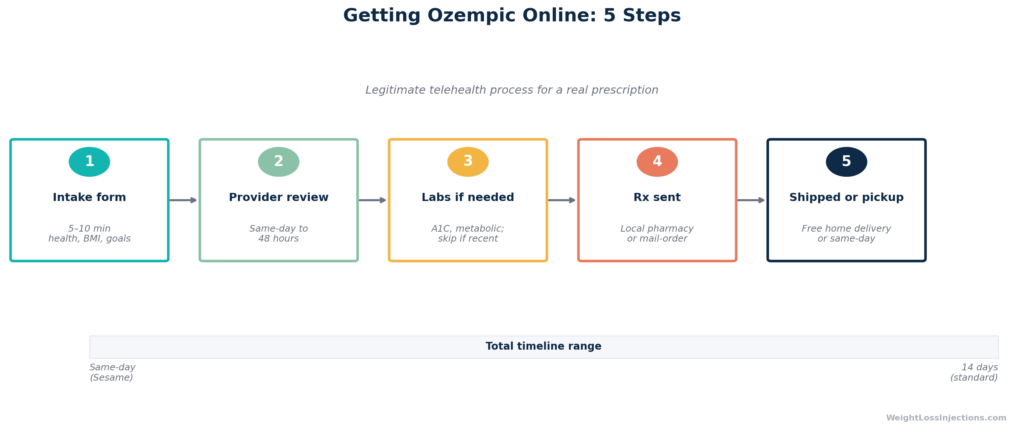
Online Ozempic Prescription Process
Yes, you can get Ozempic online with a valid prescription through a licensed telehealth provider. Novo Nordisk’s NovoCare Pharmacy offers $199/month for the first two fills (0.25 mg and 0.5 mg pens, through June 30, 2026), then $349–$499/month ongoing.
What you cannot legally do: buy Ozempic without a prescription, or purchase compounded semaglutide from mass-market sites that have no prescribing provider involved. Those routes carry real safety risks, the FDA has documented 605 adverse event reports tied to compounded semaglutide as of mid-2025.
Can You Get Ozempic Online Legally?
The short answer is yes, with one non-negotiable requirement: a valid prescription from a licensed provider.
FDA prescribing information for Ozempic (NDA 209637) classifies semaglutide as a prescription-only medication in all approved doses (0.25 mg, 0.5 mg, 1 mg, and 2 mg weekly injections). The FDA is explicit on this point: “Patients should obtain a prescription from their doctor and fill the prescription at a state-licensed pharmacy,” according to its guidance on unapproved GLP-1 drugs. Full stop.
What telehealth changes is not the prescription requirement, it is where you get that prescription. Instead of scheduling an in-person appointment with your primary care physician or endocrinologist (which can take weeks), a licensed telehealth provider in your state can evaluate your clinical eligibility, issue a prescription, and route it to a pharmacy that ships to your door, often within days. The clinical evaluation is real; it is just conducted via secure intake forms, video visits, or asynchronous messaging rather than in a waiting room.
What the FDA Warns Against
The FDA’s guidance on unapproved GLP-1 drugs used for weight loss is specific about the danger of bypassing this system. “Unapproved versions do not undergo FDA’s review for safety, effectiveness and quality before they are marketed,” the agency states. It has documented counterfeit Ozempic circulating in the U.S. supply chain, products that “could contain the wrong ingredients, contain too little, too much or no active ingredient at all or other harmful ingredients.” As of July 31, 2025, the FDA had received 605 reports of adverse events associated with compounded semaglutide, some requiring hospitalization.
The key distinction: a legitimate telehealth platform prescribes and dispenses FDA-approved Ozempic (the branded Novo Nordisk product) through a licensed pharmacy. A fraudulent or non-compliant site sells something else, compounded, counterfeit, or unapproved, without a real prescriber involved.
Ozempic Eligibility: Who Qualifies?
Ozempic was FDA-approved on December 5, 2017 (NDA 209637) and has three approved indications, none of which is weight loss in isolation. Understanding which bucket you fall into determines whether you qualify for Ozempic specifically, or whether Wegovy (which carries the weight-loss indication) is the more appropriate prescription.
FDA-Approved Uses: Type 2 Diabetes, Cardiovascular Risk, and CKD
Per the 2025 Ozempic prescribing information, Ozempic is approved as:
- An adjunct to diet and exercise to improve glycemic control in adults with type 2 diabetes mellitus
- A treatment to reduce the risk of major adverse cardiovascular events (cardiovascular death, non-fatal MI, non-fatal stroke) in adults with T2D and established cardiovascular disease
- A treatment to reduce the risk of sustained eGFR decline, end-stage kidney disease, and cardiovascular death in adults with T2D and chronic kidney disease (the FLOW indication, approved January 28, 2025)
If you have type 2 diabetes and your A1C is above goal, or you have T2D with established cardiovascular disease, you qualify for Ozempic on-label. Most commercial insurance plans — and many Medicaid programs — cover Ozempic for T2D without requiring the prior authorization battle that plagues off-label weight-loss prescriptions.
Off-Label Weight Loss: The BMI Threshold
Providers regularly prescribe Ozempic off-label for weight management in patients without diabetes. The clinical criteria borrowed from obesity medicine guidelines align with those used for Wegovy:
- BMI ≥ 30 (obesity), or
- BMI ≥ 27 with at least one weight-related comorbidity (hypertension, dyslipidemia, obstructive sleep apnea, type 2 diabetes, or cardiovascular disease)
In real-world clinical data, patients on semaglutide at Ozempic doses saw a mean 5.9% body weight loss at 3 months in a Mayo Clinic / JAMA Network Open analysis (Ghusn et al., 2022). For comparison, the SUSTAIN-1 trial of Ozempic’s 0.5 mg and 1 mg doses in adults with T2D showed mean weight loss of 4.5% and 6.0% respectively at 30 weeks, per the SUSTAIN-1 trial published in Diabetes Care. Neither of these is the 14.9% body weight reduction at 68 weeks seen in the STEP 1 trial (NEJM, 2021) — that result is specific to Wegovy’s 2.4 mg weekly dose. If maximum weight loss is your primary goal, your provider may discuss whether Wegovy (approved for weight management) is the more appropriate choice.
Contraindications: Who Cannot Take Ozempic
The Ozempic FDA prescribing information lists the following absolute contraindications:
| Contraindication | Reason |
|---|---|
| Personal or family history of medullary thyroid carcinoma (MTC) | Semaglutide causes thyroid C-cell tumors in rodents; human relevance unknown but risk not excluded |
| Multiple Endocrine Neoplasia syndrome type 2 (MEN 2) | Elevated baseline risk of MTC |
| Serious hypersensitivity to semaglutide or any excipient | Including prior anaphylaxis or angioedema |
Additional clinical warnings that a provider will evaluate (not absolute contraindications, but serious considerations):
- History of pancreatitis: Ozempic has been associated with acute pancreatitis; patients with a history of pancreatitis require careful risk-benefit discussion before prescribing
- Pregnancy or planned pregnancy: Limited human data; animal studies show embryofetal risk. The FDA PI recommends discontinuing at least 2 months before a planned pregnancy given semaglutide’s long washout period
- Diabetic retinopathy: Worsening retinopathy has been reported, particularly with rapid glycemic improvement; ophthalmologic monitoring is warranted in patients with this history
A legitimate telehealth intake form will screen for all of these. Any platform that does not ask about thyroid history, pancreatitis, or pregnancy is not conducting an adequate evaluation.
Step-by-Step: How to Get an Ozempic Prescription Online
The process at most legitimate telehealth platforms follows five steps. Timelines vary based on how quickly you submit documentation and whether labs are required.
Step 1 — Complete the intake form (5–15 minutes)
You provide your health history: current medications, diagnoses (especially T2D, cardiovascular disease, thyroid conditions), BMI, and goals. Most platforms ask you to enter your current weight and height; some request a photo of a recent A1C or metabolic panel result.
Step 2 — Provider review (same-day to 48 hours)
A licensed physician, nurse practitioner, or physician assistant in your state reviews your intake. Some platforms offer synchronous video visits; others use asynchronous clinical review. Platforms like Sesame advertise same-day provider availability; standard telehealth platforms (Ro, PlushCare) typically complete the review within 24–48 hours.
Step 3 — Labs if needed (adds 3–10 days)
For patients without recent bloodwork, the provider may order a baseline A1C, comprehensive metabolic panel, or lipid panel. Many platforms partner with Labcorp or Quest for in-person draws. If you have labs from within the past 6–12 months, this step can be skipped.
Step 4 — Prescription sent to pharmacy
If approved, the provider sends a prescription to your preferred pharmacy. Most telehealth platforms integrate directly with NovoCare Pharmacy for self-pay patients, or can route to a local retail pharmacy for insurance billing.
Step 5 — Medication shipped or ready for pickup
NovoCare offers free home delivery. Standard retail pharmacies (CVS, Walgreens, Walmart) typically have Ozempic in stock or can order within a few days; call ahead to verify. The complete timeline from intake to pen in hand: same-day at best (expedited same-day platforms), typically 3–7 days, and up to 2 weeks when labs are required.
Our Top 3 · September 2026
The best GLP-1 providers right now
Independently reviewed. Ranked by price, medication access, provider quality, and patient outcomes.
Renew GLP
Personalized GLP-1, GIP plans: Semaglutide & Tirzepatide.
Medvi
No membership or hidden fees. Everything you need is included.
Trimi
US-licensed clinicians and shipped to your door, from $99/mo.
2026 Costs Without Insurance: What You’ll Actually Pay
The single most common barrier to getting Ozempic online is cost. Ozempic’s list price runs approximately $1,028/month — a number most uninsured patients cannot sustain. Here is what the legitimate self-pay landscape looks like in April 2026.
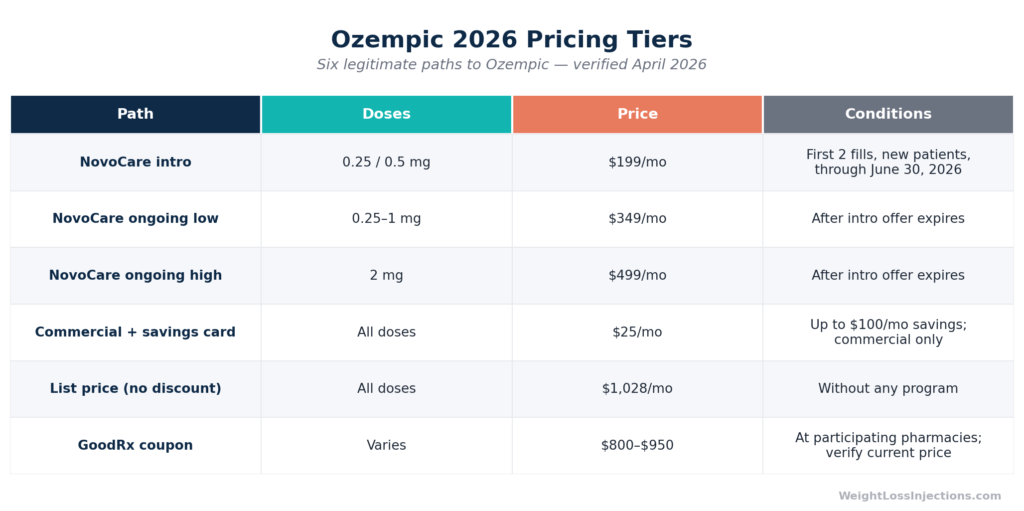
Ozempic 2026 Cost Tier Table
NovoCare Pharmacy Self-Pay (Novo Nordisk’s Direct Program)
NovoCare Pharmacy is Novo Nordisk’s own mail-order pharmacy, and it is currently the most cost-effective legal self-pay route for most uninsured patients:
- $199/month introductory offer — applies to new NovoCare patients on the 0.25 mg and 0.5 mg starting doses, for up to two monthly fills, through June 30, 2026
- $349/month ongoing — for Ozempic 0.25 mg, 0.5 mg, or 1 mg pens after the introductory period
- $499/month ongoing — for the 2 mg pen
This pricing requires a valid Ozempic prescription routed to NovoCare. Government beneficiaries (Medicare, Medicaid, TRICARE) are excluded from the NovoCare self-pay savings program. All doses ship with free home delivery.
For patients with commercial insurance, a separate Novo Nordisk savings card can bring monthly copays to as low as $25/month (subject to a $100/month maximum savings benefit), per NovoCare’s terms.
What About GoodRx?
GoodRx coupons for Ozempic at retail pharmacies fluctuate but generally land in the $800–$950/month range for a single 1 mg pen, meaningfully higher than NovoCare’s self-pay pricing. Verify current pricing at GoodRx.com/ozempic before filling a prescription, as prices vary by pharmacy and region. For most cash-paying patients, NovoCare’s $199–$349 self-pay tier is the better option.
Looking Ahead: 2027 List Price Reset
Novo Nordisk announced in February 2026 that it will reset list prices for all semaglutide forms to approximately $675/month in 2027, a reduction from the current $1,028/month list price that would make NovoCare-type programs less necessary for commercially insured patients. That change has not yet taken effect as of April 2026.
The Counterfeit and Compounding Warning You Need to Read
The post-shortage landscape makes this section essential for any patient considering Ozempic online.
The Shortage Is Over and Compounding Is Severely Restricted
The FDA declared the semaglutide injection shortage officially resolved on February 21, 2025. Two enforcement deadlines followed: the 503A (state-licensed pharmacy) deadline of April 22, 2025, and the 503B (outsourcing facility) deadline of May 22, 2025. After those dates, large-scale production and distribution of compounded semaglutide lost its legal basis.
What 503A pharmacies can still do: A licensed compounding pharmacy may prepare semaglutide for a specific patient if the prescriber documents a significant clinical difference from any available FDA-approved product, for example, a medically necessary dose or formulation not commercially available. This is a narrow, individualized pathway, not a mass-market channel.
What 503B outsourcing facilities cannot do: They cannot compound copies of Ozempic or Wegovy at scale. The FDA has confirmed it will take enforcement action against outsourcing facilities producing compounded semaglutide outside the narrow 503A framework.
Counterfeit Risk Is Real
The FDA has documented counterfeit Ozempic circulating in the U.S., including products with falsified labels bearing the names of pharmacies that never compounded them. Per FDA’s unapproved GLP-1 guidance: illegally marketed drugs “may be counterfeit; could contain the wrong ingredients or harmful ingredients; could contain too little, too much or no active ingredient at all.” By July 31, 2025, the agency had logged 605 adverse event reports linked to compounded semaglutide.
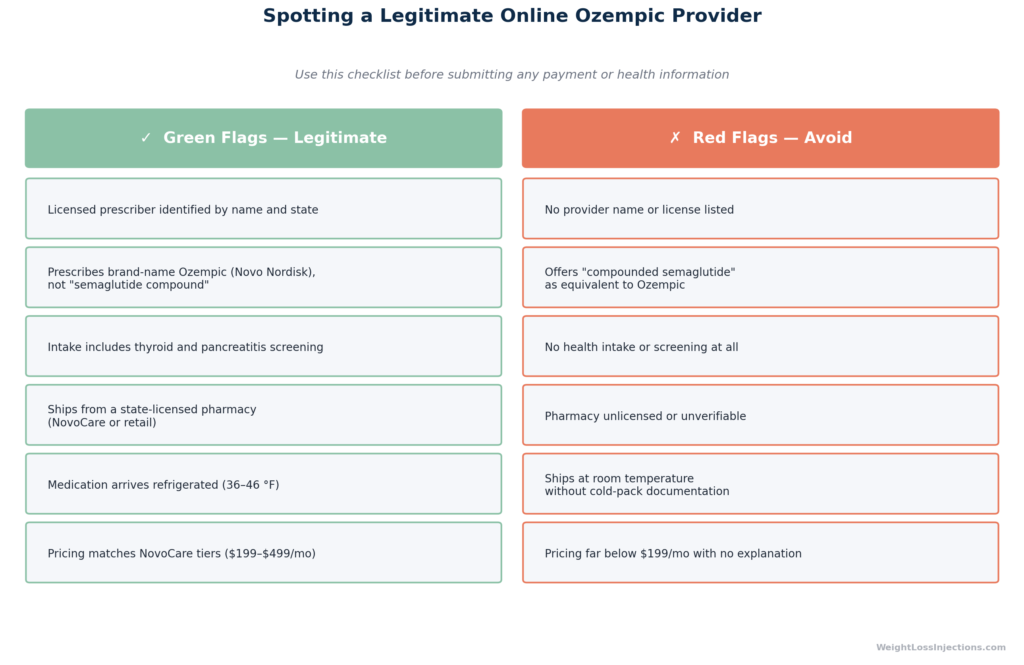
Ozempic Online Risk Red-Flag Visual
Practical rule: If a website offers “semaglutide” without requiring a clinical intake, lists no prescriber, charges substantially under $199/month, or ships without cold-chain documentation, that is not a legitimate Ozempic source. Ozempic must be stored at 36–46°F; a product that arrives warm is compromised, per FDA guidance.
Comparing Telehealth Providers for Online Ozempic
Several legitimate telehealth platforms operate in this space. Here is a high-level comparison of the major names, followed by where WeightLossInjections.com fits.
Ro (Rory/Body): One of the largest telehealth GLP-1 platforms. Offers provider consultations with a monthly membership model. Prescribes FDA-approved Ozempic (T2D indication) or Wegovy (weight management). Pricing bundles the consultation fee; medication is billed separately through your pharmacy of choice or NovoCare. Known for strong user interface and customer support, but not the lowest all-in cost for cash-pay patients.
PlushCare: A broader telehealth primary care platform that covers GLP-1 prescribing as one of many services. Monthly membership fee plus per-visit charges. Can be a good option for patients who want ongoing primary care in addition to GLP-1 management. The PlushCare Ozempic page is among the top-ranking SERP results on this topic, suggesting solid patient traffic, though its model is less specialized for GLP-1 management than dedicated platforms.
Sesame: A direct-pay marketplace connecting patients with licensed providers without insurance involvement. Notable for offering same-day appointments at lower per-visit prices than subscription telehealth. The tradeoff: less structured ongoing management compared to dedicated GLP-1 platforms.
WeightLossInjections.com: Our model is built specifically around GLP-1 access and ongoing management for cash-pay patients. We bundle the telehealth consultation, dose-adjustment support, and provider messaging into a flat [$X/month] — no insurance prior authorization required, no per-visit billing surprises. [service detail]. We prescribe FDA-approved Ozempic where clinically appropriate, route prescriptions through NovoCare for patients who want to use the $199 introductory pricing, and manage the ongoing dose titration from 0.25 mg through 2 mg as indicated. If Ozempic is not the right clinical fit, we discuss Wegovy or other GLP-1 options with you directly.
Our take at WeightLossInjections.com: The landscape of online Ozempic prescribing has matured significantly since the shortage years. The mass-market compounding channels are largely gone; what remains is a cleaner, more legitimate market of telehealth providers prescribing FDA-approved medications. The right choice is the platform that gives you a real licensed provider, uses brand-name Ozempic at NovoCare pricing, and provides ongoing support — not just a one-time Rx. That is what we are built to do.
Alternatives If Ozempic Isn’t the Right Fit
Ozempic is not the only GLP-1 option available online, and for weight management specifically, it may not even be the best starting point.
Wegovy (semaglutide, FDA-approved for weight loss): Contains the same active ingredient as Ozempic but is specifically approved for chronic weight management at the higher 2.4 mg weekly dose. The STEP 1 trial (NEJM, 2021) showed a mean 14.9% body weight loss at 68 weeks, substantially more than Ozempic’s on-label dose produces in a weight-loss context. Via NovoCare, Wegovy injectable pens start at $199/month (introductory), $349/month ongoing. If your primary goal is weight loss rather than glycemic control, your provider may prefer prescribing Wegovy over off-label Ozempic.
Wegovy oral pill: Launched January 2026, Novo Nordisk’s oral semaglutide tablet carries the weight-management indication and is available through NovoCare at $149–$299/month depending on dose, currently the most affordable semaglutide option for cash-pay weight-loss patients. See our Ozempic vs. Wegovy guide for the full comparison.
Compounded semaglutide (now severely restricted): Post-shortage, this is no longer a reliable or legally straightforward option for most patients. See the compounding section above.
For a full comparison of all weight-loss medication options and their 2026 cash prices, see our guide to cheaper Ozempic alternatives.
Frequently Asked Questions
No. Ozempic is a Schedule-free but prescription-only medication under FDA regulation. The FDA explicitly requires that patients obtain a prescription from a licensed provider and fill it at a state-licensed pharmacy. Any website offering Ozempic or semaglutide without a prescribing step is operating illegally. The telehealth model streamlines the prescription process but does not eliminate it, a licensed provider must evaluate your eligibility and sign the prescription.
The short answer is that the mass-market compounded semaglutide sold during 2022–2024 is no longer legally available. The semaglutide shortage was resolved on February 21, 2025, after which 503A and 503B enforcement deadlines (April 22 and May 22, 2025, respectively) ended large-scale compounding. The FDA received 605 adverse event reports associated with compounded semaglutide as of July 31, 2025, including dosing errors requiring hospitalization. A narrow 503A pathway still exists for individualized, prescriber-justified formulations, but it is not a mass-market product and should not be sought through telehealth platforms marketing it as an Ozempic equivalent.
Through NovoCare Pharmacy, new patients pay $199/month for the first two fills (0.25 mg and 0.5 mg pens) through June 30, 2026. After that introductory period: $349/month for the 0.25 mg, 0.5 mg, or 1 mg pen; $499/month for the 2 mg pen. Ozempic’s list price without any discount program is approximately $1,028/month. GoodRx coupons at retail pharmacies generally land in the $800–$950/month range, making NovoCare the better cash-pay option for most patients. Government beneficiaries (Medicare, Medicaid, TRICARE) are excluded from NovoCare’s self-pay savings program.
Not always, but often. For patients with documented type 2 diabetes who have recent A1C results (typically within 6–12 months), many telehealth providers can issue a prescription without ordering new labs. For patients pursuing off-label weight management, providers may request a baseline A1C and metabolic panel to confirm there is no undiagnosed diabetes or contraindication. Labs add 3–10 days to the timeline. If you have recent bloodwork from your primary care physician, have it ready to upload during the intake process, it typically accelerates approval.
Yes. NovoCare Pharmacy offers free home delivery for all Ozempic doses. Medication is shipped refrigerated (required storage temperature: 36–46°F) in cold-pack packaging. Most telehealth platforms that route prescriptions to NovoCare will coordinate direct shipment to your address. Standard retail pharmacies (CVS, Walgreens, Walmart) also carry Ozempic, if you prefer local pickup, call ahead to confirm availability, as stock varies by location.
Per the 2025 Ozempic prescribing information, Ozempic is contraindicated in anyone with: (1) a personal or family history of medullary thyroid carcinoma (MTC); (2) Multiple Endocrine Neoplasia syndrome type 2 (MEN 2); or (3) a serious hypersensitivity reaction to semaglutide or its excipients. Providers will also conduct a careful risk-benefit discussion before prescribing Ozempic to patients with a history of pancreatitis, active or planned pregnancy (a minimum 2-month washout before conception is recommended), or diabetic retinopathy requiring monitoring.
This article is for educational purposes only and is not a substitute for medical advice. WeightLossInjections.com’s medical team reviews content quarterly; last medical review: April 2026. Consult a licensed provider before starting or switching any weight-loss medication.