
Key Takeaways
- Retatrutide is investigational and not approved by the FDA or any other regulatory authority as of July 2026 — all body composition data discussed here comes from clinical trial substudies, not real-world use.
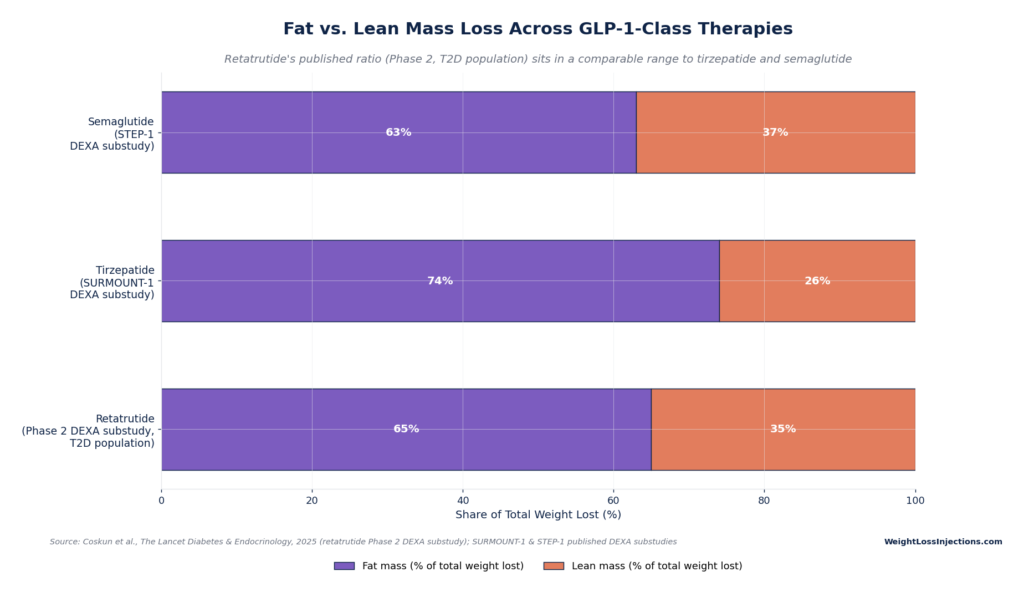
- The most rigorous published retatrutide body composition data comes from a Phase 2 DEXA substudy in people with type 2 diabetes (Coskun et al., The Lancet Diabetes & Endocrinology, 2025), which found a fat loss index of 64.6% — meaning roughly 35% of total weight lost was lean mass, a proportion the study authors described as “similar to other obesity treatments.”
- For comparison, published DEXA data puts lean mass at roughly 25–26% of total weight lost with tirzepatide (SURMOUNT-1 substudy) and ~34–40% with semaglutide (STEP-1 substudy) — meaning retatrutide’s published ratio sits in a comparable range, not a clearly better or worse one.
- No DEXA body composition substudy has yet been published for TRIUMPH-1 or TRIUMPH-4, the Phase 3 obesity trials most relevant to the general population — the only published retatrutide DEXA data comes from a Phase 2 substudy in a type 2 diabetes population.
- Lean mass loss is a class-wide concern with GLP-1 and incretin-based therapies, not something unique to retatrutide, and protein intake plus resistance training are the two most consistently cited protocol considerations for mitigating it.
This article summarizes published body composition research for informational purposes. It is not exercise or nutrition medical advice, and it does not represent retatrutide as an approved treatment.
Why Body Composition Matters Beyond the Number on the Scale
Retatrutide (LY3437943) is an investigational triple hormone receptor agonist — targeting GIP, GLP-1, and glucagon receptors — developed by Eli Lilly and Company. It is not approved by the FDA or any other regulator as of July 2026, and the body composition data discussed in this article comes entirely from clinical trial substudies, not from real-world clinical use. The only legal way to access retatrutide today is enrollment in an authorized clinical trial through ClinicalTrials.gov.
With retatrutide producing some of the largest mean weight-loss percentages ever reported in a pharmaceutical obesity trial — 28.3% at 80 weeks in TRIUMPH-1’s 12 mg arm — a natural and clinically important question follows: what, specifically, is being lost? Total body weight is made up of fat mass, lean mass (which includes skeletal muscle, organs, water, and connective tissue), and bone. Losing 70+ pounds is only an unambiguous health win if the overwhelming majority of that loss is fat rather than functional lean tissue.
The Class-Wide Concern: GLP-1 Therapies and Lean Mass Loss
This isn’t a retatrutide-specific issue — it’s a documented characteristic of essentially every significant pharmacological or dietary weight-loss intervention. The concern has become more prominent as GLP-1-class drugs have produced larger absolute amounts of weight loss than earlier generations of obesity treatment, meaning even a modest percentage of lean mass loss can translate into a larger absolute amount of muscle tissue lost.
Semaglutide (STEP-1 DEXA Substudy)
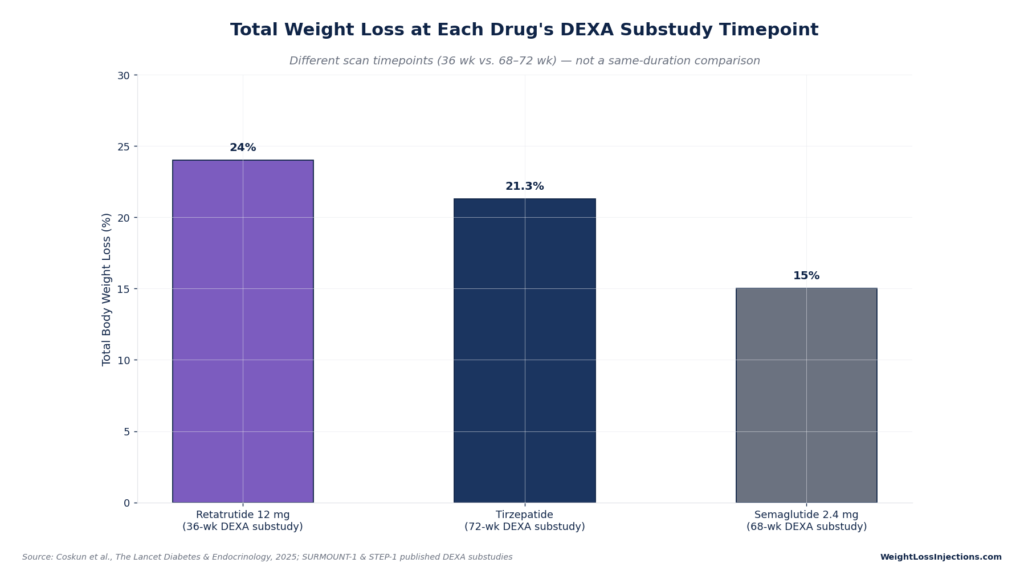
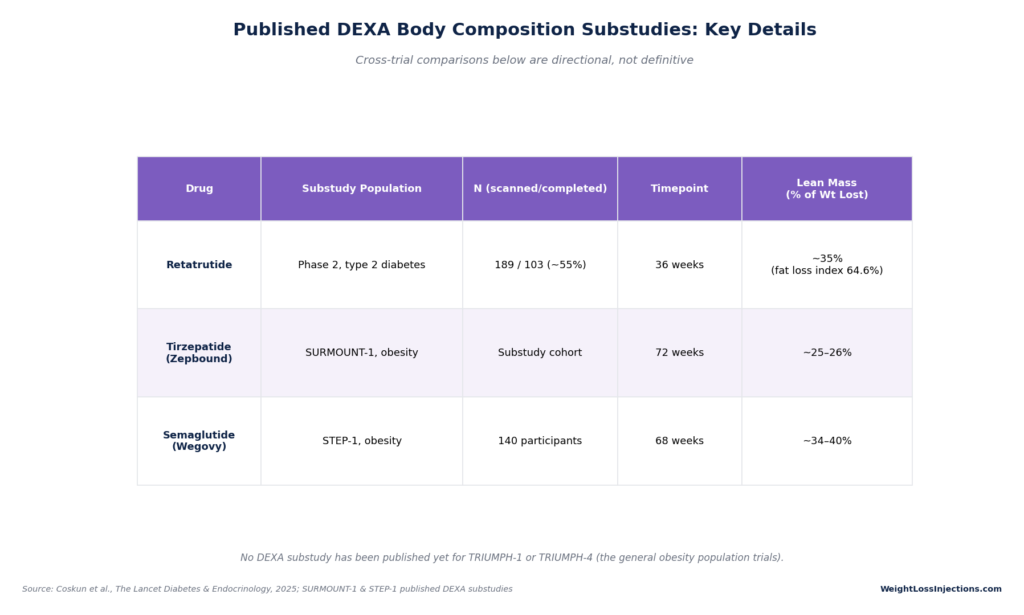
The body composition substudy within STEP-1, the pivotal semaglutide trial that underlies Wegovy, used DEXA scanning in 140 participants over 68 weeks. Semaglutide 2.4 mg produced roughly 15% total body weight loss, composed of approximately 19.3% fat mass reduction and 9.7% lean mass reduction. When broken into a proportion of total weight lost, lean mass accounted for roughly 34–40% of the total, depending on which published analysis is referenced — a commonly cited figure in the GLP-1 research literature.
Tirzepatide (SURMOUNT-1 DEXA Substudy)
The corresponding substudy for tirzepatide — the dual GIP/GLP-1 agonist behind Zepbound — showed a somewhat more favorable ratio. At 72 weeks, tirzepatide produced roughly 21.3% total weight loss, with fat mass falling by approximately 33.9% and lean mass falling by approximately 8.3–10.9% (estimates vary slightly across published analyses). This corresponds to lean mass accounting for roughly 25–26% of total weight lost — modestly better preservation than the semaglutide figures, though the two drugs haven’t been tested head-to-head in a single trial.
Retatrutide (Phase 2 DEXA Substudy in Type 2 Diabetes)
The most rigorous published retatrutide-specific body composition data comes from a prespecified DEXA substudy within the Phase 2 trial, conducted in people with type 2 diabetes and published by Coskun and colleagues in The Lancet Diabetes & Endocrinology in 2025. Researchers scanned 189 participants at baseline, with 103 completing both baseline and week-36 DEXA scans across the 0.5 mg, 4 mg (pooled), 8 mg (pooled), and 12 mg dose groups, plus placebo and a dulaglutide 1.5 mg comparator arm.
The key finding: total fat mass fell by 26.1% in the pooled 8 mg group and 23.2% in the 12 mg group, substantially more than the 2.6% and 4.5% reductions seen with dulaglutide and placebo, respectively. The study’s fat loss index — a measure of what proportion of total weight change came from fat versus lean tissue — was 64.6% across the active dose groups. In plain terms, that means roughly 35% of total weight lost was lean mass. The study authors’ own conclusion was direct: this proportion of lean-to-total weight loss was “similar to other obesity treatments” (Coskun et al., The Lancet Diabetes & Endocrinology, 2025).
| Drug | Trial/Substudy | Total Weight Loss | Lean Mass as % of Total Weight Lost |
|---|---|---|---|
| Retatrutide (pooled active doses) | Phase 2 DEXA substudy, T2D population | Varies by dose (up to ~24% at 12 mg) | ~35% (fat loss index 64.6%) |
| Tirzepatide 10–15 mg | SURMOUNT-1 DEXA substudy | ~21.3% | ~25–26% |
| Semaglutide 2.4 mg | STEP-1 DEXA substudy | ~15% | ~34–40% |
Important Caveats on the Retatrutide Data
A few limitations are worth being explicit about, because they materially affect how much weight this comparison should carry:
- The retatrutide DEXA substudy was conducted in people with type 2 diabetes, not the general obesity population. TRIUMPH-1 and TRIUMPH-4 — the Phase 3 trials most relevant to the broader population this site covers — have not yet published body composition substudy results as of July 2026. T2D and general-obesity populations can have differing baseline metabolic and body composition profiles, so results may not translate directly.
- This was a Phase 2 substudy with a substantial dropout rate. Of 189 enrolled participants, only 103 completed both DEXA scans — a completion rate of roughly 55%, which is a meaningful limitation when interpreting the reliability of the results.
- Cross-trial comparisons are directional, not definitive. Different trials used different populations, different scan timepoints (36 weeks for retatrutide’s substudy vs. 68–72 weeks for the semaglutide and tirzepatide substudies), and different measurement protocols. No head-to-head DEXA comparison of all three drugs in the same trial exists.
- “Lean mass” on a DEXA scan is not the same as “skeletal muscle.” DEXA-measured lean mass includes water, glycogen stores, connective tissue, and organ tissue in addition to skeletal muscle — meaning the percentages above likely overstate true muscle loss to some degree, a limitation shared across all the drugs discussed here.
Our Top 3 · September 2026
The best GLP-1 providers right now
Independently reviewed. Ranked by price, medication access, provider quality, and patient outcomes.
Renew GLP
Personalized GLP-1, GIP plans: Semaglutide & Tirzepatide.
Medvi
No membership or hidden fees. Everything you need is included.
Trimi
US-licensed clinicians and shipped to your door, from $99/mo.
Why Lean Mass Loss Happens During Rapid Weight Loss
Significant weight loss achieved primarily through reduced caloric intake — which is largely how GLP-1 and incretin-based therapies work, by suppressing appetite — tends to produce some lean mass loss regardless of the specific drug involved. This is a well-established phenomenon in weight-loss physiology generally, seen with dietary interventions, bariatric surgery, and pharmacological treatment alike. The body doesn’t lose weight exclusively from fat stores; some proportion of lean tissue loss is a physiological byproduct of substantial caloric deficit, particularly without specific countermeasures.
Retatrutide’s added glucagon receptor activity has been proposed as a potential advantage here — glucagon signaling is associated with increased energy expenditure and fat oxidation, which theoretically could favor fat loss over lean tissue loss compared to GLP-1-only mechanisms. However, the published Phase 2 T2D substudy data doesn’t clearly demonstrate a meaningfully better lean-mass-sparing effect than tirzepatide; the ratios are in a broadly similar range. This remains a plausible mechanistic hypothesis rather than a proven clinical advantage.
What Trial Protocols Have Considered: Protein and Resistance Training
Across the GLP-1 research literature broadly — and echoed in commentary on the retatrutide body composition substudy specifically — two factors are consistently identified as the most actionable levers for mitigating lean mass loss during significant pharmacological weight loss:
- Adequate dietary protein intake. Higher protein intake during a caloric deficit is associated with better preservation of lean tissue across many weight-loss modalities, not specific to any one drug.
- Resistance training. Progressive resistance exercise provides a stimulus for muscle protein synthesis that can help offset some of the lean tissue loss associated with caloric deficit, again across weight-loss methods generally.
Neither of these has been tested as a formal intervention within retatrutide’s own Phase 2 or Phase 3 trial protocols in a way that isolates their specific effect on retatrutide-associated lean mass loss — the published substudy simply measured what happened without a structured exercise or high-protein arm. Their inclusion here reflects general body-composition science applicable across weight-loss interventions, not retatrutide-specific trial findings.
The Bottom Line, and What’s Still Unknown
Based on the best currently published evidence — a DEXA-confirmed Phase 2 substudy in a type 2 diabetes population — retatrutide’s lean mass loss as a proportion of total weight lost (roughly 35%) sits in a range comparable to, not clearly better or worse than, what’s been reported for tirzepatide and semaglutide. The Phase 3 obesity population data that would most directly answer this question for the general audience interested in retatrutide has not yet been published; TRIUMPH-3 was designed with a planned DEXA substudy of approximately 100 participants, but results are pending as of July 2026.
The Only Legal Way to Generate Individual Body Composition Data on Retatrutide
Because retatrutide remains investigational — with no USP/NF monograph and no inclusion in the FDA’s April 2026 peptide reclassification — there is no legal compounded or off-label source. The DEXA data referenced in this article came entirely from structured, medically supervised clinical trial substudies. The only legal way to receive retatrutide, and therefore to generate any individual body composition data while on it, is enrollment in an authorized clinical trial through ClinicalTrials.gov.
For those managing lean mass concerns with a currently approved option, tirzepatide-based treatment has the more extensive published DEXA dataset (SURMOUNT-1) among approved incretin-based therapies, and is worth discussing with a healthcare provider alongside a resistance training and protein-intake plan.
FAQ
Does retatrutide cause more muscle loss than semaglutide or tirzepatide?
Based on the only published retatrutide-specific DEXA data — a Phase 2 substudy in people with type 2 diabetes — lean mass accounted for roughly 35% of total weight lost, a proportion the study authors described as similar to other obesity treatments. This is comparable to, not clearly worse than, tirzepatide’s ~25–26% and semaglutide’s ~34–40% in their respective DEXA substudies.
Has retatrutide’s Phase 3 obesity trial data on muscle mass been published?
Not yet, as of July 2026. TRIUMPH-1 and TRIUMPH-4 have not published DEXA body composition substudy results. TRIUMPH-3 has a planned DEXA substudy of approximately 100 participants, but results are pending.
Is “lean mass” the same thing as muscle?
Not exactly. DEXA-measured lean mass includes skeletal muscle along with water, glycogen, connective tissue, and organ mass. This means published lean-mass-loss percentages across all GLP-1-class drugs likely overstate true skeletal muscle loss to some degree.
What can reduce lean mass loss during significant weight loss?
Adequate dietary protein intake and resistance training are the two most commonly cited strategies across the general body-composition research literature. Neither has been formally tested as a controlled intervention within retatrutide’s own trial protocols to date.
Can I get a DEXA scan while using retatrutide to track my own body composition?
Retatrutide is only legally available through enrollment in an authorized clinical trial, and body composition monitoring would depend on that specific trial’s protocol. There’s no legal way to use retatrutide outside a trial, so individual DEXA tracking outside a trial setting isn’t a lawful or available option at this time.
Medical disclaimer: Retatrutide is an investigational drug not approved by the FDA or any other regulatory authority as of July 2026. It is available only through enrollment in authorized clinical trials. This article is for informational purposes only and does not constitute medical advice, endorsement, or a recommendation to obtain retatrutide outside of a registered clinical trial. Speak with your healthcare provider about currently approved weight-loss treatments. Content published by WeightLossInjections.com.