
Key Takeaways
- Retatrutide is investigational and not approved by the FDA or any other regulatory authority as of July 2026 — there is currently nothing to “get ready to take,” because there is no approved product yet.
- The only legal access route today is enrollment in an authorized clinical trial via ClinicalTrials.gov; this article does not recommend seeking retatrutide through any other channel.
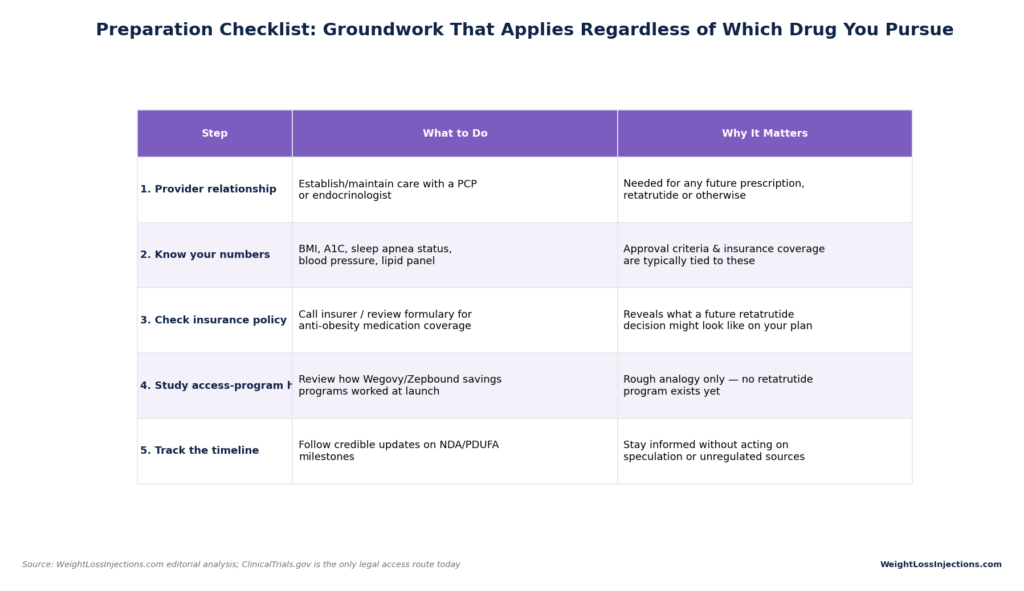
- General preparation focuses on things that matter regardless of which future obesity treatment you may eventually pursue: an established relationship with a primary care provider, clear documentation of your BMI and related health conditions, and early research into how your insurance plan handles anti-obesity medications.
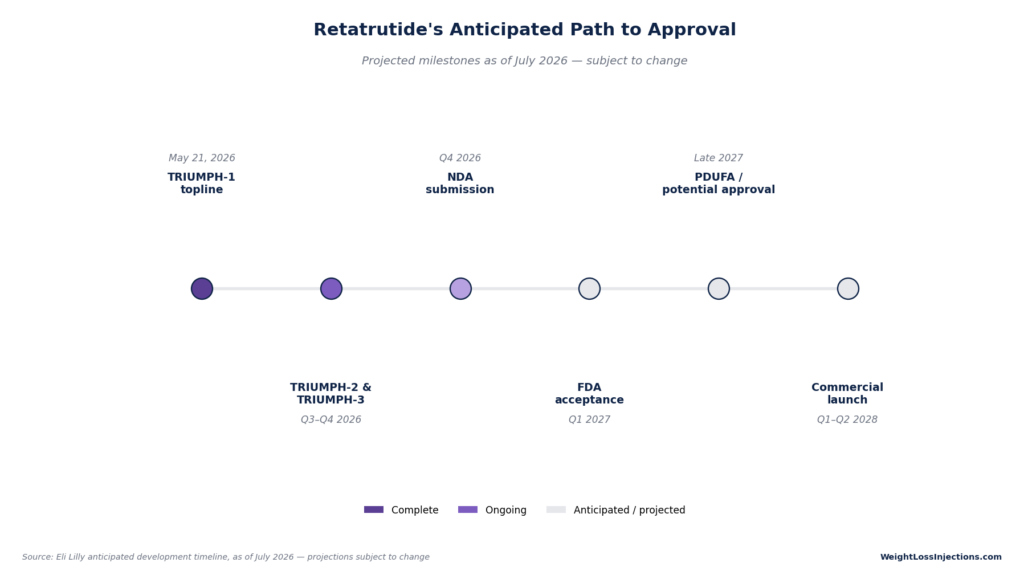
- Eli Lilly’s anticipated timeline points to an NDA submission around Q4 2026, potential FDA approval in late 2027, and commercial availability in early-to-mid 2028 — plans can change, and none of this is guaranteed.
- Historical patient-access and copay-savings program patterns from Wegovy and Zepbound offer a rough template for what a future retatrutide access program might look like, but no such program exists yet for retatrutide.
This article is intended to help readers understand the general landscape of obesity-medication access and administrative preparation. It is not a guide to obtaining retatrutide, and nothing here should be read as instructions for acquiring the drug before FDA approval.
Why “Preparing” Means Something Different for an Unapproved Drug
Retatrutide (LY3437943) is an investigational triple hormone receptor agonist from Eli Lilly and Company. It has not been approved by the FDA, the European Medicines Agency, or any other regulatory body as of July 2026, and it has no assigned brand name. Because of that, this article is not a guide to getting retatrutide — there is no legal, non-trial pathway to obtain it, and none of the preparation below changes that. Compounded versions are not a legal option: retatrutide has no USP/NF monograph, is not a component of an FDA-approved drug, and was not part of the FDA’s April 2026 reclassification of certain peptides. The only legal way to receive retatrutide right now is enrollment in an authorized clinical trial listed on ClinicalTrials.gov.
What this article is about is a different, more useful question: if retatrutide (or a similarly effective future obesity medication) does eventually reach the market, what groundwork can a person reasonably lay today that would put them in a stronger position — administratively and medically — regardless of which specific drug ends up being right for them? Much of this groundwork is generic good practice for anyone managing weight-related health conditions, not retatrutide-specific action.
Step 1: Build (or Rebuild) a Relationship With a Primary Care Provider
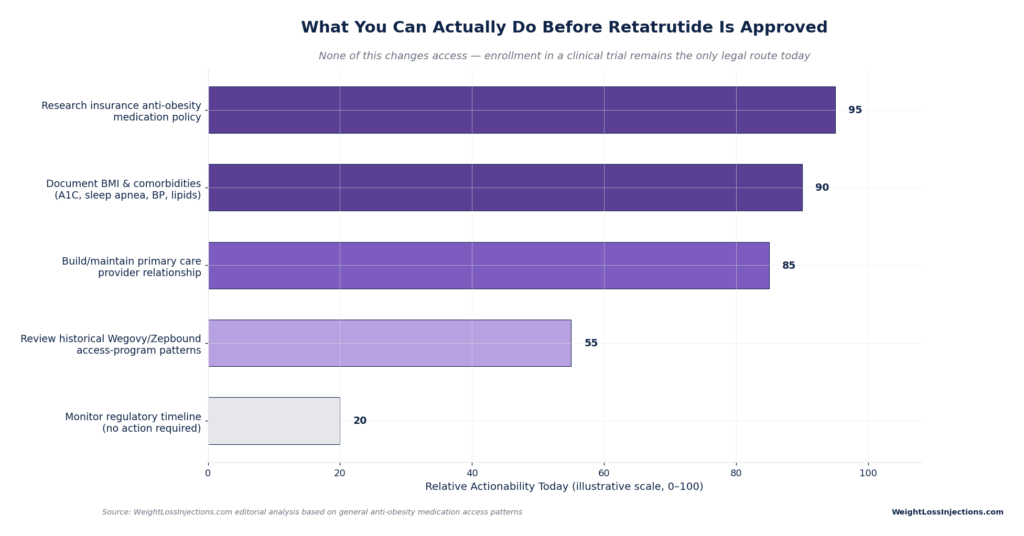
Every currently approved anti-obesity medication — semaglutide (Ozempic, Wegovy) and tirzepatide (Zepbound, tirzepatide) included — requires a prescription from a licensed provider who evaluates a patient’s full health picture before prescribing. If retatrutide is eventually approved, it will almost certainly follow the same model. That means one of the most useful things a person can do today has nothing to do with retatrutide specifically: establish or maintain a relationship with a primary care physician or endocrinologist who knows your health history.
A provider who already has your recent labs, blood pressure trends, and weight history on file is in a much better position to have an informed conversation about any future treatment option — whether that ends up being an already-approved drug, a newly approved one, or a non-pharmacological approach. Waiting until a drug is approved to find a doctor adds delay that has nothing to do with the drug itself.
Step 2: Understand Your Own BMI and Comorbidity Profile
Anti-obesity drug approvals, and the insurance coverage that follows them, are typically tied to specific clinical criteria — most commonly a BMI threshold (generally ≥30, or ≥27 with a weight-related comorbidity) combined with documentation of conditions like type 2 diabetes, obstructive sleep apnea, or cardiovascular disease. Retatrutide’s own Phase 3 program reflects this pattern: TRIUMPH-1 enrolled adults with obesity or overweight plus at least one weight-related complication, TRANSCEND-T2D-1 focused specifically on people with type 2 diabetes, and TRIUMPH-4 enrolled people with obesity and knee osteoarthritis.
Knowing your own numbers now — your current BMI, your most recent A1C if you have prediabetes or diabetes, whether you have a sleep apnea diagnosis, your blood pressure and lipid panel — means you’ll be able to have a substantive conversation with a provider about any future treatment option without starting from zero. This is useful information to have regardless of what gets approved next, and it costs nothing to gather it now through a routine physical or annual check-up.
Our Top 3 · September 2026
The best GLP-1 providers right now
Independently reviewed. Ranked by price, medication access, provider quality, and patient outcomes.
Renew GLP
Personalized GLP-1, GIP plans: Semaglutide & Tirzepatide.
Medvi
No membership or hidden fees. Everything you need is included.
Trimi
US-licensed clinicians and shipped to your door, from $99/mo.
Step 3: Research How Your Insurance Plan Handles Anti-Obesity Medications — Now
Insurance coverage for anti-obesity medications varies enormously by plan, employer, and state, and that variation predates retatrutide entirely. Many plans that cover semaglutide or tirzepatide for weight management require prior authorization, step therapy (trying diet/exercise programs or other medications first), or documentation of a qualifying BMI and comorbidity. Some employer plans exclude anti-obesity medications from coverage altogether, regardless of clinical need.
Calling your insurer or checking your plan’s formulary today to understand:
- Whether your plan currently covers any GLP-1 or dual-agonist medication for weight management
- What documentation or prior authorization steps are required
- Whether your employer’s specific plan has an anti-obesity medication exclusion
…gives you a realistic sense of what a future retatrutide coverage decision might look like on your specific plan, since insurers typically apply similar utilization-management criteria to new drugs in the same class as they do to existing ones. This is useful information whether or not retatrutide is ever approved, because it tells you where you stand today.
Step 4: Learn From How Wegovy and Zepbound Patient-Access Programs Have Worked
When Wegovy and Zepbound launched, both had manufacturer-sponsored savings and access programs intended to reduce out-of-pocket costs for eligible patients with commercial insurance, along with cash-pay options for the uninsured or those without coverage. These programs have evolved over time — eligibility rules, savings-card values, and direct-to-consumer purchasing options have all changed since initial launch.
If Eli Lilly follows a similar approach for retatrutide after any eventual approval, a comparable program would likely be introduced around commercial launch — something the current timeline projects for Q1–Q2 2028 at the earliest, following an anticipated NDA submission around Q4 2026 and a potential PDUFA decision in late 2027. None of this is confirmed, and Eli Lilly has not announced specific pricing or access-program details for retatrutide as of July 2026. Readers interested in understanding what a program might resemble can review publicly available information about how Zepbound’s and Wegovy’s savings programs have functioned historically — as a rough analogy, not a guarantee of what retatrutide’s program will look like.
Step 5: Keep an Eye on the Regulatory Timeline, Without Acting on Speculation
| Milestone | Timeframe | Status (as of July 2026) |
|---|---|---|
| TRIUMPH-1 topline | May 21, 2026 | Complete |
| TRIUMPH-2 (obesity + T2D) | Q3–Q4 2026 | Ongoing |
| TRIUMPH-3 (obesity + CVD) | Q3–Q4 2026 | Ongoing |
| NDA submission | Q4 2026 | Anticipated |
| FDA acceptance | Q1 2027 | Projected |
| PDUFA / potential approval | Late 2027 | Projected |
| Commercial launch | Q1–Q2 2028 | Projected |
This timeline can and likely will shift as trials complete and the FDA review process unfolds. There’s genuine value in following credible updates on this timeline so you’re not caught off guard by news of an approval, but there’s no action to take today based on where retatrutide sits in this pipeline — no waitlist to join, no “early access” program that legitimately exists, and no reason to seek out unregulated sources claiming otherwise.
What Preparation Should Not Look Like
To be direct about it: preparing for a possible future approval does not mean trying to obtain retatrutide now through research chemical suppliers, gray-market peptide vendors, or telehealth platforms claiming to offer it. None of these are legal sources. Retatrutide has no USP/NF monograph, was excluded from the FDA’s April 2026 compounding reclassification, and the only legitimate way to receive it before approval is through an authorized clinical trial. If you are specifically interested in trial enrollment rather than administrative preparation, ClinicalTrials.gov is the correct and only legal starting point.
For those who want to address obesity or a related condition now rather than wait for a future approval, currently available FDA-approved options — including semaglutide-based and tirzepatide-based treatments — are worth discussing with a healthcare provider today.
FAQ
Can I sign up for a retatrutide waitlist to get it early?
No. There is no legitimate waitlist or early-access program for retatrutide outside of clinical trial enrollment. Retatrutide is investigational, and the only legal way to receive it before FDA approval is through an authorized clinical trial listed on ClinicalTrials.gov.
Should I switch off my current weight-loss medication in anticipation of retatrutide?
This article does not recommend any medication changes in anticipation of a drug that is not yet approved. Decisions about starting, stopping, or switching any weight-loss medication should be made with your healthcare provider based on your current health needs, not speculation about a future drug’s availability.
When is retatrutide expected to be approved?
As of July 2026, Eli Lilly’s anticipated timeline points to an NDA submission around Q4 2026, a possible FDA decision in late 2027, and commercial launch in Q1–Q2 2028 — all projected and subject to change based on ongoing TRIUMPH-2 and TRIUMPH-3 trial data.
What’s the most useful thing I can do right now if I’m interested in retatrutide eventually?
Establish a relationship with a primary care provider, document your BMI and any relevant comorbidities (type 2 diabetes, obstructive sleep apnea, cardiovascular risk factors), and research how your specific insurance plan currently handles anti-obesity medications. These steps are useful regardless of which treatment you eventually pursue.
Will insurance definitely cover retatrutide once it’s approved?
There’s no way to know this yet. Coverage will depend on decisions Eli Lilly and individual insurers make around launch, which historically have varied significantly for comparable drugs like Wegovy and Zepbound. Researching your current plan’s anti-obesity medication policy today is the most useful step available.
Medical disclaimer: Retatrutide is an investigational drug not approved by the FDA or any other regulatory authority as of July 2026. It is available only through enrollment in authorized clinical trials. This article is for informational purposes only and does not constitute medical advice, endorsement, or a recommendation to obtain retatrutide outside of a registered clinical trial. Speak with your healthcare provider about currently approved weight-loss treatments. Content published by WeightLossInjections.com.