
Key Takeaways
- Retatrutide is investigational and not approved by the FDA or any other regulatory authority as of July 2026 — all data below come from clinical trials, not real-world prescribing.
- In TRIUMPH-1’s 104-week extension, participants with baseline BMI ≥35 who continued 12 mg retatrutide reached a mean weight loss of 30.3%, up from 28.3% at 80 weeks — evidence that weight loss had not plateaued after nearly two years of treatment.
- This continued trajectory differs from the pattern reported for semaglutide (Wegovy), where weight loss has generally leveled off by roughly 60–68 weeks in published trial data.
- The 104-week findings were published by Jastreboff and colleagues, building on the May 21, 2026 TRIUMPH-1 topline announcement from Eli Lilly.
- The only legal way to receive retatrutide at any dose today is enrollment in an authorized clinical trial through ClinicalTrials.gov — it cannot be purchased, compounded, or obtained through any other channel.
This article discusses published and topline clinical trial data for informational purposes. It is not a promise of individual results and does not constitute medical advice.
An Investigational Drug With an Unusually Long Efficacy Curve
Before looking at the numbers, it’s worth restating the basics: retatrutide (developer code LY3437943) is an investigational triple hormone receptor agonist developed by Eli Lilly and Company, and it has not been approved by the FDA, the European Medicines Agency, or any other regulator as of July 2026. Everything discussed in this article — including the 104-week data — comes from a controlled clinical trial setting, not from a marketed product with a prescribing label. The only legal way for a patient to receive retatrutide today is enrollment in an active, authorized clinical trial through ClinicalTrials.gov.
With that established, the 104-week data from TRIUMPH-1 is one of the more scientifically interesting findings to emerge from the retatrutide program so far, because it speaks directly to a question that matters for anyone thinking about long-term obesity treatment: does the weight loss effect of a drug like this eventually run out, or does it keep working the longer someone stays on it?
What TRIUMPH-1’s 104-Week Extension Actually Measured
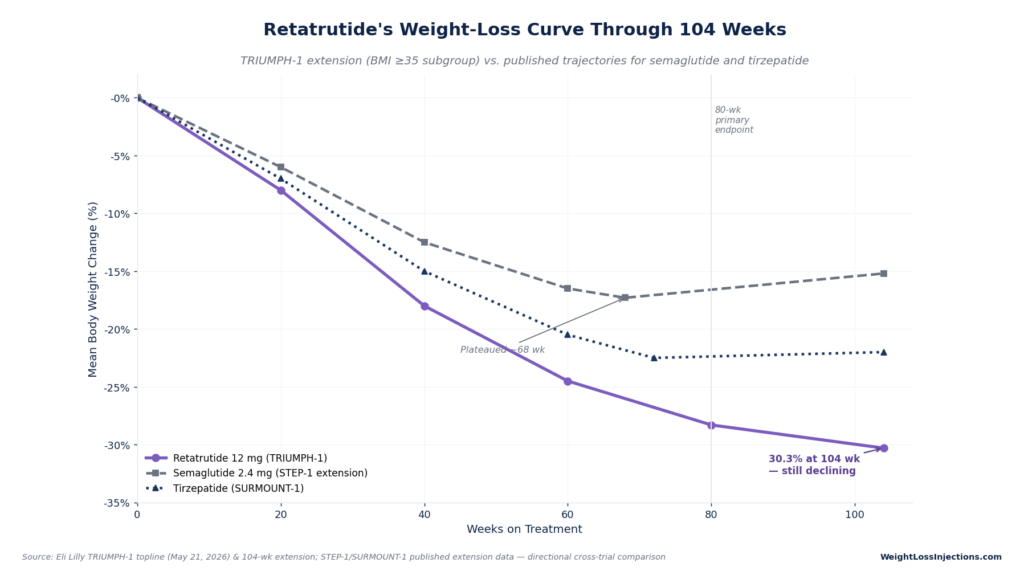
TRIUMPH-1 is the pivotal Phase 3 obesity trial for retatrutide, enrolling 2,339 adults with obesity (or overweight with at least one weight-related complication) who did not have type 2 diabetes. The trial’s primary endpoint was measured at 80 weeks, where the 12 mg dose produced a mean weight loss of 28.3%, compared with 25.9% at 9 mg, 19.0% at 4 mg, and 2.2% on placebo (Eli Lilly, May 21, 2026 topline announcement).
But TRIUMPH-1 didn’t stop at 80 weeks for everyone. A pre-specified, blinded extension enrolled participants with a baseline BMI of 35 or higher who had tolerated their assigned dose, escalating them to the maximum tolerated dose (9 mg or 12 mg) for an additional 24 weeks — carrying the observation window out to 104 weeks, or roughly two years. In that extension cohort, the 12 mg group reached a mean weight loss of 30.3%, equivalent to approximately 85 pounds for the trial’s average participant (Jastreboff et al., published data building on Eli Lilly’s topline results; coverage of the extension data also appeared via Pharmaceutical Journal reporting).
That two-point increase — from 28.3% at 80 weeks to 30.3% at 104 weeks — might look modest on paper, but it represents a meaningfully different biological story than what has been reported for other weight-loss therapies. It means the curve was still descending, not flattening, as the trial approached the two-year mark.
Why “Does It Plateau?” Is the Right Question to Ask
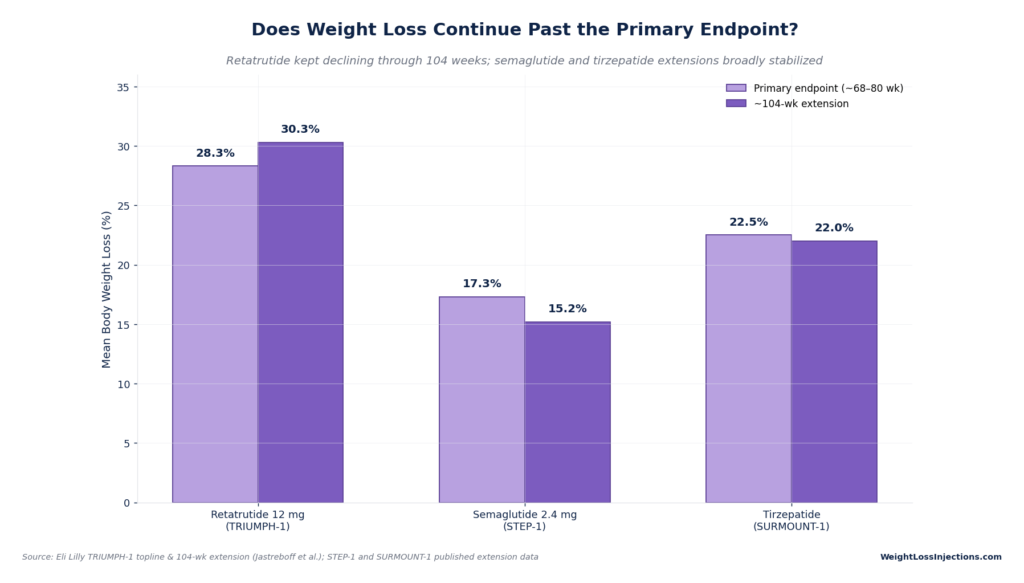
Every weight-loss intervention — behavioral, surgical, or pharmacological — eventually reaches a point of diminishing returns. Body weight doesn’t fall indefinitely; at some point, energy intake and expenditure re-equilibrate, and the scale stabilizes. The question that matters clinically is when that stabilization happens and at what magnitude of weight loss.
For semaglutide (marketed as Wegovy for weight management), published trial data has generally shown weight loss leveling off somewhere in the range of 60 to 68 weeks, after which the curve flattens and participants tend to maintain — rather than continue losing — weight while remaining on treatment. The STEP-1 104-week extension data, for example, showed weight loss broadly stabilizing after the initial ~60-week period, with participants maintaining their loss through week 104 rather than continuing to descend substantially.
TRIUMPH-1’s 104-week data tells a different story for retatrutide’s 12 mg dose in the BMI ≥35 extension subgroup: the curve was still moving downward between week 80 and week 104, rather than having already flattened. This is a meaningful distinction, because it suggests that for at least some patients, a longer duration of triple-agonist therapy may continue to produce incremental benefit well beyond the point where single-agonist therapies have historically plateaued.
Our Top 3 · September 2026
The best GLP-1 providers right now
Independently reviewed. Ranked by price, medication access, provider quality, and patient outcomes.
Renew GLP
Personalized GLP-1, GIP plans: Semaglutide & Tirzepatide.
Medvi
No membership or hidden fees. Everything you need is included.
Trimi
US-licensed clinicians and shipped to your door, from $99/mo.
Comparing the Trajectories
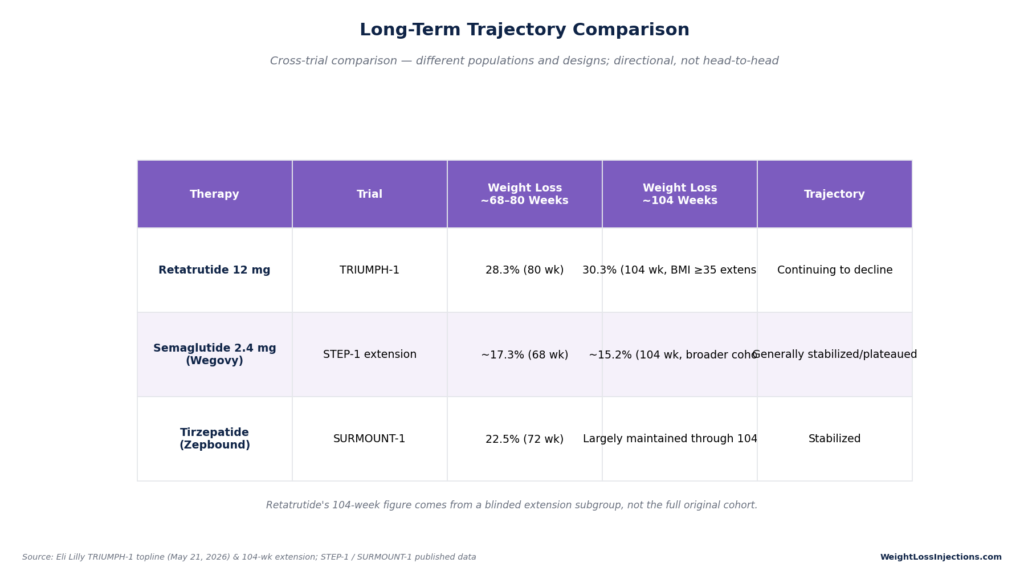
| Therapy | Trial | Weight Loss at ~68–80 Weeks | Weight Loss at ~104 Weeks | Trajectory |
|---|---|---|---|---|
| Retatrutide 12 mg | TRIUMPH-1 | 28.3% (80 wk) | 30.3% (104 wk, BMI ≥35 extension) | Continuing to decline |
| Semaglutide 2.4 mg (Wegovy) | STEP-1 extension | ~17.3% (68 wk) | ~15.2% (104 wk, broader cohort data) | Generally stabilized/plateaued |
| Tirzepatide (Zepbound/tirzepatide) | SURMOUNT-1 | 22.5% (72 wk) | Largely maintained through 104 wk without major additional decline | Stabilized |
It’s important to be precise about what this comparison does and doesn’t show. These are different trials, with different populations, different follow-up designs, and — critically — the retatrutide 104-week figure comes from a subgroup (participants with baseline BMI ≥35 who tolerated their dose and were selected into a blinded extension), not the full original TRIUMPH-1 cohort. Cross-trial comparisons of this kind are directional, not head-to-head evidence. Still, the pattern is consistent enough, and large enough in magnitude, to be clinically noteworthy.
Why Might Retatrutide’s Curve Behave Differently?
Retatrutide is a first-in-class triple hormone receptor agonist, activating GIP, GLP-1, and glucagon receptors simultaneously — a mechanism distinct from single-agonist drugs like semaglutide (GLP-1 only) or dual-agonist drugs like tirzepatide (GIP + GLP-1). The added glucagon receptor activity is thought to increase energy expenditure and promote fat oxidation in addition to the appetite-suppressing effects shared across the class. One hypothesis is that this additional metabolic pathway may allow the drug’s effect to compound over a longer window before physiological counter-regulation catches up — though this remains a hypothesis, not an established mechanism confirmed by head-to-head trial data.
It’s also possible that at least part of the difference reflects the extension design itself: participants who reached the 104-week mark were, by definition, people who tolerated their dose well enough to remain in the trial and be escalated to the maximum tolerated dose. That kind of selection can influence the apparent trajectory of a subgroup relative to the full original cohort.
What This Might Mean for Long-Term Obesity Therapy — If Retatrutide Is Approved
If retatrutide’s continued weight loss pattern beyond 80 weeks holds up in the ongoing TRIUMPH-2 and TRIUMPH-3 trials (both expected to read out in Q3–Q4 2026) and eventually in a peer-reviewed full publication, it would carry a few implications worth understanding now, before any approval decision is made:
- Obesity treatment durations may need to be reconceived. If a drug’s effect is still growing at two years, defining “success” using an 80-week endpoint may understate its ceiling.
- Longer studies matter more for this drug class. Comparisons based only on ~68–80-week data may not capture retatrutide’s full effect relative to therapies that plateau earlier.
- This is still one trial, one subgroup, one topline dataset. TRIUMPH-1’s 104-week findings have not yet completed the full peer-reviewed publication and scrutiny process that approved drugs’ pivotal data have undergone, and TRIUMPH-3’s cardiovascular outcomes data — relevant to understanding the safety of prolonged exposure — is still pending.
None of this changes retatrutide’s regulatory status. It remains an investigational compound, with an NDA submission anticipated in Q4 2026 and a potential approval not projected until late 2027 at the earliest.
The Only Legal Way to Experience This Data Firsthand
Because retatrutide has no USP/NF monograph and was not included in the FDA’s April 2026 peptide reclassification, compounded retatrutide is not a legal option, regardless of how any product is marketed. The 104-week results discussed here were generated entirely within a controlled, blinded, medically supervised trial protocol — not through any product available for purchase. Anyone interested in retatrutide’s long-term effects can only access the drug itself through enrollment in an active, authorized clinical trial listed on ClinicalTrials.gov.
For people considering options available today, currently FDA-approved tirzepatide-based treatments and semaglutide options — including compounded semaglutide where legally available — remain the closest approved analogues with established long-term data and prescribing labels.
FAQ
Does retatrutide’s weight loss effect plateau over time?
Based on TRIUMPH-1’s 104-week extension data in a subgroup of participants with baseline BMI ≥35, weight loss had not plateaued by two years — mean weight loss increased from 28.3% at 80 weeks to 30.3% at 104 weeks on the 12 mg dose. This is topline and extension data, not yet a completed peer-reviewed analysis of the full cohort.
How does retatrutide’s long-term trajectory compare to Wegovy (semaglutide)?
Published semaglutide trial data has generally shown weight loss leveling off in the 60–68-week range, with STEP-1 extension data broadly stabilizing through 104 weeks rather than continuing to substantially decline. Retatrutide’s 104-week extension data, by contrast, showed continued descent in the BMI ≥35 subgroup — though this is a cross-trial comparison, not a head-to-head study.
Is the 104-week data from the full TRIUMPH-1 trial population?
No. The 104-week figures come from a pre-specified blinded extension limited to participants with a baseline BMI of 35 or higher who tolerated their originally assigned dose and were escalated to the maximum tolerated dose for an additional 24 weeks beyond the 80-week primary endpoint.
Can I get retatrutide now to see these long-term results for myself?
No. Retatrutide is investigational and not approved by the FDA or any other regulator. It has no legal compounding pathway. The only legal access route is enrollment in an authorized clinical trial via ClinicalTrials.gov.
When might we know if this trend continues past 104 weeks?
No trial data beyond 104 weeks has been reported for retatrutide as of July 2026. Longer-term data would likely depend on further extensions of TRIUMPH-1 or new trials designed specifically to study durability beyond two years.
Medical disclaimer: Retatrutide is an investigational drug not approved by the FDA or any other regulatory authority as of July 2026. It is available only through enrollment in authorized clinical trials. This article is for informational purposes only and does not constitute medical advice, endorsement, or a recommendation to obtain retatrutide outside of a registered clinical trial. Speak with your healthcare provider about currently approved weight-loss treatments. Content published by WeightLossInjections.com.