
Key Takeaways
- TRANSCEND-T2D-1 is retatrutide’s Phase 3 trial in adults with type 2 diabetes, with topline results announced March 19, 2026 and full data published in The Lancet in June 2026. Retatrutide remains investigational and is not FDA-approved for diabetes or any other use.
- The trial enrolled 537 adults with type 2 diabetes inadequately controlled by diet and exercise, over 40 weeks, testing doses of 0.5, 4, 8, and 12 mg against a dulaglutide 1.5 mg comparator and placebo.
- HbA1c was reduced by 1.69% to 1.94% (up to a maximum of −2.0%) across active doses, compared with 0.81% for placebo.
- Weight loss ranged from 11.5% to 16.8% across active doses, compared with 2.5% for placebo — notably lower than the 28.3% seen in the non-diabetic TRIUMPH-1 population, a pattern consistent with other drugs in this class.
- The dulaglutide comparator arm allows for a direct, same-trial comparison against an already-approved GLP-1 diabetes medication, strengthening the evidential value of these results.
- TRANSCEND-T2D-1 data supports Eli Lilly’s planned New Drug Application, expected Q4 2026, but retatrutide is not approved and remains accessible only through clinical trial enrollment.
This article summarizes published trial data for informational purposes. Retatrutide is not approved to treat type 2 diabetes or any other condition.
In June 2026, The Lancet published full results from TRANSCEND-T2D-1, the pivotal Phase 3 trial evaluating retatrutide in adults with type 2 diabetes. Topline numbers had been announced by Eli Lilly on March 19, 2026, but the peer-reviewed publication gave clinicians and researchers their first complete look at the trial’s methodology, statistical detail, and full safety data. As with every article in this series, it’s essential to state clearly: retatrutide is investigational and has not been approved by the FDA, EMA, or TGA as of July 2026, whether for diabetes, obesity, or any other indication. TRANSCEND-T2D-1 is one part of the evidence package supporting a future regulatory submission — it is not a treatment recommendation.
This article covers the trial design, the glycemic and weight-loss results by dose, how retatrutide compared against the dulaglutide comparator arm, and why weight loss in this diabetic population differs from what was seen in retatrutide’s non-diabetic obesity trials.
Trial Design
TRANSCEND-T2D-1 enrolled 537 adults with type 2 diabetes that was inadequately controlled through diet and exercise alone. The trial ran for 40 weeks — notably shorter than TRIUMPH-1’s 80 weeks — and tested four doses of retatrutide against both placebo and an active comparator, dulaglutide 1.5 mg (marketed as Trulicity, an already FDA-approved GLP-1 receptor agonist for type 2 diabetes).
| Design Element | Detail |
|---|---|
| Participants | 537 adults with type 2 diabetes |
| Duration | 40 weeks |
| Doses tested | 0.5 mg, 4 mg, 8 mg, 12 mg once-weekly subcutaneous injection |
| Comparators | Placebo and dulaglutide 1.5 mg |
| Primary endpoint | HbA1c change from baseline |
| Secondary endpoint | Body weight change from baseline |
| Publication | The Lancet, June 2026 |
Including an active comparator arm — rather than placebo alone — is a notable design strength. It allows TRANSCEND-T2D-1 to report not just whether retatrutide worked, but how it performed against an existing, approved diabetes treatment within the same trial population and timeframe.
HbA1c Results
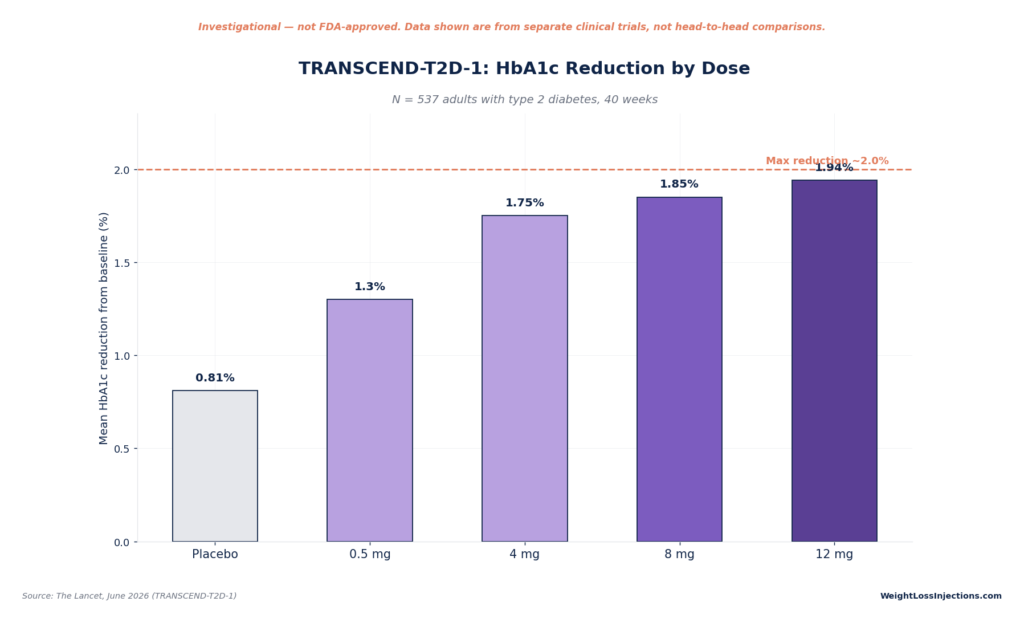
The trial’s primary endpoint, HbA1c reduction, showed a clear dose-dependent effect. Across the active retatrutide doses, HbA1c fell by 1.69% to 1.94%, with the highest-performing dose group approaching a maximum reduction of 2.0% — compared with just 0.81% in the placebo group, according to the Lancet publication, June 2026.
| Dose | HbA1c Reduction |
|---|---|
| 12 mg | Up to 1.94% (approaching 2.0% maximum) |
| 8 mg | Within 1.69%–1.94% range |
| 4 mg | Within 1.69%–1.94% range |
| 0.5 mg | Lower end of active range |
| Placebo | 0.81% |
An HbA1c reduction approaching 2.0 percentage points is a substantial glycemic effect. For context, this magnitude of reduction is generally sufficient to move many patients with type 2 diabetes from poorly controlled levels into or near the target range recommended by diabetes management guidelines, though individual results vary and this is not a substitute for guidance from an endocrinologist or diabetes care provider.
Weight-Loss Results
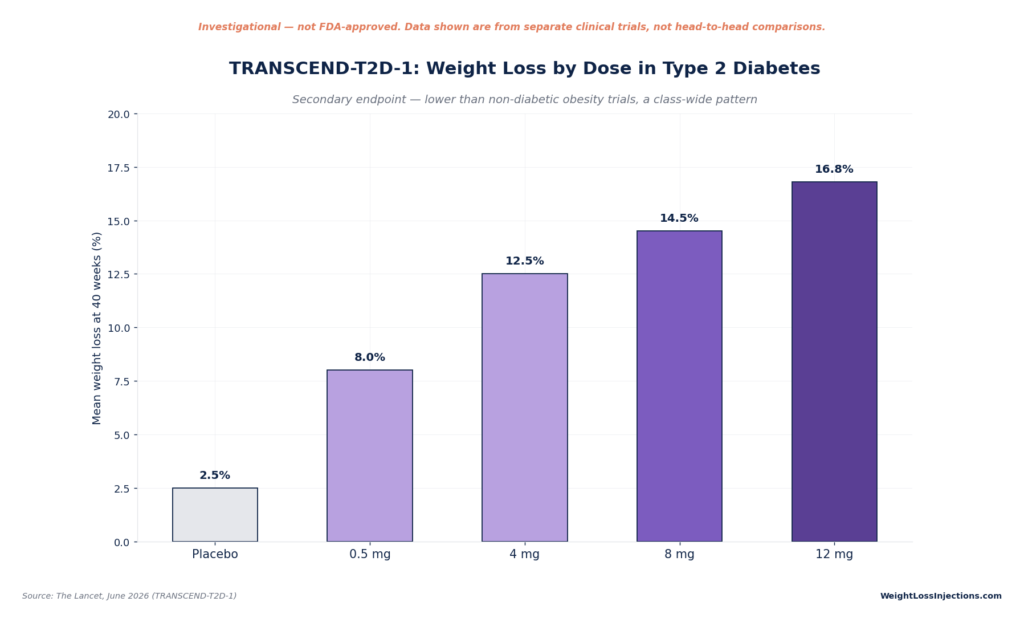
Weight loss was a secondary endpoint in TRANSCEND-T2D-1, and the results ranged from 11.5% to 16.8% across the active dose groups, compared with 2.5% for placebo.
| Dose | Weight Loss |
|---|---|
| 12 mg | Up to 16.8% |
| 8 mg | Within 11.5%–16.8% range |
| 4 mg | Within 11.5%–16.8% range |
| 0.5 mg | Lower end of active range |
| Placebo | 2.5% |
Our Top 3 · September 2026
The best GLP-1 providers right now
Independently reviewed. Ranked by price, medication access, provider quality, and patient outcomes.
Renew GLP
Personalized GLP-1, GIP plans: Semaglutide & Tirzepatide.
Medvi
No membership or hidden fees. Everything you need is included.
Trimi
US-licensed clinicians and shipped to your door, from $99/mo.
Why Weight Loss Is Lower in Diabetic Populations
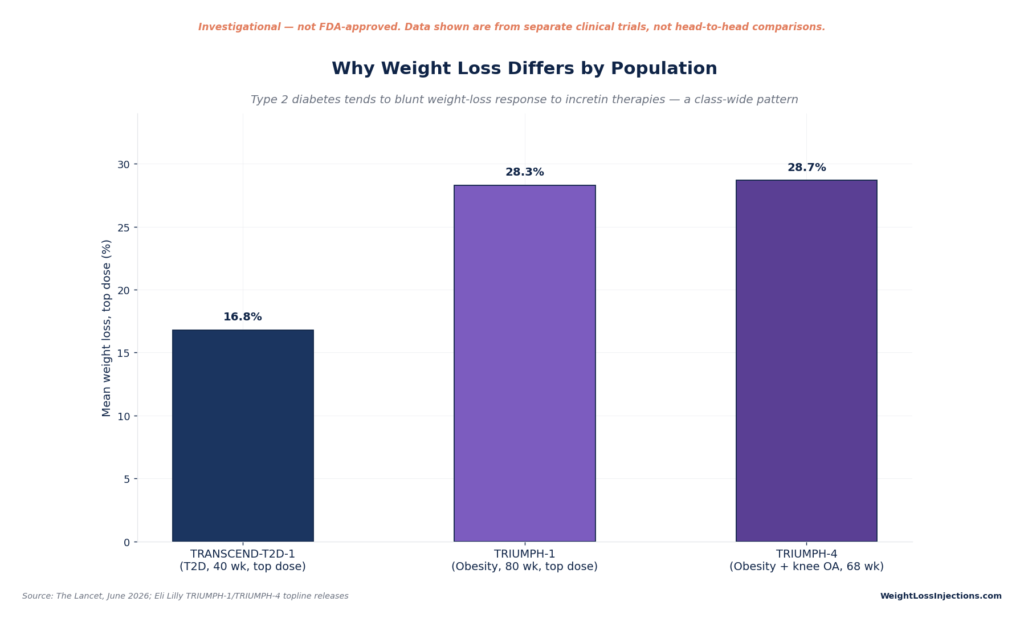
Readers familiar with retatrutide’s obesity trial data may notice these weight-loss figures — topping out at 16.8% — are considerably lower than the 28.3% reported in TRIUMPH-1’s non-diabetic obesity population. This is not a sign that retatrutide “works less well” in an absolute sense; it reflects a well-established pattern seen consistently across the entire incretin drug class, including semaglutide and tirzepatide.
| Trial | Population | Duration | Weight Loss (top dose) |
|---|---|---|---|
| TRANSCEND-T2D-1 | Type 2 diabetes | 40 weeks | 11.5%–16.8% |
| TRIUMPH-1 | Obesity, no diabetes | 80 weeks | 19.0%–28.3% |
| TRIUMPH-4 | Obesity + knee OA | 68 weeks | 28.7% |
Several factors likely explain this gap. First, TRANSCEND-T2D-1 ran for only 40 weeks, roughly half the duration of TRIUMPH-1, giving less time for weight loss to accumulate. Second, and more fundamentally, people with type 2 diabetes often have impaired insulin signaling and altered metabolic regulation that tends to blunt weight-loss response to incretin-based therapies relative to people without diabetes — a pattern documented across semaglutide’s and tirzepatide’s own trial programs, where diabetic populations have also shown smaller percentage weight loss than non-diabetic populations tested at similar doses. This is a class-wide phenomenon, not something unique to retatrutide.
Comparison Against Dulaglutide
Because TRANSCEND-T2D-1 included dulaglutide 1.5 mg as an active comparator, the trial offers a rare same-study comparison between an investigational triple agonist and an approved GLP-1 diabetes drug.
| Comparator | Class | Regulatory Status |
|---|---|---|
| Retatrutide (0.5–12 mg) | Triple agonist (GLP-1 + GIP + glucagon) | Investigational |
| Dulaglutide 1.5 mg | Single agonist (GLP-1) | FDA-approved (Trulicity) |
While granular dulaglutide-arm results are reported in the full Lancet dataset rather than summarized in Eli Lilly’s topline release, the trial’s inclusion of an approved comparator strengthens the overall evidentiary value of TRANSCEND-T2D-1 for regulators reviewing retatrutide’s eventual New Drug Application. This structure mirrors how tirzepatide’s own diabetes trials were designed against comparators to build the evidence base that ultimately supported its approval.
What This Means for Retatrutide’s Regulatory Path
TRANSCEND-T2D-1 is one of three completed Phase 3 readouts — alongside TRIUMPH-4 (December 2025) and TRIUMPH-1 (May 2026) — expected to anchor Eli Lilly’s New Drug Application, projected for Q4 2026. Two additional trials, TRIUMPH-2 (obesity with type 2 diabetes) and TRIUMPH-3 (obesity with cardiovascular disease), remain ongoing through late 2026 and will add further data to the regulatory package, particularly around long-term cardiovascular safety.
If the anticipated timeline holds, FDA acceptance of the application would occur around Q1 2027, with a possible approval decision in late 2027 and commercial launch around Q1–Q2 2028. Until then, retatrutide is not an approved treatment for type 2 diabetes, obesity, or any other condition, and it cannot legally be prescribed or compounded. People with type 2 diabetes seeking currently available options should speak with their healthcare provider about approved therapies, including semaglutide-based treatments and tirzepatide, which carry FDA approval for diabetes and/or weight management today. The only legal way to access retatrutide remains enrollment in an authorized clinical trial via ClinicalTrials.gov.
FAQ
What did TRANSCEND-T2D-1 study?
TRANSCEND-T2D-1 was a Phase 3 trial of retatrutide in 537 adults with type 2 diabetes inadequately controlled by diet and exercise, run over 40 weeks and published in The Lancet in June 2026.
How much did HbA1c improve in the trial?
HbA1c fell by 1.69% to 1.94% across active retatrutide doses, approaching a maximum reduction of 2.0%, compared with 0.81% for placebo, according to the Lancet publication.
Why was weight loss lower than in retatrutide’s obesity trials?
Weight loss in TRANSCEND-T2D-1 (up to 16.8%) was lower than in TRIUMPH-1 (up to 28.3%), largely because the trial was shorter (40 weeks vs. 80 weeks) and because type 2 diabetes tends to blunt weight-loss response to incretin therapies — a pattern seen across the entire drug class, not unique to retatrutide.
Did the trial compare retatrutide to an approved diabetes drug?
Yes. TRANSCEND-T2D-1 included dulaglutide 1.5 mg, an FDA-approved GLP-1 agonist, as an active comparator arm alongside placebo.
Is retatrutide approved to treat type 2 diabetes?
No. Retatrutide is investigational and not approved by the FDA for type 2 diabetes or any other condition as of July 2026. It is available only through enrollment in an authorized clinical trial.
Medical disclaimer: Retatrutide is an investigational drug not approved by the FDA or any other regulatory authority as of July 2026. It is available only through enrollment in authorized clinical trials. This article is for informational purposes only and does not constitute medical advice, endorsement, or a recommendation to obtain retatrutide outside of a registered clinical trial. Speak with your healthcare provider about currently approved weight-loss treatments. Content published by WeightLossInjections.com.