
Key Takeaways
- TRIUMPH-1 is retatrutide’s pivotal Phase 3 obesity trial, with topline results announced by Eli Lilly on May 21, 2026. Retatrutide remains investigational and is not FDA-approved.
- The trial enrolled 2,339 adults with obesity (no diabetes) and ran for 80 weeks, testing 4 mg, 9 mg, and 12 mg doses against placebo.
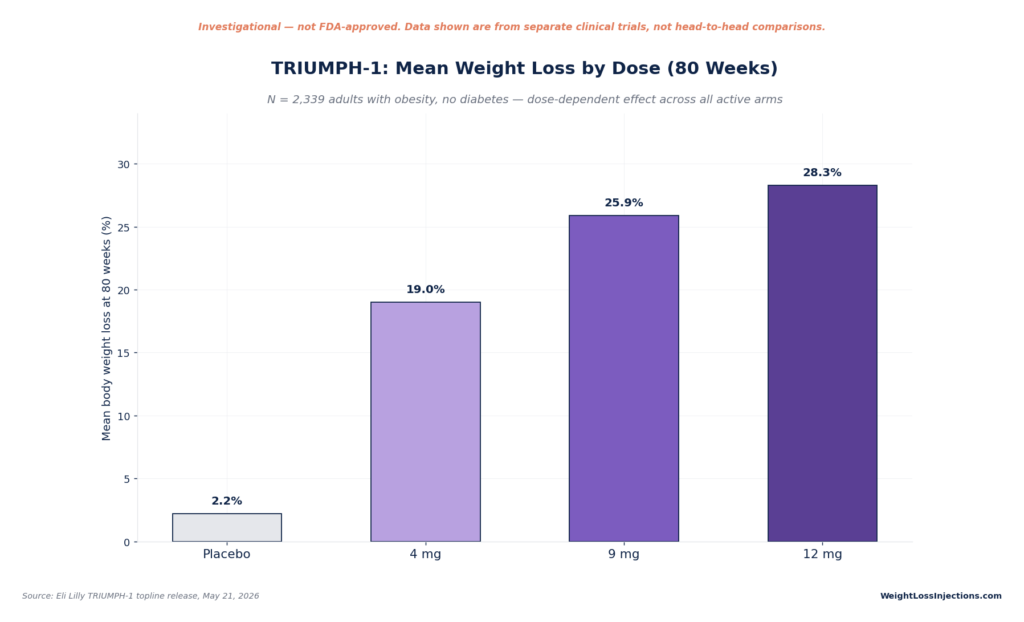
- Mean weight loss was 19.0% at 4 mg, 25.9% at 9 mg, and 28.3% at 12 mg, compared with 2.2% for placebo.
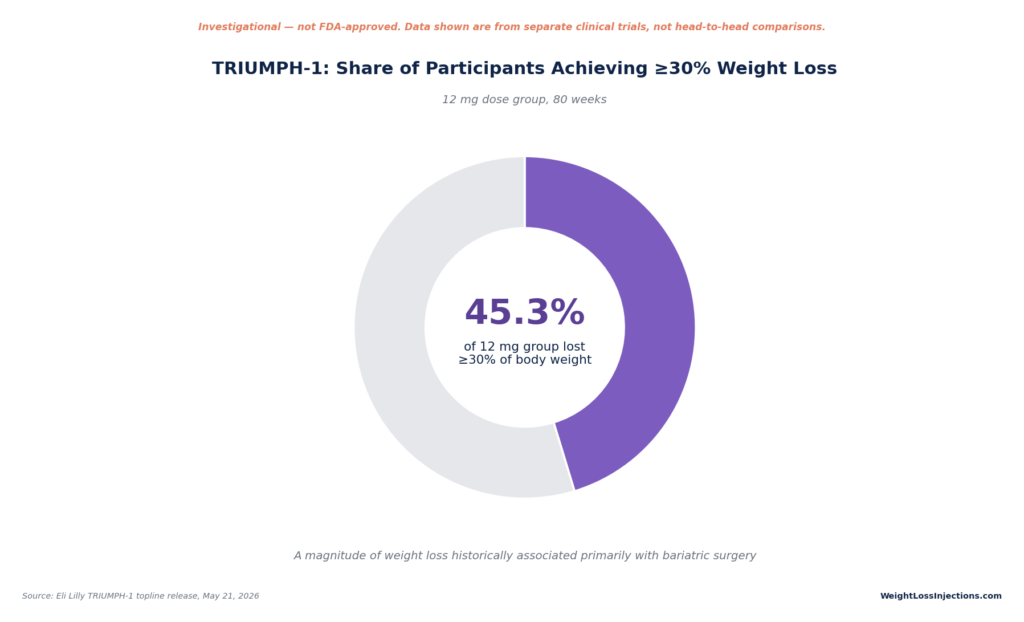
- 45.3% of participants on the 12 mg dose lost at least 30% of their starting body weight — a level historically associated with bariatric surgery.
- Discontinuation due to adverse events at the 12 mg dose was 11.3%; a 104-week extension showed continued loss to 30.3%, and a nested sleep apnea sub-study reported a 60.6% reduction in AHI (apnea-hypopnea index).
- These results support Eli Lilly’s plans for a New Drug Application, expected in Q4 2026, but retatrutide has not completed FDA review and remains accessible only through clinical trial enrollment.
TRIUMPH-1 results are presented here for informational purposes. Retatrutide is investigational and not an approved treatment.
On May 21, 2026, Eli Lilly announced topline results from TRIUMPH-1, the largest and most closely watched Phase 3 trial in the company’s retatrutide obesity program. The data drew immediate attention across the weight-loss drug field because it represented the first large-scale, pivotal confirmation of what Phase 2 data had hinted at years earlier: that adding a third hormone receptor mechanism to the class of drugs that includes semaglutide and tirzepatide could meaningfully outperform existing options. It’s essential to be clear from the outset: retatrutide is an investigational drug, not approved by the FDA or any other regulatory authority as of July 2026. TRIUMPH-1 is a step in the approval process, not a marketing authorization, and access remains limited to clinical trial participation.
This article walks through the trial design, the full efficacy results by dose, the safety and discontinuation data, the extension study findings, and what the results mean for retatrutide’s path toward a possible FDA decision.
Trial Design and Population
TRIUMPH-1 was designed as a randomized, controlled Phase 3 trial evaluating retatrutide against placebo in adults with obesity who did not have type 2 diabetes. Key design features, per Eli Lilly’s TRIUMPH-1 topline release and the trial’s ClinicalTrials.gov listing (NCT05929066):
| Design Element | Detail |
|---|---|
| Participants | 2,339 adults with obesity, no diabetes |
| Duration | 80 weeks |
| Doses tested | 4 mg, 9 mg, 12 mg once-weekly subcutaneous injection |
| Comparator | Placebo |
| Primary endpoint | Percent change in body weight from baseline |
| Extension | 104-week follow-up data also reported |
| Nested sub-study | Obstructive sleep apnea (OSA) basket analysis |
Participants were titrated gradually to their assigned maintenance dose over approximately 20 weeks, consistent with the dose-escalation approach used throughout retatrutide’s Phase 3 program, before continuing at a stable dose for the remainder of the 80-week study period.
Efficacy Results by Dose
The headline finding from TRIUMPH-1 was a clear, dose-dependent weight-loss effect across all three active doses, each of which significantly outperformed placebo.
| Dose | Mean Weight Loss (80 weeks) | Approx. Weight Lost (250-lb baseline) |
|---|---|---|
| 12 mg | 28.3% | ~70.3 lbs |
| 9 mg | 25.9% | — |
| 4 mg | 19.0% | — |
| Placebo | 2.2% | — |
At the highest studied dose, average participants lost more than a quarter of their body weight over the course of the study. Perhaps even more striking than the mean figure is the distribution of responses: 45.3% of participants in the 12 mg group lost 30% or more of their starting body weight — a magnitude of weight loss historically seen mainly with bariatric surgical procedures, not injectable medications.
| Response Threshold | 12 mg Group |
|---|---|
| Achieved ≥30% weight loss | 45.3% |
| Mean weight loss | 28.3% |
| Placebo mean weight loss | 2.2% |
These figures met the trial’s primary endpoint of percent change in body weight from baseline, with statistically significant separation from placebo at every active dose, according to the Eli Lilly press release.
Safety and Discontinuation
TRIUMPH-1’s safety profile was broadly consistent with what had been observed in retatrutide’s earlier Phase 2 program and with the incretin drug class as a whole. The most commonly reported adverse events were gastrointestinal: nausea, vomiting, diarrhea, and constipation, with the highest incidence occurring during the dose-escalation period and generally described as mild-to-moderate in severity.
| Safety Metric | 12 mg Group |
|---|---|
| Most common adverse events | Nausea, vomiting, diarrhea, constipation |
| Discontinuation due to adverse events | 11.3% |
| Unique signal | Dysesthesia (altered skin sensation), 2.3–4.5% across doses |
| Heart rate | Modest increase, consistent with GLP-1 class |
The discontinuation rate of 11.3% at the highest dose is a figure regulators and clinicians will weigh carefully — it indicates that roughly nine in ten participants tolerated the drug well enough to continue treatment through the study period. Dysesthesia — an altered or abnormal skin sensation — emerged as a side effect not typically seen with single- or dual-mechanism drugs in this class, and researchers have linked it tentatively to the added glucagon-receptor activity that distinguishes retatrutide from semaglutide and tirzepatide.
Our Top 3 · October 2026
The best GLP-1 providers right now
Independently reviewed. Ranked by price, medication access, provider quality, and patient outcomes.
Renew GLP
Personalized GLP-1, GIP plans: Semaglutide & Tirzepatide.
Medvi
No membership or hidden fees. Everything you need is included.
Trimi
US-licensed clinicians and shipped to your door, from $99/mo.
The 104-Week Extension: Does Weight Loss Continue?
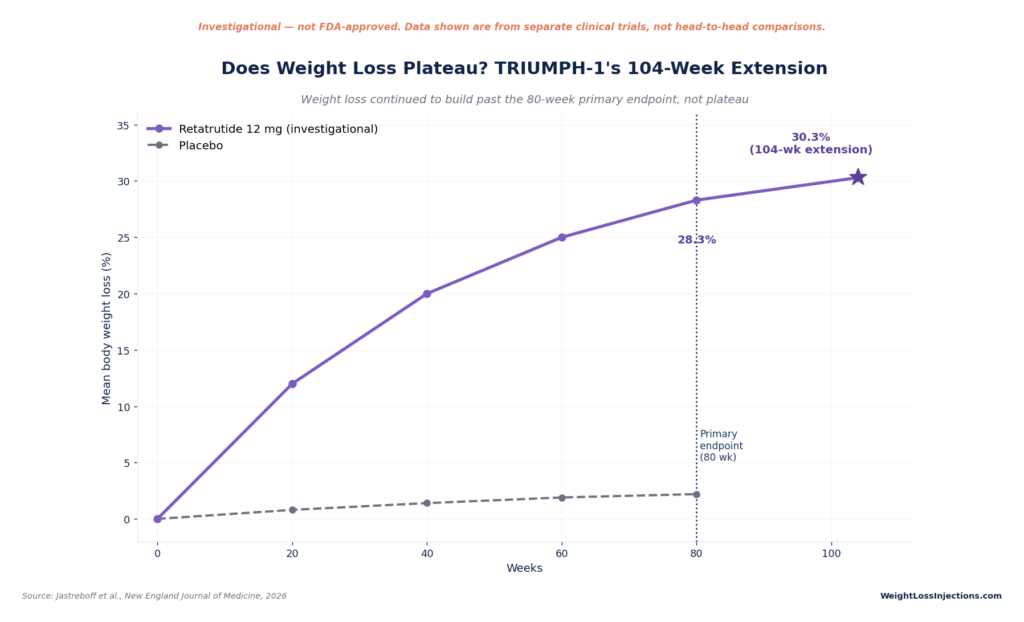
One of the most closely watched follow-up questions after any obesity trial is whether weight loss plateaus. TRIUMPH-1’s extension data, reported in Jastreboff et al., New England Journal of Medicine, 2026, suggests it does not — at least not within the study’s timeframe. At 104 weeks, the 12 mg group’s mean weight loss was reported at 30.3%, an increase from the 28.3% recorded at 80 weeks.
| Timepoint | Mean Weight Loss (12 mg) |
|---|---|
| 80 weeks | 28.3% |
| 104 weeks | 30.3% |
This continued trajectory, rather than a plateau, is a notable data point for the obesity field, since it suggests that longer treatment duration may continue to yield incremental benefit rather than an early ceiling effect.
The OSA Basket: A Secondary Signal Worth Watching
TRIUMPH-1 also included a nested sub-study examining obstructive sleep apnea (OSA) outcomes among participants who had the condition at baseline. This “basket” analysis reported a 60.6% reduction in AHI (apnea-hypopnea index, the standard measure of sleep apnea severity), a substantial improvement that mirrors the broader trend of weight-loss drugs producing meaningful secondary benefits for obesity-related comorbidities.
| Sub-Study | Outcome |
|---|---|
| OSA basket AHI reduction | 60.6% |
What TRIUMPH-1 Means for the NDA and Approval Timeline
TRIUMPH-1’s results are central to Eli Lilly’s regulatory strategy for retatrutide. The company is expected to submit a New Drug Application in Q4 2026, incorporating TRIUMPH-1 data alongside results from TRIUMPH-4 (obesity and knee osteoarthritis) and TRANSCEND-T2D-1 (type 2 diabetes). FDA acceptance of the application is projected for Q1 2027, with a potential approval decision (PDUFA date) in late 2027, and a possible commercial launch in Q1–Q2 2028 if the application is approved.
Two additional Phase 3 trials — TRIUMPH-2 (obesity with type 2 diabetes) and TRIUMPH-3 (obesity with cardiovascular disease) — remain ongoing through Q3–Q4 2026 and will factor into the complete regulatory picture, particularly for cardiovascular safety data that TRIUMPH-1 alone does not fully address.
Until an approval decision is reached, retatrutide remains available only through enrollment in an authorized clinical trial listed on ClinicalTrials.gov. It cannot legally be prescribed or compounded, and no pharmacy can lawfully dispense it outside a registered trial protocol.
FAQ
What was the main finding of TRIUMPH-1?
TRIUMPH-1 found that retatrutide produced dose-dependent weight loss of up to 28.3% at 80 weeks (12 mg dose) compared with 2.2% for placebo, in a trial of 2,339 adults with obesity, according to Eli Lilly’s topline announcement.
How many people lost 30% or more of their body weight?
45.3% of participants in the 12 mg dose group achieved at least 30% weight loss, a magnitude historically associated primarily with bariatric surgery.
Did TRIUMPH-1 show weight loss plateauing over time?
No. A 104-week extension reported mean weight loss of 30.3% at the 12 mg dose, up from 28.3% at 80 weeks, suggesting continued rather than plateaued benefit, per Jastreboff et al., NEJM 2026.
What side effects were most common in TRIUMPH-1?
Gastrointestinal effects — nausea, vomiting, diarrhea, and constipation — were most common. A unique signal, dysesthesia (altered skin sensation), occurred in 2.3–4.5% of participants. Discontinuation for adverse events was 11.3% at the 12 mg dose.
Does TRIUMPH-1 mean retatrutide is now approved?
No. TRIUMPH-1 is trial data supporting a future New Drug Application, expected in Q4 2026. Retatrutide remains investigational as of July 2026 and is not approved by the FDA. The only legal access route is enrollment in an authorized clinical trial.
Medical disclaimer: Retatrutide is an investigational drug not approved by the FDA or any other regulatory authority as of July 2026. It is available only through enrollment in authorized clinical trials. This article is for informational purposes only and does not constitute medical advice, endorsement, or a recommendation to obtain retatrutide outside of a registered clinical trial. Speak with your healthcare provider about currently approved weight-loss treatments. Content published by WeightLossInjections.com.