
Key Takeaways
- Retatrutide is an investigational triple hormone receptor agonist that has not been approved by the FDA as of July 2026. Semaglutide (Ozempic, Wegovy) is FDA-approved and widely prescribed.
- In separate Phase 3 trials, retatrutide’s highest dose produced 28.3% mean weight loss at 80 weeks in TRIUMPH-1, compared with 14.9% mean weight loss at 68 weeks for semaglutide 2.4 mg in the STEP-1 trial published in the New England Journal of Medicine — nearly double.
- Semaglutide activates a single receptor (GLP-1); retatrutide activates three (GLP-1, GIP, and glucagon), which is the leading explanation for the efficacy gap.
- Retatrutide’s trials report a unique dysesthesia signal (2.3–4.5%) not characterized with semaglutide; both share a common GI side effect profile.
- These figures come from separate trials with different populations and durations, so the comparison is directional, not a controlled head-to-head result.
- Semaglutide is currently accessible by prescription; retatrutide is accessible only through clinical trial enrollment.
This is a comparison of published trial data, not a recommendation of one drug over another. Retatrutide remains investigational.
Among the most common questions in obesity-medicine circles right now is how retatrutide, Eli Lilly’s experimental triple-hormone-receptor agonist, compares to semaglutide, the single-mechanism GLP-1 drug behind Ozempic and Wegovy. Before diving into the numbers, one point needs to be stated clearly: retatrutide is an investigational compound, not approved by the FDA, EMA, or TGA as of July 2026. It is not available by prescription and cannot legally be compounded. Semaglutide, by contrast, has been FDA-approved for years and is available today through a licensed prescriber under the brand names Ozempic and Wegovy.
This article lays out what the trial data actually shows — the mechanistic reason for the efficacy gap between a single agonist and a triple agonist, the discontinuation and side effect profiles, and the current reality that only one of these two drugs can legally be used outside of a study.
Single Agonist vs. Triple Agonist: What’s the Mechanistic Difference?
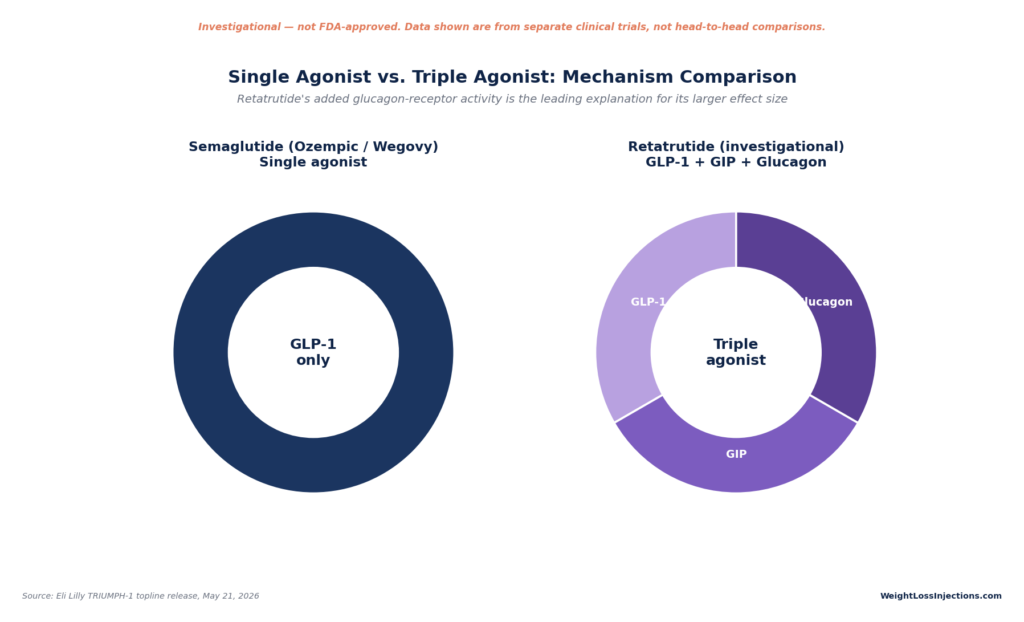
Semaglutide works by activating a single receptor: GLP-1 (glucagon-like peptide-1). This receptor slows gastric emptying, increases satiety signaling in the brain, and improves insulin secretion — the mechanism behind essentially all of the appetite-suppressing effects seen with Ozempic and Wegovy.
Retatrutide activates that same GLP-1 receptor, but adds two more: GIP (glucose-dependent insulinotropic polypeptide) and glucagon. The GIP component appears to enhance insulin sensitivity and may amplify GLP-1’s appetite effects. The glucagon component is believed to be the more significant addition for weight loss specifically, since glucagon receptor activation increases resting energy expenditure and hepatic glucose output — an effect entirely absent from semaglutide’s single-target mechanism, according to Eli Lilly’s TRIUMPH-1 topline data released May 21, 2026.
| Feature | Retatrutide (investigational) | Semaglutide (Ozempic/Wegovy) |
|---|---|---|
| Receptor targets | GLP-1 + GIP + Glucagon | GLP-1 only |
| Number of mechanisms | Triple agonist | Single agonist |
| Regulatory status | Not FDA-approved; investigational | FDA-approved |
| Administration | Once-weekly subcutaneous injection | Once-weekly subcutaneous injection |
| Developer | Eli Lilly and Company | Novo Nordisk |
Efficacy: TRIUMPH-1 vs. STEP-1
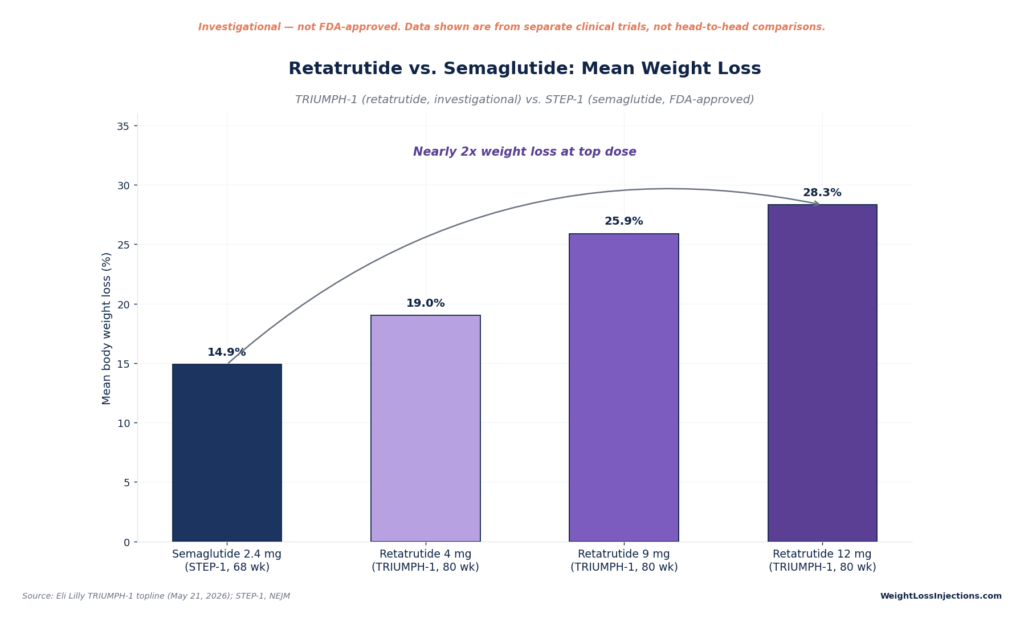
The clearest data point comes from comparing each drug’s pivotal obesity trial. As with any cross-trial comparison, these are separate studies with different participant populations, run at different times — not a randomized head-to-head trial.
TRIUMPH-1 enrolled 2,339 adults with obesity and no diabetes and followed them for 80 weeks. At the 12 mg dose, mean weight loss reached 28.3%, compared with 2.2% for placebo. The 9 mg dose produced 25.9% loss and the 4 mg dose produced 19.0% loss. A striking 45.3% of the 12 mg group lost at least 30% of body weight.
STEP-1, semaglutide’s pivotal trial published in the New England Journal of Medicine, followed participants for 68 weeks. At the 2.4 mg dose, mean weight loss was 14.9%.
| Trial | Drug | Dose | Duration | Mean Weight Loss |
|---|---|---|---|---|
| TRIUMPH-1 | Retatrutide (investigational) | 12 mg | 80 weeks | 28.3% |
| TRIUMPH-1 | Retatrutide (investigational) | 9 mg | 80 weeks | 25.9% |
| TRIUMPH-1 | Retatrutide (investigational) | 4 mg | 80 weeks | 19.0% |
| STEP-1 | Semaglutide (Wegovy) | 2.4 mg | 68 weeks | 14.9% |
At their respective top doses, trial data shows retatrutide’s mean weight loss was nearly double semaglutide’s — 28.3% versus 14.9%. Even retatrutide’s lowest studied Phase 3 dose (4 mg, 19.0%) outperformed semaglutide’s highest approved dose in cross-trial terms. A 104-week extension of TRIUMPH-1 reported continued weight loss to 30.3% at the 12 mg dose, according to Jastreboff et al., NEJM 2026 — suggesting the gap may widen further with longer treatment, though semaglutide’s own long-term extension data also shows durable, sustained loss over multi-year use.
Our Top 3 · October 2026
The best GLP-1 providers right now
Independently reviewed. Ranked by price, medication access, provider quality, and patient outcomes.
Renew GLP
Personalized GLP-1, GIP plans: Semaglutide & Tirzepatide.
Medvi
No membership or hidden fees. Everything you need is included.
Trimi
US-licensed clinicians and shipped to your door, from $99/mo.
Why the Gap Is So Large
Obesity researchers point to the added glucagon-receptor activity as the primary driver of retatrutide’s larger effect size. Glucagon receptor agonism increases energy expenditure independent of appetite suppression — meaning it burns more calories through metabolic pathways rather than relying solely on eating less. Semaglutide’s single-receptor mechanism produces meaningful, clinically significant weight loss through appetite and satiety pathways alone, but it does not include this additional energy-expenditure channel. This is the same basic principle explored in how retatrutide’s triple mechanism differs from single and dual agonists.
Discontinuation and Side Effect Profile
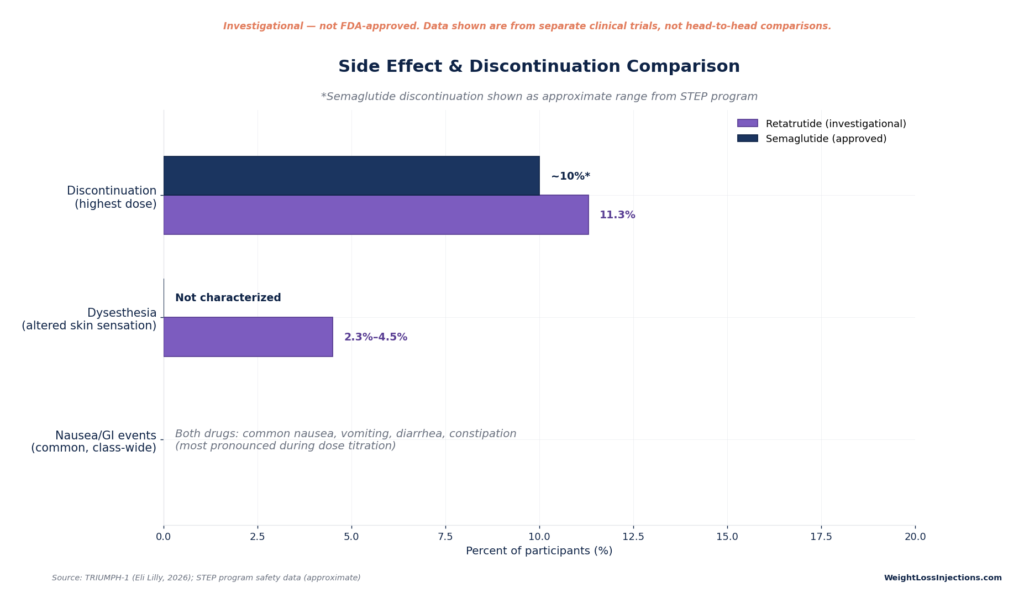
Both drugs are gastrointestinal-side-effect-forward, as is typical of the entire incretin drug class: nausea, vomiting, diarrhea, and constipation are the most frequently reported adverse events for both semaglutide and retatrutide, generally most pronounced during dose titration.
Retatrutide’s Phase 3 program additionally reports dysesthesia, an altered skin sensation, in 2.3% to 4.5% of participants — a signal that researchers believe may be tied to glucagon receptor activation and has not been similarly characterized in semaglutide’s trials. Discontinuation for adverse events in the retatrutide 12 mg group was 11.3% in TRIUMPH-1, a figure in a similar range to discontinuation rates reported for semaglutide’s highest dose across its STEP program.
| Side Effect Category | Retatrutide (investigational) | Semaglutide (approved) |
|---|---|---|
| Nausea, vomiting, diarrhea, constipation | Common, mostly mild-to-moderate | Common, mostly mild-to-moderate |
| Dysesthesia (altered skin sensation) | 2.3%–4.5% reported | Not a characterized signal |
| Heart rate increase | Modest increase reported | Modest increase reported |
| Discontinuation (highest dose) | ~11.3% (TRIUMPH-1) | Comparable range reported in STEP program |
| Long-term real-world safety data | Limited; drug not yet marketed | Extensive; years of post-market use |
Approved vs. Investigational: The Framing That Matters Most
It’s tempting to read the efficacy numbers and conclude retatrutide is simply “the stronger drug.” But efficacy percentages don’t change the regulatory reality: semaglutide is FDA-approved, has years of real-world safety data, and is accessible today. Retatrutide has not completed the FDA review process, has no confirmed long-term cardiovascular safety data (the TRIUMPH-3 cardiovascular outcomes trial is still ongoing), and cannot legally be prescribed, purchased, or compounded by any pharmacy in the United States.
As of July 2026, retatrutide has no USP/NF monograph and was not included in the FDA’s April 2026 compounding reclassification — meaning any product marketed as “compounded retatrutide” is not a legal or verified pharmaceutical product. The only legal way to access retatrutide is enrollment in an authorized clinical trial through ClinicalTrials.gov.
Eli Lilly is expected to file a New Drug Application in Q4 2026, with FDA acceptance projected for Q1 2027 and a possible approval decision in late 2027. Until that happens, approved options — semaglutide products like Wegovy, and dual agonists like tirzepatide — remain the only regulator-reviewed injectable choices in this category. Patients should never consider compounded semaglutide or any compounded retatrutide product as a substitute without discussing risks with a licensed provider.
FAQ
Is retatrutide really twice as effective as semaglutide?
Cross-trial data shows retatrutide’s top dose produced roughly double the mean weight loss of semaglutide’s top dose (28.3% vs. 14.9%), but these numbers come from two different trials, not a head-to-head study. The comparison is suggestive, not conclusive.
Why does adding glucagon receptor activity increase weight loss so much?
Glucagon receptor agonism raises energy expenditure and hepatic glucose output, adding a metabolic effect on top of the appetite suppression that GLP-1 alone (semaglutide’s mechanism) provides.
Can I switch from semaglutide to retatrutide?
Not currently. Retatrutide is investigational and only accessible through clinical trial enrollment. Any decision about your semaglutide treatment should be made with your prescribing provider.
Does retatrutide have more side effects than semaglutide?
Both share a similar GI side effect profile. Retatrutide’s trials report an additional dysesthesia signal in 2.3–4.5% of participants that has not been characterized with semaglutide. Long-term real-world safety data for retatrutide does not yet exist because it is not marketed.
When could retatrutide become an approved alternative to semaglutide?
If the anticipated timeline holds, a New Drug Application is expected in Q4 2026, with a possible approval decision in late 2027 and commercial launch around Q1–Q2 2028.
Medical disclaimer: Retatrutide is an investigational drug not approved by the FDA or any other regulatory authority as of July 2026. It is available only through enrollment in authorized clinical trials. This article is for informational purposes only and does not constitute medical advice, endorsement, or a recommendation to obtain retatrutide outside of a registered clinical trial. Speak with your healthcare provider about currently approved weight-loss treatments. Content published by WeightLossInjections.com.