
Key Takeaways
- Retatrutide is investigational — not FDA-approved — and available only through enrollment in an authorized clinical trial.
- TRIUMPH-1 reported a modest increase in resting heart rate, roughly 4–6 beats per minute, consistent with what has been observed across the GLP-1 receptor agonist class.
- No increase in major adverse cardiovascular events was reported in TRIUMPH-1, though this trial was not specifically designed as a dedicated cardiovascular outcomes trial.
- TRIUMPH-3, retatrutide’s dedicated cardiovascular outcomes trial (CVOT) in adults with obesity and cardiovascular disease, is ongoing with results expected Q3–Q4 2026.
- Modest heart rate increases matter most for patients with existing cardiovascular conditions, who should discuss any GLP-1-class therapy — investigational or approved — with a cardiologist or primary care provider.
- Full clarity on retatrutide’s cardiovascular risk/benefit profile will not be available until TRIUMPH-3 reports and is reviewed by regulators.
Heart rate changes are a well-documented, class-wide characteristic of GLP-1 receptor agonist medications, and retatrutide — as a triple hormone receptor agonist that includes GLP-1 activity — is no exception. Because cardiovascular safety is one of the most scrutinized aspects of any weight-loss drug review, this article focuses specifically on what TRIUMPH-1 has reported about retatrutide’s effect on heart rate, and what remains unknown pending further trial data. As with all retatrutide content, it bears repeating: retatrutide is investigational, not approved by the FDA or any other regulatory authority, and is currently accessible only through enrollment in a clinical trial.
Why GLP-1-Class Drugs Affect Heart Rate
GLP-1 receptor agonists — including semaglutide (Ozempic, Wegovy) and tirzepatide (Zepbound) — have consistently been associated with a modest increase in resting heart rate in clinical trials. The precise mechanism is not fully settled, but it is thought to relate to GLP-1 receptor activity in the heart and autonomic nervous system, which can produce a mild chronotropic (heart-rate-increasing) effect. Because retatrutide activates the GLP-1 receptor alongside GIP and glucagon receptors, a similar heart rate effect would be expected — and that is indeed what TRIUMPH-1 reported.
What TRIUMPH-1 Reported on Heart Rate
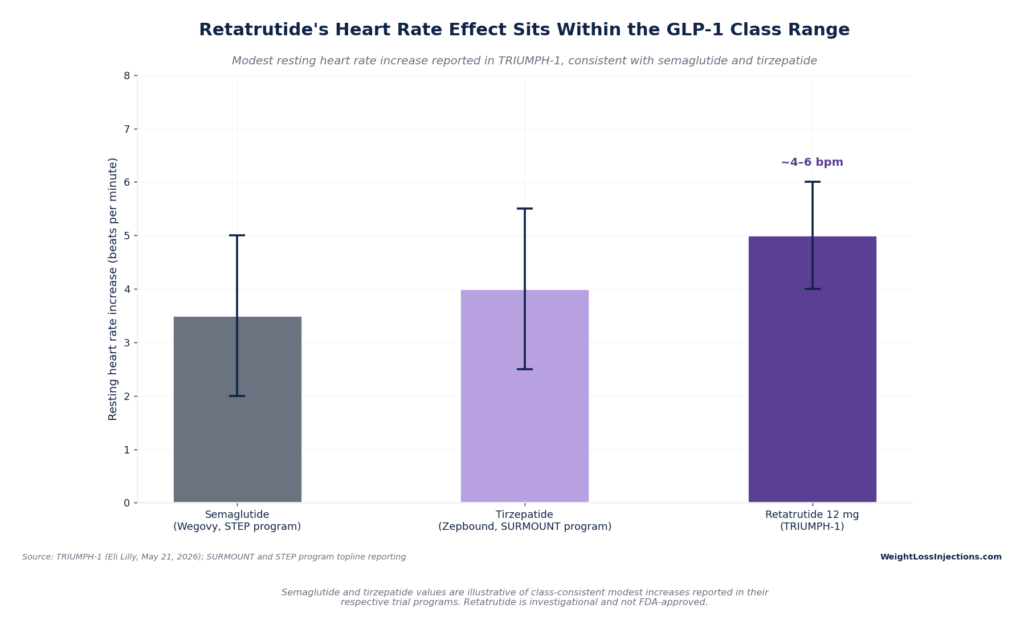
TRIUMPH-1, Eli Lilly’s pivotal 80-week obesity trial enrolling 2,339 adults, reported a modest increase in resting heart rate of approximately 4 to 6 beats per minute among participants on active retatrutide doses. This magnitude is broadly in line with what has been reported for other GLP-1-class drugs in their own pivotal trials, suggesting retatrutide’s cardiovascular effect on heart rate is not meaningfully different from the established class, despite its additional glucagon receptor activity.
Importantly, TRIUMPH-1 did not report an increase in major adverse cardiovascular events (a category that typically includes heart attack, stroke, and cardiovascular death) among participants on retatrutide. However, it’s important to understand the limits of this reassurance: TRIUMPH-1 was designed primarily as an obesity efficacy and safety trial, not as a dedicated cardiovascular outcomes trial with the statistical power specifically built to detect small differences in cardiovascular event rates.
Why a Dedicated Cardiovascular Outcomes Trial Still Matters
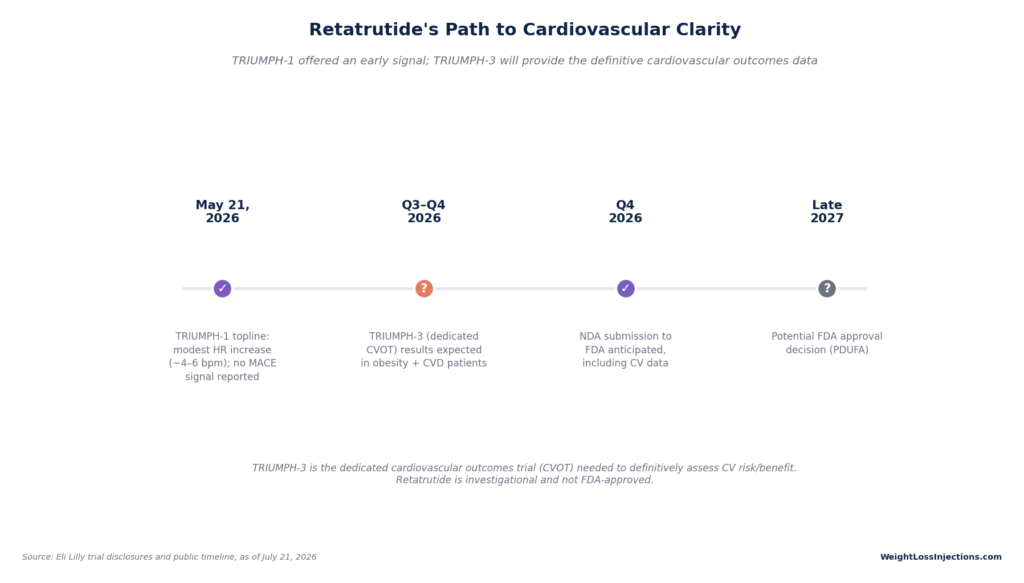
This is precisely why TRIUMPH-3 exists. TRIUMPH-3 is retatrutide’s dedicated cardiovascular outcomes trial (CVOT), studying the drug specifically in adults with obesity and existing cardiovascular disease. CVOTs are designed with the statistical power and endpoint selection needed to definitively assess whether a drug increases, decreases, or has no effect on serious cardiovascular events over time — a bar that general efficacy trials like TRIUMPH-1 are not built to clear on their own. TRIUMPH-3 results are expected in Q3–Q4 2026, and this data will be a critical component of Eli Lilly’s eventual New Drug Application, anticipated in Q4 2026.
Until TRIUMPH-3 reports, retatrutide’s long-term cardiovascular risk/benefit profile — beyond the modest heart rate signal already observed — remains an open question. This mirrors the regulatory path taken by semaglutide (SELECT trial) and tirzepatide (SURMOUNT-MMO and related outcomes work), both of which required dedicated cardiovascular outcomes data as part of establishing their full safety profiles.
How Retatrutide’s Heart Rate Effect Compares to the GLP-1 Class
| Drug | Reported Heart Rate Change | Source |
|---|---|---|
| Retatrutide (12 mg) | ~4–6 bpm increase | TRIUMPH-1 |
| Tirzepatide (Zepbound) | Modest increase (class-consistent) | SURMOUNT program |
| Semaglutide (Wegovy) | Modest increase (class-consistent) | STEP program |
Retatrutide’s heart rate effect sits within the range typically observed across the GLP-1 receptor agonist class, rather than representing an outlier finding. This is a reassuring data point, though it should not be interpreted as a substitute for the more definitive cardiovascular event data that TRIUMPH-3 is designed to provide.
Our Top 3 · October 2026
The best GLP-1 providers right now
Independently reviewed. Ranked by price, medication access, provider quality, and patient outcomes.
Renew GLP
Personalized GLP-1, GIP plans: Semaglutide & Tirzepatide.
Medvi
No membership or hidden fees. Everything you need is included.
Trimi
US-licensed clinicians and shipped to your door, from $99/mo.
Why This Matters for Patients With Existing Cardiovascular Conditions
A modest resting heart rate increase of 4–6 beats per minute is generally not considered clinically significant for most healthy adults. However, for individuals with existing cardiovascular conditions — such as arrhythmias, heart failure, or coronary artery disease — even modest changes in heart rate can be more clinically relevant and warrant closer monitoring. This is a key reason TRIUMPH-3 specifically enrolls adults with obesity and cardiovascular disease: to understand how retatrutide performs in the population most likely to be affected by any cardiovascular signal, positive or negative.
Anyone with a pre-existing cardiovascular condition who is considering a retatrutide clinical trial — the only legal access route today — should discuss their cardiac history in detail with the trial’s medical team and their own cardiologist or primary care provider before enrolling.
What We Still Don’t Know
Because retatrutide remains investigational, several cardiovascular-related questions remain open:
- Whether TRIUMPH-3 will show a cardiovascular benefit (similar to what semaglutide demonstrated in the SELECT trial), a neutral effect, or a signal requiring further scrutiny
- How retatrutide’s heart rate effect interacts with commonly used cardiac medications (beta-blockers, for instance) — a question typically addressed through drug interaction studies ahead of approval
- Long-term (multi-year) cardiovascular effects beyond the 80-week TRIUMPH-1 window and the 104-week extension data
These questions will be addressed progressively as TRIUMPH-3 reports (Q3–Q4 2026), as Eli Lilly compiles its NDA submission, and as the FDA conducts its review, which is projected to lead to a potential approval decision in late 2027.
Lessons From Other GLP-1 Cardiovascular Outcomes Trials
Retatrutide’s path toward cardiovascular clarity closely mirrors what semaglutide and tirzepatide have already walked. Semaglutide’s SELECT trial, a dedicated cardiovascular outcomes trial in adults with established cardiovascular disease and overweight or obesity (without diabetes), ultimately demonstrated a reduction in major adverse cardiovascular events, a finding that helped support broader indications for Wegovy beyond weight management alone. Tirzepatide’s cardiovascular outcomes data has followed a similar trajectory of dedicated, purpose-built trials separate from its primary weight-loss efficacy studies. TRIUMPH-3 represents retatrutide’s equivalent step in this process, and its outcome — whether neutral, beneficial, or a signal requiring caution — will meaningfully shape how the FDA and prescribers eventually think about retatrutide’s place relative to Zepbound and Wegovy for patients with cardiovascular risk factors.
Monitoring Heart Rate During a Clinical Trial
Participants enrolled in retatrutide’s ongoing trials, including TRIUMPH-2 and TRIUMPH-3, undergo regular monitoring that typically includes vital signs such as heart rate and blood pressure at scheduled visits. This structured monitoring is part of why clinical trials are considered the appropriate and only legal setting for retatrutide exposure at this stage — any cardiovascular changes, however modest, are being tracked systematically by trained medical staff rather than left to a patient’s self-assessment. If you are considering enrollment in a retatrutide trial and have any history of cardiac arrhythmia, prior heart attack, heart failure, or are taking heart-rate-affecting medications, disclosing this fully during the trial’s screening process is essential for both your safety and the integrity of the trial’s safety data.
Why This Data Matters Now
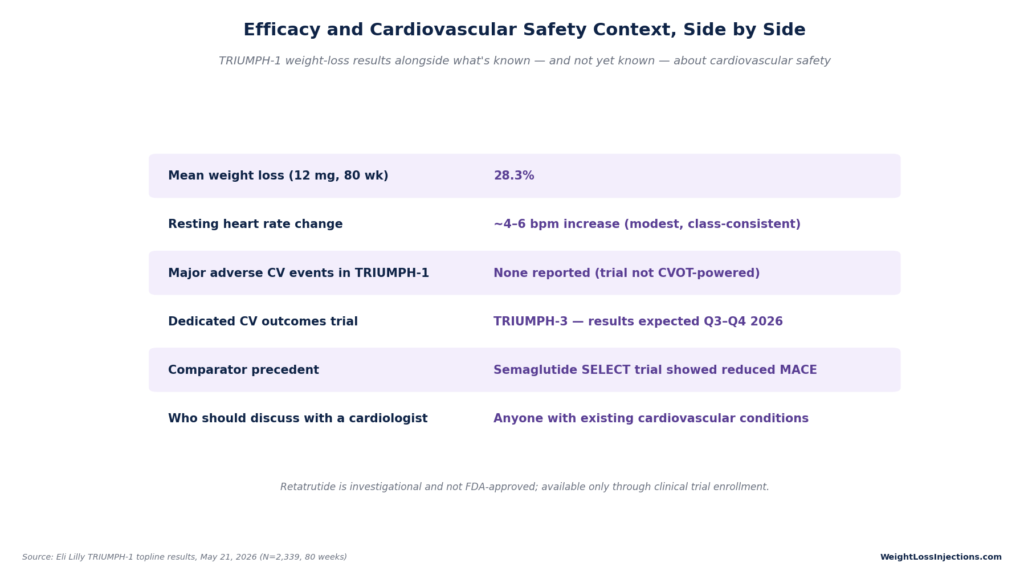
Public interest in retatrutide is high because of its weight-loss magnitude — 28.3% mean weight loss at the 12 mg dose in TRIUMPH-1, compared to 22.5% for Zepbound (tirzepatide, SURMOUNT-1) and 14.9% for Wegovy (semaglutide, STEP-1). But cardiovascular safety data typically takes longer to mature than efficacy data, and regulators will weigh both carefully. Understanding what is and isn’t yet known about retatrutide’s cardiovascular profile helps set realistic expectations for anyone following the drug’s path toward potential approval — or considering enrollment in an ongoing trial.
Frequently Asked Questions
Does retatrutide increase heart rate?
Yes. TRIUMPH-1 reported a modest increase in resting heart rate of approximately 4–6 beats per minute among participants on active retatrutide doses, consistent with the broader GLP-1 receptor agonist class.
Is retatrutide’s heart rate effect dangerous?
For most participants, a 4–6 bpm increase is considered modest and consistent with what’s already observed in approved GLP-1-class drugs like Ozempic and Zepbound. Individuals with existing cardiovascular conditions should discuss this with a healthcare provider, since even modest changes can be more clinically relevant in that population.
Did TRIUMPH-1 show retatrutide increases the risk of heart attack or stroke?
No increase in major adverse cardiovascular events was reported in TRIUMPH-1. However, this trial was not specifically powered as a cardiovascular outcomes trial, so definitive conclusions await TRIUMPH-3.
What is TRIUMPH-3, and why does it matter?
TRIUMPH-3 is retatrutide’s dedicated cardiovascular outcomes trial, studying the drug in adults with obesity and existing cardiovascular disease. It is designed to definitively assess cardiovascular risk or benefit and is expected to report in Q3–Q4 2026.
Should people with heart conditions avoid retatrutide trials?
This is a decision to make with a cardiologist or primary care provider, factoring in the individual’s specific cardiac history and the trial’s inclusion/exclusion criteria. TRIUMPH-3 specifically enrolls people with cardiovascular disease under close medical supervision to study this question directly.
Medical disclaimer: Retatrutide is an investigational drug not approved by the FDA or any other regulatory authority as of July 2026. It is available only through enrollment in authorized clinical trials. This article is for informational purposes only and does not constitute medical advice, endorsement, or a recommendation to obtain retatrutide outside of a registered clinical trial. Speak with your healthcare provider about currently approved weight-loss treatments. Content published by WeightLossInjections.com.