
Key Takeaways
- Retatrutide is investigational — not FDA-approved — and available only through enrollment in an authorized clinical trial.
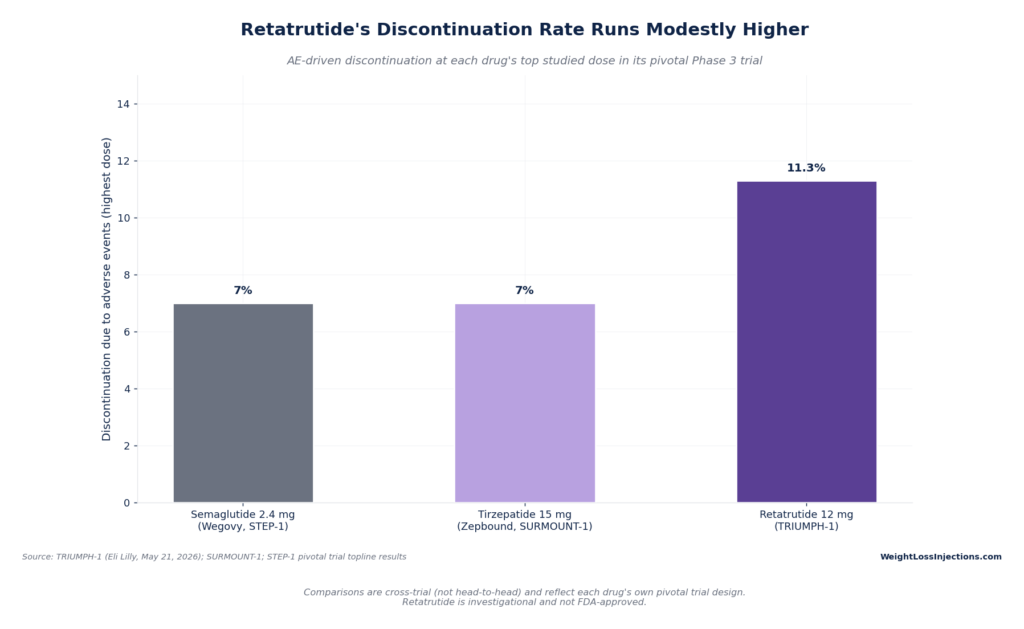
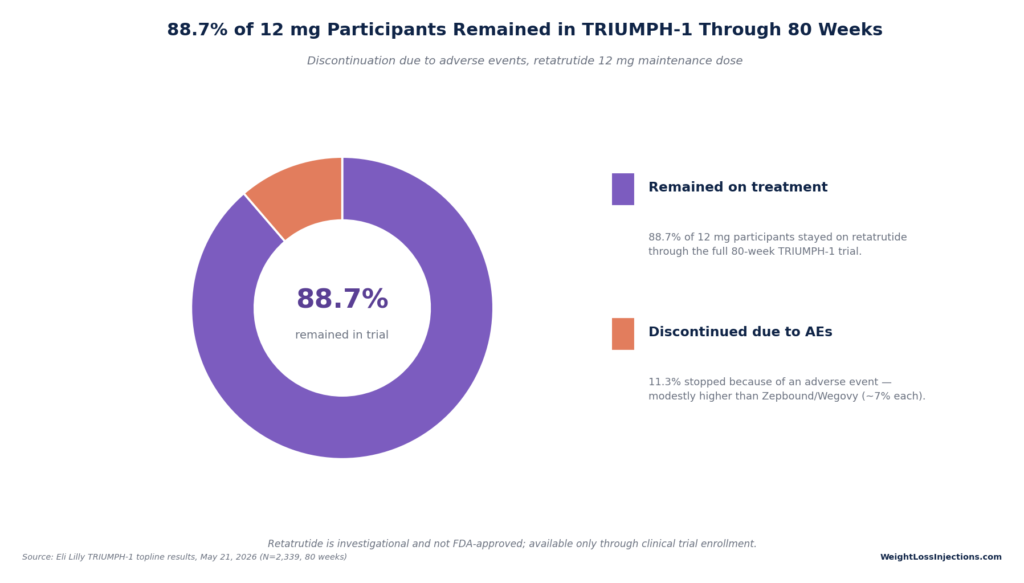
- In TRIUMPH-1, 11.3% of participants on the 12 mg dose discontinued treatment due to adverse events over the 80-week trial.
- That rate is modestly higher than Zepbound (tirzepatide, SURMOUNT-1) and Wegovy (semaglutide, STEP-1), each around 7% discontinuation for adverse events in their pivotal trials.
- Researchers believe retatrutide’s added glucagon receptor activity — the feature that distinguishes it as a triple agonist — may explain part of this modestly higher discontinuation rate.
- Discontinuation for adverse events is different from discontinuation for any reason (which includes withdrawal of consent, loss to follow-up, etc.); this article focuses specifically on AE-driven discontinuation.
- Because retatrutide is not yet approved, no official post-approval dose-adjustment protocol exists; any tolerability strategy is currently determined by clinical trial design.
Tolerability — not just efficacy — determines whether a weight-loss medication succeeds in the real world. A drug that produces excellent weight loss on paper but that a large share of patients cannot tolerate long enough to benefit from is a very different clinical proposition than one that is both effective and easy to stay on. This article looks at what’s known about retatrutide’s discontinuation rates, drawing on Eli Lilly’s Phase 3 program, and compares those figures to already-approved GLP-1-class drugs. As with all retatrutide content, it’s important to state upfront: retatrutide is investigational and not approved by the FDA or any other regulatory authority. It is currently accessible only through enrollment in a registered clinical trial.
What “Discontinuation for Adverse Events” Means
In clinical trials, researchers track multiple reasons a participant might stop taking a study drug: adverse events, withdrawal of consent, loss to follow-up, protocol deviations, and others. Discontinuation due to adverse events (AEs) specifically captures participants who stopped because they experienced a side effect significant enough — in their own judgment or their physician’s — to end treatment. This metric is one of the most closely watched tolerability indicators in obesity-drug trials because it reflects real-world usability far more directly than a simple list of reported side effects.
The TRIUMPH-1 Discontinuation Figure: 11.3%
TRIUMPH-1, Eli Lilly’s pivotal Phase 3 obesity trial, enrolled 2,339 adults with obesity (without diabetes) and followed them for 80 weeks. Among participants assigned to the 12 mg maintenance dose — the highest dose studied and the one producing the trial’s headline 28.3% mean weight loss — 11.3% discontinued treatment due to adverse events. This figure was reported alongside the trial’s topline efficacy results on May 21, 2026.
It’s worth noting that discontinuation rates in Phase 3 trials often vary by dose, with higher doses generally associated with somewhat higher discontinuation, mirroring the dose-dependence seen in GI side effects covered in our article on retatrutide side effects. The 11.3% figure specifically applies to the 12 mg group, which is also the dose used for the trial’s primary efficacy comparisons.
How Retatrutide Compares to Zepbound and Wegovy
To put retatrutide’s 11.3% discontinuation rate in context, compare it to two already-approved therapies:
| Drug | Trial | Discontinuation for AEs (highest dose) |
|---|---|---|
| Retatrutide 12 mg | TRIUMPH-1 | ~11.3% |
| Tirzepatide 15 mg (Zepbound) | SURMOUNT-1 | ~7% |
| Semaglutide 2.4 mg (Wegovy) | STEP-1 | ~7% |
Retatrutide’s discontinuation rate runs several percentage points higher than both comparators. While 11.3% is not a dramatic outlier — the large majority of TRIUMPH-1 participants remained on treatment through 80 weeks — it is a meaningful data point for anyone weighing retatrutide’s tolerability against established options like Zepbound, Wegovy, or tirzepatide-based therapies more broadly.
Why Might a Triple Agonist Have a Slightly Higher Discontinuation Rate?
Retatrutide’s defining feature is that it activates three hormone receptors — GIP, GLP-1, and glucagon — compared to semaglutide’s one (GLP-1 only) and tirzepatide’s two (GLP-1 and GIP). Researchers and endocrinologists have proposed that the added glucagon receptor activity, while contributing to retatrutide’s larger weight-loss effect (glucagon receptor activation increases energy expenditure and affects lipid metabolism), may also introduce additional tolerability considerations not present with GLP-1-only or GLP-1/GIP dual-agonist mechanisms. This is consistent with the emergence of dysesthesia — an altered skin sensation not typically reported with Ozempic or Zepbound — which is covered in detail in our article on retatrutide and dysesthesia. In other words, the same mechanism that appears to drive retatrutide’s superior efficacy may also be contributing modestly to its higher discontinuation rate. This remains a hypothesis based on mechanistic reasoning rather than a definitively proven causal pathway, and further Phase 3 data (TRIUMPH-2, TRIUMPH-3) may clarify this relationship.
Our Top 3 · October 2026
The best GLP-1 providers right now
Independently reviewed. Ranked by price, medication access, provider quality, and patient outcomes.
Renew GLP
Personalized GLP-1, GIP plans: Semaglutide & Tirzepatide.
Medvi
No membership or hidden fees. Everything you need is included.
Trimi
US-licensed clinicians and shipped to your door, from $99/mo.
Is 11.3% a High Discontinuation Rate?
Context matters here. An 11.3% discontinuation rate for adverse events means that roughly 9 out of 10 participants on the 12 mg dose remained in treatment through the 80-week trial despite side effects — a tolerability profile that, while somewhat less favorable than Zepbound‘s or Wegovy‘s, is not unusually high for a novel mechanism drug in Phase 3. For comparison, earlier-generation obesity drugs and even some GLP-1 formulations in real-world (non-trial) use have shown higher discontinuation rates than what’s typically reported in tightly monitored clinical trials, where dose titration and side-effect management are closely supervised.
What Might Post-Approval Dose Adjustment Look Like?
Because retatrutide has not been approved, there is no official prescribing information or approved dose-adjustment protocol. However, based on how tirzepatide and semaglutide are managed in real-world practice, it’s reasonable to anticipate — without asserting this as confirmed — that if retatrutide is approved, clinicians may have flexibility to:
- Extend the titration period for patients experiencing tolerability challenges
- Consider a lower maintenance dose (e.g., 9 mg or 4 mg) if the 12 mg dose is not well tolerated
- Pause escalation temporarily before continuing titration
These possibilities are speculative extrapolations from how the approved GLP-1 class is typically managed, not confirmed retatrutide protocols. Any future dosing and adjustment guidance will be determined by the FDA-approved label if and when retatrutide is approved — anticipated NDA submission is Q4 2026, with potential approval in late 2027.
Discontinuation Trends Across the Titration Period
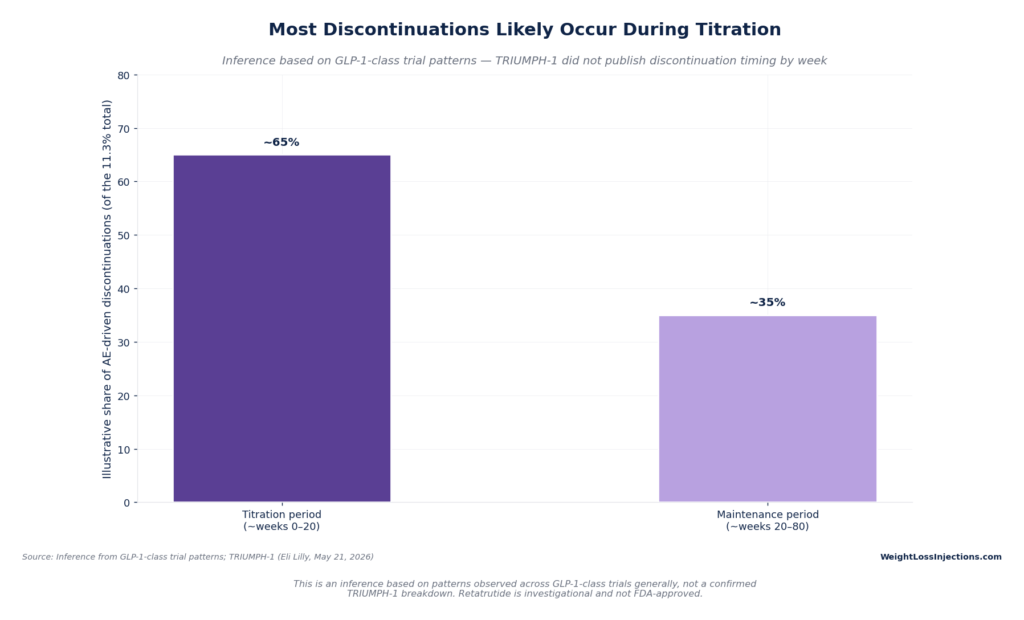
Because GI side effects and dysesthesia both tend to be more pronounced during dose escalation, it’s reasonable to expect that a meaningful share of the 11.3% discontinuation figure in TRIUMPH-1 reflects participants who stopped during the roughly 20-week titration period, before reaching the 12 mg maintenance dose, rather than after establishing tolerance at the maintenance level. Eli Lilly’s topline release did not break out discontinuation by trial week, so this remains an inference based on patterns observed across GLP-1-class trials generally, where early titration is consistently the period of highest attrition. More granular timing data may become available as TRIUMPH-1 results move toward full peer-reviewed publication.
Comparing Discontinuation Rates Across All Three Retatrutide Trials
TRIUMPH-1 is the largest and most detailed discontinuation dataset available for retatrutide, but it is not the only one. TRIUMPH-4, which studied retatrutide in adults with obesity and knee osteoarthritis over 68 weeks, and TRANSCEND-T2D-1, which studied retatrutide in adults with type 2 diabetes over 40 weeks, both contribute additional safety context, though neither trial’s topline communications have emphasized a discontinuation figure as prominently as TRIUMPH-1‘s 11.3%. Populations differ meaningfully between these trials — for example, adults with type 2 diabetes in TRANSCEND-T2D-1 were also compared against a dulaglutide 1.5 mg arm, offering a useful head-to-head tolerability reference point once more detailed safety data is published.
What This Means If You’re Considering a Retatrutide Trial
If you’re exploring enrollment in a retatrutide clinical trial — currently the only legal way to access the drug — it’s worth understanding that:
- Discontinuation for adverse events, while modestly higher than approved GLP-1 drugs, still means the large majority of participants remained on treatment
- GI side effects and dysesthesia are the primary drivers of intolerance reported so far
- Trial staff closely monitor participants and can adjust support, though formal dose-adjustment protocols are trial-specific, not standardized prescribing guidance
- Speaking with your study coordinator about what to expect, and reporting any side effects promptly, is the best way to navigate tolerability concerns during a trial
Frequently Asked Questions
What percentage of people stop taking retatrutide due to side effects?
In TRIUMPH-1, 11.3% of participants on the 12 mg dose discontinued treatment due to adverse events over 80 weeks.
Is retatrutide harder to tolerate than Zepbound or Wegovy?
Data suggests a modestly higher discontinuation rate for retatrutide (11.3%) compared to Zepbound and Wegovy (roughly 7% each) in their respective pivotal trials, potentially related to retatrutide’s additional glucagon receptor activity.
Why would a triple agonist be less tolerable than a dual or single agonist?
The added glucagon receptor pathway that helps drive retatrutide’s larger weight-loss effect may also contribute to additional side effects, such as dysesthesia, not seen with GLP-1-only or GLP-1/GIP therapies. This remains an area of ongoing research.
Will retatrutide have a lower starting dose option to improve tolerability once approved?
There is no confirmed post-approval dosing protocol since retatrutide is not yet approved. Based on patterns in the approved GLP-1 class, extended titration or lower maintenance doses may be considerations, but this is speculative until an FDA-approved label exists.
How can I find out if I qualify for a retatrutide trial?
The only legal, currently available way to access retatrutide is by enrolling in an active clinical trial through ClinicalTrials.gov. Speak with your healthcare provider about whether a trial might be appropriate for you.
Medical disclaimer: Retatrutide is an investigational drug not approved by the FDA or any other regulatory authority as of July 2026. It is available only through enrollment in authorized clinical trials. This article is for informational purposes only and does not constitute medical advice, endorsement, or a recommendation to obtain retatrutide outside of a registered clinical trial. Speak with your healthcare provider about currently approved weight-loss treatments. Content published by WeightLossInjections.com.