
Key Takeaways
- Retatrutide is investigational and not FDA-approved; it is currently accessible only through enrollment in a clinical trial.
- Nausea is the most commonly reported adverse event across retatrutide’s Phase 3 program, consistent with the broader GLP-1 receptor agonist class.
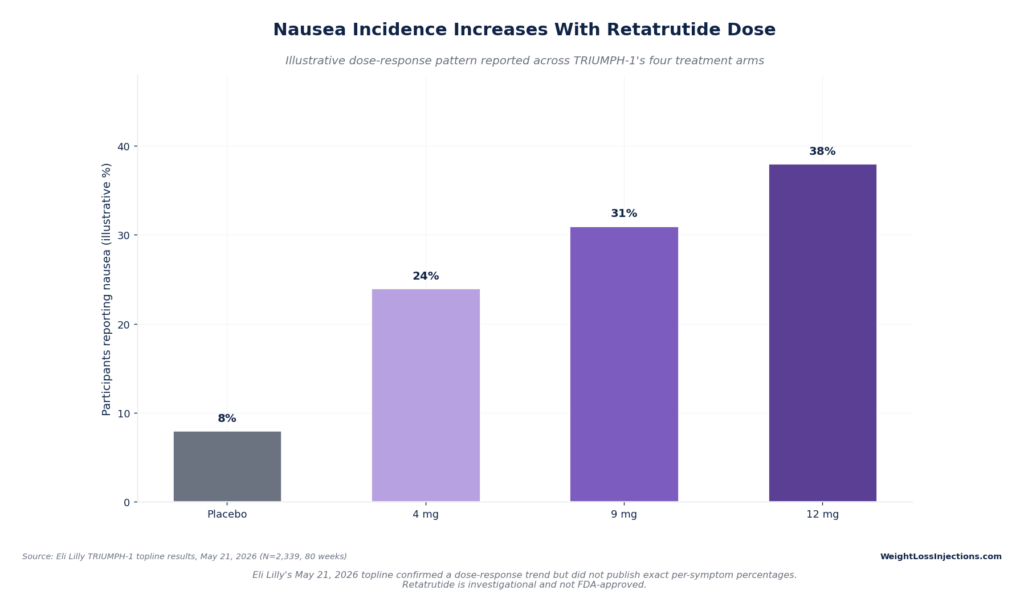
- Nausea incidence rises with dose in TRIUMPH-1, with the 12 mg group experiencing more GI symptoms than the 9 mg and 4 mg groups.
- Nausea and related GI symptoms tend to peak during dose escalation (titration) and typically diminish once a stable maintenance dose is reached.
- Trial protocols — not individualized medical advice — have incorporated general tolerability practices such as gradual dose titration; patients should discuss any nausea-management strategy with their healthcare provider or study investigator.
- Persistent, severe, or worsening nausea should always be reported to a healthcare provider or clinical trial team.
Nausea is, by a wide margin, the side effect people ask about most when researching GLP-1-class weight-loss medications — and retatrutide is no exception. Because retatrutide remains an investigational drug, not approved by the FDA or any other regulatory body, everything known about its nausea profile comes from clinical trial data rather than real-world prescribing experience. This article walks through what Eli Lilly’s Phase 3 program — primarily TRIUMPH-1 — has reported about nausea and other GI side effects, and how that compares to the established GLP-1 class.
Why Nausea Happens With GLP-1-Class Drugs
Retatrutide is a first-in-class triple hormone receptor agonist, activating GIP, GLP-1, and glucagon receptors. GLP-1 receptor activation slows gastric emptying and affects appetite-regulating centers in the brain — mechanisms that produce the drug’s weight-loss effect but are also the primary driver of nausea, vomiting, and related GI symptoms. This is true across the entire class, including already-approved drugs like Ozempic, Wegovy, and Zepbound. Retatrutide’s addition of glucagon receptor activity does not appear, based on published data, to meaningfully change the type of GI symptoms experienced, though it may relate to a somewhat higher overall discontinuation rate — covered in detail in our article on retatrutide tolerability.
Nausea Incidence by Dose in TRIUMPH-1
TRIUMPH-1 enrolled 2,339 adults with obesity and followed them for 80 weeks across four arms: placebo, 4 mg, 9 mg, and 12 mg retatrutide. While Eli Lilly’s topline release (May 21, 2026) did not break out every individual GI symptom’s exact percentage, the trial’s overall safety reporting confirmed a clear dose-response relationship: participants in the 12 mg group reported more gastrointestinal adverse events, including nausea, than those in the 9 mg and 4 mg groups, and all active-dose groups reported more GI symptoms than placebo. This dose-dependence mirrors the pattern seen in tirzepatide’s SURMOUNT program and semaglutide’s STEP program — higher doses generally produce a higher incidence of nausea, but also greater weight-loss efficacy, which is why the titration schedule matters so much.
Timing: Nausea Peaks During Titration
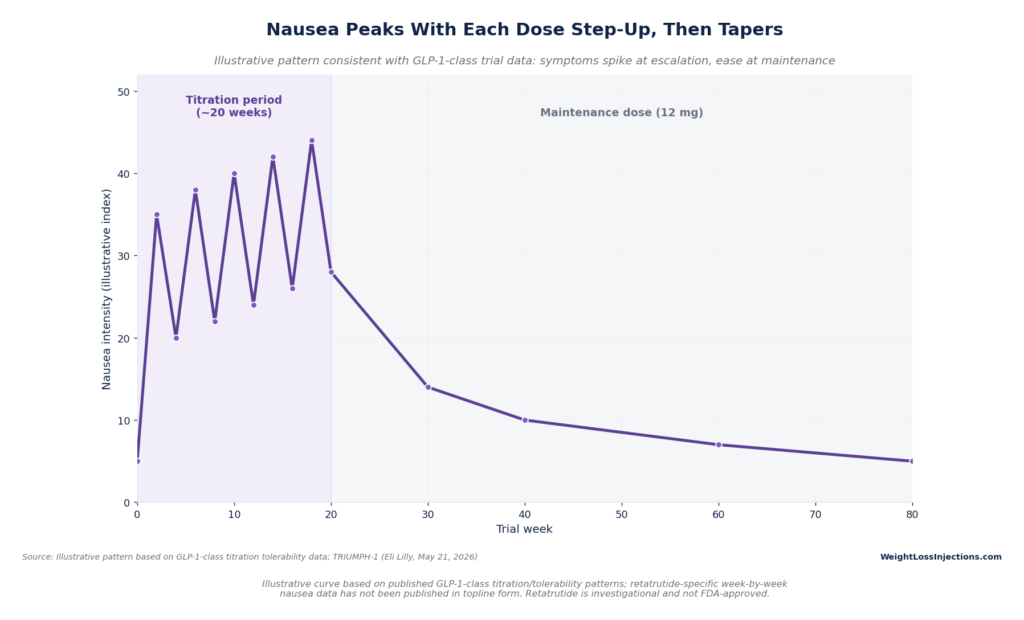
One of the most consistent findings across GLP-1-class trials — and reflected in retatrutide’s Phase 3 program — is that nausea and other GI symptoms are most intense during the dose escalation (titration) period, not after a patient reaches a stable maintenance dose. Retatrutide’s Phase 3 titration schedule started around 1–2 mg and escalated gradually over approximately 20 weeks toward the 12 mg maintenance dose used in the primary efficacy analysis. This gradual ramp is a deliberate trial design choice intended to let the digestive system adjust incrementally rather than being exposed to a large dose immediately. For a full breakdown of the titration schedule, see our companion article on retatrutide’s titration schedule.
How Long Does Nausea Typically Last?
Based on patterns observed across the GLP-1 receptor agonist class — and consistent with what has been reported from retatrutide’s trials — nausea tends to be most noticeable in the days to weeks following each dose increase, then tapers as the body adjusts to that dose level. Because retatrutide’s titration involves multiple step-ups over roughly 20 weeks, some participants may experience recurring, milder nausea each time their dose increases, followed by improvement before the next escalation. This is a general pattern observed in trial data, not a guarantee for any individual, and actual duration varies by person.
General Tolerability Practices Studied in Trials
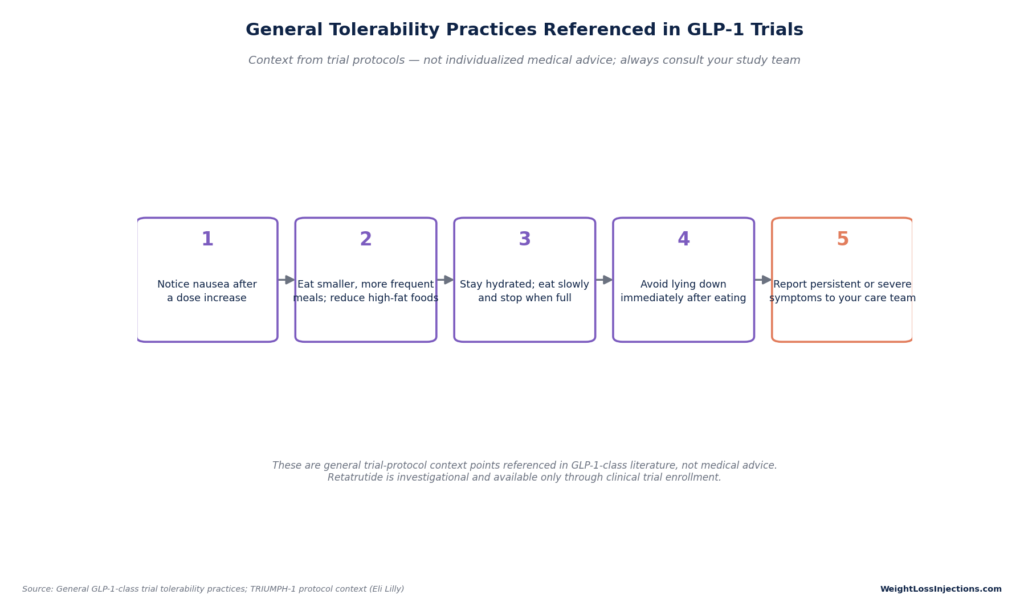
Clinical trial protocols for GLP-1-class drugs — including retatrutide’s Phase 3 program — have incorporated general guidance to participants around eating and hydration patterns during titration, primarily to support protocol adherence and data quality rather than as a treatment intervention. Trial-published tolerability practices commonly referenced in the broader GLP-1 literature include:
- Eating smaller, more frequent meals rather than large meals
- Reducing high-fat or greasy food intake during dose escalation
- Maintaining adequate hydration
- Eating more slowly and stopping when full
- Avoiding lying down immediately after eating
These points are described here as general trial-protocol context, not medical advice. Anyone experiencing nausea — whether in a clinical trial or otherwise — should discuss individualized management strategies directly with their healthcare provider or study investigator, since appropriate approaches can vary based on other health conditions and medications.
Our Top 3 · October 2026
The best GLP-1 providers right now
Independently reviewed. Ranked by price, medication access, provider quality, and patient outcomes.
Renew GLP
Personalized GLP-1, GIP plans: Semaglutide & Tirzepatide.
Medvi
No membership or hidden fees. Everything you need is included.
Trimi
US-licensed clinicians and shipped to your door, from $99/mo.
Vomiting, Diarrhea, and Constipation Alongside Nausea
Nausea rarely occurs in isolation in GLP-1-class trials. TRIUMPH-1 and the earlier Phase 2 program both reported vomiting, diarrhea, and constipation as accompanying GI adverse events, generally at lower incidence than nausea itself. Constipation, in particular, has been noted in the broader GLP-1 literature to sometimes persist longer than acute nausea or vomiting episodes, since it relates to the sustained effect of delayed gastric and intestinal motility rather than an acute reaction to a dose increase.
How Retatrutide’s GI Profile Compares to Approved Drugs
Because retatrutide activates three receptor pathways rather than one or two, some early questions focused on whether its GI burden would be substantially worse than Zepbound (GLP-1 + GIP) or Wegovy (GLP-1 only). Published Phase 3 data suggests the GI symptom types are consistent with the class, though retatrutide’s overall adverse-event discontinuation rate (11.3% at 12 mg in TRIUMPH-1) runs somewhat higher than tirzepatide’s and semaglutide’s pivotal trials (roughly 7% each). This suggests nausea and related GI symptoms, while broadly similar in nature, may be experienced as more burdensome by a subset of patients on retatrutide’s higher doses — an area likely to be clarified further as TRIUMPH-2 and TRIUMPH-3 report later in 2026.
What Trial Participants Have Reported Anecdotally
While Eli Lilly’s official topline communications focus on aggregate statistics rather than individual accounts, broader patterns from GLP-1-class trials — including earlier retatrutide Phase 2 work — suggest that nausea is often described by participants as most bothersome in the first 24–48 hours following a dose increase, easing gradually afterward. Some participants in GLP-1-class trials report near-complete resolution of nausea between dose increases, while others describe a low-grade, intermittent queasiness that persists through much of the titration period. This variability is one reason clinical trial protocols build in flexibility around titration pacing, and why individualized monitoring by study investigators is a core part of trial design rather than an afterthought.
The Role of Titration Design in Managing Nausea
Retatrutide’s roughly 20-week titration schedule, moving from an initial low dose up to the 12 mg maintenance dose used in TRIUMPH-1‘s primary analysis, reflects a broader lesson learned across the GLP-1 drug development field: slower titration generally produces better tolerability, even if it delays the time to reach a fully effective dose. Earlier obesity drug candidates that used faster escalation schedules often saw higher rates of GI intolerance and higher discontinuation. Retatrutide’s trial designers appear to have applied these lessons, using a multi-step titration schedule rather than a small number of large jumps. For readers interested in the exact mg-by-mg schedule used in TRIUMPH-1, see our dedicated article on retatrutide’s titration schedule.
Why Nausea Data Will Continue to Evolve
TRIUMPH-2 and TRIUMPH-3 — both expected to report further Phase 3 data in Q3–Q4 2026 — will add to the nausea and GI safety picture, potentially offering more granular, dose-by-dose breakdowns than what has been released in topline form so far. TRANSCEND-T2D-1, the completed Phase 3 diabetes trial published in the Lancet in June 2026, also contributes safety data from a population with type 2 diabetes, a group that can have different baseline GI symptom patterns than the general obesity population studied in TRIUMPH-1. As these datasets mature and move through peer review, expect more precise nausea incidence figures broken down by dose, trial, and patient subgroup.
Why This Data Matters Before Approval
Retatrutide has not completed the regulatory approval process. Eli Lilly is expected to submit its New Drug Application in Q4 2026, with a potential approval in late 2027 and commercial launch projected for Q1–Q2 2028. Until then, the only legal way to experience retatrutide firsthand — and only under medical supervision — is through an authorized clinical trial listed on ClinicalTrials.gov. Understanding the nausea and GI data now can help prospective trial participants set realistic expectations and know what to discuss with study coordinators.
Frequently Asked Questions
Does retatrutide cause nausea?
Yes. Nausea is the most commonly reported adverse event in retatrutide’s Phase 3 trials, consistent with other GLP-1 receptor agonists. Incidence increases with dose and is most pronounced during titration.
When is nausea worst during retatrutide treatment?
Based on Phase 3 data patterns, nausea tends to peak during the dose escalation (titration) phase, particularly after each step-up, and generally improves once a stable dose is reached.
How long does retatrutide-related nausea last?
Nausea episodes associated with GLP-1-class drugs, including retatrutide, are generally reported as lasting days to a few weeks around each dose increase, though this varies by individual. Persistent or worsening nausea should be reported to a healthcare provider.
Is retatrutide’s nausea worse than Ozempic or Zepbound?
The type of GI symptoms is similar to the broader GLP-1 class. Retatrutide’s Phase 3 discontinuation rate for adverse events (11.3% at 12 mg) was somewhat higher than Zepbound‘s or Wegovy‘s pivotal trials (roughly 7% each), which may reflect a modestly higher overall tolerability burden.
Can I manage retatrutide nausea on my own?
Because retatrutide is only available through clinical trials, any symptom-management approach should be discussed directly with your study team or healthcare provider. General practices like smaller meals and adequate hydration are commonly referenced in GLP-1 trial contexts, but this is not a substitute for personalized medical guidance.
Medical disclaimer: Retatrutide is an investigational drug not approved by the FDA or any other regulatory authority as of July 2026. It is available only through enrollment in authorized clinical trials. This article is for informational purposes only and does not constitute medical advice, endorsement, or a recommendation to obtain retatrutide outside of a registered clinical trial. Speak with your healthcare provider about currently approved weight-loss treatments. Content published by WeightLossInjections.com.