
Key Takeaways
- Retatrutide is investigational and not approved by the FDA or any other regulatory authority as of July 2026 — the titration pattern described here reflects a clinical trial protocol, not a prescribing schedule available to patients.
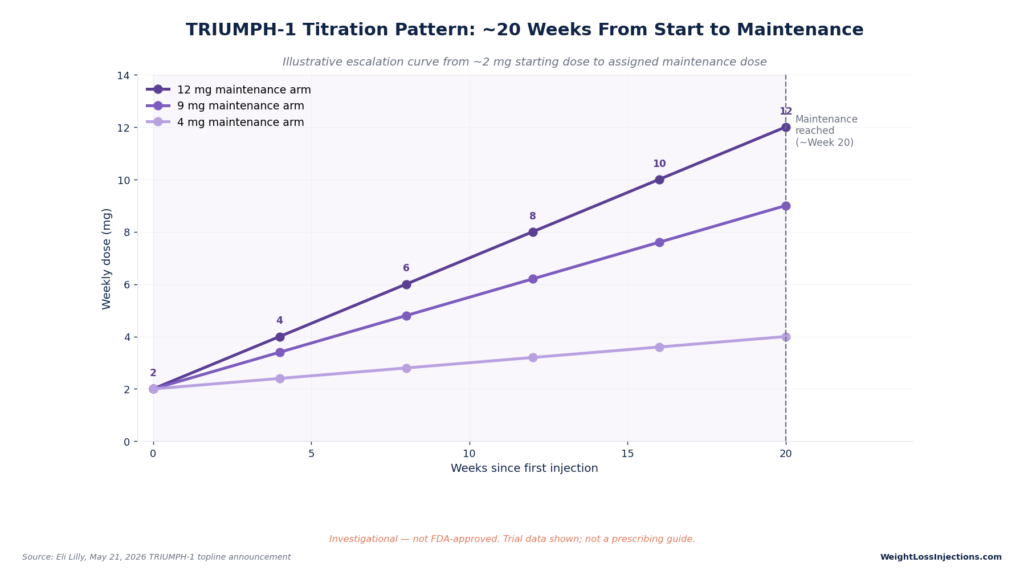
- In TRIUMPH-1, participants began at a low starting dose of approximately 2 mg and were gradually increased over roughly 20 weeks to reach a maintenance dose of 4 mg, 9 mg, or 12 mg, depending on trial arm.
- Gradual dose escalation (“titration”) is a standard technique across the entire incretin drug class, used to reduce the frequency and severity of gastrointestinal side effects like nausea and vomiting.
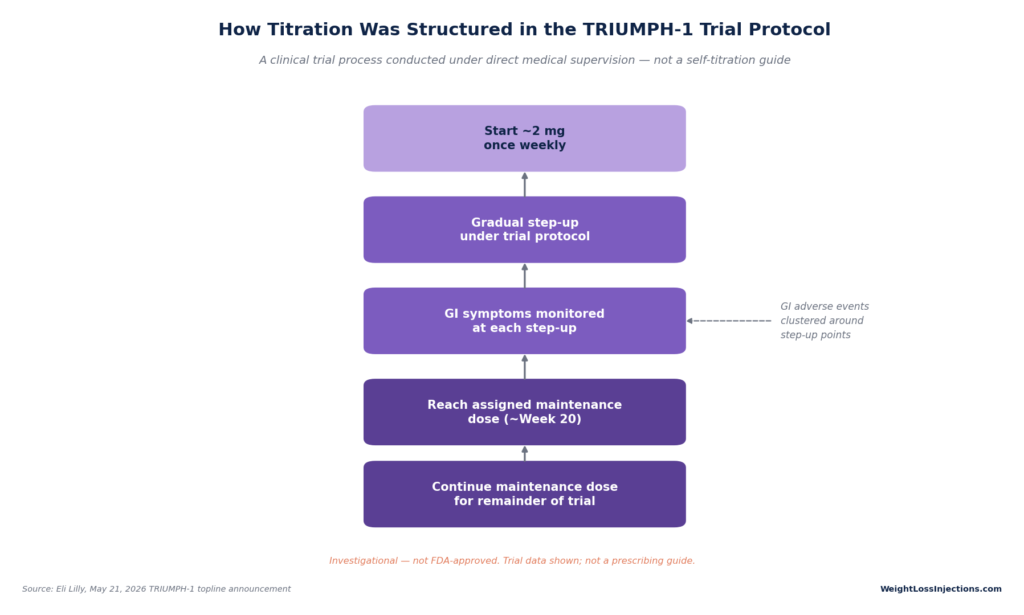
- Discontinuation and adverse-event reports tend to cluster around dose step-up points, when the body is adjusting to a new, higher level of receptor activation.
- Titration is not something patients can replicate on their own with retatrutide — it was conducted under a defined clinical trial protocol with medical oversight, and there is no legal, approved version of this schedule available outside of a trial.
- The only legal way to receive retatrutide, at any point in a titration schedule, is enrollment in an authorized clinical trial.
This article describes a dose-escalation pattern used in a specific clinical trial for educational purposes. It is not instructional guidance for titrating or self-administering retatrutide.
Why Trials Don’t Start Everyone at the Target Dose
Retatrutide (LY3437943), developed by Eli Lilly, is investigational and has not been approved by the FDA or any other regulatory authority as of July 2026. Its clinical development program, including the pivotal TRIUMPH-1 obesity trial, used a gradual dose-escalation design rather than starting participants directly at their assigned maintenance dose. Understanding why trials are designed this way — and what TRIUMPH-1’s escalation pattern looked like — helps explain both the drug’s efficacy data and its side-effect profile, without serving as a guide for individual use.
Gradual dose escalation, often called titration, is standard practice across the entire incretin-based drug class, including approved medications like Ozempic, Wegovy, and Zepbound. The core rationale is the same across all of these drugs: starting at a high dose immediately tends to produce more severe gastrointestinal side effects than the body can comfortably adjust to, while a gradual increase allows the digestive system time to adapt at each step.
The TRIUMPH-1 Titration Pattern: Roughly 20 Weeks From Start to Maintenance
TRIUMPH-1, the pivotal Phase 3 obesity trial that enrolled 2,339 adults without diabetes, used a titration schedule that began at a low starting dose of approximately 2 mg once weekly and escalated over roughly 20 weeks until participants reached their assigned maintenance dose — 4 mg, 9 mg, or 12 mg, depending on which trial arm they were randomized to (Eli Lilly, May 21, 2026 topline announcement).
This means that participants assigned to the highest studied dose, 12 mg, did not receive 12 mg in their first injection. Instead, the trial protocol moved them through a sequence of intermediate doses over roughly five months before they reached the full maintenance level. This extended runway is longer than the titration schedules used for some earlier GLP-1 drugs, which may reflect the added complexity of gradually introducing activity at three separate receptors — GLP-1, GIP, and glucagon — rather than one or two, and Eli Lilly’s effort to keep the process as tolerable as possible given retatrutide’s higher top-line doses.
It’s worth being clear about what is and isn’t publicly detailed: Eli Lilly’s topline releases describe the overall duration and starting/ending points of titration, but the complete step-by-step intermediate dose sequence used in TRIUMPH-1 has not been published in full patient-facing detail. That level of protocol specificity is determined by the study design and administered under clinical trial supervision — it is not something this article can respond by outlining a self-titration path, and doing so would misrepresent an investigational protocol as usable guidance.
Our Top 3 · October 2026
The best GLP-1 providers right now
Independently reviewed. Ranked by price, medication access, provider quality, and patient outcomes.
Renew GLP
Personalized GLP-1, GIP plans: Semaglutide & Tirzepatide.
Medvi
No membership or hidden fees. Everything you need is included.
Trimi
US-licensed clinicians and shipped to your door, from $99/mo.
Why Gradual Escalation Matters for Tolerability
The entire incretin drug class shares a common tolerability challenge: these drugs slow digestion and alter appetite signaling, which can cause nausea, vomiting, diarrhea, or constipation, especially when the body first encounters a new dose level. Titration exists specifically to manage this challenge.
The Physiological Logic
When a GLP-1, GIP, or glucagon receptor agonist dose increases, receptor activation increases correspondingly, and the digestive system needs time to adjust to the new level of gastric-emptying delay and hormonal signaling. Introducing that increase gradually, rather than all at once, generally allows the body’s adaptive mechanisms — including changes in gut motility and hormone receptor sensitivity — to catch up before the next increase occurs. This is the same underlying principle behind titration schedules for semaglutide and tirzepatide, both of which use multi-step dose increases rather than starting patients at their target maintenance dose.
Retatrutide’s Three-Receptor Profile May Raise the Stakes
Because retatrutide activates three receptors rather than one or two, there is a reasonable mechanistic basis to expect that gradual escalation is especially important for this drug — more simultaneous hormonal pathways being activated could plausibly mean more adjustment needed at each step. This is consistent with (though not definitively proven by) the observation that GI-related adverse events in TRIUMPH-1 were concentrated during the titration period rather than spread evenly across the full 80-week trial.
Dose-Response and Discontinuation Patterns During Titration
TRIUMPH-1’s published safety data shows a pattern common across this drug class: gastrointestinal side effects, including nausea, vomiting, diarrhea, and constipation, were most frequently reported during periods when the dose was actively being increased, rather than during stretches at a stable maintenance dose. This “peak at step-up” pattern is one of the primary reasons drug developers use titration in the first place — it’s an attempt to spread out the body’s adjustment period rather than concentrating it all at once.
Overall Discontinuation Was Highest at the Top Dose
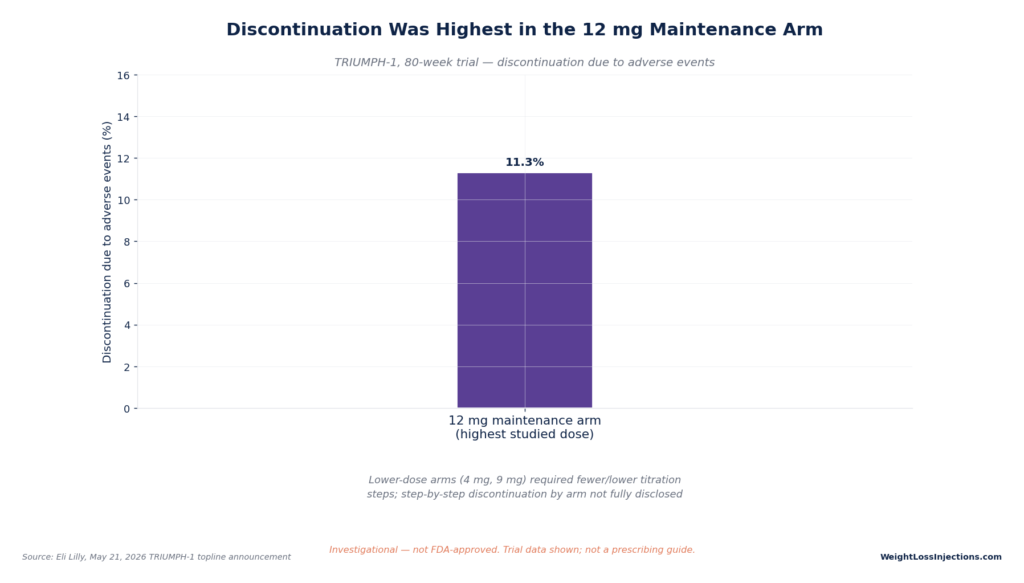
Across the full 80-week trial, 11.3% of participants in the 12 mg arm discontinued treatment due to adverse events — the highest discontinuation rate among the studied maintenance doses. Because the 12 mg arm required passing through more, and higher, titration steps than the 4 mg or 9 mg arms, at least part of this elevated discontinuation rate is plausibly linked to the cumulative titration experience, though Eli Lilly’s public disclosures don’t break discontinuation down step-by-step within the titration period itself.
A Trade-Off Between Speed and Tolerability
The 20-week titration period reflects a deliberate trade-off: a faster escalation schedule might get participants to their full-strength dose sooner, but at the cost of more severe or frequent side effects; a slower schedule improves tolerability but delays the point at which participants experience the full weight-loss effect of their assigned dose. Lilly’s roughly 20-week approach represents its clinical judgment about where that balance sits for a three-receptor molecule — a judgment that will ultimately be reviewed by the FDA as part of the approval process.
This Is a Clinical Trial Protocol, Not a Do-It-Yourself Plan
It bears repeating: everything above describes how dose escalation was structured within a specific, medically supervised clinical trial. TRIUMPH-1 participants received their doses under direct trial oversight, with monitoring for adverse events built into the study design. There is no FDA-approved titration schedule available to the public, no legal source from which to obtain the intermediate doses used in this schedule, and no safe or legal way to replicate this process outside of a registered trial. Retatrutide has no USP/NF monograph and is not legally compoundable, meaning even the lower, early-titration doses cannot be legally obtained through a compounding pharmacy.
Readers who want to understand how titration works for a currently approved drug can review dosing information for tirzepatide or semaglutide, both of which have FDA-reviewed titration schedules included in their approved labeling.
The Only Legal Way to Go Through Retatrutide Titration Today
The only legal route to experience any part of retatrutide’s titration schedule — from the initial ~2 mg dose through the final maintenance level — is enrollment in an authorized clinical trial via ClinicalTrials.gov. Within that setting, dose escalation follows the specific study protocol under direct clinical supervision, not a self-directed schedule.
FAQ
How long is the retatrutide titration period in TRIUMPH-1?
Approximately 20 weeks, starting from a low dose of about 2 mg and increasing gradually to a maintenance dose of 4 mg, 9 mg, or 12 mg depending on trial arm.
Why can’t participants just start at the 12 mg dose?
Gradual dose escalation is used across the incretin drug class to reduce the severity and frequency of gastrointestinal side effects like nausea and vomiting, which tend to be more pronounced when a higher dose is introduced immediately.
When do side effects tend to occur during titration?
Published trial data indicates gastrointestinal side effects were most frequently reported during periods of active dose escalation (step-ups), rather than while participants were on a stable, unchanging dose.
Is there a public, step-by-step retatrutide titration schedule I can follow?
No. Eli Lilly has disclosed the overall duration and dose range of the TRIUMPH-1 titration protocol, but there is no publicly available, patient-usable titration guide, and retatrutide cannot legally be obtained or self-titrated outside of an authorized clinical trial.
Does a longer titration period mean the drug is harder to tolerate than other options?
Not necessarily. A longer titration period is more likely a reflection of retatrutide’s three-receptor mechanism requiring a more gradual introduction, and may actually improve overall tolerability compared to a faster escalation — the goal of titration is to make each step easier, not to signal that the drug is especially difficult to tolerate.
Medical disclaimer: Retatrutide is an investigational drug not approved by the FDA or any other regulatory authority as of July 2026. It is available only through enrollment in authorized clinical trials. This article is for informational purposes only and does not constitute medical advice, endorsement, or a recommendation to obtain retatrutide outside of a registered clinical trial. Speak with your healthcare provider about currently approved weight-loss treatments. Content published by WeightLossInjections.com.