
Key Takeaways
- Retatrutide is investigational and not approved by the FDA or any other regulatory authority as of July 2026 — there is no approved injection product or patient instructions available.
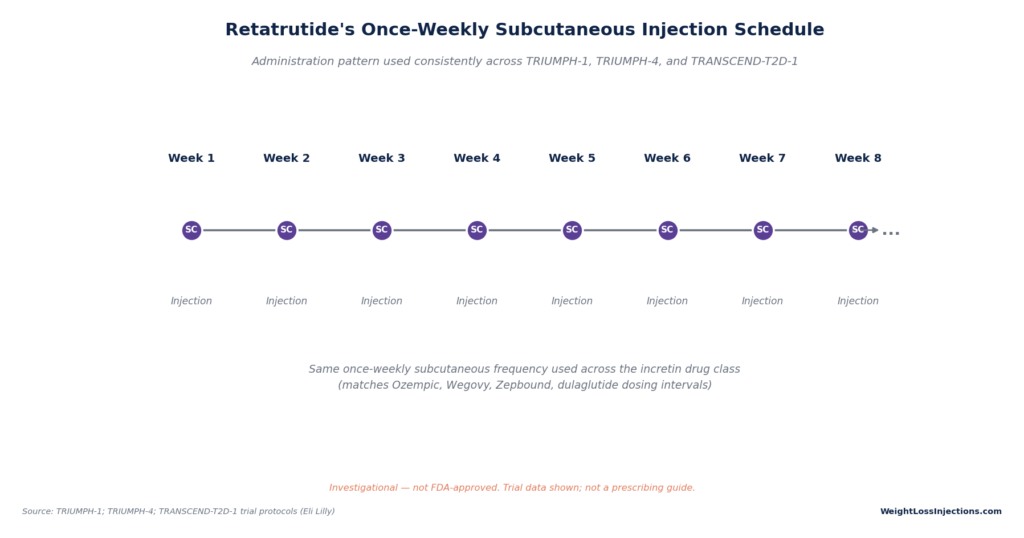
- In every clinical trial conducted so far, retatrutide has been administered as a once-weekly subcutaneous (under-the-skin) injection, the same frequency and route used by approved drugs like Ozempic, Wegovy, and Zepbound.
- Current trials administer retatrutide from vials, not pre-filled pens — commercial launch, if approval occurs, would likely introduce an auto-injector pen similar to those used for approved GLP-1 and dual-agonist drugs.
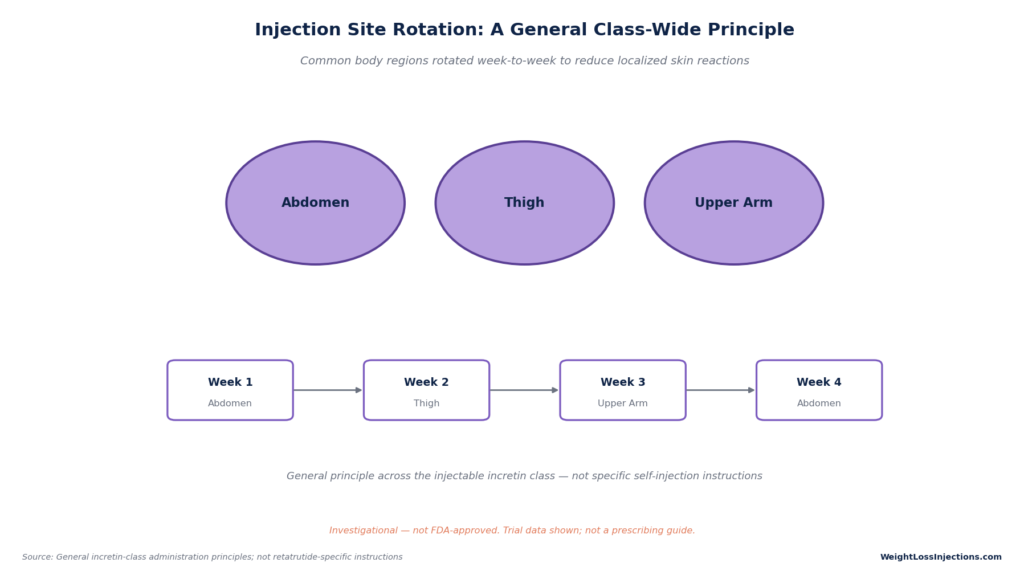
- Subcutaneous injections in this drug class are generally rotated across a small number of general body regions to help minimize injection-site irritation, a principle common across the entire injectable incretin drug category — not specific self-injection instructions.
- This article is educational context about how the drug has been delivered in research settings — it is not a self-injection guide, and retatrutide cannot legally be self-administered outside of a clinical trial.
- The only legal way to receive a retatrutide injection today is through enrollment in an authorized clinical trial.
This article explains administration methods used in clinical research settings. It does not provide instructions for self-administration, and retatrutide is not available for use outside of authorized clinical trials.
Understanding How an Investigational Drug Is Actually Given in Trials
Retatrutide (LY3437943), developed by Eli Lilly, remains investigational and has not been approved by the FDA or any other regulatory authority as of July 2026. Because it has no approved label, there is no official patient-facing administration guide, no FDA-approved delivery device, and no legal route to self-administer it outside of a clinical trial setting. What follows is a description of how retatrutide has been delivered in the research trials conducted so far — useful context for understanding the drug, not a how-to guide.
Every dose of retatrutide given in a clinical trial is administered under a defined study protocol, typically with direct oversight from clinical trial staff, particularly during the early titration period.
Once-Weekly Dosing: Consistent With the Rest of the Drug Class
Across every retatrutide trial reported to date — TRIUMPH-1, TRIUMPH-4, and TRANSCEND-T2D-1 — the drug has been administered once per week. This weekly frequency is a defining feature of the modern incretin-based drug class and is not unique to retatrutide. It matches the dosing interval used by:
- Semaglutide (Ozempic for diabetes, Wegovy for weight management) — once weekly
- Tirzepatide (Zepbound for weight management) — once weekly
- Dulaglutide (used as the active comparator in TRANSCEND-T2D-1) — once weekly
The reason this entire drug class has converged on a once-weekly schedule comes down to pharmacokinetics: these molecules are engineered — often through modifications like fatty acid chains that bind to albumin in the blood — to have a long half-life, meaning the drug clears from the body slowly enough that a single injection maintains therapeutic levels for about seven days. This is what allows patients (in an eventual approved product) to inject once a week rather than daily, as earlier-generation GLP-1 drugs like exenatide once required.
Subcutaneous Route: Injected Under the Skin, Not Into Muscle or Vein
Retatrutide is injected subcutaneously — into the layer of fatty tissue just beneath the skin, rather than into muscle (intramuscular) or directly into a blood vessel (intravenous). Subcutaneous injection is the standard route for this entire drug class because the fatty tissue layer absorbs these large peptide molecules gradually, which is part of what allows the weekly-dosing interval to work as intended.
This is the same general injection route used across approved products in this category, including Ozempic, Wegovy, and Zepbound, all of which are self-injected subcutaneously by patients at home once a prescriber has provided training.
Current Trial Administration: Vials, Not Pens
One detail that differs between retatrutide’s current research use and what patients might expect from an eventual commercial product: retatrutide is currently administered from vials in clinical trials, requiring a separate syringe to draw and administer each dose, rather than a pre-filled, ready-to-use injector pen.
This is a normal characteristic of clinical trial-stage drug development. Pre-filled auto-injector pens — like the ones used for Wegovy and Zepbound — are typically developed and validated later in a drug’s lifecycle, closer to commercial launch, since they require their own manufacturing and regulatory processes separate from the drug substance itself.
What Commercial Packaging Would Likely Look Like
If retatrutide receives FDA approval — anticipated at the earliest in late 2027, based on Eli Lilly’s current regulatory timeline — the commercial product would likely be packaged in a pre-filled auto-injector pen, mirroring the format Eli Lilly already uses for tirzepatide (Zepbound) and that Novo Nordisk uses for semaglutide (Wegovy). This is an industry-standard approach for weekly injectable incretin therapies, designed to simplify at-home administration once a product moves from clinical research into general patient use. However, this is a projection based on industry patterns and Eli Lilly’s existing product lines — the company has not published specific device details for a commercial retatrutide product as of July 2026.
Our Top 3 · October 2026
The best GLP-1 providers right now
Independently reviewed. Ranked by price, medication access, provider quality, and patient outcomes.
Renew GLP
Personalized GLP-1, GIP plans: Semaglutide & Tirzepatide.
Medvi
No membership or hidden fees. Everything you need is included.
Trimi
US-licensed clinicians and shipped to your door, from $99/mo.
Injection Site Rotation: A General Principle Across the Drug Class
Injectable medications given subcutaneously on a recurring weekly basis are generally administered across a small set of general body areas — commonly the abdomen, thigh, or upper arm — with the specific site varying from week to week. This practice, sometimes called site rotation, is a general principle used across the entire injectable incretin category (including approved drugs like Ozempic and Wegovy) to help reduce the likelihood of localized skin reactions or tissue changes from repeated injections in the exact same spot.
This is mentioned here only as general background on how this class of injectable drug is typically handled — it is not instructional guidance for administering retatrutide, which cannot legally be self-injected outside of a clinical trial protocol. Within trials, injection site selection and rotation follow the specific study protocol and are typically guided by clinical trial staff.
How Once-Weekly Dosing Changed the Injectable Weight-Loss Category
It’s worth appreciating why once-weekly dosing became the industry standard, since it directly shapes what an eventual retatrutide product would look like. Earlier-generation injectable diabetes drugs, including the first GLP-1 receptor agonists brought to market in the mid-2000s, required daily or even twice-daily injections. That frequency created a meaningful adherence burden — patients had to remember and tolerate an injection every single day, indefinitely.
The development of long-acting formulations — often using fatty-acid side chains that bind reversibly to albumin, a protein abundant in blood plasma — allowed these molecules to be released slowly into circulation over roughly a week instead of clearing within hours. This pharmacological advance is what enabled once-weekly dosing across the modern incretin drug class, from semaglutide to tirzepatide to retatrutide. Fewer required injections per month is generally associated with better long-term adherence in chronic, self-administered therapies, which is part of why once-weekly dosing has become the default expectation for any new entrant in this category, including an eventual approved retatrutide product.
How Retatrutide’s Schedule Compares Across Its Own Trial Program
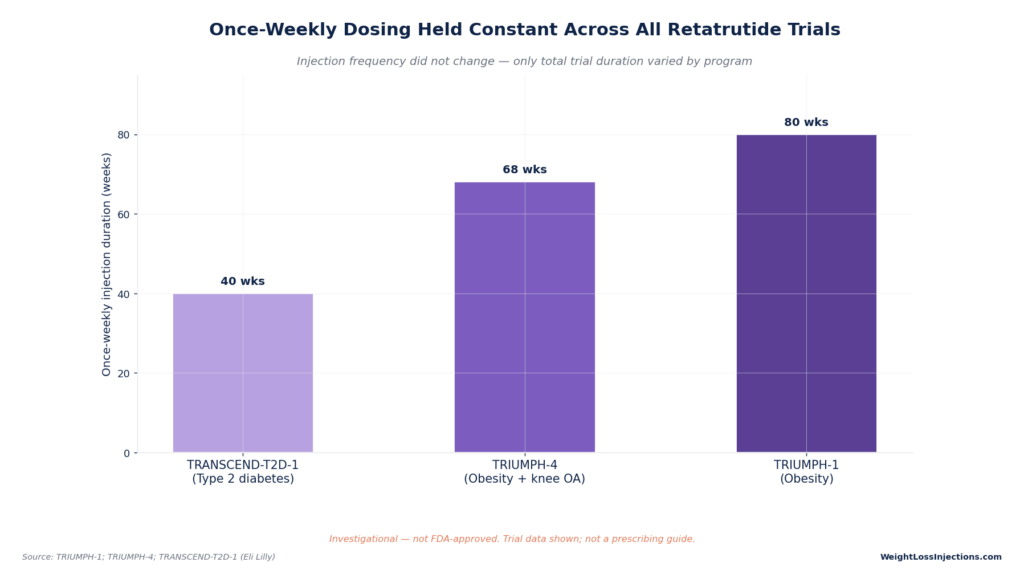
Although the injection frequency has been consistent at once weekly across retatrutide’s clinical program, the specific trials have varied somewhat in duration and design, which is useful context for understanding how much real-world weekly-injection experience the data actually represents:
- TRIUMPH-1 (obesity, no diabetes): 80 weeks of once-weekly dosing, with a 104-week extension phase
- TRIUMPH-4 (obesity plus knee osteoarthritis): 68 weeks of once-weekly dosing
- TRANSCEND-T2D-1 (type 2 diabetes): 40 weeks of once-weekly dosing, compared against once-weekly dulaglutide
Across all three trials, the weekly interval itself did not change — only the total trial duration and the specific maintenance dose reached did. This consistency is one of the more straightforward aspects of retatrutide’s clinical profile, even though other elements, like exact titration steps, differ somewhat by trial and have not been fully detailed in public disclosures.
Why There’s No Patient Injection Guide for Retatrutide Yet
Approved drugs like Wegovy and Zepbound come with FDA-reviewed patient instructions — including exact injection technique, needle handling, and storage requirements — because the FDA has evaluated and approved the specific device and instructions as part of the drug’s label. Retatrutide has no such approved label, meaning no official, patient-facing injection instructions exist, and any injection information available online outside of registered trial materials should be treated with caution. Providing self-injection instructions for an unapproved drug would be inappropriate and is not the purpose of this article.
The Only Legal Way to Receive a Retatrutide Injection Today
Retatrutide cannot be purchased from a pharmacy, ordered through a telehealth platform, or obtained from a compounding pharmacy — it has no USP/NF monograph and was not part of the FDA’s April 2026 peptide reclassification. The only legal way to receive a retatrutide injection, on any schedule, is enrollment in an authorized clinical trial through ClinicalTrials.gov, where all administration is handled according to the study protocol and clinical oversight.
Readers interested in currently approved once-weekly injectable options can learn more about tirzepatide and semaglutide-based treatments, both of which have FDA-approved administration instructions available today.
FAQ
How often is retatrutide injected in clinical trials?
Once weekly, matching the dosing frequency of approved drugs in the same class, including semaglutide and tirzepatide.
Is retatrutide injected into a vein or muscle?
No. Like other approved GLP-1 and dual-agonist drugs, retatrutide is injected subcutaneously — into the fatty tissue layer beneath the skin.
Will retatrutide come in a pen like Wegovy or Zepbound?
Current clinical trials use vials, not pens. If retatrutide is approved, a pre-filled auto-injector pen is the likely commercial format based on industry patterns, though Eli Lilly has not confirmed specific device details as of July 2026.
Can I learn how to self-inject retatrutide from this article?
No. This article provides general educational background on how the drug has been administered in research settings. It is not a self-injection guide, and retatrutide cannot legally be self-administered outside of an authorized clinical trial.
How can I receive a retatrutide injection legally?
The only legal access route is enrollment in an authorized clinical trial. You can search current studies at ClinicalTrials.gov.
Medical disclaimer: Retatrutide is an investigational drug not approved by the FDA or any other regulatory authority as of July 2026. It is available only through enrollment in authorized clinical trials. This article is for informational purposes only and does not constitute medical advice, endorsement, or a recommendation to obtain retatrutide outside of a registered clinical trial. Speak with your healthcare provider about currently approved weight-loss treatments. Content published by WeightLossInjections.com.