Key Takeaways
- Retatrutide is investigational and not approved by the FDA or any other regulatory authority as of July 2026 — there is no legal prescription dose because there is no approved product.
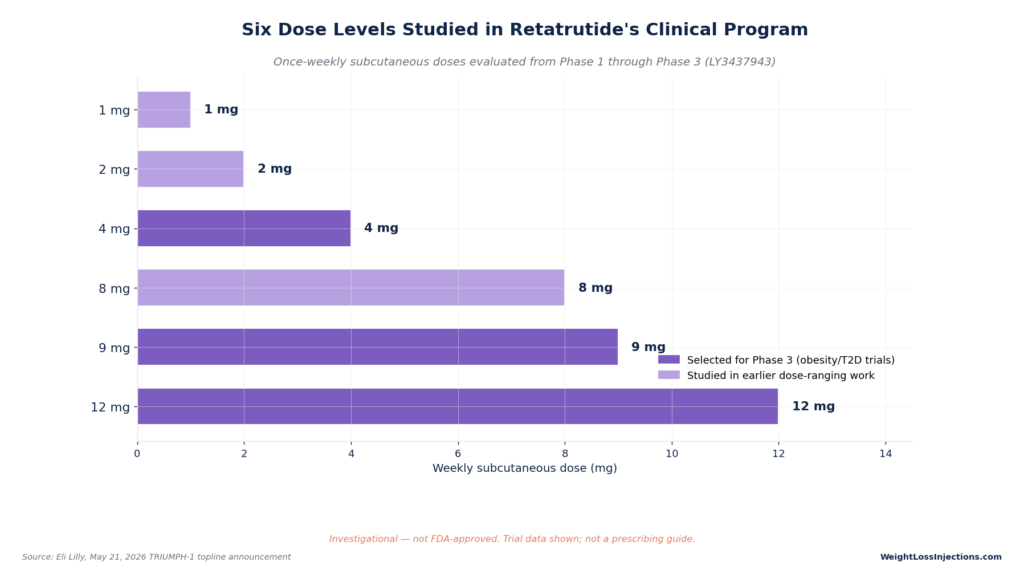
- Across Eli Lilly’s clinical development program, researchers studied six dose levels: 1 mg, 2 mg, 4 mg, 8 mg, 9 mg, and 12 mg, administered once weekly by subcutaneous injection.
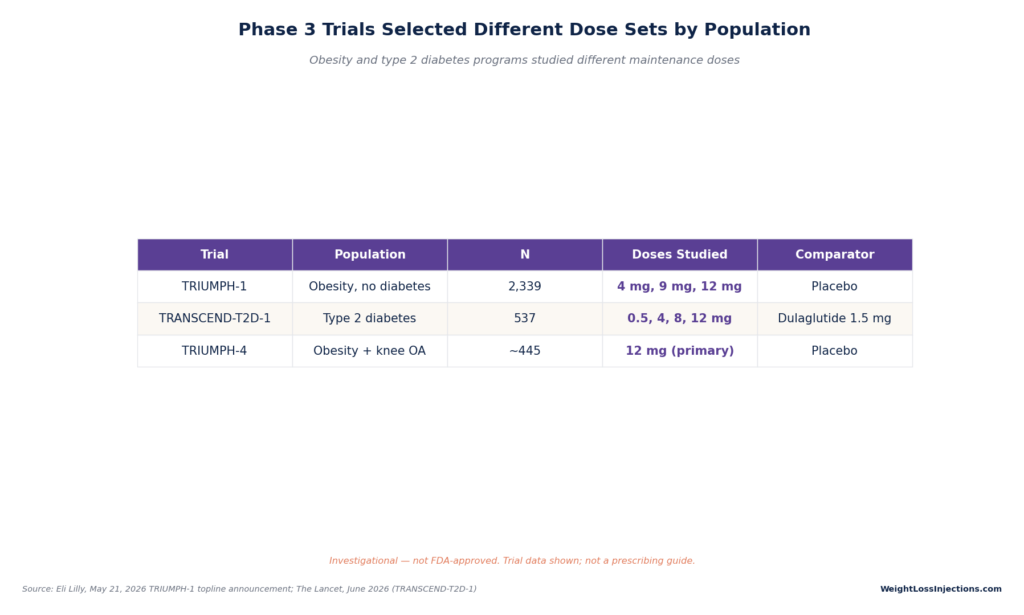
- Phase 3 obesity trials (TRIUMPH-1) tested three maintenance doses — 4 mg, 9 mg, and 12 mg — while the Phase 3 type 2 diabetes trial (TRANSCEND-T2D-1) tested 0.5 mg, 4 mg, 8 mg, and 12 mg.
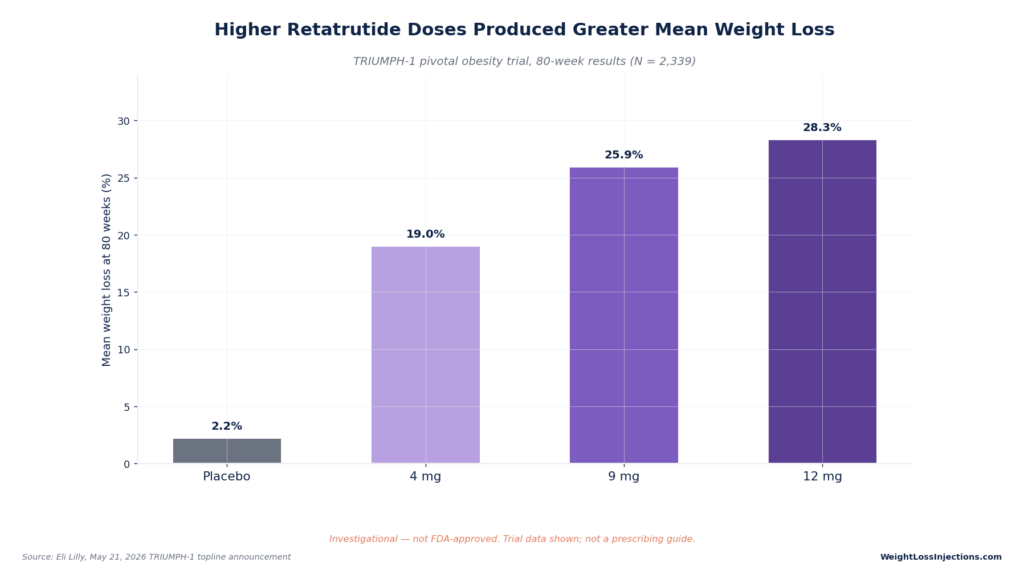
- In TRIUMPH-1, mean weight loss rose with dose: 19.0% at 4 mg, 25.9% at 9 mg, and 28.3% at 12 mg over 80 weeks, compared with 2.2% on placebo.
- Higher doses produced greater average weight loss but also more gastrointestinal side effects and a higher discontinuation rate — meaning the “best” dose in a trial setting is not automatically the right dose for every individual.
- The only legal way to receive retatrutide today is through enrollment in an authorized clinical trial listed on ClinicalTrials.gov.
This article discusses doses studied in clinical trials for research and educational purposes. It is not a prescribing guide, and nothing here should be interpreted as a recommended dose for any individual.
Retatrutide Is Not an Approved Drug: So There Is No “Approved Dose”
Before looking at any numbers, it’s important to understand what those numbers actually represent. Retatrutide (developer code LY3437943) is an investigational drug that has not been approved by the FDA, the European Medicines Agency, or any other regulatory body as of July 2026. It has no brand name, no FDA-approved label, and no legally prescribable dose. Every dose discussed in this article is a research dose — a quantity that Eli Lilly’s scientists selected for study in a specific clinical trial protocol, not a recommendation for use outside that trial.
This distinction matters because dosing information for approved drugs like semaglutide (Ozempic, Wegovy) or tirzepatide (Zepbound) comes from an FDA-reviewed label that a licensed prescriber can legally follow. Retatrutide has no such label. The only legal access point for retatrutide today is enrollment in an active clinical trial through ClinicalTrials.gov, where dosing is determined entirely by the study protocol and administered under direct medical supervision.
The Six Doses Studied in Clinical Development
Across Eli Lilly’s retatrutide program — from early Phase 1 work through the ongoing TRIUMPH and TRANSCEND Phase 3 trials — researchers have evaluated six distinct dose levels of once-weekly subcutaneous retatrutide:
- 1 mg
- 2 mg
- 4 mg
- 8 mg
- 9 mg
- 12 mg
Not every trial tested every dose. Early-phase studies used a broader range to characterize the drug’s dose-response relationship — essentially, to map out how much weight loss and glucose-lowering effect could be expected at each level, and at what point side effects became limiting. That dose-ranging work informed which specific doses moved forward into Phase 3.
Our Top 3 · October 2026
The best GLP-1 providers right now
Independently reviewed. Ranked by price, medication access, provider quality, and patient outcomes.
Renew GLP
Personalized GLP-1, GIP plans: Semaglutide & Tirzepatide.
Medvi
No membership or hidden fees. Everything you need is included.
Trimi
US-licensed clinicians and shipped to your door, from $99/mo.
Why Phase 3 Trials Selected Different Doses for Obesity vs. Diabetes
Once a drug moves into Phase 3, sponsors typically narrow the dose range to the levels most likely to show a favorable balance of efficacy and tolerability in the target population. Retatrutide’s two major Phase 3 programs selected different dose sets because they were designed to answer different clinical questions.
Obesity: TRIUMPH-1 Tested 4 mg, 9 mg, and 12 mg
The pivotal obesity trial, TRIUMPH-1, enrolled 2,339 adults with obesity and no diabetes and studied three maintenance doses: 4 mg, 9 mg, and 12 mg, each reached through a gradual titration period rather than starting at the target dose (Eli Lilly, May 21, 2026 topline announcement). This three-dose design let researchers directly compare a lower, middle, and higher maintenance dose against placebo over 80 weeks, generating a clear dose-response curve for weight loss.
Type 2 Diabetes: TRANSCEND-T2D-1 Tested 0.5 mg, 4 mg, 8 mg, and 12 mg
The Phase 3 diabetes trial, TRANSCEND-T2D-1, used a different dose set — 0.5 mg, 4 mg, 8 mg, and 12 mg — compared against dulaglutide 1.5 mg as an active comparator in 537 adults with type 2 diabetes inadequately controlled by diet and exercise (The Lancet, June 2026). The inclusion of a very low 0.5 mg dose reflects a diabetes-specific consideration: people with type 2 diabetes can be more sensitive to rapid changes in insulin and glucagon signaling, so researchers wanted data across a wider low-dose range to understand glucose-lowering effects at gentler starting points.
The difference between the obesity and diabetes dose sets illustrates a broader principle in drug development: the “right” doses to study depend on the population and the outcome being measured, not a single fixed number.
Efficacy by Dose: What TRIUMPH-1 Showed
The clearest picture of retatrutide’s dose-response relationship for weight loss comes from TRIUMPH-1’s 80-week results. Mean weight loss increased at each higher dose studied:
| Dose | Mean Weight Loss (80 weeks) |
|---|---|
| Placebo | 2.2% |
| 4 mg | 19.0% |
| 9 mg | 25.9% |
| 12 mg | 28.3% |
At the highest studied dose, 12 mg, 45.3% of participants lost 30% or more of their body weight — a magnitude of weight loss that begins to approach outcomes historically associated with bariatric surgery (Eli Lilly, May 21, 2026). The 104-week extension data, published alongside the primary results in the New England Journal of Medicine, showed weight loss continuing to climb to a mean of 30.3% at two years, indicating that the effect had not plateaued by 80 weeks (NEJM, Jastreboff et al., 2026).
This dose-response pattern — more weight loss at higher doses — is consistent with what has been observed in other incretin-based therapies, including tirzepatide trials, but the magnitude at retatrutide’s top dose is notably larger than anything reported for approved single- or dual-agonist drugs to date.
Why Higher Doses Aren’t Automatically Better for Every Patient
A dose-response curve showing “more drug, more weight loss” can create a misleading impression that everyone should aim for the highest dose. Clinical trial data tells a more nuanced story.
Tolerability Declines as Dose Increases
The most common adverse events reported across retatrutide trials — nausea, vomiting, diarrhea, and constipation — are typical of the broader incretin-mimetic drug class that also includes semaglutide and tirzepatide. These gastrointestinal effects were more frequent at higher doses, particularly during the periods when the dose was being increased (TRIUMPH-1 safety data, Eli Lilly).
Discontinuation Was Highest at the Top Dose
In TRIUMPH-1, 11.3% of participants in the 12 mg arm discontinued treatment due to adverse events, a higher rate than in the lower-dose arms. This doesn’t mean 12 mg is unsafe for most people who tolerated it well — the majority did — but it does mean that a meaningful minority of participants could not sustain the highest studied dose long enough to complete the trial protocol.
A Unique Signal: Dysesthesia
Retatrutide’s trials have also reported dysesthesia — an altered or unusual skin sensation — in roughly 2.3% to 4.5% of participants, most cases mild. Researchers believe this may be linked to activation of the glucagon receptor, the third receptor target that distinguishes retatrutide from dual and single agonists. This side effect has not been prominently reported with GLP-1-only drugs like Ozempic or Wegovy, suggesting it may be tied specifically to retatrutide’s expanded mechanism.
The Takeaway on Dose Selection
In an eventual approved product, dose selection for an individual patient would be a decision made by a licensed prescriber, weighing expected benefit against tolerability, other health conditions, and patient preference — exactly as happens today with approved GLP-1 and dual-agonist medications. Nothing in the published trial data suggests that 12 mg is the “right” dose for everyone, nor that lower doses are inadequate; the data instead shows a spectrum of outcomes across a spectrum of doses.
The Only Legal Way to Access Any Retatrutide Dose Today
Because retatrutide remains investigational, there is no pharmacy, telehealth platform, or compounding source that can legally dispense it in the United States. It has no USP/NF monograph and was not included in the FDA’s April 2026 peptide reclassification, meaning compounded retatrutide is not a legal option regardless of how it is marketed. The only legal route to receive any dose of retatrutide — at any level, for any condition — is enrollment in an active, authorized clinical trial through ClinicalTrials.gov, where dosing follows a fixed protocol under direct medical supervision.
For readers interested in currently approved options while retatrutide moves through regulatory review, tirzepatide-based treatments and semaglutide options remain the closest analogues with FDA-reviewed dosing labels.
FAQ
Is there a recommended retatrutide dose?
No. Retatrutide is not FDA-approved, so there is no recommended or prescribable dose. The doses discussed in this article — 1 mg through 12 mg — are research doses studied in clinical trials, not clinical recommendations.
What is the highest dose of retatrutide studied?
The highest dose studied in Phase 3 trials is 12 mg once weekly, which produced the greatest mean weight loss (28.3% at 80 weeks in TRIUMPH-1) but also the highest discontinuation rate among the doses tested.
Why did the diabetes trial use a lower starting dose (0.5 mg) than the obesity trial?
TRANSCEND-T2D-1 included a 0.5 mg dose to generate data across a broader low-dose range in people with type 2 diabetes, a population that can be sensitive to changes in insulin and glucagon signaling. The obesity trial, TRIUMPH-1, started its comparison at 4 mg.
Does a higher dose always mean more weight loss?
In the trial data reported so far, mean weight loss did increase with each higher dose studied (4 mg, 9 mg, 12 mg). However, individual responses vary, and higher doses were also associated with more gastrointestinal side effects and higher discontinuation rates.
How can I access retatrutide at any dose right now?
The only legal access route is enrollment in an authorized clinical trial. You can search current studies at ClinicalTrials.gov. Retatrutide is not available through pharmacies, telehealth services, or compounding pharmacies.
Medical disclaimer: Retatrutide is an investigational drug not approved by the FDA or any other regulatory authority as of July 2026. It is available only through enrollment in authorized clinical trials. This article is for informational purposes only and does not constitute medical advice, endorsement, or a recommendation to obtain retatrutide outside of a registered clinical trial. Speak with your healthcare provider about currently approved weight-loss treatments. Content published by WeightLossInjections.com.