
Key Takeaways
- Retatrutide has no official price because it is investigational and not yet FDA-approved — any number you see online is an estimate, not a confirmed list price.
- Analysts project a monthly list price in the $1,300–$1,600 range, based on benchmarking against comparable drugs.
- Current 2026 list prices for comparable injectables are $1,349/month for both Zepbound (tirzepatide) and Wegovy (semaglutide).
- Manufacturer savings cards and commercial coupon programs, similar to those Eli Lilly and Novo Nordisk offer today, are expected to accompany any retatrutide launch.
- The gap between list price and what patients actually pay will depend heavily on insurance coverage — a topic covered in depth in our companion article on retatrutide insurance coverage.
Retatrutide Is Not Yet Priced: Here’s Why That Matters
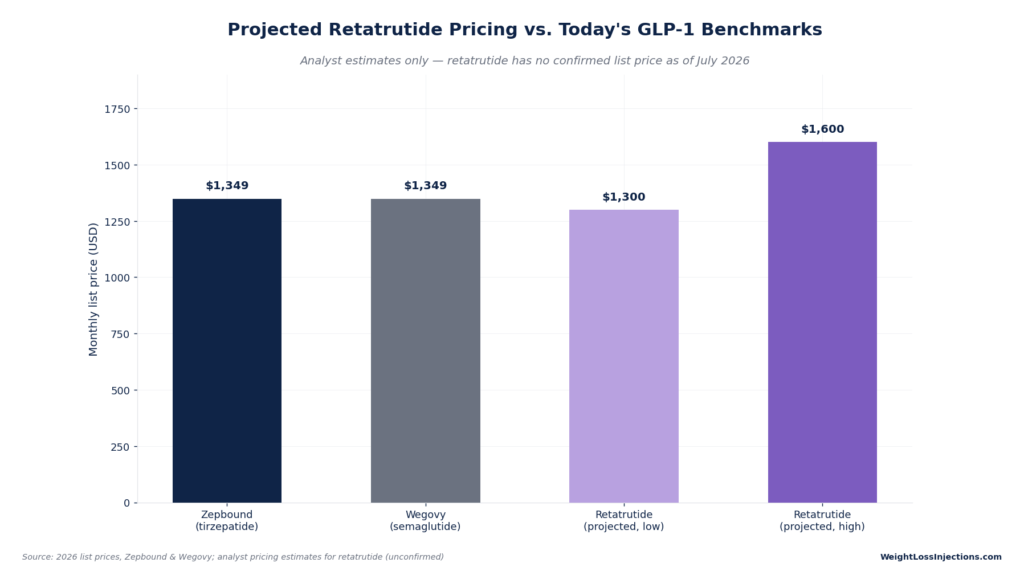
Retatrutide (developer code LY3437943), developed by Eli Lilly and Company, is investigational and not approved by the FDA as of July 2026. Pharmaceutical companies do not set list prices for drugs until they are much closer to approval and commercial launch — typically within months of an FDA decision. That means any specific dollar figure circulating online right now, including the projections in this article, is an estimate based on market benchmarking, not a confirmed price.
This article exists to give you a realistic, evidence-based sense of what retatrutide might cost once it launches — using the pricing history of comparable GLP-1 drugs as the foundation — while being clear that no price has been set. Retatrutide is currently available only through enrollment in an authorized clinical trial, where the investigational drug and monitoring are provided as part of the study protocol, not sold at a market price. See our guide to joining a retatrutide clinical trial for details on that pathway.
The Benchmark: What Comparable Drugs Cost Today
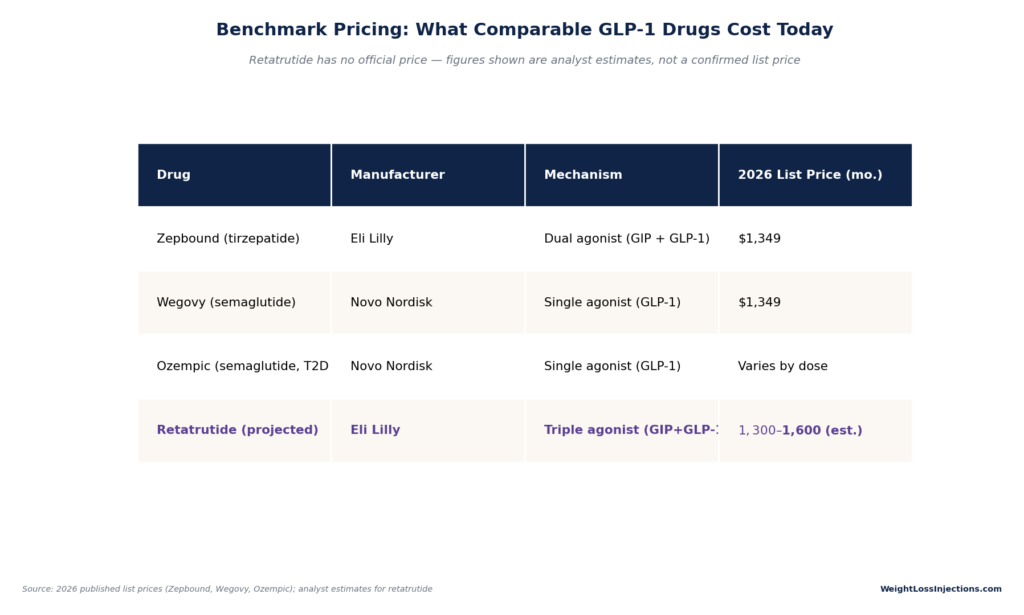
The most reliable way to estimate retatrutide’s future price is to look at what Eli Lilly and Novo Nordisk currently charge for their approved GLP-1-class weight-loss injectables.
| Drug | Manufacturer | Mechanism | 2026 List Price (per month) |
|---|---|---|---|
| Zepbound (tirzepatide) | Eli Lilly | Dual agonist (GIP + GLP-1) | $1,349 |
| Wegovy (semaglutide) | Novo Nordisk | Single agonist (GLP-1) | $1,349 |
| Ozempic (semaglutide, diabetes label) | Novo Nordisk | Single agonist (GLP-1) | Varies by dose; comparable list pricing |
| Retatrutide (projected) | Eli Lilly | Triple agonist (GIP + GLP-1 + glucagon) | $1,300–$1,600 (estimated) |
Notice that Zepbound and Wegovy — despite coming from different manufacturers and using different mechanisms — currently converge on nearly identical list prices. This suggests that list pricing in this category is driven less by the specific molecule and more by what the market and payers are willing to bear for this class of drug overall.
Why Analysts Expect $1,300–$1,600 Per Month
Retatrutide’s projected pricing sits in a similar band to Zepbound and Wegovy for several reasons:
1. It’s the Same Manufacturer as Zepbound
Eli Lilly already has commercial infrastructure, payer contracts, and pricing precedent in place for tirzepatide. Retatrutide is highly likely to be positioned within the same general pricing architecture rather than a radically different one.
2. Superior Efficacy Could Support a Premium
In the pivotal TRIUMPH-1 trial, described in Eli Lilly’s May 21, 2026 press release, the 12 mg dose produced average weight loss of 28.3% — meaningfully higher than tirzepatide’s ~22.5% in SURMOUNT-1 and semaglutide’s ~14.9% in STEP-1. Manufacturers have historically priced more effective next-generation drugs at or slightly above prior-generation list prices, rather than dramatically higher, in part because payers push back hard against premium pricing in this category.
3. Competitive and Payer Pressure Cuts Both Ways
By the time retatrutide potentially launches in Q1–Q2 2028, the GLP-1 weight-loss market will include Zepbound, Wegovy, oral GLP-1 formulations, and possibly other new entrants. That competitive landscape — plus continued political and insurer pressure to lower GLP-1 prices — makes it unlikely that Eli Lilly would price meaningfully above the current $1,349 benchmark, even with superior trial results.
Our Top 3 · September 2026
The best GLP-1 providers right now
Independently reviewed. Ranked by price, medication access, provider quality, and patient outcomes.
Renew GLP
Personalized GLP-1, GIP plans: Semaglutide & Tirzepatide.
Medvi
No membership or hidden fees. Everything you need is included.
Trimi
US-licensed clinicians and shipped to your door, from $99/mo.
Self-Pay vs. Insurance: Lessons From Prior GLP-1 Launches
History offers a useful pattern for what to expect when retatrutide launches, based on how Zepbound and Wegovy rolled out:
Early Launch Period: Mostly Self-Pay or Limited Coverage
When Zepbound launched in late 2023, most insurance plans had not yet added it to their formularies, and many patients paid out of pocket or used manufacturer savings cards. Broad insurance coverage typically lags 6–18 months behind a drug’s approval, as payers evaluate cost-effectiveness data and negotiate formulary placement.
Manufacturer Savings Programs Fill the Gap
Both Eli Lilly (with Zepbound) and Novo Nordisk (with Wegovy) introduced savings card programs that significantly reduced out-of-pocket costs for commercially insured patients, and self-pay/cash-price options for uninsured or underinsured patients at a reduced rate relative to list price. If retatrutide follows this pattern, expect Eli Lilly to launch a comparable savings card and/or self-pay program alongside commercial availability.
Coverage Expands Gradually
Over time, as real-world outcomes and cost-effectiveness data accumulate, more employer health plans and insurers add coverage — often with prior authorization requirements tied to BMI thresholds or documented comorbidities. Our companion article on retatrutide insurance coverage covers this dynamic in depth, including how Medicare and Medicaid factor in.
How Manufacturer Pricing Strategy Could Shape Retatrutide’s Launch Price
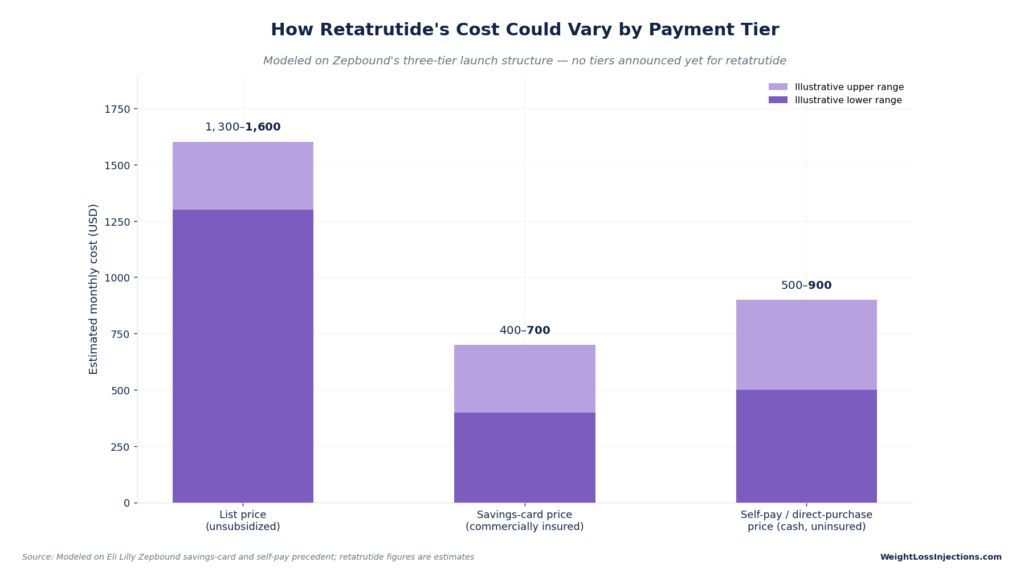
Eli Lilly’s pricing decisions for retatrutide will likely be shaped by lessons learned from the Zepbound launch. When Zepbound launched in late 2023, Eli Lilly introduced a tiered savings-card structure that offered steep discounts to commercially insured patients and a separate, lower self-pay price for cash-paying patients purchasing through Lilly’s direct-to-consumer pharmacy channel. That self-pay channel — which bypassed traditional pharmacy benefit managers — proved popular enough that Lilly expanded it over time to include additional dose strengths and vial-based options priced below the branded pen list price.
If retatrutide follows this same playbook, expect a multi-tiered pricing structure rather than a single flat number:
- A list price (the official, unsubsidized price used for insurance billing), likely in the $1,300–$1,600/month range analysts currently project
- A savings-card price for commercially insured patients with at least partial coverage, similar to the reduced copay programs Lilly and Novo Nordisk currently offer for Zepbound and Wegovy
- A self-pay or direct-purchase price for uninsured or underinsured patients, potentially lower than the list price, following the precedent Lilly set with Zepbound’s direct-to-consumer vial program
None of these tiers have been announced for retatrutide, and none will be until much closer to its projected Q1–Q2 2028 launch window. But the existence of this now-standard three-tier structure across the GLP-1 category gives useful context for what “cost” will likely mean in practice: not one number, but a range depending on insurance status and how the drug is purchased.
What Could Push the Price Higher or Lower
Factors that could push retatrutide’s price higher:
- Manufacturing complexity tied to a novel triple-receptor molecule
- Strong early demand outpacing supply, as seen with Zepbound and Wegovy shortages in 2023–2024
- Premium positioning if retatrutide receives priority review and launches with limited direct competition in the triple-agonist category
Factors that could push it lower:
- Political and public pressure on GLP-1 pricing, including scrutiny from lawmakers and payers
- Competing pipeline drugs (oral GLP-1s, other triple agonists in development) reaching the market around the same time
- Medicare and Medicaid negotiation dynamics affecting the broader weight-loss drug category
What This Means for You Today
Because retatrutide has no confirmed price and no FDA approval, there is nothing to purchase yet — and no legitimate source, including online peptide sellers or compounding pharmacies, can legally sell it. Retatrutide has no USP/NF compounding monograph and was excluded from the FDA’s 2026 compounding reclassification, so 503A and 503B pharmacies are not permitted to prepare it under any circumstance. If cost is a major concern for you, it may be worth exploring currently approved and priced options like tirzepatide-based Zepbound or semaglutide-based Ozempic and Wegovy, which already have established savings programs and expanding insurance coverage. For background on retatrutide’s mechanism and trial results, see our foundational retatrutide guide.
Frequently Asked Questions
How much will retatrutide cost per month?
No official price exists yet. Based on comparable drugs, analysts project a list price somewhere between $1,300 and $1,600 per month, similar to Zepbound and Wegovy’s current $1,349/month list price. This is an estimate, not a confirmed figure.
Will retatrutide be cheaper or more expensive than Zepbound?
It’s not yet known. Given that Eli Lilly manufactures both drugs and faces similar payer and competitive pressures, most analysts expect retatrutide’s list price to land in a similar range to Zepbound’s current $1,349/month rather than dramatically higher or lower.
Can I get retatrutide for free or at a discount right now?
No. Because retatrutide is not FDA-approved, there are no commercial savings cards, coupons, or discount programs for it yet. The only way to receive retatrutide before approval is through a clinical trial, where the study drug is typically provided at no cost as part of the research protocol.
Will insurance cover retatrutide when it launches?
That depends on the payer and typically takes time to develop after approval. See our detailed breakdown in Will Insurance Cover Retatrutide? for what to expect based on how Zepbound and Wegovy coverage evolved.
Why doesn’t retatrutide have a price yet?
Drug manufacturers set list prices close to their commercial launch date, not during clinical trials. Since retatrutide isn’t expected to launch until Q1–Q2 2028 at the earliest, pricing details likely won’t be finalized until shortly before then.
Medical disclaimer: Retatrutide is an investigational drug not approved by the FDA or any other regulatory authority as of July 2026. It is available only through enrollment in authorized clinical trials. This article is for informational purposes only and does not constitute medical advice, endorsement, or a recommendation to obtain retatrutide outside of a registered clinical trial. Speak with your healthcare provider about currently approved weight-loss treatments. Content published by WeightLossInjections.com.