Key Takeaways
- All three oral GLP-1s — Foundayo (orforglipron), the Wegovy pill (oral semaglutide 25 mg), and Rybelsus (oral semaglutide 3/7/14 mg) — do not require refrigeration, a major logistical advantage over injectable GLP-1 pens.
- TSA allows prescription medications, including pills, in carry-on luggage; keeping them in original labeled packaging and carrying a copy of the prescription can smooth security screening.
- Crossing time zones complicates morning-dose, fasting-dependent drugs (Rybelsus and the Wegovy pill) more than it complicates Foundayo, which has no timing restrictions.
- Missed doses while traveling should generally be handled the same way they’d be handled at home — never double up without checking with a prescriber first.
- International travel requires planning around prescription documentation, since customs and pharmacy rules vary by country.
Why Oral GLP-1s Are Genuinely Easier to Travel With
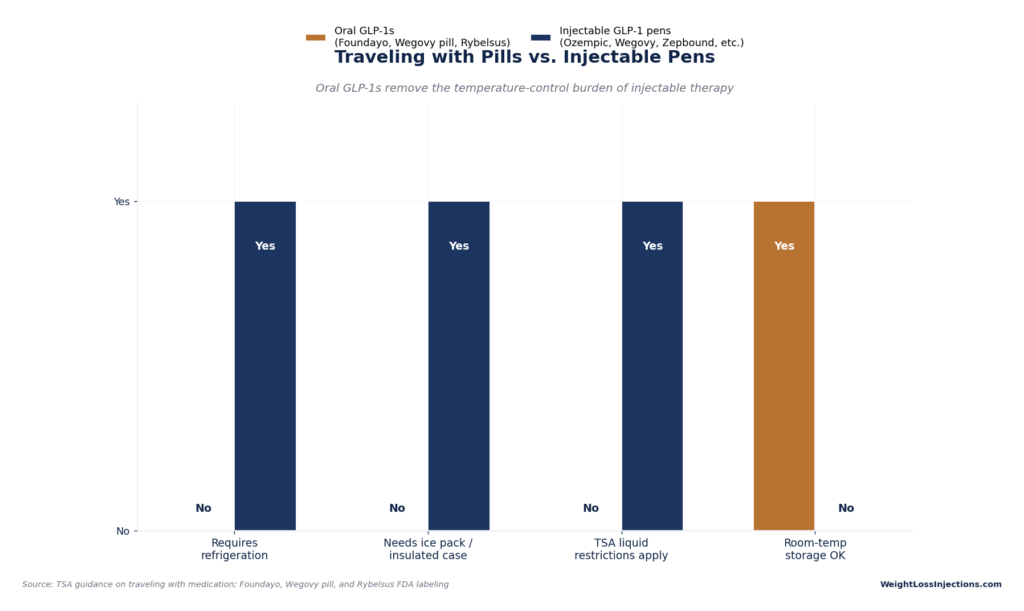
One of the most underrated advantages of oral GLP-1 medications over injectable options like Ozempic, Wegovy, Mounjaro, or Zepbound is what happens when a suitcase gets packed. Injectable GLP-1 pens generally need to be kept cold — either refrigerated before first use or protected from excessive heat during a room-temperature use window — which means insulated travel cases, ice packs, and constant vigilance about temperature exposure at airports, in hot cars, or during long transit days.
None of the three currently approved oral GLP-1s — Foundayo (orforglipron), the Wegovy pill, or Rybelsus — require refrigeration. They can be stored at room temperature, which removes an entire category of travel planning that injectable users have to manage. This is one of the more practical reasons some patients and prescribers consider oral options attractive for people who travel frequently, whether for business or leisure.
Packing Your Oral GLP-1 for a Trip
Because oral GLP-1s don’t need refrigeration, packing is straightforward, but a few general best practices apply to any prescription medication:
- Keep it in original packaging. Pills in their original blister packs or pharmacy-labeled bottles are easier to identify at security checkpoints and if questioned by customs officials abroad.
- Pack enough for the entire trip, plus a buffer. Bringing a few extra days’ supply protects against travel delays, lost luggage, or an unexpectedly extended trip.
- Split doses across bags when possible. Keeping a few days’ supply in a carry-on, separate from checked luggage, protects against the possibility of lost or delayed checked bags.
- Bring a copy of the prescription or a note from the prescriber. This isn’t required for TSA screening within the U.S. but can be useful documentation, especially for international travel.
Going Through TSA Security
The Transportation Security Administration permits prescription medications, including pills and tablets, in carry-on bags. There’s no need to declare oral medications separately at the checkpoint the way liquid injectable medications sometimes require, since solid oral tablets aren’t subject to the same liquid-volume restrictions. That said, a few practical tips can make screening smoother:
- Keep pills in their original prescription bottle or blister packaging with the pharmacy label visible, in case a TSA officer has questions.
- If traveling with a large supply (for example, several months’ worth for an extended trip), having supporting documentation like a prescription printout can help avoid questions.
- Declare any medication if directly asked by a TSA officer — do not attempt to conceal medications, which can create unnecessary complications.
Because oral GLP-1s don’t need to be kept cold, there’s no need for the insulated pouches or ice packs that injectable GLP-1 travelers typically bring through security, which can simplify the screening process.
Our Top 3 · September 2026
The best GLP-1 providers right now
Independently reviewed. Ranked by price, medication access, provider quality, and patient outcomes.
Renew GLP
Personalized GLP-1, GIP plans: Semaglutide & Tirzepatide.
Medvi
No membership or hidden fees. Everything you need is included.
Trimi
US-licensed clinicians and shipped to your door, from $99/mo.
Crossing Time Zones: A Bigger Deal for Fasting-Dependent Pills
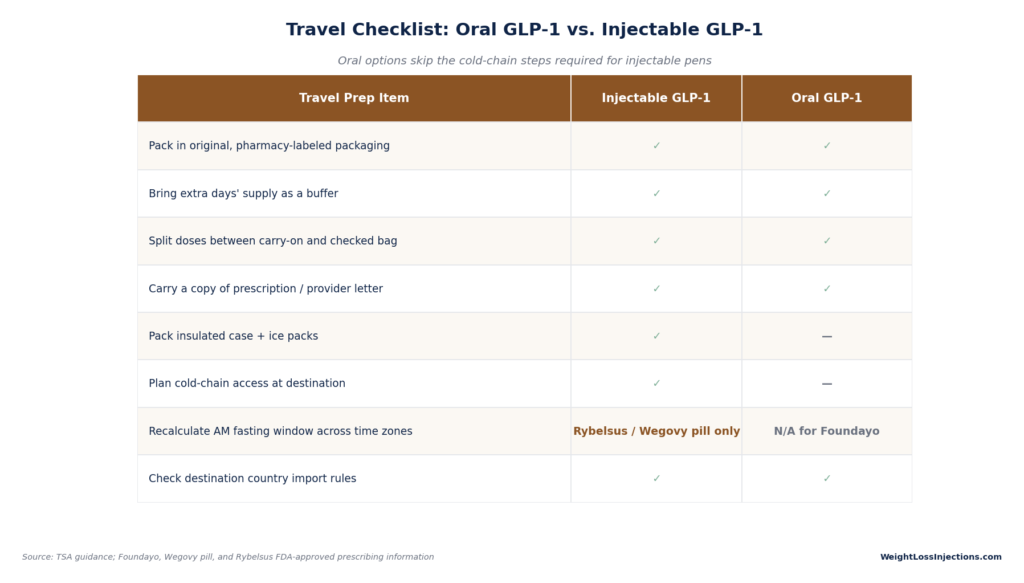
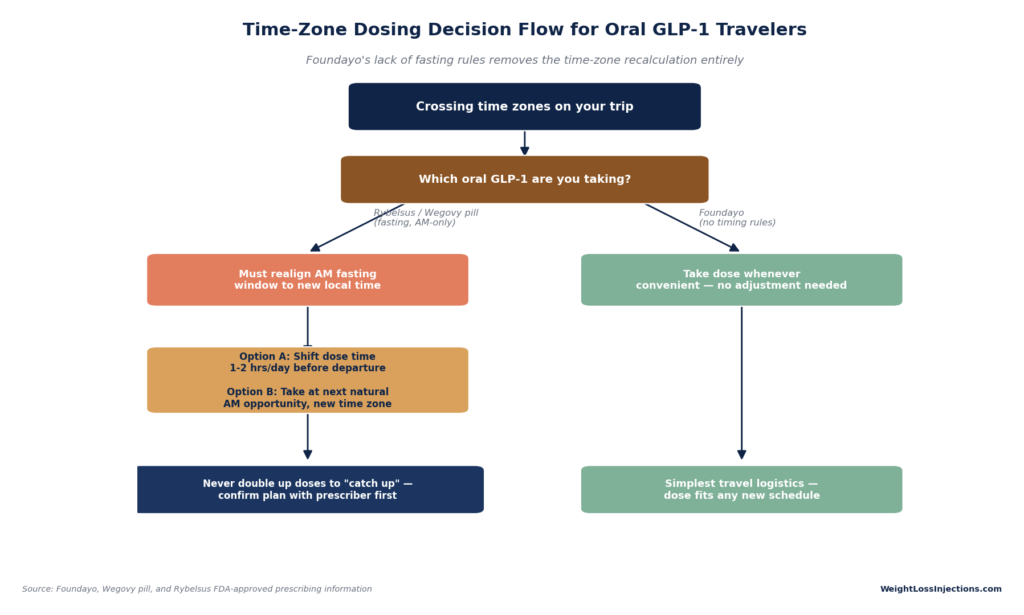
Time zone changes create a genuinely different challenge depending on which oral GLP-1 someone takes. Rybelsus and the Wegovy pill must be taken first thing in the morning, on an empty stomach, per their FDA labels — a rule that gets complicated when “morning” suddenly shifts by several hours due to time zone travel. Someone flying from the U.S. East Coast to Europe, for example, effectively loses several hours overnight, and their usual wake-and-dose routine may no longer line up neatly with a new local morning.
For travelers on Rybelsus or the Wegovy pill, a few general approaches can help, though the specific plan should be worked out with a prescriber ahead of a trip with significant time zone changes:
- Some travelers gradually shift their dosing time by an hour or two per day in the days leading up to a big time zone change, easing into the new schedule rather than making an abrupt jump.
- Others simply take the dose at the first natural waking/fasting opportunity in the new time zone, even if that means the interval between doses is somewhat shorter or longer than 24 hours on the travel day itself.
- It’s important not to double up on doses to “catch up” after a schedule disruption — spacing doses too closely together is not advised without a prescriber’s guidance.
Foundayo removes this entire problem. Because it can be taken at any time of day, with or without food or water, a traveler crossing multiple time zones can simply take their daily dose whenever convenient in the new local time, without needing to recalibrate a fasting-dependent morning routine. For more on how Foundayo’s flexible dosing works, see our guide to Foundayo dosing and titration.
What to Do About a Missed Dose While Traveling
Travel days are disruptive by nature — delayed flights, early departures, jet lag, and unfamiliar schedules all raise the odds of a missed or delayed dose. The general approach to a missed dose while traveling mirrors the approach at home: follow the specific guidance in the medication’s FDA label and any instructions provided by the prescriber, and avoid taking an extra dose to compensate for a missed one. For a detailed breakdown of missed-dose guidance across all three oral GLP-1s, see our dedicated article on what happens if you miss a dose of your oral GLP-1.
If a trip is likely to involve unusual schedule disruption — an overnight flight, a multi-leg itinerary, or a significant time zone shift — it’s worth raising the itinerary with a prescriber beforehand so they can give trip-specific guidance rather than relying on general missed-dose rules after the fact.
International Travel: Bringing Prescriptions Abroad
International travel with any prescription medication requires more planning than domestic travel. A few general considerations apply to oral GLP-1s specifically:
- Check the destination country’s rules on prescription medications. Some countries have restrictions on bringing in certain classes of prescription drugs, and GLP-1 medications have occasionally drawn additional scrutiny in some markets due to demand and availability issues. Checking the destination country’s embassy or consulate guidance before travel is a reasonable precaution.
- Carry medications in original, labeled packaging. This is even more important internationally, where customs officials may be less familiar with U.S. prescription drug names or packaging conventions.
- Bring a letter from the prescribing provider. A simple letter stating the medication, dosage, and medical necessity can help resolve questions at international borders.
- Understand that brand names may differ abroad. Semaglutide-based products are marketed under different brand names in different countries, and orforglipron’s international branding and availability may also differ from its U.S. brand name, Foundayo. If a traveler needs to refill a prescription abroad in an emergency, a local pharmacist or physician will need to identify the correct local equivalent.
- Factor in supply for the full trip. Refilling a U.S. prescription while abroad is often difficult or impossible, so travelers should aim to bring a complete supply rather than planning to restock during the trip.
Storage Conditions While Traveling
While oral GLP-1s don’t need refrigeration, they should still be protected from extreme heat, direct sunlight, and humidity, consistent with standard storage guidance for most oral medications. A hot car dashboard, a beach bag left in direct sun, or a checked bag stored near an aircraft’s heat-generating equipment are all worth avoiding when possible. Checking the specific storage guidance on the medication’s packaging or prescribing information is the most reliable way to confirm appropriate conditions.
FAQ
Do I need to refrigerate Foundayo, the Wegovy pill, or Rybelsus while traveling?
No. All three oral GLP-1s can be stored at room temperature and do not require refrigeration, unlike injectable GLP-1 pens. They should still be protected from extreme heat and humidity.
Can I bring my oral GLP-1 medication through TSA security?
Yes. Prescription pills, including oral GLP-1s, are permitted in carry-on luggage. Keeping them in original, pharmacy-labeled packaging can help avoid questions at the checkpoint, though it isn’t strictly required for solid oral medications.
How do I handle Rybelsus or Wegovy pill dosing across time zones?
Because both require morning, fasting-state dosing, significant time zone changes can disrupt the routine. Some travelers gradually shift their dosing time before departure or simply take the dose at the next natural morning opportunity in the new time zone. Always check with your prescriber before making significant schedule adjustments, and never double up on doses.
Is Foundayo easier to manage while traveling across time zones than Rybelsus or the Wegovy pill?
Yes, in principle. Because Foundayo has no fasting requirement and can be taken at any time of day, it doesn’t require the same schedule recalibration that fasting-dependent pills do when crossing time zones.
What should I do if customs officials abroad question my GLP-1 medication?
Keep medications in original, labeled packaging and carry a letter or printed prescription from your provider stating the medication name, dosage, and medical necessity. Checking destination-specific rules with the country’s embassy or consulate before travel is a reasonable precaution given occasional scrutiny of GLP-1 medications in some markets.
Medical Disclaimer
Medical disclaimer: This article is for informational purposes only and does not constitute medical advice, diagnosis, or treatment recommendations. Foundayo (orforglipron), Wegovy pill (oral semaglutide 25 mg), and Rybelsus (oral semaglutide 3/7/14 mg) are prescription medications with important safety information and contraindications. Discuss any medication decision with a qualified healthcare provider. Content published by WeightLossInjections.com, your complete resource for GLP-1 medications — injections and pills alike.
Sources: Foundayo, Wegovy pill, and Rybelsus FDA-approved prescribing information; FDA Drugs@FDA — Foundayo approval, April 1, 2026; FDA Drugs@FDA — Wegovy pill approval, December 22, 2025; TSA guidance on traveling with medication (tsa.gov).