
Key Takeaways
- Foundayo (orforglipron) is Eli Lilly’s first-in-class oral small-molecule GLP-1 receptor agonist, approved by the FDA on April 1, 2026 for chronic weight management.
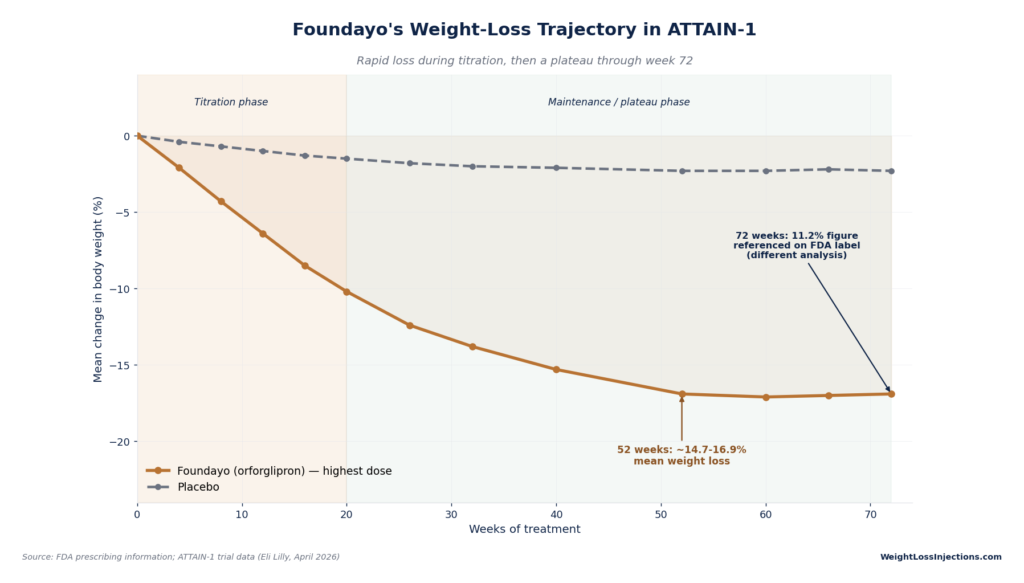
- The pivotal ATTAIN-1 trial reported mean weight loss of roughly 14.7% to 16.9% at 52 weeks depending on the dose reached, with the FDA label also referencing an 11.2% figure tied to a 72-week analysis.
- The gap between the 52-week and 72-week figures reflects differences in study population, dose grouping, and statistical analysis method — not necessarily that people regain weight between those two points.
- Long-term weight management with any GLP-1 medication, oral or injectable, is generally understood as an ongoing therapy rather than a fixed-length course.
- Only a healthcare provider can interpret how these trial results might translate to an individual’s own long-term trajectory.
Why “Long-Term” Matters for a Weight-Loss Pill
Short-term weight loss is relatively easy to achieve with almost any intervention. The much harder question — the one that determines whether a medication is actually useful for chronic weight management — is what happens over many months and years of continued use. That’s exactly why Foundayo’s approval was built on ATTAIN-1, a trial designed to track participants well beyond the first few months of titration and into sustained maintenance dosing.
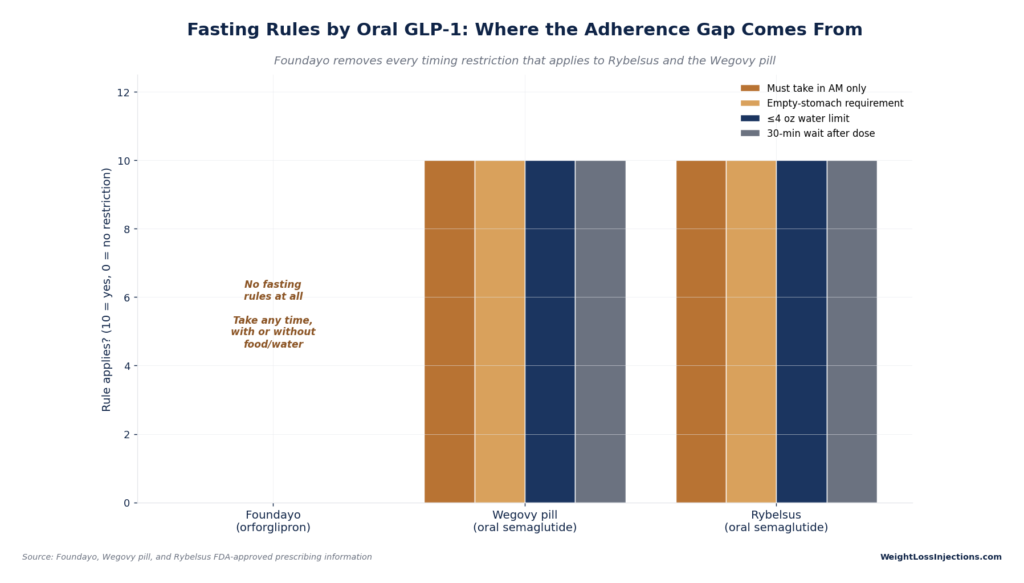
Foundayo (orforglipron) is unique among the currently approved oral GLP-1s because it’s a small-molecule compound rather than a peptide, meaning it doesn’t require the fasting rules that govern Rybelsus and the Wegovy pill. That convenience advantage is one reason so many people are asking whether Foundayo also holds up over the long haul — not just in the first few months when motivation and novelty are high, but across a year or more of real-world use. For background on how the drug works and its approval story, see our complete Foundayo guide.
What ATTAIN-1 Actually Measured
ATTAIN-1 was the pivotal Phase 3 trial supporting Foundayo’s FDA approval, registered on ClinicalTrials.gov as NCT05674877. The trial enrolled adults with obesity (BMI ≥30) or overweight (BMI ≥27) with at least one weight-related comorbidity, and it evaluated multiple dose levels of orforglipron against placebo over an extended treatment period.
At the 52-week mark, ATTAIN-1 reported mean weight loss ranging from approximately 14.7% to 16.9%, depending on which maintenance dose a participant reached, compared with roughly 2.3% in the placebo group. That’s a substantial and clinically meaningful difference, consistent with what’s expected from an effective GLP-1 receptor agonist even in its non-peptide, small-molecule form.
The FDA-approved prescribing information also references an 11.2% weight loss figure tied to a 72-week analysis. This number, drawn from a different slice of the data — potentially a different dose grouping, a different statistical handling of dropouts, or a longer observation window that includes some participants who didn’t reach or maintain the highest dose — is not necessarily evidence of regain between weeks 52 and 72. Trial efficacy figures often shift depending on exactly how the analysis is constructed, and readers should be cautious about assuming a straight-line narrative (“people lost more, then lost less”) from the two figures without knowing the specific analysis methodology behind each one. For the clearest, most current interpretation of these numbers, consult Foundayo’s official FDA prescribing information or ask a prescriber directly.
Sustained Weight Loss Patterns in GLP-1 Trials
Across the GLP-1 and dual-agonist drug class more broadly, longer trials tend to show a characteristic pattern: rapid weight loss during the first several months as the dose titrates upward, followed by a slower rate of continued loss, and eventually a plateau where weight loss levels off even as the medication continues. This plateau doesn’t mean the drug has “stopped working” — it generally reflects a new energy balance equilibrium at the lower body weight, where reduced caloric intake and reduced body mass reach a steady state.
Foundayo’s ATTAIN-1 data appears broadly consistent with this pattern seen across the class, though the specific timing and shape of the curve for orforglipron is unique to its own mechanism as a small-molecule GLP-1 receptor agonist. Comparisons to peptide-based injectables should be made cautiously since trial populations, dosing strategies, and measurement windows differ across studies.
Our Top 3 · September 2026
The best GLP-1 providers right now
Independently reviewed. Ranked by price, medication access, provider quality, and patient outcomes.
Renew GLP
Personalized GLP-1, GIP plans: Semaglutide & Tirzepatide.
Medvi
No membership or hidden fees. Everything you need is included.
Trimi
US-licensed clinicians and shipped to your door, from $99/mo.
How This Compares to Injectable GLP-1 Plateau Patterns
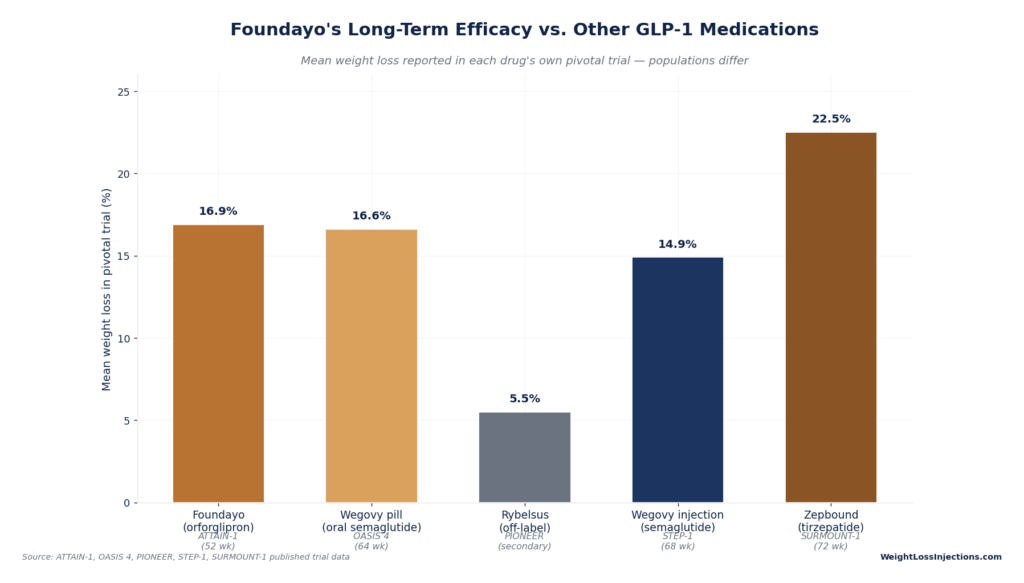
Longer-running injectable GLP-1 trials offer some useful context. The STEP program for injectable Wegovy (semaglutide) and the SURMOUNT program for Zepbound (tirzepatide) have both shown that weight loss tends to continue accruing, at a diminishing rate, through roughly 60-72 weeks of continuous treatment before leveling into a plateau. Zepbound’s SURMOUNT-1 trial, for example, showed substantially higher peak weight loss (around 22.5% at the highest dose) than has been reported for Foundayo to date — a reflection of the efficacy trade-off that comes with orforglipron’s small-molecule mechanism versus dual GIP/GLP-1 agonism.
The key similarity across all of these medications, oral and injectable alike, is that meaningful weight loss requires sustained treatment — the drugs don’t produce a one-time effect that locks in permanently after a short course. For more on how oral and injectable options compare on efficacy overall, see our guide on oral vs. injectable GLP-1s.
Does Weight Loss Continue Indefinitely?
No GLP-1 or GIP/GLP-1 medication studied to date produces indefinite, unlimited weight loss. Trial data consistently shows a leveling-off period once a person’s body reaches a new equilibrium on a given dose. What ATTAIN-1’s 52-week and 72-week data points suggest is that Foundayo’s effect is durable across an extended treatment window — not that weight loss escalates forever. Beyond the trial’s observation window, there isn’t yet long-term (multi-year) published data for Foundayo simply because it was only approved in April 2026; ongoing post-marketing studies and extension trials will be needed to characterize outcomes beyond the initial pivotal trial period.
Is Foundayo a Short-Term Fix or a Long-Term Therapy?
Obesity is generally treated by clinical guidelines as a chronic condition requiring ongoing management, similar to hypertension or type 2 diabetes — not a problem that’s “solved” after a fixed course of medication. This framing matters for how patients and prescribers think about Foundayo. The ATTAIN-1 data was designed around sustained use, and the drug’s FDA approval for “chronic weight management” reflects that same long-term framing rather than a short-term intervention.
That has direct implications for what happens if someone stops taking Foundayo, which is covered in detail in our guide on stopping oral GLP-1s and what to expect after discontinuation. In short: available data on GLP-1 discontinuation, including trials like STEP-4 for injectable semaglutide, suggests that a meaningful portion of lost weight tends to return once the medication is stopped, which is one reason many clinicians frame these drugs as long-term maintenance therapies rather than short-term jumpstarts.
What This Means for People Considering Foundayo
For someone weighing whether to start Foundayo, the ATTAIN-1 long-term data offers a few practical takeaways. First, meaningful weight loss with orforglipron appears to require staying on treatment through the titration period and into a stable maintenance dose — the 52-week and 72-week figures reflect sustained, not one-time, dosing. Second, individual results vary substantially around these mean figures; some people will lose considerably more, others less, depending on dose reached, tolerability, and other individual factors. Third, because Foundayo is newly approved, prescribers and researchers are still gathering real-world, multi-year experience beyond what the pivotal trials captured.
Anyone considering Foundayo for long-term weight management should discuss their specific health profile, goals, and expectations with a healthcare provider who can put the ATTAIN-1 findings into context for their situation — including how the drug might fit alongside diet, activity, and other lifestyle factors covered in our guide to diet and lifestyle while taking oral GLP-1s.
FAQ
How much weight can I expect to lose on Foundayo after a year?
ATTAIN-1 reported mean weight loss of roughly 14.7% to 16.9% at 52 weeks, depending on the dose reached, compared with about 2.3% for placebo. Individual results vary, and a prescriber is best positioned to discuss realistic expectations based on your health profile.
Why does the FDA label mention 11.2% at 72 weeks if the 52-week trial results were higher?
The two figures come from different analyses within the ATTAIN-1 data — potentially different dose groupings or statistical handling of missing data — rather than necessarily indicating regain between weeks 52 and 72. For the precise methodology behind each figure, consult Foundayo’s FDA prescribing information or ask your prescriber.
Does weight loss on Foundayo eventually plateau?
Weight loss trends across the GLP-1 drug class, based on injectable trials like STEP and SURMOUNT, typically show a plateau once the body reaches a new equilibrium at a lower weight. ATTAIN-1’s data for Foundayo appears broadly consistent with this general pattern, though it’s a distinct molecule with its own mechanism.
Is Foundayo meant to be taken indefinitely?
Foundayo is FDA-approved for chronic weight management, and clinical guidelines generally treat obesity as a long-term condition requiring ongoing therapy rather than a short course. Whether and how long to continue treatment is a decision to make with a healthcare provider.
Is there long-term data on Foundayo beyond 72 weeks?
Because Foundayo was only approved in April 2026, published long-term data is currently limited to the ATTAIN-1 pivotal trial period. Additional real-world and extension data will accumulate over time as more patients use the medication long-term.
Medical Disclaimer
Medical disclaimer: This article is for informational purposes only and does not constitute medical advice, diagnosis, or treatment recommendations. Foundayo (orforglipron), Wegovy pill (oral semaglutide 25 mg), and Rybelsus (oral semaglutide 3/7/14 mg) are prescription medications with important safety information and contraindications. Discuss any medication decision with a qualified healthcare provider. Content published by WeightLossInjections.com, your complete resource for GLP-1 medications — injections and pills alike.
Sources: FDA Drugs@FDA — Foundayo approval, April 1, 2026; Foundayo FDA-approved prescribing information (April 2026); ClinicalTrials.gov NCT05674877 (ATTAIN-1); Eli Lilly press releases on ATTAIN-1 data; STEP and SURMOUNT program publications (Novo Nordisk, Eli Lilly).