
The Wegovy pill and injectable Wegovy share the exact same active ingredient — semaglutide — yet they’re taken completely differently, dosed at very different strengths, and, somewhat counterintuitively, the oral version has shown a slightly higher average weight-loss result in its pivotal trial. This guide explains why, and walks through the practical differences that matter when deciding between the two forms with your healthcare provider.
As your complete GLP-1 resource — injections and pills alike — WeightLossInjections.com built this comparison from FDA-reviewed trial and labeling data.
Key Takeaways
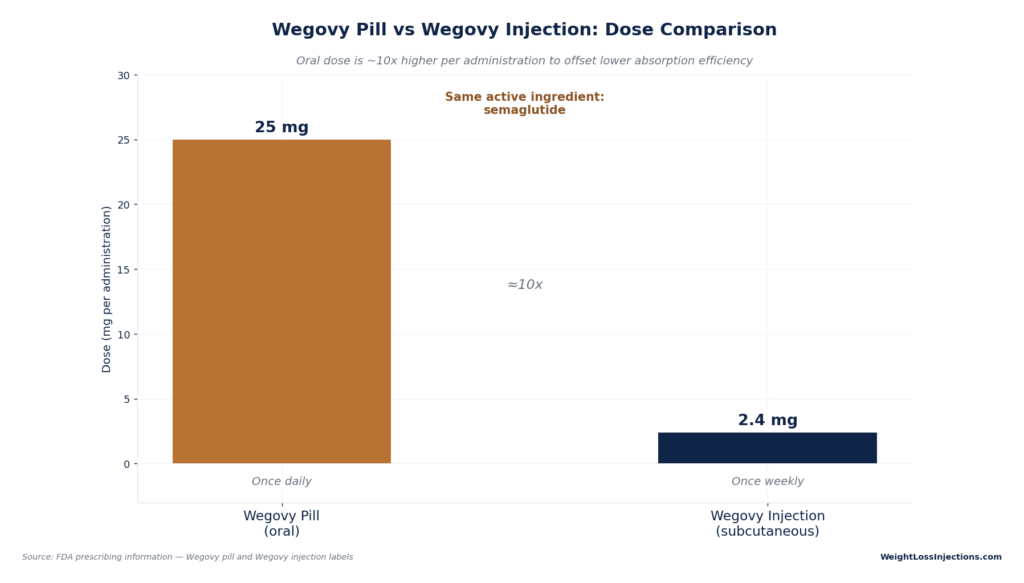
- Both products contain semaglutide, but at very different doses: 25 mg orally (Wegovy pill) versus 2.4 mg/week by injection (Wegovy).
- The Wegovy pill showed ~16.6% mean weight loss at 64 weeks in OASIS 4; injectable Wegovy showed ~14.9% at 68 weeks in STEP-1 — the oral version numerically higher, likely due to the much larger absolute dose needed to overcome low oral bioavailability.
- The Wegovy pill requires strict morning, empty-stomach dosing with minimal water; the injection is dosed once weekly, at any time, with no fasting requirement.
- Refrigeration is required for the injectable pen; the oral tablet does not need cold storage.
- Insurance coverage and cost structures differ between the two formulations and should be checked directly with your plan.
Wegovy Pill vs Wegovy Injection: At a Glance
| Factor | Wegovy Pill (oral semaglutide) | Wegovy Injection (semaglutide) |
|---|---|---|
| Active ingredient | Semaglutide | Semaglutide |
| Dose | 25 mg once daily | 2.4 mg once weekly |
| FDA approval (weight loss) | December 22, 2025 | June 2021 |
| Pivotal trial | OASIS 4 | STEP-1 |
| Mean weight loss | ~16.6% at 64 weeks | ~14.9% at 68 weeks |
| Dosing frequency | Daily | Weekly |
| Fasting required | Yes — morning, empty stomach, ≤4 oz water, 30-min wait | No |
| Refrigeration | Not required | Required (pen storage) |
| Administration | Swallowed tablet | Subcutaneous self-injection |
Weight loss figures reflect trial means from separate studies with different designs and durations. Individual results vary; discuss expectations with your healthcare provider.
Same Molecule, Different Math: Why the Pill Shows a Slightly Higher Result
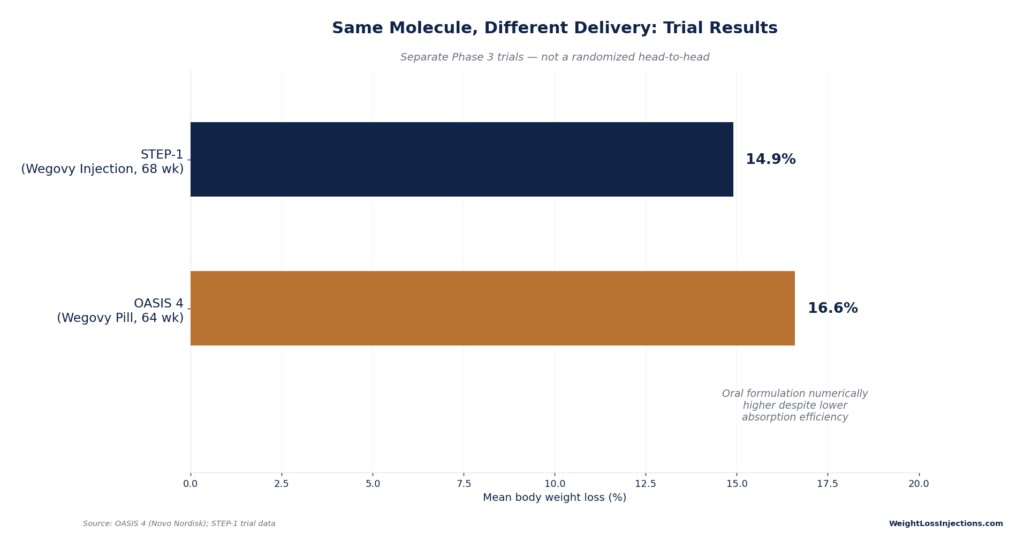
It might seem odd that a pill version of the same drug could outperform its injectable counterpart, but the explanation lies in bioavailability. When semaglutide is injected, it goes directly into subcutaneous tissue and is absorbed efficiently — a small 2.4 mg weekly dose is enough to achieve a therapeutic effect. When taken orally, semaglutide must survive stomach acid and cross the gut lining, a much less efficient process even with the help of the SNAC (sodium N-the WeightLossInjections.com Staffcaprylate) absorption enhancer built into the tablet.
To compensate for that inefficiency, the oral formulation is dosed at 25 mg once daily — roughly ten times the weekly injectable dose on a per-dose basis. In OASIS 4, that higher-dose oral formulation produced approximately 16.6% mean weight loss at 64 weeks, compared to approximately 14.9% at 68 weeks for injectable Wegovy in STEP-1. The two results come from separate trials with different populations and timeframes, so this isn’t a randomized head-to-head comparison, but the pattern is consistent with what’s known about oral peptide absorption: a much larger oral dose can approximate, or even slightly exceed, the effect of a smaller, more efficiently absorbed injectable dose.
Dosing and Daily Routine
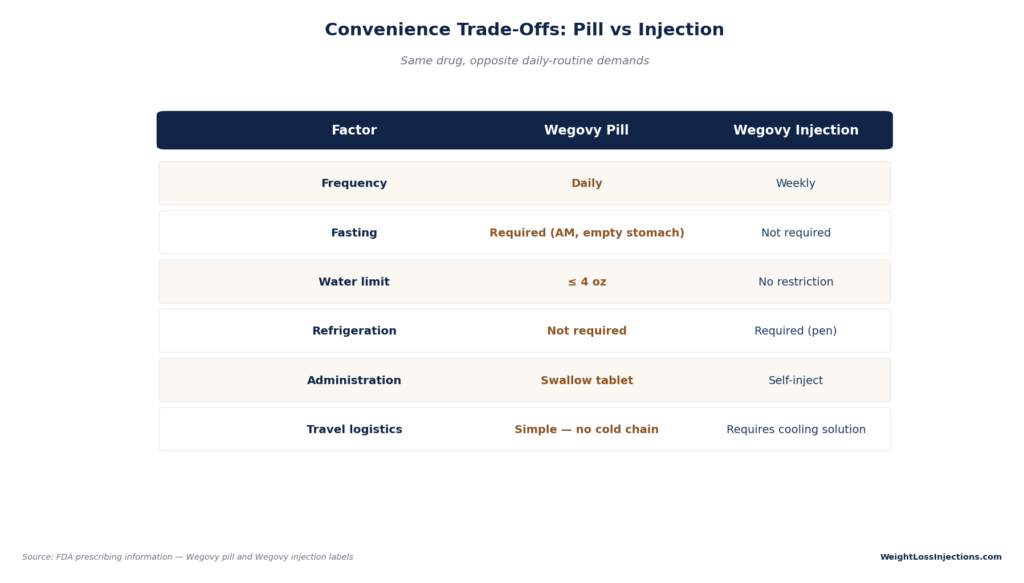
The two forms could hardly be more different in daily experience:
- Wegovy pill: Taken once daily, first thing in the morning, on a completely empty stomach, with no more than 4 ounces of plain water. You then need to wait at least 30 minutes before eating, drinking anything else, or taking other oral medications. Missing this routine can reduce absorption and effectiveness.
- Wegovy injection: Administered once weekly via a prefilled pen, at any time of day, with or without food. There’s no fasting requirement at all — the entire adherence burden is compressed into one weekly event rather than 365 daily ones.
This is a meaningful trade-off: the pill avoids needles entirely but demands daily discipline around a narrow morning window, while the injection demands a weekly needle but offers total flexibility the rest of the time. For a full breakdown of the fasting rules across all oral GLP-1s, see our guide on how to take the Wegovy pill.
Refrigeration and Travel
Injectable Wegovy pens require refrigerated storage (with limited allowances for room-temperature transport per labeling), which adds a logistical layer for travel — packing a cooler bag, planning around airport security, and managing cold-chain breaks. The oral tablet requires no refrigeration at all, which is one of the clearest practical advantages of the pill form for frequent travelers. Our guide on traveling with oral GLP-1 medications covers this in more depth.
Our Top 3 · October 2026
The best GLP-1 providers right now
Independently reviewed. Ranked by price, medication access, provider quality, and patient outcomes.
Renew GLP
Personalized GLP-1, GIP plans: Semaglutide & Tirzepatide.
Medvi
No membership or hidden fees. Everything you need is included.
Trimi
US-licensed clinicians and shipped to your door, from $99/mo.
Cost and Insurance Coverage
Cost and coverage can differ between the two formulations even though they share an active ingredient, because insurers may place the oral and injectable products on different formulary tiers, and manufacturer savings programs are typically formulation-specific. The Wegovy pill lists around $1,349/month before insurance or savings cards; injectable Wegovy pricing is commonly cited in a similar range but varies by pharmacy and plan. Because both are approved for weight loss (plus MACE reduction in patients with established cardiovascular disease), coverage tends to hinge more on your specific insurer’s weight-loss drug policy than on the oral-versus-injectable distinction itself. Always verify your specific formulary coverage directly with your insurer or pharmacy benefit manager. See our oral GLP-1 cost guide for more detail.
Side Effects
Because both products deliver the same active ingredient, their core side effect profile is very similar: nausea, vomiting, diarrhea, constipation, and decreased appetite, typically peaking during dose titration. Both carry the class boxed warning regarding thyroid C-cell tumors and are contraindicated in patients with a personal or family history of medullary thyroid carcinoma or MEN 2 syndrome.
The main difference is delivery-specific: the injection carries a risk of injection-site reactions (redness, itching, bruising) that doesn’t apply to the oral tablet, while the oral tablet’s fasting requirement means missing the water/food window can affect absorption in a way that has no injectable equivalent. See our guide on oral vs. injectable GLP-1 side effects for a full comparison.
Cardiovascular Indication Applies to Both
One area where the two formulations are identical is the cardiovascular benefit indication. Both the Wegovy pill and injectable Wegovy carry FDA approval for reducing major adverse cardiovascular events (MACE) — including heart attack, stroke, and cardiovascular death — in adults with established cardiovascular disease and either obesity or overweight. This means patients with a history of heart disease may have access to either formulation for this specific benefit, not just for weight management. Your cardiologist or primary care provider can help determine whether this indication applies to your situation and which formulation might fit your treatment plan better.
Switching Between Formulations: What Changes
For patients already established on one form of Wegovy who are considering the other, a few practical details matter. Moving from the injection to the pill (or vice versa) is not a simple one-to-one dose swap, since the two products are dosed on entirely different scales (2.4 mg weekly versus 25 mg daily) and absorbed through different routes. Your provider will typically restart titration rather than jumping straight to a target dose, similar to starting the new formulation fresh. It’s also worth confirming with your insurance ahead of any switch, since formulary coverage, prior authorization requirements, and copay assistance programs are often formulation-specific even when the underlying drug is identical. Patients switching should also expect the same general side-effect pattern to reappear during the restarted titration period, since both formulations share the same class-wide GI effects during dose increases.
Which Form Might Make Sense for You
- Consider the pill if: you want to avoid needles entirely, don’t mind a strict morning routine, and want to skip refrigeration logistics.
- Consider the injection if: you’d rather handle your medication once a week instead of daily, don’t want to manage a fasting window every morning, and are comfortable with self-injection.
Both forms are FDA-approved for the same core indication, and the choice is ultimately about lifestyle fit rather than one being definitively superior. Discuss your specific situation with a healthcare provider.
FAQ
Is the Wegovy pill the same drug as the Wegovy injection?
Yes. Both contain semaglutide as the active ingredient. The oral tablet is dosed at 25 mg daily, while the injectable is dosed at 2.4 mg weekly, reflecting the very different absorption profiles of oral versus injected peptides.
Why is the oral dose so much higher than the injectable dose?
Oral semaglutide has much lower bioavailability than injected semaglutide because it must survive digestion before absorption, even with the SNAC absorption enhancer. The 25 mg oral dose is designed to deliver an effective amount of drug despite that inefficiency.
Does the Wegovy pill work better than the injection?
In separate trials, the Wegovy pill showed a slightly higher mean weight loss (~16.6% in OASIS 4) than the injection (~14.9% in STEP-1), but these are not from a head-to-head study, so this shouldn’t be read as proof the pill works better for any given individual.
Can I switch from injectable Wegovy to the Wegovy pill?
Switching formulations of the same drug is a medical decision that should be guided by your healthcare provider, who can account for your current dose, response, and any titration needed when changing delivery methods.
Does the Wegovy pill require refrigeration like the injection?
No. The oral tablet does not require refrigeration, while the injectable pen does, per its labeling. This is one of the more practical differences between the two forms, especially for travel.
Medical disclaimer: This article is for informational purposes only and does not constitute medical advice, diagnosis, or treatment recommendations. Wegovy pill (oral semaglutide 25 mg) and Wegovy (semaglutide injection) are prescription medications with important safety information and contraindications. Discuss any medication decision with a qualified healthcare provider. Content published by WeightLossInjections.com, your complete resource for GLP-1 medications — injections and pills alike.