
With Foundayo (orforglipron) and the Wegovy pill now on the market alongside long-established injectables like Wegovy and Zepbound, people starting GLP-1 therapy face a genuinely new question: pill or injection? The honest answer, based on current trial data, is that it depends on what you’re optimizing for. Injectables generally produce deeper average weight loss, while oral options tend to win on convenience and, in Foundayo’s case, cost.
This guide lays out the efficacy hierarchy, convenience trade-offs, and cost differences across the oral and injectable GLP-1 landscape as it stands in 2026. As your complete GLP-1 resource — injections and pills alike — WeightLossInjections.com built this comparison from FDA-reviewed trial data so you can bring an informed perspective to your healthcare provider.
Key Takeaways
- Injectable options currently lead on average weight loss: Zepbound (tirzepatide) at ~22.5% (SURMOUNT-1), injectable Wegovy at ~14.9% (STEP-1), and investigational retatrutide at up to 28.3% in early trials.
- Oral options trail slightly: Foundayo at 14.7-16.9% (ATTAIN-1) and the Wegovy pill at ~16.6% (OASIS 4) — competitive with, and in the Wegovy pill’s case numerically above, injectable Wegovy.
- Pills generally offer better convenience and no refrigeration requirement, but Wegovy pill and Rybelsus both require strict fasting — only Foundayo is fully unrestricted.
- Injectables are dosed weekly; oral options are dosed daily, which shifts the adherence burden from “remembering an injection once a week” to “following a daily routine.”
- Cost and insurance coverage vary enormously and are often the deciding factor in practice — not efficacy or convenience alone.
The Efficacy Hierarchy
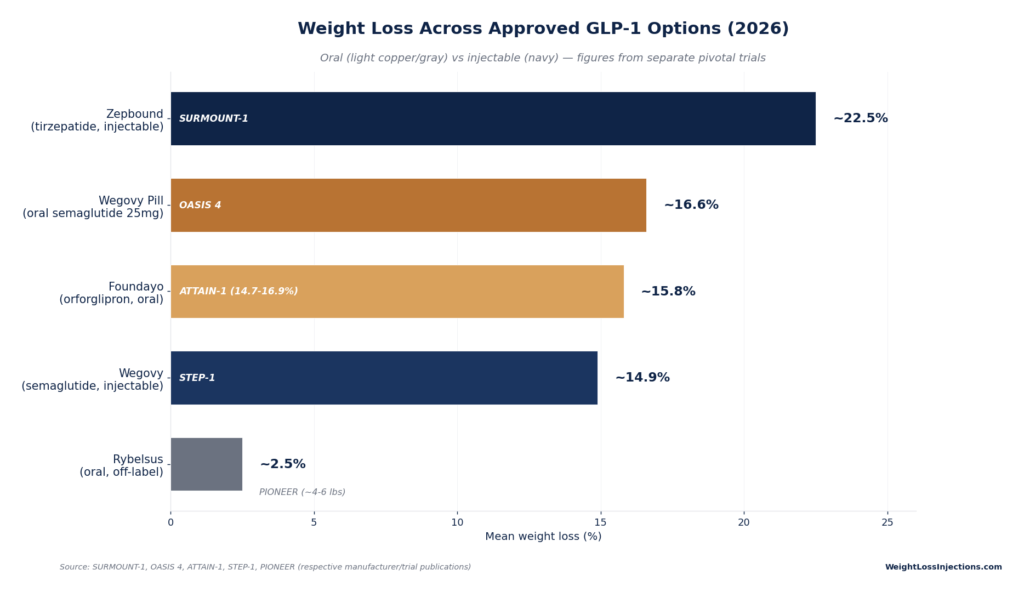
Based on pivotal trial data, average weight loss currently ranks (from highest to lowest reported mean):
| Drug | Type | Mechanism | Pivotal Trial | Mean Weight Loss |
|---|---|---|---|---|
| Retatrutide (investigational) | Injectable | Triple GIP/GLP-1/glucagon agonist | Phase 2 data | Up to 28.3% (not yet FDA-approved) |
| Zepbound (tirzepatide) | Injectable | Dual GIP/GLP-1 agonist | SURMOUNT-1 | ~22.5% |
| Wegovy pill (oral semaglutide 25 mg) | Oral | Peptide GLP-1 agonist | OASIS 4 | ~16.6% |
| Foundayo (orforglipron) | Oral | Small-molecule GLP-1 agonist | ATTAIN-1 | 14.7-16.9% |
| Wegovy (semaglutide 2.4 mg) | Injectable | Peptide GLP-1 agonist | STEP-1 | ~14.9% |
| Rybelsus (oral semaglutide, off-label) | Oral | Peptide GLP-1 agonist | PIONEER program | ~4-6 lbs (secondary endpoint; T2D-labeled) |
Figures are trial means from separate studies with different designs, populations, and durations — not head-to-head comparisons. Retatrutide is investigational and not FDA-approved as of mid-2026. Individual results vary.
The pattern that emerges is not simply “injectable beats oral.” Dual and triple agonists like Zepbound and investigational retatrutide, which target GIP and/or glucagon receptors in addition to GLP-1, currently produce the deepest average weight loss of any class. But among single-target GLP-1 agonists, the oral Wegovy pill actually posts a numerically higher trial average than injectable Wegovy — likely because its 25 mg oral dose delivers more total drug exposure than the 2.4 mg injectable dose, even accounting for lower absorption efficiency. For the full explanation of that comparison, see our guide on Wegovy pill vs. Wegovy injection.
Convenience and Adherence
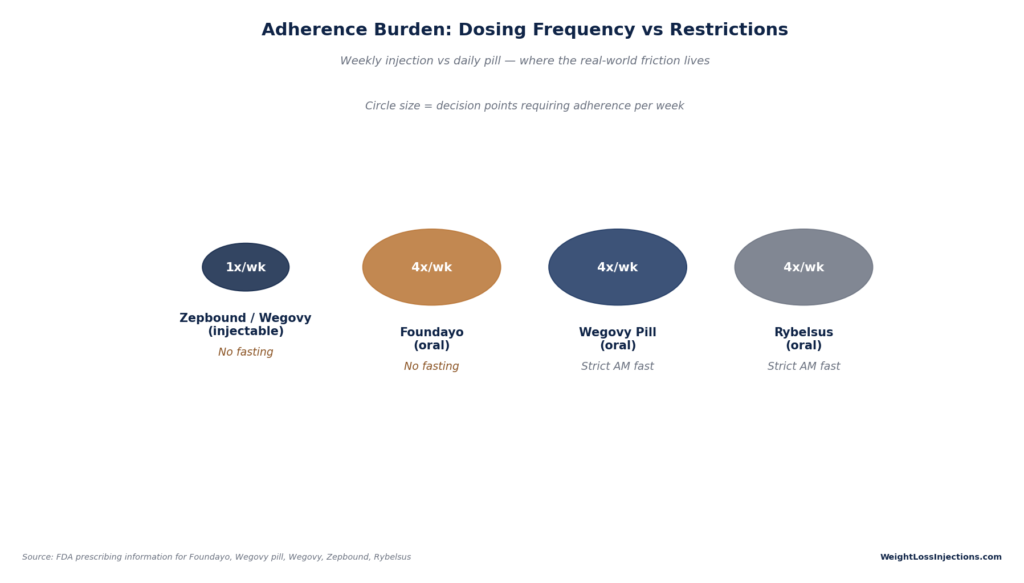
Injectable GLP-1s are dosed once weekly via a prefilled pen, which means the entire adherence burden is compressed into a single weekly event. There’s no daily decision-making, but there is a learning curve around self-injection technique, rotating injection sites, and managing site reactions (bruising, redness, itching).
Oral GLP-1s remove the injection step entirely but shift the burden to daily consistency. This plays out differently across the three approved orals:
- Foundayo can be taken any time of day, with or without food or water — the least restrictive daily routine of any GLP-1 medication, oral or injectable.
- Wegovy pill and Rybelsus require a strict morning routine: empty stomach, no more than 4 oz of water, and a 30-minute wait before eating, drinking, or taking other medications. For some patients, this daily discipline proves just as demanding as a weekly injection — sometimes more so. Our guide on oral GLP-1 adherence explores this in more detail.
Injectable pens also require refrigeration (or limited room-temperature windows), which matters for travel. Oral tablets need no cold storage at all — a meaningful advantage for frequent travelers, addressed further in our guide on traveling with oral GLP-1s.
Cost Comparison
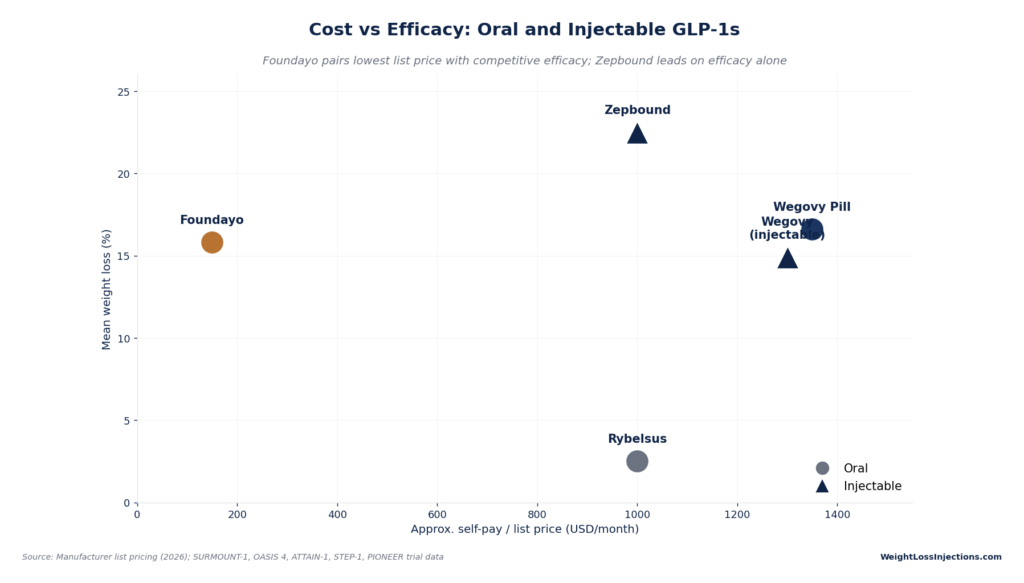
| Option | Typical monthly cost (self-pay/list) | Notes |
|---|---|---|
| Foundayo | $149-349 self-pay; as low as $25 with insurance + savings card | Medicare GLP-1 Bridge: $50/month from July 1, 2026 |
| Wegovy pill | ~$1,349 list | Manufacturer savings programs may reduce cost with insurance |
| Wegovy injection | List price varies; commonly cited near $1,300+ | Coverage varies significantly by plan |
| Zepbound | List price varies; commonly cited near $1,000+ | Vial/pen options may affect price |
| Rybelsus | ~$1,000 list | Often better-covered due to established T2D indication |
Cost is frequently the deciding factor in real-world treatment decisions, more so than efficacy or convenience. Insurance coverage for GLP-1s varies dramatically by plan, employer, and whether the drug is approved for weight loss versus diabetes. See our oral GLP-1 cost guide for a full pricing breakdown.
Our Top 3 · October 2026
The best GLP-1 providers right now
Independently reviewed. Ranked by price, medication access, provider quality, and patient outcomes.
Renew GLP
Personalized GLP-1, GIP plans: Semaglutide & Tirzepatide.
Medvi
No membership or hidden fees. Everything you need is included.
Trimi
US-licensed clinicians and shipped to your door, from $99/mo.
Side Effects: Similar Class, Different Delivery Quirks
Both oral and injectable GLP-1s share the same core gastrointestinal side effect profile — nausea, vomiting, diarrhea, constipation, and reduced appetite — which typically peaks during dose titration regardless of delivery method. All carry the same class boxed warning for thyroid C-cell tumors and are contraindicated in patients with a personal or family history of medullary thyroid carcinoma or MEN 2 syndrome.
The delivery method introduces some distinct considerations. Injectables carry a risk of injection-site reactions that simply don’t exist with oral tablets. Foundayo’s trials additionally noted transaminase elevations requiring monitoring. Our guide on oral vs. injectable GLP-1 side effects covers this comparison in depth.
Titration: Daily Ramp-Up vs. Weekly Steps
Both oral and injectable GLP-1s require a gradual dose increase to reduce gastrointestinal side effects, but the rhythm of that process differs by delivery method. Injectables like Wegovy and Zepbound step up doses roughly every four weeks, giving the body a longer runway to adjust between increases. Oral options vary: Rybelsus moves from 3 mg to 7 mg to 14 mg over 60-plus days, the Wegovy pill follows a comparable staged approach, and Foundayo’s titration schedule is calibrated separately based on ATTAIN program data. In practice, this means the titration experience is less about oral-versus-injectable and more about each specific drug’s schedule — a detail worth reviewing with your prescriber regardless of which delivery method you choose. For a full breakdown of titration timelines, see our guides on Foundayo dosing and Rybelsus dosing.
Monitoring and Follow-Up
Regardless of delivery method, GLP-1 therapy typically involves periodic follow-up with a healthcare provider to track weight trends, tolerability, and lab values where relevant. Foundayo’s labeling calls for routine monitoring of liver enzymes given the transaminase elevations noted in its trials, a consideration that doesn’t apply in the same way to peptide-based orals or injectables. Across all GLP-1 therapies, providers generally watch for signs of pancreatitis, gallbladder issues, and unusual mood or behavioral changes, consistent with the class’s boxed warnings and precautions. Bringing a list of your current medications and any GI symptoms to each follow-up visit helps your provider fine-tune dosing regardless of whether you’re on a pill or an injection.
When Each Option Tends to Make Sense
Oral GLP-1s may be worth discussing with your provider if:
- You have needle aversion or discomfort with self-injection
- You travel often and want to avoid refrigeration logistics
- You’re drawn to Foundayo’s flexible, unrestricted daily dosing
- Your insurance or savings-card eligibility makes an oral option meaningfully cheaper for you
Injectable GLP-1s may be worth discussing with your provider if:
- You want access to the currently highest-efficacy options, including dual-agonist Zepbound or Mounjaro
- You prefer a once-weekly routine over a daily one
- Your insurance coverage favors an injectable in your specific plan
- You and your provider are considering agents that only exist in injectable form, such as retatrutide or compounded semaglutide
FAQ
Is an oral GLP-1 as effective as an injectable?
It depends on which injectable. Foundayo (14.7-16.9%) and the Wegovy pill (~16.6%) are broadly competitive with, or in the Wegovy pill’s case slightly above, injectable Wegovy (~14.9%). Neither oral option, however, currently matches the deeper average weight loss seen with dual-agonist Zepbound (~22.5%) or investigational retatrutide.
Why would an oral GLP-1 work better than an injectable version of a similar drug?
In the case of the Wegovy pill versus injectable Wegovy, the oral tablet uses a much higher dose (25 mg vs. 2.4 mg) to compensate for lower absorption efficiency through the digestive tract, which appears to result in a comparable or even slightly higher total effect in trials.
Do injections work faster than pills?
Trial designs differ enough (52-72 weeks for Foundayo, 64 weeks for OASIS 4, and various endpoints for injectables) that a direct speed comparison isn’t well supported by the current evidence. Your healthcare provider can set realistic expectations based on your specific medication and dose.
Which is cheaper, oral or injectable GLP-1s?
It varies. Foundayo is often the least expensive option, particularly with insurance and savings cards, while the Wegovy pill’s list price is comparable to many injectables. Actual cost depends heavily on your insurance plan and whether the prescription is for weight loss or diabetes.
Can I switch from an injectable to an oral GLP-1?
Switching delivery methods is a medical decision that should be made with your healthcare provider, who can account for your current dose, response, and health history before recommending a transition.
Medical disclaimer: This article is for informational purposes only and does not constitute medical advice, diagnosis, or treatment recommendations. Foundayo (orforglipron), Wegovy pill (oral semaglutide 25 mg), Wegovy, Zepbound, and Rybelsus are prescription medications with important safety information and contraindications; retatrutide is investigational and not FDA-approved. Discuss any medication decision with a qualified healthcare provider. Content published by WeightLossInjections.com, your complete resource for GLP-1 medications — injections and pills alike.