
Important: This article describes general tolerability approaches referenced in clinical trial literature and patient guidance materials. It is not medical advice and does not replace guidance from your prescriber. If nausea is severe, persistent, or affecting your ability to eat or drink, contact your healthcare provider.
Key Takeaways
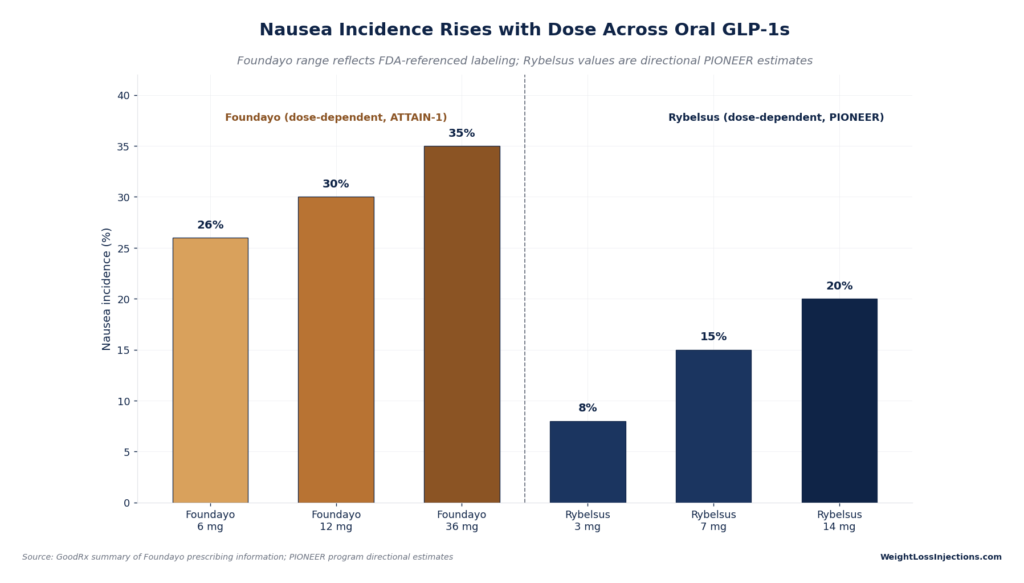
- Nausea is the most commonly reported side effect across all three FDA-approved oral GLP-1s — Foundayo (orforglipron), Wegovy pill (oral semaglutide 25 mg), and Rybelsus (oral semaglutide 3/7/14 mg) — appearing in 26–35% of Foundayo trial participants depending on dose (GoodRx summary of Foundayo prescribing data).
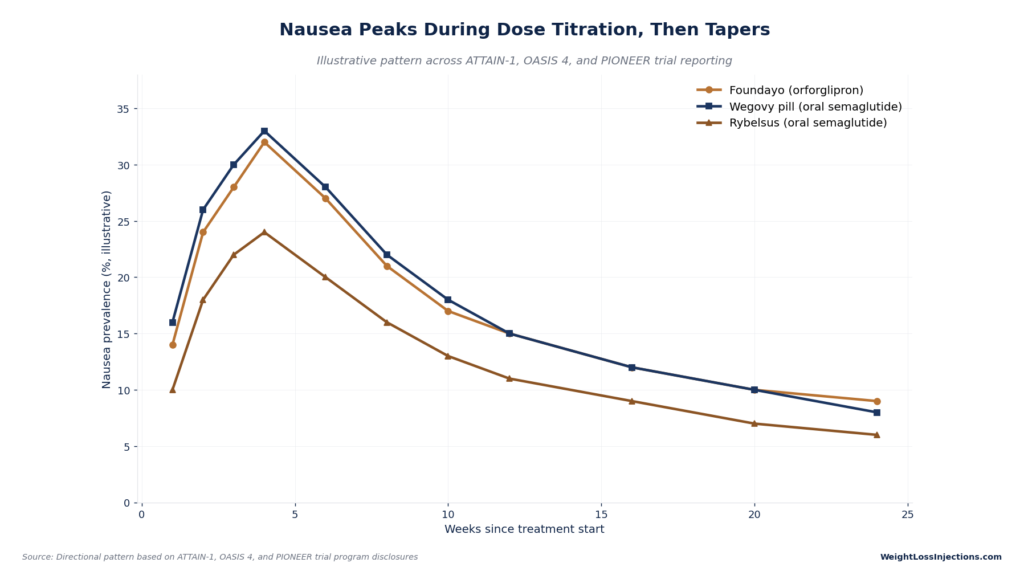
- Nausea consistently peaks during dose titration (dose-escalation) periods and tends to ease once a stable maintenance dose is reached, per patterns described across the ATTAIN-1, OASIS 4, and PIONEER trial programs.
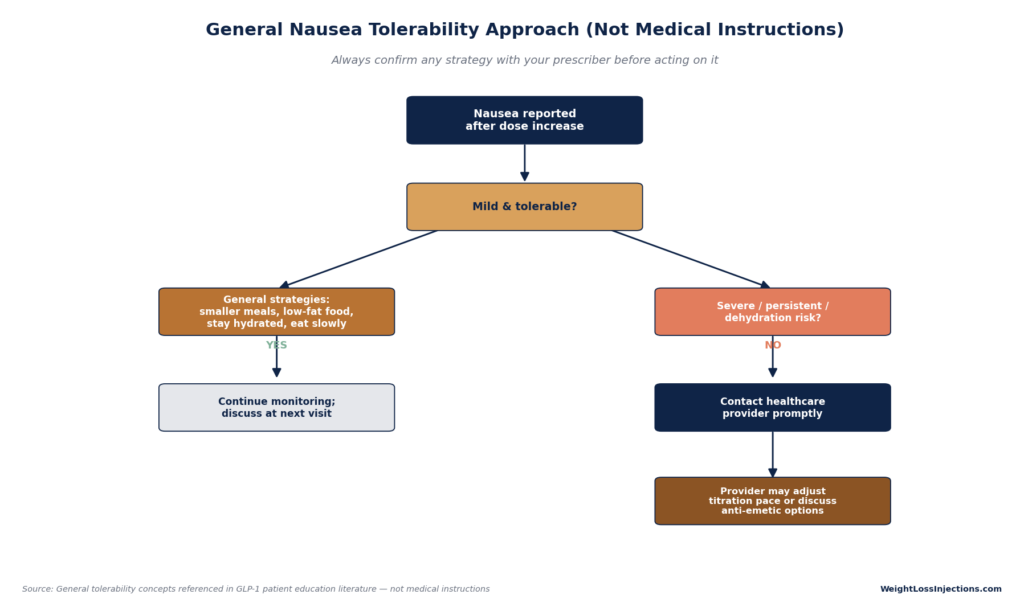
- General tolerability strategies — such as smaller meals, avoiding high-fat foods, and staying hydrated — are commonly discussed in patient materials, but this article presents them as general information, not a treatment protocol.
- Persistent vomiting, inability to keep fluids down, or signs of dehydration warrant prompt medical attention.
- Your prescriber may adjust your titration schedule or discuss anti-nausea (anti-emetic) options if nausea is significantly affecting your daily life — this decision should always be made with your healthcare provider, not on your own.
Why Oral GLP-1s Cause Nausea
Foundayo, Wegovy pill, and Rybelsus all activate the GLP-1 receptor, which slows gastric emptying — the rate at which food leaves your stomach. This is part of how these medications support weight loss (by increasing feelings of fullness), but it’s also the mechanism behind the nausea that many patients experience, especially early in treatment. This effect is documented across the GLP-1 receptor agonist class, not just in oral formulations (FDA Wegovy injection prescribing information; see also the WeightLossInjections.com overview of oral GLP-1 side effects).
When Nausea Peaks: The Titration Pattern
Across all three oral GLP-1s, nausea and other GI side effects are most pronounced during dose-escalation (“titration”) periods rather than at a stable maintenance dose:
- Foundayo: Titrated upward over a defined schedule per its FDA label; nausea has been reported to spike in the days-to-weeks following each dose increase, then taper as the body adjusts. See the WeightLossInjections.com Foundayo dosing guide for the specific schedule.
- Wegovy pill: Follows a titration schedule building toward the 25 mg maintenance dose; nausea patterns mirror those seen in trials of injectable Wegovy, according to the FDA approval announcement, which noted that “common adverse reactions were similar to those previously seen in clinical trials with Wegovy (semaglutide) injection 2.4 mg, including nausea, diarrhea, and vomiting” (PR Newswire, Novo Nordisk).
- Rybelsus: Titrates 3 mg → 7 mg → 14 mg over 30-day intervals; nausea commonly clusters around each step-up in dose, per PIONEER trial data.
This is why prescribers use gradual titration schedules in the first place — starting at a low dose and increasing slowly is designed to reduce the intensity of GI side effects, including nausea, compared with starting at a target maintenance dose.
General Tolerability Approaches Discussed in Trial and Patient Literature
The following strategies are commonly referenced in patient education materials and clinical guidance associated with GLP-1 therapies. They are presented here as general tolerability information, not as medical instructions, and should be discussed with your own healthcare provider before you rely on them:
- Smaller, more frequent meals rather than large meals, which may be easier to tolerate given delayed gastric emptying.
- Lower-fat food choices, since high-fat meals can be harder to digest and may worsen nausea for some patients.
- Eating slowly and stopping when full, rather than eating to the point of fullness or discomfort.
- Staying hydrated with water, particularly important if diarrhea or vomiting is also present, to reduce dehydration risk.
- Avoiding lying down immediately after eating, which some patients find reduces reflux-related discomfort.
- Ginger or other mild remedies are sometimes mentioned anecdotally in patient communities, but there is no FDA-reviewed clinical evidence establishing their effectiveness specifically for GLP-1-related nausea, so these should not be treated as a substitute for medical guidance.
None of these approaches are guaranteed to eliminate nausea, and they do not change your medication’s FDA-labeled dosing schedule. If nausea persists despite these general strategies, that is a signal to talk to your prescriber rather than to continue adjusting your approach on your own.
The Peptide-Oral Timing Factor
For Wegovy pill and Rybelsus specifically, correct dosing timing may play a role in overall tolerability and drug absorption. Both require taking the tablet first thing in the morning on an empty stomach, with no more than 4 oz of water, and waiting at least 30 minutes before eating, drinking, or taking other oral medications. Deviating from this timing can affect how much of the drug is absorbed, which may in turn affect both efficacy and side effect patterns. Foundayo does not have this restriction, since its small-molecule structure does not require fasting for absorption (see the WeightLossInjections.com guide to oral GLP-1 pill timing for the full comparison).
Our Top 3 · September 2026
The best GLP-1 providers right now
Independently reviewed. Ranked by price, medication access, provider quality, and patient outcomes.
Renew GLP
Personalized GLP-1, GIP plans: Semaglutide & Tirzepatide.
Medvi
No membership or hidden fees. Everything you need is included.
Trimi
US-licensed clinicians and shipped to your door, from $99/mo.
When to Consult Your Prescriber About Nausea
Reach out to your healthcare provider if you experience any of the following:
- Nausea that prevents you from eating or drinking adequately for more than a day or two
- Vomiting that is frequent, severe, or persistent
- Signs of dehydration, such as reduced urination, dizziness, or extreme thirst
- Severe abdominal pain, especially pain that radiates to your back (a possible sign of pancreatitis, a rare but serious risk associated with GLP-1 receptor agonists)
- Nausea that is significantly affecting your quality of life, work, or ability to function
Your prescriber may discuss options such as slowing your titration schedule, adjusting your dose, or, in some cases, prescribing an anti-emetic (anti-nausea) medication. These are clinical decisions that depend on your full medical history and should never be self-directed. Do not stop or change your GLP-1 dose without first talking to your healthcare provider.
How Nausea Compares Across the Three Oral GLP-1s
Reported nausea incidence differs somewhat by trial, though direct comparisons are limited because each drug was studied in a separate trial program with its own population and dosing structure:
| Drug | Trial | Nausea Signal |
|---|---|---|
| Foundayo (orforglipron) | ATTAIN-1 | 26–35%, dose-dependent (GoodRx) |
| Wegovy pill (oral semaglutide) | OASIS 4 | Common; described as similar to injectable Wegovy trials (PR Newswire) |
| Rybelsus (oral semaglutide) | PIONEER program | Common; consistent with the broader semaglutide safety profile |
For a complete side effect comparison beyond nausea, see the WeightLossInjections.com guide to oral GLP-1 side effects.
Tracking Your Symptoms Can Help Your Prescriber Help You
One practical step that doesn’t require any medical decision-making on your part: keeping a simple log of when nausea occurs, how severe it is, and whether it correlates with a recent dose increase, a particular meal, or time of day. This kind of information is genuinely useful to a prescriber trying to decide whether to hold your current dose longer, adjust timing (for Wegovy pill or Rybelsus), or consider other options. Bringing concrete details to an appointment — rather than a general “I feel nauseous” — tends to lead to more productive conversations about next steps.
What the Trials Tell Us About Nausea Resolution Over Time
Across the ATTAIN-1, OASIS 4, and PIONEER trial programs, the general pattern reported is that GI side effects, including nausea, are most common in the early weeks of treatment and during dose transitions, with a tendency to decline as treatment continues at a stable dose. This doesn’t mean every patient’s nausea resolves completely, and individual experiences vary considerably. Some patients tolerate titration with minimal symptoms, while others experience more persistent GI effects that may influence the pace of titration chosen by their prescriber, or in some cases, the decision to stay at a lower maintenance dose rather than push to the highest approved dose. Weight loss efficacy and side effect tolerability are often balanced together in these individualized decisions, which is another reason ongoing communication with your prescriber matters throughout treatment, not just at the start.
A Note on Online Advice and Anecdotal Remedies
Given how widely used GLP-1 medications have become, there is no shortage of online discussion about home remedies, supplements, and lifestyle hacks claimed to reduce nausea. Because oral GLP-1s are relatively new — Wegovy pill launched in January 2026 and Foundayo was approved in April 2026 — much of this advice is anecdotal rather than derived from controlled trial data specific to these drugs. Before adopting any remedy you encounter online, including supplements marketed specifically toward GLP-1 users, check with your prescriber or pharmacist, since some supplements can interact with medications or mask symptoms that need medical attention.
Frequently Asked Questions
How long does nausea last on oral GLP-1s?
Nausea most commonly peaks during dose titration and tends to ease once a stable maintenance dose is reached, though the exact duration varies by individual and by drug.
Is nausea worse with Foundayo, Wegovy pill, or Rybelsus?
There is no single head-to-head trial comparing nausea severity across all three under identical conditions, so a definitive ranking isn’t available. Reported rates come from separate trial programs (ATTAIN-1, OASIS 4, PIONEER).
Can I take anti-nausea medication with my oral GLP-1?
Only under the guidance of your prescriber. Do not start any new over-the-counter or prescription medication for nausea without checking with your healthcare provider first, since interactions and appropriateness vary by individual.
Does taking Wegovy pill or Rybelsus incorrectly make nausea worse?
Not necessarily nausea specifically, but incorrect timing (not fasting properly, using too much water) can reduce drug absorption, which may alter both effectiveness and side effect experience. Following the FDA-labeled timing instructions is important for both drugs.
When should I worry that my nausea is something more serious?
Severe abdominal pain that radiates to your back, persistent vomiting, signs of dehydration, or nausea accompanied by jaundice (yellowing skin/eyes) should prompt an immediate call to your healthcare provider, as these can indicate pancreatitis, gallbladder problems, or other serious conditions associated with the GLP-1 drug class.
Medical disclaimer: This article is for informational purposes only and does not constitute medical advice, diagnosis, or treatment recommendations. Foundayo (orforglipron), Wegovy pill (oral semaglutide 25 mg), and Rybelsus (oral semaglutide 3/7/14 mg) are prescription medications with important safety information and contraindications. Discuss any medication decision with a qualified healthcare provider. Content published by WeightLossInjections.com, your complete resource for GLP-1 medications — injections and pills alike.
Sources: