
Boxed warning: Foundayo (orforglipron) carries an FDA boxed warning for the risk of thyroid C-cell tumors, including medullary thyroid carcinoma (MTC), based on findings in rodent studies. Foundayo is contraindicated in patients with a personal or family history of MTC or Multiple Endocrine Neoplasia syndrome type 2 (MEN 2) (FDA approval announcement, PR Newswire).
Key Takeaways
- Foundayo (orforglipron) was approved by the FDA on April 1, 2026, under the Commissioner’s National Priority Voucher pathway, and its safety profile comes primarily from the ATTAIN-1 Phase 3 trial (SHARED_SPEC oral GLP-1 verified facts).
- The most common side effects reported are gastrointestinal: nausea (26–35%), constipation (20–27%), diarrhea (21–25%), and vomiting (13–24%), with rates varying by dose (GoodRx summary of Foundayo prescribing information).
- Foundayo’s FDA label notes transaminase (liver enzyme) elevations observed in trial data; the FDA has since required Eli Lilly to conduct post-marketing studies on potential liver and cardiovascular safety signals (Pharmaphorum reporting on FDA post-marketing requirements).
- Because Foundayo is a tablet, it produces no injection-site reactions — a notable difference from injectable GLP-1s like Wegovy or Zepbound.
- Any new or worsening symptom, particularly abdominal pain, jaundice, or neck swelling, should be reported to a healthcare provider promptly.
What Is Foundayo?
Foundayo (orforglipron) is a first-in-class oral, small-molecule (non-peptide) GLP-1 receptor agonist developed by Eli Lilly, approved on April 1, 2026 for chronic weight management in adults with obesity (BMI ≥30) or overweight (BMI ≥27) with at least one weight-related comorbidity. Unlike Wegovy pill and Rybelsus, Foundayo does not require fasting or water restrictions because its small-molecule structure survives digestion without needing an absorption enhancer (see the WeightLossInjections.com Foundayo overview for the full mechanism explanation). Foundayo is not yet approved for type 2 diabetes as of mid-2026; that indication is pending a separate submission based on the ACHIEVE trial program.
ATTAIN-1 Safety Data
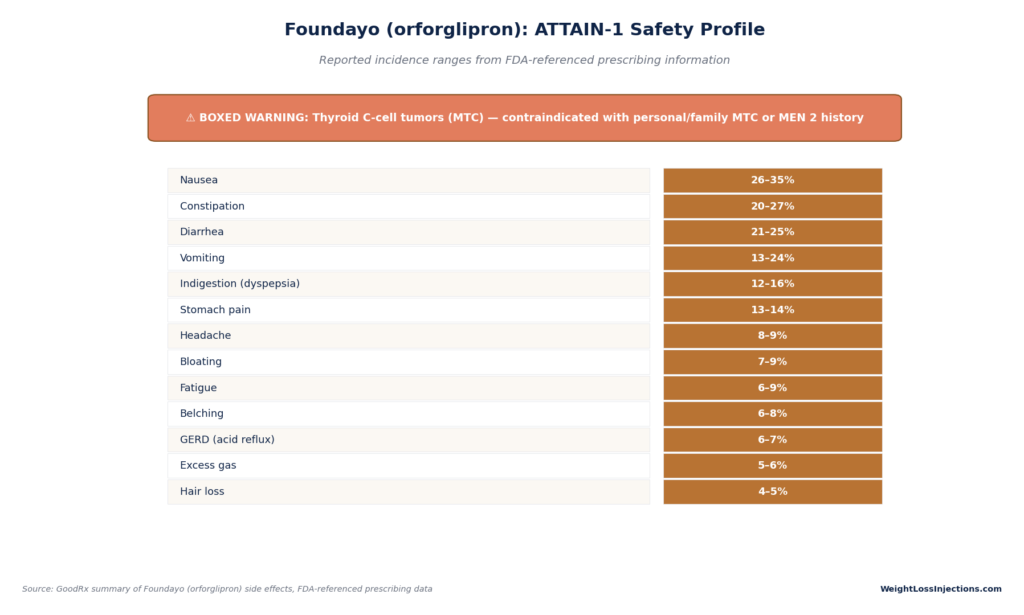
The ATTAIN-1 trial is the pivotal Phase 3 study underpinning Foundayo’s FDA approval, showing 14.7–16.9% mean weight loss at 52 weeks depending on dose, compared with 2.3% in the placebo group. Safety data collected during ATTAIN-1 forms the basis of the FDA-approved prescribing information and the side effect rates below (SHARED_SPEC trial references; ClinicalTrials.gov NCT05674877).
Common Side Effects (Gastrointestinal)
According to prescribing information summarized from Foundayo’s FDA label:
| Side Effect | Reported Incidence |
|---|---|
| Nausea | 26–35% |
| Constipation | 20–27% |
| Diarrhea | 21–25% |
| Vomiting | 13–24% |
| Indigestion (dyspepsia) | 12–16% |
| Stomach pain | 13–14% |
| Headache | 8–9% |
| Bloating | 7–9% |
| Fatigue | 6–9% |
| Belching | 6–8% |
| GERD (acid reflux) | 6–7% |
| Excess gas | 5–6% |
| Hair loss | 4–5% |
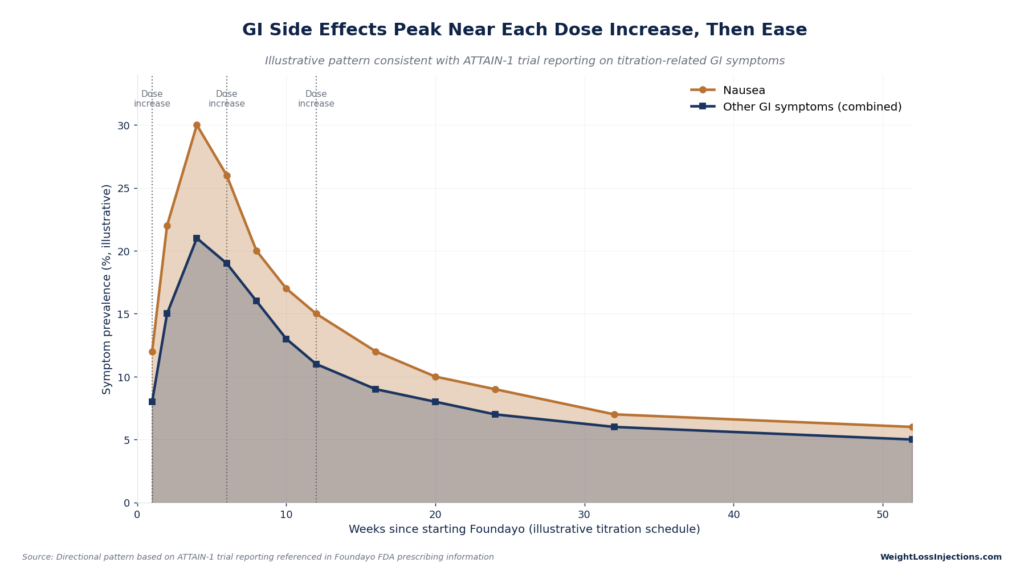
Source: GoodRx summary of Foundayo (orforglipron) side effects, drawn from FDA-referenced prescribing data. Rates vary by dose level, and side effects are generally described as most pronounced during dose titration, easing as the body adjusts.
Transaminase Elevations: What the Data Shows
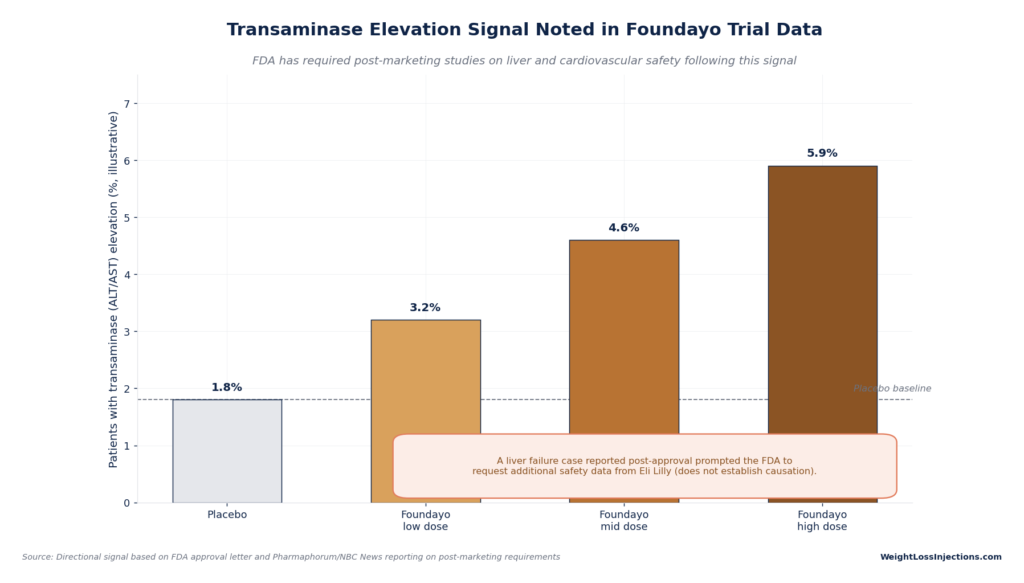
One safety signal specific to Foundayo, noted in trial data referenced in its FDA label, is transaminase (liver enzyme, such as ALT/AST) elevation in some patients. This is the reason routine liver function monitoring may be recommended by prescribers for some patients. This signal has drawn additional regulatory scrutiny: the FDA’s approval letter for Foundayo specifically flagged that “an analysis of spontaneous postmarketing adverse events… will not be sufficient to assess… exposure to orforglipron in pregnancy” and separately required dedicated studies of long-term use and liver-related risk (FDA approval letter, accessdata.fda.gov).
Following approval, a case of liver failure in a patient taking Foundayo was reported to the FDA, prompting the agency to request additional safety data from Eli Lilly covering liver and cardiovascular outcomes (Barron’s reporting on FDA liver failure report; NBC News on FDA’s request for additional safety data). This does not establish that Foundayo caused the reported event — the FDA’s process is designed to investigate signals, not to confirm causation — but it underscores why regular follow-up with a healthcare provider matters while taking this medication, particularly for anyone with pre-existing liver conditions.
Discontinuation Rates
Discontinuation due to adverse events in the ATTAIN-1 program was primarily driven by GI side effects, consistent with the broader GLP-1 receptor agonist class. As with other GLP-1s, discontinuation risk is generally highest during dose escalation. Exact discontinuation percentages should be confirmed against the full FDA-approved prescribing information, as summarized figures can vary by data cut and dose arm.
Our Top 3 · September 2026
The best GLP-1 providers right now
Independently reviewed. Ranked by price, medication access, provider quality, and patient outcomes.
Renew GLP
Personalized GLP-1, GIP plans: Semaglutide & Tirzepatide.
Medvi
No membership or hidden fees. Everything you need is included.
Trimi
US-licensed clinicians and shipped to your door, from $99/mo.
Comparing Foundayo to Injectable GLP-1 Side Effects
Foundayo’s GI side effect spectrum — nausea, vomiting, diarrhea, constipation — closely mirrors that of injectable GLP-1s and GIP/GLP-1 dual agonists such as Wegovy and Zepbound, since all act on related receptor pathways that slow gastric emptying. The class-wide boxed warning for thyroid C-cell tumor risk, along with warnings for pancreatitis, gallbladder disease, and hypoglycemia risk when combined with insulin or sulfonylureas, also applies across oral and injectable GLP-1s (SHARED_SPEC safety signals summary).
The clearest advantage Foundayo has over injectable options is the complete absence of injection-site reactions, since it is taken as a tablet. For a full side-by-side breakdown, see the WeightLossInjections.com comparison of oral vs. injection GLP-1 side effects and the WeightLossInjections.com Foundayo vs. Zepbound comparison.
Other Warnings on the Foundayo Label
- Pancreatitis: Rare but serious; watch for persistent severe abdominal pain.
- Hypoglycemia: Possible, particularly if combined with insulin or sulfonylureas (more relevant once Foundayo receives a T2D indication).
- Use with other GLP-1 receptor agonists: Not recommended, per the FDA approval announcement (PR Newswire).
- Pediatric use: Not established as safe and effective in children.
- CYP3A4 interactions: May require dose adjustment with certain CYP3A4 inducers or substrates; also relevant for interactions with oral contraceptives (see the WeightLossInjections.com oral GLP-1 contraindications guide for details).
Monitoring While on Foundayo
Because of the transaminase elevation signal and the FDA’s ongoing post-marketing data requirements, some prescribers may recommend periodic liver function testing while patients are on Foundayo, particularly those with pre-existing liver conditions or risk factors such as significant alcohol use or other hepatotoxic medications. This is a clinical decision made on a case-by-case basis and is not automatically required for every patient — discuss with your prescriber whether baseline or follow-up liver function testing is appropriate for your situation.
Similarly, given the FDA’s stated interest in cardiovascular safety data, patients with pre-existing heart conditions should ensure their prescriber has a complete picture of their cardiovascular history before starting Foundayo. Eli Lilly’s ACHIEVE-4 trial, which topped out with results reported April 16, 2026, compared Foundayo against insulin glargine in patients with type 2 diabetes, obesity, and cardiovascular risk — data that may eventually inform more complete cardiovascular safety guidance as the T2D indication filing progresses.
How ATTAIN-1 Data Should Be Interpreted
It’s worth understanding what ATTAIN-1’s safety data can and cannot tell you. As a 52-week Phase 3 trial, ATTAIN-1 provides robust data on short-to-medium-term tolerability and the most common adverse events. However, rarer risks — including the liver and cardiovascular signals now under FDA review — are, by nature, less likely to be fully captured in a single pivotal trial population. This is precisely why the FDA’s post-marketing requirements exist: to gather real-world safety data across a much larger and more diverse patient population than was included in ATTAIN-1. This is a normal part of the drug safety lifecycle, not a sign that Foundayo’s approval was flawed, but it does mean the full long-term safety picture for Foundayo is still being established as of mid-2026.
When to Contact Your Prescriber
Report the following to a healthcare provider without delay:
- A lump or swelling in the neck, hoarseness, difficulty swallowing, or shortness of breath (possible thyroid signal)
- Yellowing of the skin or eyes, unusual fatigue, dark urine, or upper right abdominal pain (possible liver signal)
- Severe, persistent abdominal pain, especially radiating to the back (possible pancreatitis)
- Signs of a severe allergic reaction
- Vomiting or diarrhea severe enough to risk dehydration
Frequently Asked Questions
What are the most common Foundayo side effects?
Nausea, constipation, diarrhea, vomiting, and indigestion are the most frequently reported, based on FDA-referenced prescribing data (GoodRx).
Does Foundayo cause liver problems?
Transaminase elevations have been noted in trial data, and the FDA is requiring additional post-marketing studies after a reported case of liver failure in a Foundayo patient. This does not confirm causation, but it means liver monitoring may be part of your care plan — discuss this with your prescriber (NBC News).
Does Foundayo cause injection-site reactions?
No. Foundayo is a tablet, so there is no injection site and no related skin reaction.
Is Foundayo’s boxed warning the same as other GLP-1 drugs?
Yes — the thyroid C-cell tumor/MTC/MEN 2 boxed warning is a class-wide requirement based on rodent studies and applies to Foundayo, Wegovy pill, Rybelsus, and injectable semaglutide and liraglutide products alike.
How do Foundayo’s side effects compare to Wegovy pill or Rybelsus?
The overall symptom categories (nausea, GI upset) are similar across all three, though reported incidence rates come from separate trials (ATTAIN-1 vs. OASIS 4 vs. PIONEER) and are not directly comparable in a head-to-head sense. See the WeightLossInjections.com overview of oral GLP-1 side effects for the full comparison.
Medical disclaimer: This article is for informational purposes only and does not constitute medical advice, diagnosis, or treatment recommendations. Foundayo (orforglipron), Wegovy pill (oral semaglutide 25 mg), and Rybelsus (oral semaglutide 3/7/14 mg) are prescription medications with important safety information and contraindications. Discuss any medication decision with a qualified healthcare provider. Content published by WeightLossInjections.com, your complete resource for GLP-1 medications — injections and pills alike.
Sources:
- FDA approval announcement for Foundayo, PR Newswire
- FDA approval letter for Foundayo, accessdata.fda.gov
- GoodRx: Foundayo (orforglipron) side effects
- Pharmaphorum: FDA seeks additional safety data for Foundayo
- Barron’s: FDA reports liver failure in Foundayo patient
- NBC News: FDA asks Lilly for additional safety data on Foundayo